Bullseye Discipleship – Influence

We think that when a disciple sees you, the disciple-maker, as their spiritual leader, you’ve hit the discipleship bullseye.  

But there’s a lot that should take place before someone sees you as their spiritual leader! Let’s take a look at the principles in Hebrews.

Remember your leaders, those who spoke to you the word of God. Consider the outcome of their way of life, and imitate their faith…Obey your leaders and submit to them, for they are keeping watch over your souls, as those who will have to give an account. Let them do this with joy and not with groaning, for that would be of no advantage to you.

(Hebrews 13.7,17)

There are Seven Key Principles to Consider

  1. Leaders teach the Word of God. Are you teaching the Word? Spiritual leaders are using everything but the Word these days. There are a lot of good books out there. But let the Bible be your standard.
  2. Leaders apply the Word of God. We don’t just preach it, we live it out in front of the disciples. I’m sorry, but I’m not putting my soul in your hands because you preach great sermons (Or write a 500-word blog).
  3. Leaders live a life worth imitating. Am I living a “do as I do” life or a “do as I say” life? Remember you can’t follow what you can’t see.
  4. Leaders can expect to be followed when they have met the first three requirements. Many leaders expect disciples to follow them when they haven’t paid the price. Pay the price.
  5. Leadership is serious business. As one of my Bible college profs used to say; “A brain surgeon messes with a man’s brain. That’s nothing compared to messing with a man’s soul.”
  6. Leadership should be a joy for both the disciple and the disciple-maker. (3 John 1:4)
  7. Leadership is a huge gift and advantage! If you have had a mentor, thank them today. If not, stand in the gap and be a mentor to someone else.

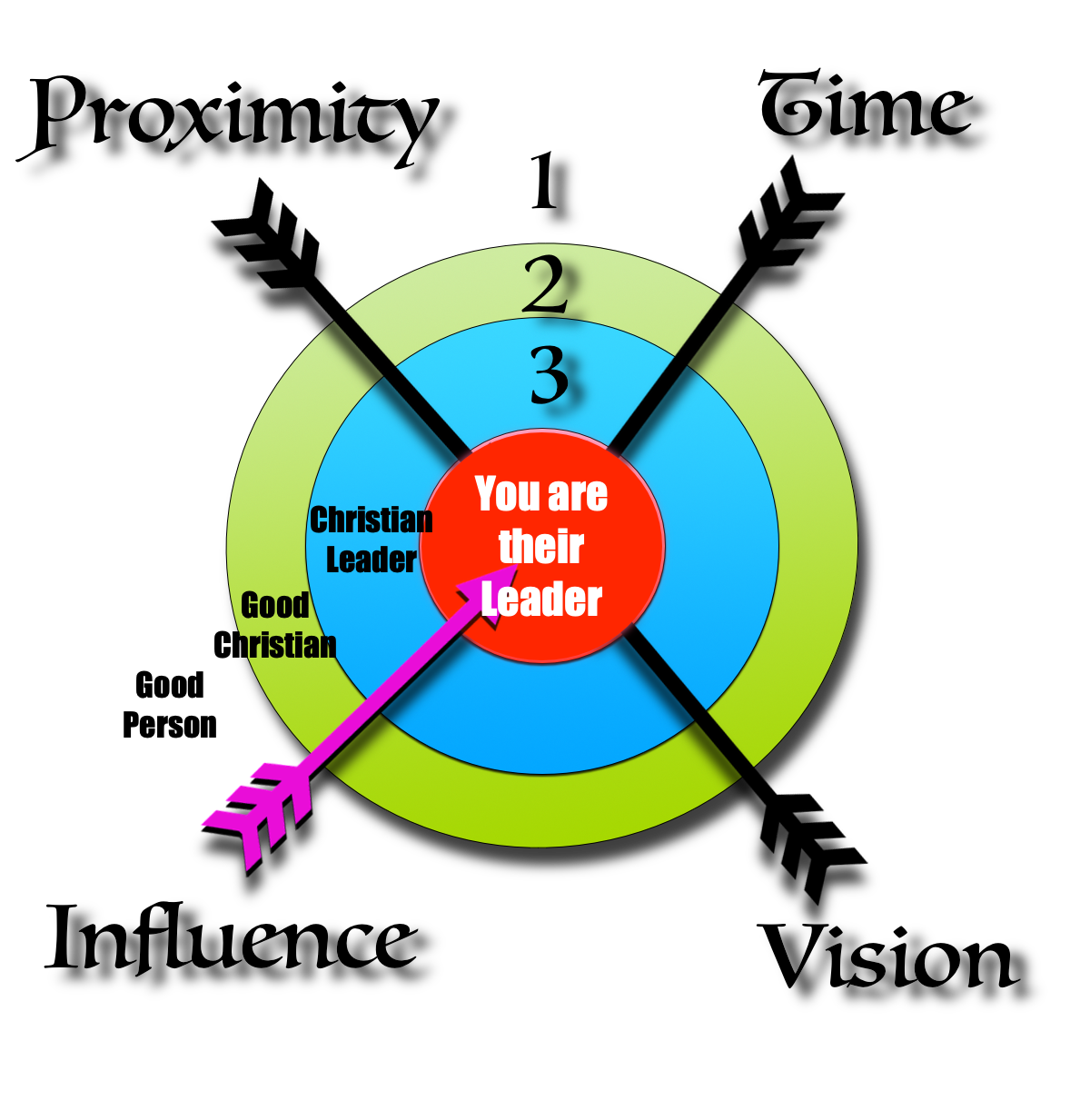
Here’s what influence looks like on the bullseye. The outermost ring would represent a person who sees you as a good person. The second, they see you as a good Christian. The third would represent someone who sees as a spiritual leader. And the bullseye would be a person who sees you as their spiritual leader. You are their Paul and they are your Timothy.

One note of caution before we leave the topic of influence. There is a big difference between influence and manipulation or control. (Mark 10.45, 1 Peter 5:2, Philemon 8-9) I say that the easiest form of leadership is leading people where they want to go. (Amos 3.3) If you have to force a person to follow you, stop and go find someone who’s eager to join you in the journey. That’s what Jesus did.

Call to Action: 

If you have a mentor, thank them. Write down the names of the people that would consider you a spiritual leader. Narrow the list to 1, 2, or 3. Spend focused time together studying Heb 13.7, 17.

A Blast from the Past: America’s Favorite Pass Time

Bullseye Discipleship – Proximity

We think disciples living within 10 minutes of the disciple-maker is hitting the bullseye in discipleship. Wow again! You may as well live with the disciple-maker! Yes, that’s an option but keep reading. You are going to need a buddy to read this blog post. I suggest the person you are discipling in order to get more time with them :)

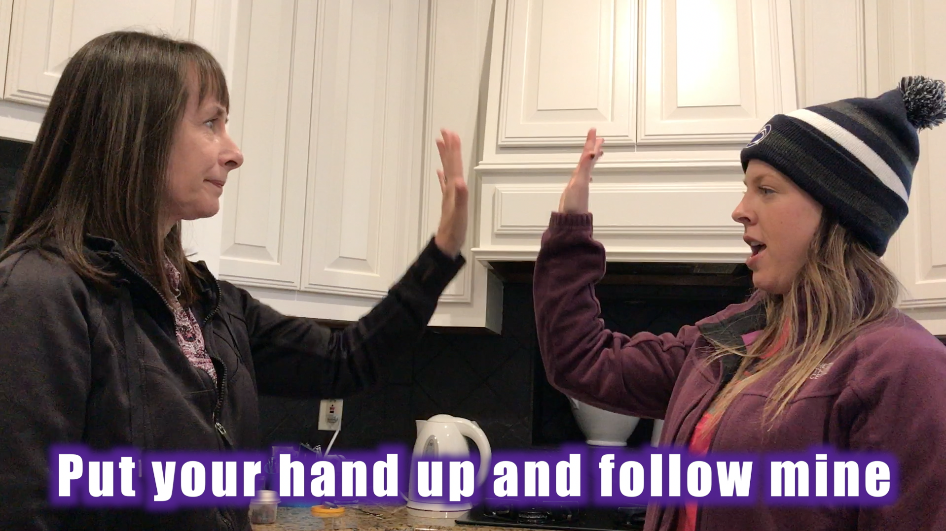
Stand face to face and you both put your hand in the air.

Now the disciple-maker instructs the disciple to follow her hand. If she raises her hand, the disciple raises her hand. If she moves it side to side, the disciple moves her hand side to side with her.

Now the disciple-maker instructs her to close her eyes and try to follow her hand. Obviously, she cannot. The point; you cannot follow what you cannot see. One of the strongest benefits of proximity is being able to model.

Now the disciple-maker instructs the disciple to open her eyes and follow her hand. The disciple-maker starts moving her hand. First slowly and then faster. At first, it is quite easy to follow her hand. But as she speeds up, it will become more and more difficult for her to imitate the disciple-maker.

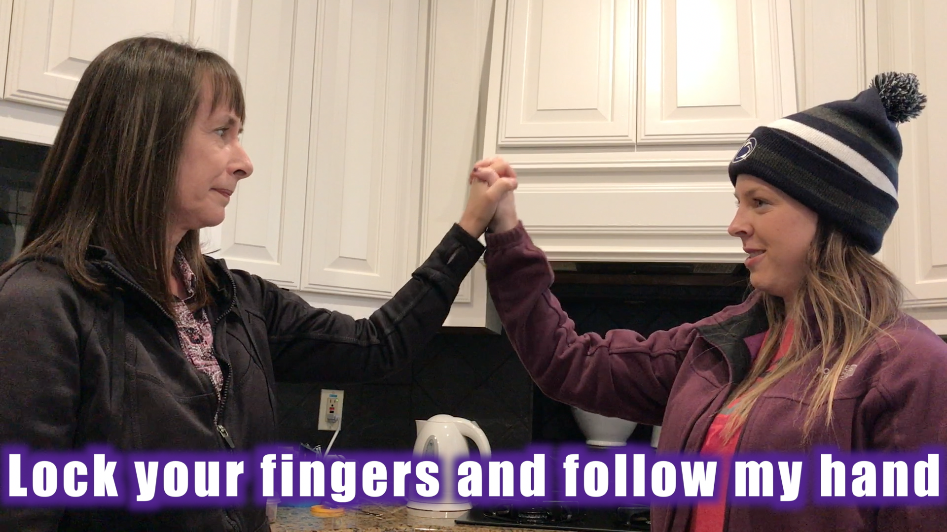
Now they put their hands together and interlock their fingers. The disciple-maker instructs the disciple to follow her hand. Of course, it’s much easier because they have locked their hands together. This illustrates the power of proximity.

Jesus did this with His disciples.

And He appointed twelve, so that they would be with Him and that He could send them out to preach…

(Mark 3.14)

We call this the “With Him” principle. Jesus, the Master Disciple-Maker, leveraged the power of proximity. The closer a disciple gets to the disciple-maker, the easier it is for the disciple to follow the disciple-maker. (Watch the video for further explanation)

How does this apply to you as a mentor? Well, we have found the closer a person lives to the disciple-maker, the more time they get and the more effective the discipleship.

Generally speaking, if the disciple lives within 10 minutes of the disciple-maker they will spend quite a bit more time together. You can usually get three to four touches a week.

If a disciple lives 20 minutes away, it’s probably two to three touches a week.  If it’s 30 minutes its probably one or two touches. At 40 minutes the disciple might as well live in a different state! Deb and I have found that these times are consistent with the number of touches that we get with the people that we are discipling.

Carter and Hannah in OKC wanted to reach a particular set of apartments with the gospel so they intentionally moved into the complex. The men and women they were discipling joined them. Not only did they share the gospel with everyone in the complex, but they also got a boatload of time with the folks they were mentoring. The principle of proximity is too powerful to ignore.

Call to Action: How far do you live from the people you are discipling or being discipled by. Is there any way to get closer?

A Blast From the Past: Choosing the 12

Bullseye Discipleship – Time

bullseye time

We think it takes four quality meetings a week to hit the discipleship bullseye. Wow! That’s a lot of time! But don’t give up. Keep reading. I’ve already written about the importance of time in the discipleship process but let’s look at some specifics. Remember, you can only do this with a few disciples. You can help many but focus on a few. If you focus on everyone, you are focused on no one.


Quantity


Deb and I have found that 3 to 4 touches a week are the key to healthy discipleship. One touch would be our corporate family meeting with other disciples. Another should be an accountability time (A-Teams / Huddles). Two more can be casual times of eating a meal, having coffee, or a fun activity together. (We found that some of the most meaningful discussions happen spontaneously in the normal course of life). Notice I didn’t designate any one of these as church. To us, it’s ALL church.


Quality


But it’s not just the amount of time that makes the difference. It’s also the quality of time. Quality begins with “thought.” In Hebrews we are commanded to “…consider how to stimulate one another to love and good deeds.” (Heb 10.24) Forethought leads to intentional effective discipleship. I’ve heard people say, “I don’t have an agenda in my discipleship.” Jesus did and every good disciple-maker will as well. Our agenda is to stimulate our fellow disciples to love and good deeds. Our ultimate goal is to help people connect with Jesus in such a way they become like Him (Mat 10:24-25, Rom 8:28-29, 1Jn 2:6).


I love the illustration Mark from OKC uses to show the dynamics between the disciple-maker and the disciple. We start as heralds of good news pointing people to Jesus. As wise disciple-makers, we say with the Apostle Paul, “Follow me as I follow Christ.” (1Cor 11:1) But the disciple-maker keeps pointing to Jesus as the primary Disciple-maker throughout the process. See Mark’s video for further explanation. (Click here for video)

Two Tips for More Time


But finding time to get 3-4 touches a week is quite challenging for many busy people. Two practical tips will help you find the time.


  1. Multiply your efforts. There are things that you already do on a routine basis; meals, shopping, household chores, kids activities, road trips, vacations, etc… Bring those you are discipling along with you. (Mark 3.14) You’d be surprised at the depth of discussion that can happen during some of these mundane events.


  1. Say no to something good. Most of us know how to fill our plates with good stuff but only a few of us know how to fill our plates with the best stuff. Everyone gets 24 hours a day. The question is “How will you use them?” What will you say no to and to what will you say yes? We need to see “No” as a strategic response and say yes to discipleship.


Call to Action: Make a list of things you will say “no” to in order to get 3-4 meetings with a few disciples you are focused on this week.


A Blast from the Past: What are we building?