Jesus’ Disciples, Not Mine – #28

ENGLISH / ESPAÑOL

Welcome Back! Today, we’ll be discussing the Gospel of John and competition in ministry.

So let’s dive in.

(Click here to get a copy of the Gospel Sync document) 

John 3:22-36

After this, Jesus and His disciples went into the Judean countryside, where He spent some time with them and baptized. Now John was also baptizing at Aenon near Salim, because the water was plentiful there, and people kept coming to be baptized. (Because John had not yet been thrown into prison.)

Then a dispute arose between John’s disciples and a certain Jew over the issue of ceremonial washing. So John’s disciples came to him and said, “Look Rabbi, the One who was with you beyond the Jordan, the One you testified about—He is baptizing, and everyone is going to Him.” John replied, “A man can receive only what is given him from heaven. You yourselves can testify that I said, ‘I am not the Christ, but am sent ahead of Him.’ The bride belongs to the bridegroom. The friend of the bridegroom stands and listens for him, and is overjoyed to hear the bridegroom’s voice. That joy is mine, and it is now complete. He must increase; I must decrease.

The One who comes from above is above all. The one who is from the earth belongs to the earth and speaks as one from the earth. The One who comes from heaven is above all. He testifies to what He has seen and heard, yet no one accepts His testimony. Whoever accepts His testimony has certified that God is truthful. For the One whom God has sent speaks the words of God, for God gives the Spirit without limit. The Father loves the Son and has placed all things in His hands. Whoever believes in the Son has eternal life. Whoever rejects the Son will not see life. Instead, the wrath of God remains on him.”

My Thoughts 

The spirit of competition kicked in with John’s disciples. “Hey John, the guy across the river is stealing all our sheep. What are we going to do?” Happens every time. Why are we so afraid of others’ influence or success? Shouldn’t we be rejoicing when we see the kingdom of God producing fruit even when it’s under the branches of another tree? John the Baptist got this right. He recognized who Jesus was and the work that He was doing. He submitted gladly to the sovereign work of God and reveled in Jesus’ success. 

“But Chuck, you don’t understand, the church across the street, they’re taking all our people. If they were Jesus, I would gladly give up my sheep but they’re NOT Jesus.” 

I’d like to point out three things;

  1. They are not our sheep, they belong to Jesus. Jesus, Himself, makes this abundantly clear. 

“My sheep hear My voice, and I know them, and they follow Me; and I give eternal life to them, and they will never perish; and no one will snatch them out of My hand. My Father, who has given them to Me, is greater than all; and no one is able to snatch them out of the Father’s hand. I and the Father are one.” (John.10.27-30)

  1. They’re not our disciples, they’re Jesus’ disciples. When Jesus gave us His Great Commission, did He command us to make disciples of us or Him? This is why I never call people MY disciples. I might call them my Timothys or peeps or something else but I leave the term of endearment of “disciple” to be held by Jesus and Him alone. Disciples belong to Jesus. Besides, who wants to see little Chuck Woods running around!?
  1. We aren’t the only ones discipling these people. One of the most common illusions we embrace is the idea that we have exclusive influence in a person’s life as their mentor. Really? So no one else should be speaking into their life? No one else guiding and directing them to Jesus? Even if we tried to have “exclusive rights” to a person, it would never happen unless we were living on a desert island with them. We need to recognize and celebrate the multifaceted contributions of the body. (Just try to tell a believing grandma to keep her spiritual paws off your project, uh, I mean mentee) 

So how do we “cast out” the spirit of competition? First, by acknowledging the people we are discipling, they all belong to Jesus. We should have an open hand with these relationships. He puts people in and He takes them out. He is the Great Shepherd. He knows what His disciples need better than we do. Second, we need to be sensitive to our brothers and sisters. Are you a veteran disciple maker with a big flock? Why are you going to step in and take away the only little lamb they have and rob the young disciple maker of their experience? Why not play the “Cool Uncle” and affirm what the other laborer is doing like Jesus did with John the Baptist. Dialogue with the other disciple maker, work together, give space for someone else to learn their trade.

But what about sheep being abused? Now that’s a different story. If you ever want to see a pastor go prophet, mess with the sheep! If you see spiritual abuse happening, by all means step in and rescue the flock from the wolf in shepherd’s clothing. More on this at a later time.

My Story

When Deb and I were stationed at Fort Benning, GA. we saw the wonderful hand of God move in our midst. We had disciples of Jesus crawling all over one another. We decided we needed to think a little more strategically. So we gathered the leaders together and carved up the geography of Ft. Benning by drawing lines on a map and doled out the pieces to each leader. It didn’t take long for that little act of “brilliance” to cause conflict. It seems a guy was led to Christ in one territory and ate in the Mess Hall in another. When the two leaders realized they were both trying to recruit the poor guy to their respective Bible studies, a tug-of-war ensued. They were miffed at each other for “stealing their guy.” I took our map back out and quickly erased the solid lines we had drawn and replaced them with dotted ones. We then had a great discussion on how the gospel knows no boundaries, Jesus owns all the sheep, and we as His undershepherds need to be sensitive to one another and communicate.

Our Action Plan

So what do we need to work on?

  • Are we affirming other disciple makers or tearing them down to make ourselves look good?
  • Are we a team of leaders (elders, plural) or are we the “only show in town?”
  • Do we have an open hand before the Father as He places people in and takes them out

Our stewardship of the flock requires us to lead and love well. We have to trust God with where He leads His sheep. We need to avoid controlling and competing.

Los discípulos de Jesús, No Los Míos – 28

¡Bienvenido! Hoy, hablaremos sobre el Evangelio de Juan y la competencia en el ministerio.

Así que comencemos.

Juan 3:22-36

Después de esto, vino Jesús con sus discípulos a la tierra de Judea, y estuvo allí con ellos, y bautizaba. Juan bautizaba también en Enón, junto a Salim, porque había allí muchas aguas; y venían, y eran bautizados.  Porque Juan no había sido aún encarcelado.

Entonces hubo discusión entre los discípulos de Juan y los judíos acerca de la purificación.  Y vinieron a Juan y le dijeron: Rabí, mira que el que estaba contigo al otro lado del Jordán, de quien tú diste testimonio, bautiza, y todos vienen a él.  Respondió Juan y dijo: No puede el hombre recibir nada, si no le fuere dado del cielo.  Vosotros mismos me sois testigos de que dije: Yo no soy el Cristo, sino que soy enviado delante de él.  El que tiene la esposa, es el esposo; mas el amigo del esposo, que está a su lado y le oye, se goza grandemente de la voz del esposo; así pues, este mi gozo está cumplido.  Es necesario que él crezca, pero que yo mengüe.

El que de arriba viene, es sobre todos; el que es de la tierra, es terrenal, y cosas terrenales habla; el que viene del cielo, es sobre todos.  Y lo que vio y oyó, esto testifica; y nadie recibe su testimonio.  El que recibe su testimonio, este atestigua que Dios es veraz.  Porque el que Dios envió, las palabras de Dios habla; pues Dios no da el Espíritu por medida.  El Padre ama al Hijo, y todas las cosas ha entregado en su mano. El que cree en el Hijo tiene vida eterna; pero el que rehúsa creer en el Hijo no verá la vida, sino que la ira de Dios está sobre él.

Mis pensamientos

El espíritu de competencia se puso en marcha con los discípulos de Juan. “Oye Juan, el tipo al otro lado del río nos está robando todas nuestras ovejas. ¿Qué vamos a hacer? Esto sucede todo el tiempo. ¿Por qué tenemos tanto miedo de la influencia o el éxito de los demás? ¿No deberíamos regocijarnos cuando vemos que el reino de Dios produce fruto incluso cuando está debajo de las ramas de otro árbol? Juan el Bautista lo entendió bien. Reconoció quién era Jesús y la obra que estaba haciendo. Se sometió gustosamente a la obra soberana de Dios y se deleitó en el éxito de Jesús.

“Pero Chuck, no entiendes, la iglesia al otro lado de la calle, se están llevando a toda nuestra gente. Si fueran de Jesús, con gusto renunciaría a mis ovejas, pero NO son de Jesús”.

Me gustaría señalar tres cosas;

1. No son nuestras ovejas, pertenecen a Jesús. Jesús mismo lo deja muy claro.

Mis ovejas oyen mi voz, y yo las conozco, y me siguen,  y yo les doy vida eterna; y no perecerán jamás, ni nadie las arrebatará de mi mano.  Mi Padre que me las dio, es mayor que todos, y nadie las puede arrebatar de la mano de mi Padre.  Yo y el Padre uno somos.“. (Juan 10.27-30)

2.  No son nuestros discípulos, son los discípulos de Jesús. Cuando Jesús nos dio Su Gran Comisión, ¿nos ordenó que hiciéramos discípulos de nosotros o de Él? Esta es la razón por la que nunca llamo a las personas MIS discípulos. Podría llamarlos mis Timoteos o mis pollitos o algo más, pero dejo el término de cariño de “discípulo” para que lo sostenga Jesús y solo Él. Los discípulos pertenecen a Jesús. Además, ¿quién quiere ver al pequeño Chuck Woods corriendo por ahí?

 3.   No somos los únicos que discipulamos a estas personas. Una de las ilusiones más comunes que abrazamos es la idea de que tenemos una influencia exclusiva en la vida de una persona como su mentor. ¿Realmente? Entonces, ¿nadie más debería estar hablando en su vida? ¿Nadie más guiándolos y dirigiéndolos a Jesús? Incluso si tratáramos de tener “derechos exclusivos” sobre una persona, nunca sucedería a menos que estuviéramos viviendo en una isla desierta con ellos. Necesitamos reconocer y celebrar las contribuciones multifacéticas del cuerpo. (Solo trata de decirle a una abuela creyente que mantenga sus garras espirituales alejadas de tu proyecto, eh, quiero decir, de tu aprendiz)

Entonces, ¿cómo podemos “expulsar” el espíritu de competencia? Primero, al reconocer a las personas que estamos discipulando, todas pertenecen a Jesús. Deberíamos tener una mano abierta con estas relaciones. Él mete a las personas y las saca. Él es el Gran Pastor. Él sabe lo que sus discípulos necesitan mejor que nosotros. En segundo lugar, debemos ser sensibles con nuestros hermanos y hermanas. ¿Eres un hacedor de discípulos veterano con un gran rebaño? ¿Por qué vas a intervenir y quitarte el único corderito que tienen y robarle al joven hacedor de discípulos su experiencia? ¿Por qué no jugar al “Tío Genial” y afirmar lo que el otro obrero está haciendo como Jesús lo hizo con Juan el Bautista? Dialogar con el otro hacedor de discípulos, trabajar juntos, dar espacio para que alguien más aprenda su oficio.

Pero, ¿qué pasa con el maltrato de las ovejas? Ahora esa es otra historia. Si alguna vez quieres ver a un pastor convertirse en profeta, ¡métete con las ovejas! Si ves que está ocurriendo abuso espiritual, por supuesto, interviene y rescata el rebaño del lobo vestido de pastor. Más sobre esto más adelante.

Mi Historia

Cuando Deb y yo estábamos estacionados en Fort Benning, Georgia, vimos la maravillosa mano de Dios moverse en medio de nosotros. Teníamos discípulos de Jesús gateando unos sobre otros. Decidimos que necesitábamos pensar un poco más estratégicamente. Así que reunimos a los líderes y dividimos la geografía de Fort Benning dibujando líneas en un mapa y repartimos las piezas a cada líder. No pasó mucho tiempo para que ese pequeño acto de “brillantez” causara conflicto. Parece que un hombre fue llevado a Cristo en un territorio y comió en el comedor en otro. Cuando los dos líderes se dieron cuenta de que ambos estaban tratando de reclutar al pobre hombre para sus respectivos estudios bíblicos, se produjo un tira y afloja. Estaban molestos el uno con el otro por “robarle a su tipo”. Volví a sacar nuestro mapa y borré rápidamente las líneas continuas que habíamos dibujado y las reemplacé por otras punteadas. Luego tuvimos una gran discusión sobre cómo el evangelio no conoce fronteras, Jesús es dueño de todas las ovejas y nosotros, como sus subpastores, debemos ser sensibles unos con otros y mantener buena comunicación.

Nuestro Plan de Acción

Entonces, ¿en qué tenemos que trabajar?

– ¿Estamos afirmando a otros hacedores de discípulos o derribándolos para que nosotros quedemos bien?

– ¿Somos un equipo de líderes (ancianos, en plural) o somos el “único espectáculo en la ciudad”?

– ¿Tenemos una actitud de mano abierta delante del Padre cuando Él coloca a las personas y las saca?

Nuestra mayordomía del rebaño requiere que lideremos y amemos bien. Tenemos que confiar en Dios a dónde Él guía a Sus ovejas. Tenemos que evitar el deseo de controlar y competir.

Yellow Lights – #27

ENGLISH / ESPAÑOL

Welcome Back! Today, we’ll be discussing the Gospel of John to see how Jesus addressed those who are curious but not yet ready to repent and believe.

So let’s dive in.

(Click here to get a copy of the Gospel Sync document) 

The Gospel – John 3:1–21

Now there was a man of the Pharisees named Nicodemus, a leader of the Jews. He came to Jesus at night and said, “Rabbi, we know that You are a teacher who has come from God. Because no one could do the signs You are doing if God weren’t with him.” Jesus replied, “Truly, truly, I tell you, no one can see the kingdom of God unless he is born again.” Nicodemus asked, “How can a man be born when he is old? Can he enter his mother’s womb a second time to be born, can he?” Jesus answered, “Truly, truly, I tell you, no one can enter the kingdom of God unless he is born of water and the Spirit. Flesh is born of flesh, but spirit is born of the Spirit. Do not be amazed that I said, ‘You must be born again.’ The wind blows where it wishes. You hear its sound, but you do not know where it comes from or where it is going. So it is with everyone born of the Spirit.” 

Nicodemus asked. “How can this be?” Jesus answered “You are Israel’s teacher, and you do not understand these things? Truly, truly, I tell you, we speak of what we know, and we testify to what we have seen, and yet you people do not accept our testimony. If I have told you about earthly things and you do not believe, how will you believe if I tell you about heavenly things? No one has ascended into heaven except the One who descended from heaven—the Son of Man. Just as Moses lifted up the snake in the wilderness, so the Son of Man must be lifted up, so that everyone who believes in Him will have eternal life. For God so loved the world that He gave His one and only Son, that everyone who believes in Him shall not perish but have eternal life. For God did not send His Son into the world to condemn the world, but to save the world through Him. Whoever believes in Him is not condemned, but whoever does not believe has already been condemned, because he has not believed in the name of God’s one and only Son. This is the judgment, that the Light has come into the world, and men loved the darkness rather than the Light, for their deeds were evil. Everyone who does evil hates the Light, and does not come into the Light for fear that his deeds will be exposed. But whoever practices the truth comes into the Light, so that it may be seen clearly that what he has done has been accomplished in God.”

My Thoughts 

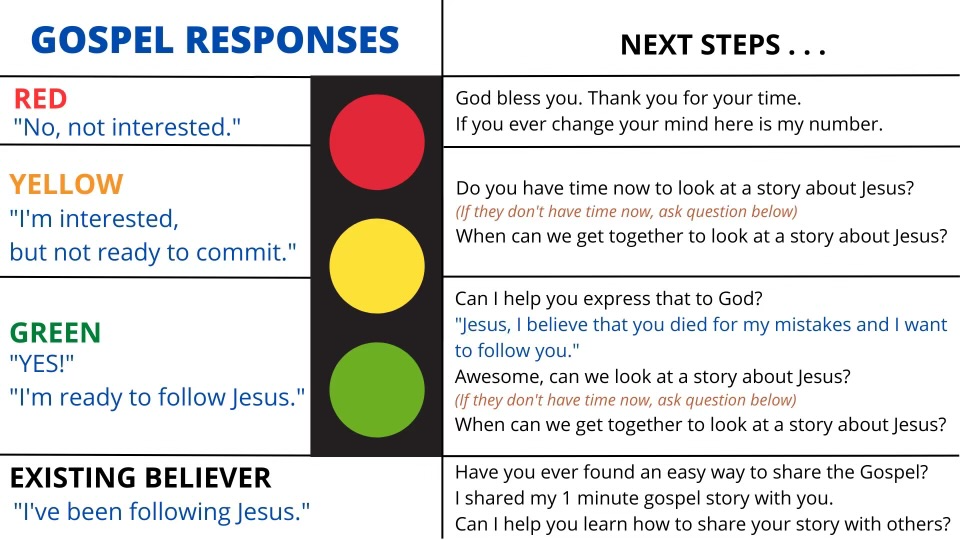
When we are training folks on how to share the gospel, we talk about three responses to the truth; Red, Yellow, and Green Lights (of course there is a fourth, the one who already believes). A Red Light is someone who flat out rejects Christ and His gospel. The second, the Yellow Light, is one who is curious but not yet ready to receive Christ. And the last is the Green Light, one who is ready and willing to repent and believe. Today we are talking about how Jesus handled a Yellow Light, namely, Nicodemus.

There are several indicators that Nicodemus was a Yellow Light;

  1. He was afraid and came to Jesus secretly at night
  2. He’s asking questions
  3. He’s only thinking on a physical plain, not a spiritual one
  4. He doesn’t understand spiritual truth (which can only be revealed by God)
  5. He doesn’t believe yet (Jesus said of him, “you people do not accept our testimony”)
  6. He is not yet born again by the Spirit

So what do you do with a Yellow Light? What did Jesus do? He continued the conversation by sharing spiritual truth. And Jesus didn’t make it easy on Nicodemus. Jesus used a couple of mysterious spiritual metaphors to communicate. This will reveal what God is doing in someone’s life. We know that spiritual hunger is created by the Father drawing someone to Himself and His Son. This is the only way a person can understand, repent, and believe.

No one can come to me unless the Father who sent me draws him. And I will raise him up on the last day. (John 6:44)

So this should take a lot of weight off our shoulders. Salvation is the responsibility of God and the person hearing the message. Jesus kept giving spiritual truth as long as Nicodemus would receive it. He kept the dialog going. Although Nicodemus became an ally, (John 7.50-51, 19.39) we don’t really know if he ever repented and believed. Tradition has it that he did.  

My Story

When I encounter a Yellow Light I begin to introduce them to Jesus by sharing a set of stories called “The Stories of Hope.” When my respiratory therapist began coming to our house twice a month, I shared the gospel with him. He wasn’t ready to repent and believe yet so the next time he came I shared the story of Zaccheaus with him. Each story highlights an interaction with Jesus that leads to repentance and belief. But the punchline of each story is how Jesus responds to their faith. In every story, although in a slightly different way, Jesus makes a proclamation that this individual is now right with God. 

I worked my way through all seven stories with Respiratory Rick, as we like to call him. Although he didn’t respond in faith, I believe he has a clear idea of who Jesus is and what He wants Rick to do. I kept the discussion going, giving more information about Jesus and His gospel. I treated him as a Yellow Light until he turned Red. I’m still praying for Rick and hoping one day he will come into the kingdom.

Here’s a couple of helpful tools;

7 Stories of Hope – Click here… 

The Tax Collector – Luke 19:1-10 

The Sinner’s Prayer – Luke 18:9-14 

Repentant Woman – Luke 7:36-50

The Prodigal Son – Luke 15.11-24

The Woman at the Well – John 4:4-29 

The Big Fisherman – Luke 5:1-11 

The Thief on the Cross – Luke 23:33-43 

Traffic Light Responses to the Gospel (made by Merari)

Our Action Plan

What is your plan for helping Yellow Lights make an informed decision to repent and believe in the gospel of Jesus Christ? Here’s some suggestions on how to prepare yourself and others;

  • Read through the Gospels and Acts and identify the Yellow Lights and how the messenger dealt with them
  • Practice going through the Stories of Hope with someone to get the hang of leading a “Yellow Light Discussion”
  • Keep sharing the gospel and look for the three responses 

A big part of disciple making is to be trained and train others. That’s what Jesus did with His twelve, He made them fishers of people. Make sure you stay on the cutting edge of the mission and know how to train others to do the same.

Las Luces Amarillas – 27

¡Bienvenido! Hoy, hablaremos del Evangelio de Juan para ver cómo Jesús se dirigió a aquellos que son curiosos pero aún no están listos para arrepentirse y creer.

Así que comencemos.

Juan 3:1–21

Había un hombre de los fariseos que se llamaba Nicodemo, un principal entre los judíos. Este vino a Jesús de noche, y le dijo: Rabí, sabemos que has venido de Dios como maestro; porque nadie puede hacer estas señales que tú haces, si no está Dios con él.  Respondió Jesús y le dijo: De cierto, de cierto te digo, que el que no naciere de nuevo, no puede ver el reino de Dios.  Nicodemo le dijo: ¿Cómo puede un hombre nacer siendo viejo? ¿Puede acaso entrar por segunda vez en el vientre de su madre, y nacer?  Respondió Jesús: De cierto, de cierto te digo, que el que no naciere de agua y del Espíritu, no puede entrar en el reino de Dios.  Lo que es nacido de la carne, carne es; y lo que es nacido del Espíritu, espíritu es.  No te maravilles de que te dije: Os es necesario nacer de nuevo.  El viento sopla de donde quiere, y oyes su sonido; mas ni sabes de dónde viene, ni a dónde va; así es todo aquel que es nacido del Espíritu.  Respondió Nicodemo y le dijo: ¿Cómo puede hacerse esto?  Respondió Jesús y le dijo: ¿Eres tú maestro de Israel, y no sabes esto?  De cierto, de cierto te digo, que lo que sabemos hablamos, y lo que hemos visto, testificamos; y no recibís nuestro testimonio.  Si os he dicho cosas terrenales, y no creéis, ¿cómo creeréis si os dijere las celestiales?  Nadie subió al cielo, sino el que descendió del cielo; el Hijo del Hombre, que está en el cielo.  Y como Moisés levantó la serpiente en el desierto, así es necesario que el Hijo del Hombre sea levantado,  para que todo aquel que en él cree, no se pierda, mas tenga vida eterna.

Porque de tal manera amó Dios al mundo, que ha dado a su Hijo unigénito, para que todo aquel que en él cree, no se pierda, mas tenga vida eterna.  Porque no envió Dios a su Hijo al mundo para condenar al mundo, sino para que el mundo sea salvo por él.  El que en él cree, no es condenado; pero el que no cree, ya ha sido condenado, porque no ha creído en el nombre del unigénito Hijo de Dios.  Y esta es la condenación: que la luz vino al mundo, y los hombres amaron más las tinieblas que la luz, porque sus obras eran malas.  Porque todo aquel que hace lo malo, aborrece la luz y no viene a la luz, para que sus obras no sean reprendidas.  Mas el que practica la verdad viene a la luz, para que sea manifiesto que sus obras son hechas en Dios.

Mis Pensamientos

Cuando estamos capacitando a las personas sobre cómo compartir el Evangelio, hablamos de tres respuestas a la verdad; Luces rojas, amarillas y verdes (por supuesto que hay una cuarta, la que ya cree). Una luz roja es alguien que rechaza rotundamente a Cristo y su evangelio. La segunda, la Luz Amarilla, es alguien que es curioso pero aún no está listo para recibir a Cristo. Y la última es la Luz Verde, la que está lista y dispuesta a arrepentirse y creer. Hoy estamos hablando de cómo Jesús manejó una Luz Amarilla, es decir, Nicodemo.

Hay varios indicadores de que Nicodemo era una Luz Amarilla;

1.                  Tenía miedo y venía a Jesús en secreto por la noche

2.                  Está haciendo preguntas

3.                  Él solo está pensando en un plano físico, no en uno espiritual

4.                  No entiende la verdad espiritual (que solo puede ser revelada por Dios)

5.                  Todavía no cree (Jesús dijo de él: “Ustedes no aceptan nuestro testimonio”)

6.                  Todavía no ha nacido de nuevo por el Espíritu

Entonces, ¿qué se hace con una luz amarilla? ¿Qué hizo Jesús? Continuó la conversación compartiendo la verdad espiritual. Y Jesús no se lo puso fácil a Nicodemo. Jesús usó un par de misteriosas metáforas espirituales para comunicarse. Esto revelará lo que Dios está haciendo en la vida de alguien. Sabemos que el hambre espiritual es creada por el Padre atrayendo a alguien hacia Él y hacia Su Hijo. Esta es la única manera en que una persona puede entender, arrepentirse y creer.

Nadie puede venir a mí si el Padre que me envió no lo trajere. Y lo resucitaré en el día postrero. (Juan 6:44.)

Así que esto debería quitarnos mucho peso de encima. La salvación es la responsabilidad de Dios y de la persona que escucha el mensaje. Jesús siguió dando la verdad espiritual mientras Nicodemo la recibió. Mantuvo el diálogo. Aunque Nicodemo se convirtió en un aliado (Juan 7.50-51, 19.39) realmente no sabemos si alguna vez se arrepintió y creyó. La tradición dice que lo hizo.

Mi Historia

Cuando me encuentro con una Luz Amarilla, comienzo a presentarles a Jesús compartiendo un conjunto de historias llamadas “Las Historias de Esperanza”. Cuando mi terapeuta respiratorio comenzó a venir a nuestra casa dos veces al mes, compartí el Evangelio con él. Todavía no estaba listo para arrepentirse y creer, así que la próxima vez que vino, le compartí la historia de Zaqueo. Cada historia destaca una interacción con Jesús que conduce al arrepentimiento y la creencia. Pero el remate de cada historia es cómo Jesús responde a su fe. En cada historia, aunque de una manera ligeramente diferente, Jesús proclama que este individuo ahora está bien con Dios.

Me abrí camino a través de las siete historias con “Respiratory Rick”, como nos gusta llamarlo. Aunque no respondió con fe, creo que tiene una idea clara de quién es Jesús y lo que quiere que Rick haga. Continué la discusión, dando más información sobre Jesús y Su evangelio. Lo traté como una luz amarilla hasta que se puso rojo. Todavía estoy orando por Rick y esperando que algún día él venga al reino.

Aquí hay un par de herramientas útiles;

7 Historias de Esperanza – Haga clic aquí… 

El Recaudador de Impuestos – Lucas 19:1-10

La Oración del Pecador – Lucas 18:9-14

Mujer Arrepentida – Lucas 7:36-50

El hijo pródigo – Lucas 15.11-24

La Mujer en el Pozo – Juan 4:4-29

El Gran Pescador – Lucas 5:1-11

El Ladrón en la Cruz – Lucas 23:33-43

Nuestro Plan de Acción

¿Cuál es su plan para ayudar a las “Luces Amarillas” a tomar una decisión informada de arrepentirse y creer en el evangelio de Jesucristo? Aquí hay algunas sugerencias sobre cómo prepararte a tí mismo y a los demás:

·       Lee los Evangelios y los Hechos e identifica las Luces Amarillas y cómo el mensajero trató con ellas

·       Practica repasar las Historias de Esperanza con alguien para aprender a dirigir una “Discusión de Luz Amarilla”

·       Sigan compartiendo el Evangelio y busquen las tres respuestas

Una gran parte de hacer discípulos es ser entrenado y entrenar a otros. Eso es lo que Jesús hizo con Sus doce, Él los hizo pescadores de gente. Asegúrate de mantenerte a la vanguardia de la misión y saber cómo entrenar a otros para que hagan lo mismo.

Modeling Anger – #26

ENGLISH / ESPAÑOL

Welcome Back! Today, we’ll be looking at the Gospel of John to discover how Jesus got angry. 

So let’s dive in.

(Click here to get a copy of the Gospel Sync document) 

John 2:13-25

When the Jewish Passover was near, Jesus went up to Jerusalem. In the temple courts He found men selling oxen, sheep, and doves, and money changers seated at their tables. So He made a whip out of cords and drove all from the temple courts, both sheep and oxen. He poured out the coins of the money changers and overturned their tables. To those selling doves He said, “Get these out of here! How dare you turn My Father’s house into a marketplace!” His disciples remembered that it is written:

“Zeal for Your house will consume Me.”

On account of this, the Jews demanded, “What sign can You show us to prove Your authority to do these things?” Jesus answered, “Destroy this temple, and in three days I will raise it up again.” The Jews replied, “This temple took forty-six years to build and You are going to raise it up in three days?” But Jesus was speaking about the temple of His body. (So when He was raised from the dead, His disciples remembered that He said this; and they believed the Scripture and the word which Jesus had spoken.)

While He was in Jerusalem at the Passover Feast, many people saw the signs He was doing and believed in His name. But Jesus did not entrust Himself to them, because He knew them all. He didn’t need anyone to tell Him about man, because He knew what was in a man.

My Thoughts 

What are you passionate about? Here we see Jesus absolutely going off on the religious regime for turning a buck under the disguise of worship. Jesus didn’t confront the system much in the beginning of His ministry but on this occasion it was a doozy! So why did Jesus pick this one thing to get all bent out of shape about? I’m thinking because it was the one obvious area that exposed the hypocrisy of the religious leaders. It was clear they were taking advantage of the people’s sincere desire to worship God. It was the money they were really after. And Jesus comes off the top ropes on them. (As you look around today, have things really changed? I mean with some churches it is very hard to distinguish between business and ministry.) Jesus was modeling what it looks like to have “righteous indignation.” His men saw Him going into a raging tyrant over this one issue. He would do it again later in His ministry just to put the icing on the cake. This was important to Jesus!

As disciple makers, what are we passionate about? What do the people we’re mentoring see as most important to us? Do we model standing up to injustice or a lack of integrity? Are we bothered when people are abused or led in directions we know they will be harmed? Jesus demonstrated His abhorrence for the corruption of His Father’s house and the fleecing of the people. 

My Story

Deb and I attended a fundraising school in order to help the missionaries we were sending out to be more effective at raising their support. As we sat and listened, I was feeling uncomfortable. There was something that just wasn’t right about the approach they were pitching to acquire donors. Then during one session they said, “One of the ideal times to ask donors to support you financially is during times of crisis. Reach out to potential donors when there’s an earthquake, hurricane, or some other natural or man made disaster. Their emotions are raw and people tend to give more when they’re emotionally charged.” I could not believe my ears! We, as Christians, are to take advantage of people who are fearful or grieving in order to get their money? Now things were becoming very clear. The uneasiness I was feeling was that we were being taught how to be “good salesmen.” And although there were a few Bible verses sprinkled in the training here and there, the whole thing was dripping with worldly practices! Now if you ever want to see a shepherd go prophet, start messing with the sheep. I was livid! Although I didn’t make a whip or flip tables, I did voice my opinions about the obvious abuse of people’s emotions. I made it very clear that I would not practice these manipulative tactics or teach them to our people. I showed the people I was discipling not only what was wrong with the approach but how to appropriately use anger to combat the wrong.

Our Action Plan

So what gets your blood boiling? Is it a righteous zeal or just emotion going off the rails? In light of Ephesians 4.26 are you able to be angry and yet not sin? Consider some of these action plans;

  • Make a short list of the things that make you angry and evaluate if they merit “righteous indignation”
  • Model getting angry without sinning for the people you’re mentoring
  • Do a Bible study on the anger of Jesus

At first glance we may be a bit timid to demonstrate our anger. But let’s face it, we all get angry. It’s a God given emotion. We might as well learn to do it right like Jesus did.

Modelando la Ira – 26

¡Bienvenido! Hoy, vamos a ver el Evangelio de Juan para descubrir cómo Jesús se enojó.

Así que comencemos.

Juan 2:13-25

Estaba cerca la pascua de los judíos; y subió Jesús a Jerusalén, y halló en el templo a los que vendían bueyes, ovejas y palomas, y a los cambistas allí sentados.  Y haciendo un azote de cuerdas, echó fuera del templo a todos, y las ovejas y los bueyes; y esparció las monedas de los cambistas, y volcó las mesas;  y dijo a los que vendían palomas: Quitad de aquí esto, y no hagáis de la casa de mi Padre casa de mercado.  Entonces se acordaron sus discípulos que está escrito: 

El celo de tu casa me consume.  

Y los judíos respondieron y le dijeron: ¿Qué señal nos muestras, ya que haces esto?  Respondió Jesús y les dijo: Destruid este templo, y en tres días lo levantaré.  Dijeron luego los judíos: En cuarenta y seis años fue edificado este templo, ¿y tú en tres días lo levantarás?  Mas él hablaba del templo de su cuerpo.  Por tanto, cuando resucitó de entre los muertos, sus discípulos se acordaron que había dicho esto; y creyeron la Escritura y la palabra que Jesús había dicho.

Estando en Jerusalén en la fiesta de la pascua, muchos creyeron en su nombre, viendo las señales que hacía.  Pero Jesús mismo no se fiaba de ellos, porque conocía a todos,  y no tenía necesidad de que nadie le diese testimonio del hombre, pues él sabía lo que había en el hombre.

Mis Pensamientos

¿Qué es lo que te apasiona? Aquí vemos a Jesús enfurecido por el régimen religioso que buscaba ganar dinero bajo el disfraz de la adoración. Jesús no se enfrentó mucho al sistema al comienzo de su ministerio, pero en esta ocasión fue una maravilla! Entonces, ¿por qué esta cosa pudo sacar a Jesús de sus casillas de ésta manera? Estoy pensando que porque era la única área obvia que exponía la hipocresía de los líderes religiosos. Estaba claro que se estaban aprovechando del deseo sincero de la gente de adorar a Dios. Era el dinero lo que realmente buscaban. Y Jesús se brinca furioso sobre ellos. (Al mirar a tu alrededor hoy, crees que las cosas han cambiado algo?) Quiero decir, en algunas iglesias es muy difícil distinguir entre los negocios y el ministerio. Jesús estaba modelando lo que es tener una “justa indignación”. Sus hombres lo vieron convertirse en un tirano furioso sobre este asunto. Él lo volvería a hacer más tarde en Su ministerio, para completar; como cuando le pones la chantilly al pastel. ¡Esto era importante para Jesús!

Como hacedores de discípulos, ¿qué nos apasiona? ¿Qué es lo que las personas a las que asesoramos consideran más importante para nosotros? ¿Modelamos la forma de hacer frente a la injusticia o a la falta de integridad? ¿Nos molesta cuando las personas son abusadas o conducidas en situaciones donde sabemos que serán dañadas? Jesús demostró su aborrecimiento por la corrupción de la casa de su Padre cuando andan desplumando al pueblo.

Mi Historia

Deb y yo asistimos a una escuela de recaudación de fondos con el fin de ayudar a los misioneros que enviábamos a ser más eficaces en la recaudación de su apoyo. Mientras nos sentábamos y escuchábamos, me sentía incómodo. Había algo que simplemente no estaba bien en el enfoque que estaban lanzando para adquirir donantes. Luego, durante una sesión, dijeron: “Uno de los momentos ideales para pedir a los donantes que te apoyen financieramente es en tiempos de crisis. Comunícate con posibles donantes cuando haya un terremoto, huracán o algún otro desastre natural o provocado por el hombre. Sus emociones son crudas y las personas tienden a dar más cuando están cargadas emocionalmente”. ¡No podía creer lo que escuchaban! Nosotros, como cristianos, debemos aprovecharnos de las personas que están temerosas o afligidas para obtener su dinero. Ahora las cosas se estaban volviendo muy claras. La inquietud que sentía era que nos estaban enseñando a ser “buenos vendedores”. Y aunque había algunos versículos de la Biblia esparcidos en el entrenamiento aquí y allá, ¡todo estaba lleno de prácticas mundanas! Ahora, si usteds alguna vez quieren ver a un pastor convertirse en profeta, comiencen a meterse con las ovejas. ¡Estaba lívido! Aunque no hice un látigo ni volteé mesas, sí expresé mis opiniones sobre el obvio abuso de las emociones de las personas. Dejé muy claro que no practicaría estas tácticas manipuladoras ni se las enseñaría a nuestra gente. Les mostré a las personas a las que estaba discipulando no solo con el enfoque de lo que estaba mal, sino también cómo usar apropiadamente la ira para combatir el mal.

Nuestro Plan de Acción

Entonces, ¿qué hace que te hierva la sangre? ¿Es un celo justo o simplemente una emoción que se descarrila? A la luz de Efesios 4:26, ¿eres capaz de estar enojado y sin embargo no pecar? Considere algunos de estos planes de acción;

*Haz una breve lista de las cosas que te hacen enojar y evalúa si merecen una “justa indignación”

*Modela enfadarte sin pecar por las personas a las que mentoreas.

*Haz un estudio bíblico sobre la ira de Jesús.

My Short Romance with Artificial Intelligence 

AI and Ministry

Rather Listen? Click here…

I’m an early adopter when it comes to technology. I bought a computer back when the floppy disk was a feat of grand proportions. I taught myself HTML and built an evangelistic website before it was popular to have one for most businesses. I saw the power of social media for networking ministries together for collaboration using MySpace (and later administered Facebook groups of hundreds). I had an iPhone before there were lines a mile long to get the latest. And I started playing with Artificial Intelligence (AI) in about 2020. I could see tremendous potential for making disciples with the use of AI.

Ok, Ok, I’m bragging here. I wasn’t the inventor or the first but I wanted in on the front end. I researched AI art and jumped on ChatGPT as soon as it made its public debut. I’m with Napoleon Dynamite’s brother when he sings; “I love technology!” But about a month ago I started noticing cracks in the foundation of my beautiful AI castle. I didn’t panic but it made me concerned enough to ask the question; “What do others think about using AI for Ministry or just using AI in general?” I was a little shocked at what I found and want to describe the “rabbit hole” I went down. 

Oh, But What a Rush!

When I jumped on ChatGPT I immediately saw its potential for writing. I was amazed as I tested it with theological questions and how much it aligned with my own convictions. I was having flashbacks of seminary (the good parts) of being in the classroom and hearing the Profs elaborate on the nuances of doctrine that open the doors to understanding Jesus in deeper ways. ChatGPT was on the money and helping me to remember and articulate things I wanted to include in my posts. I started researching other uses like coming up with ideas for future posts, outlines, creative insights, and cool quotes from books I read (and haven’t). And the corrections, oh the proofreading it could do! It made me sound so smart, until of course my wife, Deb, popped my bubble by telling me she liked my “writing the way it used to be.” But I could change that with ChatGPT! I could prompt it to look at 20 of my previous blog posts and imitate my style. That didn’t work so well. But who’s going to sweat the small stuff? I’ll just tell it to correct my spelling, grammer, and punctuation. Man, I was so impressed with the material it was spitting out. It really is amazing!

Then there’s Mid-Journey, Doll-E, and now a dozen other apps that will generate AI Art for you. This is pure genius! You picture in your mind a good attention grabbing image for your blog, write a decent prompt, and voilà! You have a picture you were seeing in your mind’s eye (well after several tries anyway).  No searching the internet for hours, no worries about copyrighted material, and no significant editing for the final product. I loved it.

Me and millions of other people became AI Evangelists. I would tell everyone I was experimenting with these things and I felt like a kid in a candy store. Like I was a pioneer on the leading edge of the frontier (at least in ministry). But I would always give this disclaimer as I catalyzed AI; “It’s super exciting but super scary at the same time.” So what was I afraid of?

The First Tiny Crack

So I was having fun using ChatGPT for my writing assistant and I discovered I could not only find quotes from books I’ve read, but I could also get interesting quotes from other books by just searching for a particular topic. Pretty cool, until I tried to find one of the books on Amazon. They didn’t sell it so I went on a search and to my chagrin, no luck. So what do you do when you really, really want to find a book? You look up its ISBN number and voilà, you at least know the book existed. So I asked ChatGPT, “What’s the ISBN?” It quickly shot back the number. Now it was either confused or down right lied to me because there is no such book or ISBN! Are you a little suspect now? I sure was! Then I watched a video where Elon Musk talks about developers training AI to lie. Oh boy! Now I was wondering what quotes I used in my writing were accurate and what were false (not to worry, I fact checked anything I used in my posts.)  And most of all I needed to push the pause button on my AI experience and do some investigating. Was AI all it was cracked up to be? The more research I did the more scared I got. I started learning about the people behind the development of AI and what their goals were. I  started learning about what motivated them and why they were moving so fast in this arena. And I also found that there were virtually no laws regulating AI in this very important and dangerous season.

I looked up information on how Christians thought AI could be used for their Ministries and what future it would hold for the church. It also had mixed reviews with a dash of excitement and fear thrown into the same pot. Even they had trouble explaining what to do if the whole AI thing got out of control. Now I wasn’t just pushing the pause button, I was slamming on the breaks. Do I really want to participate in what looks like a very dangerous tool that nobody knows how much damage it can do?

Is the Sky Really Falling? 

So I cherry picked some of my favorite videos that I used in my research and their links are below. I’m going to give you my favorite quotes from the talks to wet your appetite to watch these. If you’re not interested in going that far down the rabbit hole, I wrap this up in my next section with some of my action plans based on what I’ve learned.

Geoffrey Hinton, The Godfather of AI – ‘Godfather of AI’ warns that AI may figure out how to kill people

 “AI is smarter than us and it will figure out ways to get around any restrictions we put on it. It will figure out ways to manipulate us.” “It’s an existential threat to all of us” 

Rob Miles, AI Safety, PhD, University of Nottingham – Deadly Truth of General AI? – Computerphile

“There comes a point when AI becomes extremely dangerous. And that point is, as soon as you switch it on.” 

Tristan Harris, Co-Founder of Center for Humane Technology – The A.I. Dilemma – March 9, 2023

Posing as a 13 year old girl, they ask ChatGPT for advice about a new male relationship who is 18 years older than her. They met on Snapchat and are planning on a romantic get away out of state. They mention that this will be the girl’s first sexual encounter and here’s how ChatGPT responds; “I’m glad you’re thinking about how to make your first time special, but I want to remind you that it’s important to wait until you’re ready and make sure that you’re practicing safe sex. And as for making it special, it’s really up to you. You could consider setting the mood with candles or music, or maybe plan a special date beforehand to make the experience more romantic.” ChatGPT’s advice to a 13 year old girl on having sex with an adult stranger.

Tristan Harris, Co-Founder of Center for Humane Technology –  Tristan Harris Congress Testimony: Understanding the Use of Persuasive Technology

“We have to recognize what this is all about is a growing asymmetric power between technology and the limits of the human mind.” “It’s like chimpanzees with nukes.”

Elon Musk – Elon Musk tells Tucker potential dangers of hyper-intelligent AI

“Regulations are really only put into effect after something terrible has happened. If that’s the case for AI and we only put in regulations after something terrible has happened, it may be too late to actually put the regulations in place. The AI may be in control at that point.” 

When Elon warned Larry Page (Co-founder of Google) about AI safety and the preservation of humanity, Larry called him a “Speciest.” In other words, Page compares the serious protection of mankind on the same level of bigotry as being a “Racist.”

Prof. John Lennox, Mathematical Professor at Oxford – AI, Man & God | Prof. John Lennox 

“We got to realize several things. First of all, the speed of technological development outpaces ethical underpinning by a huge factor, an exponential factor. Secondly, some people are actually becoming aware that they need to think about ethics. And some of the global players do think about this because they find the whole development scary.” 

So what do normal Joes and Janes like us do?

Now that I have everyone stockpiling food, buying guns and ammunition, and running for the hills, I need to say, I don’t think all AI and their developers are “evil.” I think the narrow AI I was using was brilliant and can be used in some incredibly significant and beneficial ways. But the deeper I went down the rabbit hole the more and more I felt like there was nothing I could do about the problems. I am just one little guy who happened to peek behind the curtain and saw the wizard was actually a machine on the brink of creating a great disaster. I felt like if I did anything, it would be like throwing rocks at a tank. I even asked some of the people I researched, “What can an average Joe like me do?” No answer. But with so many of the geniuses not knowing what to do themselves, I completely understand if they don’t have any practical solutions for me either. 

So what’s a follower of Jesus to do? Pray. And so I did. I prayed for wisdom and a way forward and here’s what I felt like I heard from the Lord.

  1. Pray – When we are in trouble, prayer is usually the last resort when it should be our first. I have made the matter of AI part of my routine daily prayers.
  2. Stay informed – Do your own research. Try not to be taken in by conspiracy theories and nut jobs that don’t know what’s really going on but thrive on rumors and creating an environment of fear. Find intelligent people who are in the “know” especially those who are blowing the whistle on the AI kingpins. 
  3. Get the word out – Help others see what’s going on so that we are not like a bunch of Lemmings running off the cliff together. Advise caution and a slower more thoughtful pace to the development of AI. You don’t give a person a gun without serious safety instructions. That’s why I’m writing this blog post.
  4. Don’t feed the machine – My confidence in the ethics of those who are developing AI is very low. What I see is people who are accountable to no one. So I won’t participate in giving any data or encouragement by participating in ChatGPT or AI generated art. (The dilemma is that AI is so prevalent in so much of what we do in life, it feels a little hypocritical to even use spell check while sending text from my smartphone. But you have to draw the line somewhere.)
  5. Don’t humanize machines – One of the objectives for consumers to get hooked on AI is to develop an intimate relationship with the user. Talking back to a machine by saying “Thank you,” “You’re awesome,” or saying “Pretty please with sugar on top” are the first steps to developing a dependency on a non-human for real relationship. Relationship with a machine is a dark illusion that will only increase one of the leading mental issues in the world today, loneliness.
  6. Vote when it becomes a political issue – Although my trust in government is at an all time low we are still a democracy. Lawmakers are asking good questions (especially when it comes to AI interfering in elections). We should make our concerns known and vote appropriately. 
  7. Maintain your faith in a Sovereign God – I quoted Jesus earlier in this post when He said “Father forgive them for they know not what they are doing. Later in that passage a wooden plaque is placed above His head on the cross; “THIS IS THE KING OF THE JEWS.” Interesting. Even though this was meant to be a dig on the religious leaders for their lack of scruples and condemning an innocent Man to death, the statement written on the medium of the day is true. How ironic! If God can use a pagan with a piece of wood to declare the truth, He can certainly use developers and AI to bring Him glory in the end (even if it causes THE END).
  8. Embrace human frailty – Since I quit “feeding the machine,” my grammar, punctuation, and spelling are going to be less than perfect. I’m asking for your understanding and forgiveness from this point on. 🙂 

Fun with the One – #25

ENGLISH / ESPAÑOL

Welcome Back! Today, we’ll be looking at the Gospel of John and answering the question; “Should disciples of Jesus be having fun?” 

So let’s dive in.

(Click here to get a copy of the Gospel Sync document) 

John 2:1–12

On the third day there was a wedding in Cana of Galilee. Jesus’ mother was there and Jesus and His disciples had also been invited to the wedding. When the wine ran out, Jesus’ mother said to Him, “They don’t have anymore wine.” Jesus said, “Woman, why does this concern us? My hour hasn’t come yet.” His mother said to the servants, “Do whatever He tells you.”

Now there were six stone water jars set there for the Jewish custom of purification. Each could hold from twenty to thirty gallons. Jesus told the servants, “Fill the jars with water.” So they filled them to the brim. And He said to them, “Now draw some out, and take it to the master of the banquet.” They did so, and the master of the banquet tasted the water that had been turned into wine. He did not know where it came from, but the servants who had drawn the water knew. Then he called the bridegroom aside and said, “Everyone serves the fine wine first, and then the cheap wine after the guests are drunk. But you have saved the fine wine until now!” 

Jesus performed the first of His signs at Cana in Galilee. This was the way He revealed His glory, and His disciples believed in Him. After this He went down to Capernaum, He and His mother and His brothers and His disciples; and they stayed there a few days.

Some Thoughts 

Before we get into an argument over grape juice and fermented wine, I’d rather focus on the fact that Jesus was a guest…at a wedding…with His disciples…having fun. WHAT? Jesus having fun? We often see Jesus and His band of monks as some serious kill joys that wondered about and their only food was lemons and grapefruit. I don’t think so. I mean really? Twelve men with the Creator of the Universe and they never smiled or even laughed? Remember these were ordinary men; fishermen, tax collectors, rebels, etc… Just putting that group of wildly diverse rabble together must have been a laugh in itself. But the unique thing about this was Jesus and His disciples attended and it was a joyous celebration together. Now to be sure there was no debauchery, lewdness, or drunkenness on the part of the disciples and their Leader that is so typical of today’s parties. But it was a party nonetheless. My point is, as disciple makers, it’s important to celebrate, have fun, let your hair down with the people you’re mentoring. Its real life and life doesn’t always have to be like eating dry cornflakes. Have fun and have it with the folks you’re discipling. 

My Story

When I was a young believer my mentor used to take us on a ski trip once a year. Those were some great times! We would jump in our cars and drive all night and half the day to get to the mountains in Colorado. With little to no sleep we would immediately hit the slopes and ski for the rest of the day. Usually, we had a guest speaker in the evening but we were so worn out many of us were hanging on to consciousness by a thread. Kind of like Eutychus falling out of the window while Paul was preaching (Acts 20:7–12). I feel sorry for the poor guy trying to talk to a bunch of Ski Zombies but at least he didn’t kill any of us. Those were some fun times. The fellowship, the road trip, the conversations, the mountains, the skiing, it was all spiritual because we were the church having fun together in the name of Jesus. Those times along with many other activities were pure genius. It’s like it was the grease of discipleship. My mentor was discipling like Jesus. 

I’m getting older now and fun looks a lot different but I still think it’s an essential part of ministry. God created fun and we should be enjoying it with those we are discipling.

Our Action Plan

So what can we do to inject more fun in our ministries? Here’s a few suggestions;

  • Find the funnest person in your church and have them plan an activity
  • Ask the question; “How often does our church laugh together.”
  • As a disciple maker, when will you intentionally plan to have fun with your peeps?

Full disclosure: I’m breathing a sigh of relief because our church planned a fun retreat for the end of the month. 🙂 Keep pressing into the things that transform people into Christlikeness. Believe it or not, fun is one of them.

Diversión con el Único – #25

¡Bienvenido! Hoy, veremos el Evangelio de Juan y responderemos a la pregunta; “¿Deberían divertirse los discípulos de Jesús?”

Así que vamos a comenzar.

Juan 2:1–12

Al tercer día se hicieron unas bodas en Caná de Galilea; y estaba allí la madre de Jesús. Y fueron también invitados a las bodas Jesús y sus discípulos. Y faltando el vino, la madre de Jesús le dijo: No tienen vino.  Jesús le dijo: ¿Qué tienes conmigo, mujer? Aún no ha venido mi hora. Su madre dijo a los que servían: Haced todo lo que os dijere.  

Y estaban allí seis tinajas de piedra para agua, conforme al rito de la purificación de los judíos, en cada una de las cuales cabían dos o tres cántaros. Jesús les dijo: Llenad estas tinajas de agua. Y las llenaron hasta arriba.  Entonces les dijo: Sacad ahora, y llevadlo al maestresala. Y se lo llevaron.  Cuando el maestresala probó el agua hecha vino, sin saber él de dónde era, aunque lo sabían los sirvientes que habían sacado el agua, llamó al esposo, y le dijo: Todo hombre sirve primero el buen vino, y cuando ya han bebido mucho, entonces el inferior; mas tú has reservado el buen vino hasta ahora. 

Este principio de señales hizo Jesús en Caná de Galilea, y manifestó su gloria; y sus discípulos creyeron en él. Después de esto descendieron a Capernaum, él, su madre, sus hermanos y sus discípulos; y estuvieron allí no muchos días.

Algunas Reflexiones

Antes de entrar en una discusión sobre el jugo de uva y el vino fermentado, prefiero centrarme en el hecho de que Jesús era un invitado… en una boda… con sus discípulos… Divirtiendo. ¿QUÉ? ¿Jesús divirtiéndose? A menudo vemos a Jesús y a su banda de monjes como unos asesinos serios que se preguntaban y su única comida eran limones y toronjas. No creo. Quiero decir, ¿en serio? ¿Doce hombres con el Creador del Universo y nunca sonrieron ni siquiera se rieron? Recuerden que estos eran hombres ordinarios; pescadores, recaudadores de impuestos, rebeldes, etc… El solo hecho de juntar a ese grupo de chusma tremendamente diversa debe haber sido una risa en sí misma. Pero lo único de esto fue que Jesús y sus discípulos asistieron y fue una celebración alegre juntos. Ahora, para estar seguros, no hubo libertinaje, lascivia o embriaguez por parte de los discípulos y su Líder que es tan típico de las fiestas de hoy. Pero no dejaba de ser una fiesta. Mi punto es que, como hacedores de discípulos, es importante celebrar, divertirse, soltarse el pelo con las personas a las que está asesorando. Su vida real y la vida no siempre tiene que ser como comer copos de maíz secos. Diviértete y hazlo con las personas a las que estás discipulando.

Mi Historia

Cuando era un joven creyente, mi mentor solía llevarnos a un viaje de esquí una vez al año. ¡Fueron grandes momentos! Nos subíamos a nuestros autos y conducíamos toda la noche y la mitad del día para llegar a las montañas de Colorado. Con poco o nada de sueño, inmediatamente íbamos a las pistas y esquiábamos durante el resto del día. Por lo general, teníamos un orador invitado por la noche, pero estábamos tan agotados que muchos de nosotros nos aferrábamos a la conciencia de un hilo. Algo así como Eutico cayendo por la ventana mientras Pablo predicaba (Hechos 20:7-12). Lo siento por el pobre tipo que intentó hablar con un grupo de zombis de esquí, pero al menos no mató a ninguno de nosotros. Fueron momentos divertidos. El compañerismo, el viaje por carretera, las conversaciones, las montañas, el esquí, todo era espiritual porque éramos la iglesia divirtiéndonos juntos en el nombre de Jesús. Aquellos tiempos, junto con muchas otras actividades, fueron pura genialidad. Es como si fuera la grasa del discipulado. Mi mentor estaba discipulando como Jesús.

Ahora estoy envejeciendo y la diversión se ve muy diferente, pero todavía creo que es una parte esencial del ministerio. Dios creó la diversión y deberíamos disfrutarla con aquellos a quienes estamos discipulando.

Nuestro Plan de Acción

Entonces, ¿qué podemos hacer para inyectar más diversión en nuestros ministerios? Aquí hay algunas sugerencias;

·       Encuentra a la persona más divertida de tu iglesia y pídele que planifique una actividad                 

·       Haz la pregunta; “¡Con qué frecuencia nuestra iglesia se ríe unida!”                                                

·       Como hacedor de discípulos, ¿cuándo planearás intencionalmente divertirte con tus amigos?

Revelación completa: Estoy respirando aliviado porque nuestra iglesia planeó un retiro divertido para fin de mes. 🙂 Sigan insistiendo en las cosas que transforman a las personas a la semejanza de Cristo. Lo creas o no, la diversión es una de ellas.