Testimony 2: Jesus is Watching You

Chapter 2

The eyes of the LORD are in every place, Watching the evil and the good.
(Proverbs 15:3)

As we moved around the country following my dad in his Army career, I encountered other events that would shape my spiritual awareness. Some of them were not as positive as the first. My mother had left my brothers and me when Dad was in Vietnam. When my dad returned to the United States, there was no way he could take care of us by himself, with Army life being what it was at the time. So we were enrolled in the Southwestern Christian Children’s Home. It was as close to going to a parochial school as you can get without being Roman Catholic. We were required to attend chapel, devotionals, prayer times (that seemed to last forever) and church on Sundays. But the most vivid memory I have of that place was a picture of Jesus on the front wall of the study hall. This wasn’t your nice, loving Sunday School kind of picture of Jesus. Oh, no. This was a “Jesus on steroids” kind of picture. He looked like he had really had enough of kids for that century and was about to blow a fuse (the picture probably didn’t look anything like that, but that’s how I remember feeling as a kid). The worst part of the picture, though, was His eyes. The painter had done a fantastic job on the eyes. They were penetrating and seemed to follow you everywhere you went in the room. You didn’t goof off in study hall because “JESUS WAS WATCHING YOU.” So this experience wasn’t the most positive, but God would use it to His benefit in the future.

Chapter 1: The Beginning
Chapter 2: Jesus is Watching You
Chapter 3: Paratrooper Religion

For questions or comments drop me a line at charleswood1@gmail.com or click the envelope below to send this post to a friend…

The Pursuit of Righteousness in God’s Economy of Grace

Read Mt 5.17-20

“Do not think that I came to abolish the Law or the Prophets; I did not come to abolish but to fulfill.
(Matthew 5:17)

Jesus is the fulfillment of the Law and the Prophets

This passage can be very confusion and even the scholars admit the complexities of untangling the theological aspects of Jesus’ statements. This is how I have arranged the passage in my mind;

1. Jesus fulfilled the Law (He was perfect and this made Him a worthy sacrifice; 2 Cor 5.21, Heb 4.15, 7.26, 1 Pet 2.22-23)
2. The Law is good and eternal (Rom 7.13, Isa 40:8, 1 Pet 1:23, Lk 16:17)
3. The Law will accomplish its intent (to be a tutor to bring us to Christ; Gal 3.19-22, Rom 5.20, Gal 3.24-25)
4. Obedience is expected in the Kingdom of God (although our obedience in itself would never be enough to gain entrance into the Kingdom; Mt 7.24, Mt 28.20, Jm 1.22)
5. To enter the Kingdom one must be more righteous then the Scribes and Pharisees (1 Pet 1.16, Mt 5.48; Jesus is alluding to the righteousness that comes only through Him in justification. This is grace; Rom 4.6, 2 Cor 5.21, Rom 4.22-25, Heb 7.26-27)

The implications of what Jesus says for disciplemaking are huge. We must completely embrace the gift of grace while at the same time shoulder the responsibility of obedience. This causes us to live in a tricky tension that, although we may not completely understand, we accept as truth. Communicating these truths to young disciples takes time and clarification through study, explanation, and experience. FJ79

If you have other cross-references that would fit into these categories, please send them to me. I’d love to include them as an edit to this devo.

For questions or comments drop me a line at charleswood1@gmail.com or click the envelope below to send this post to a friend…

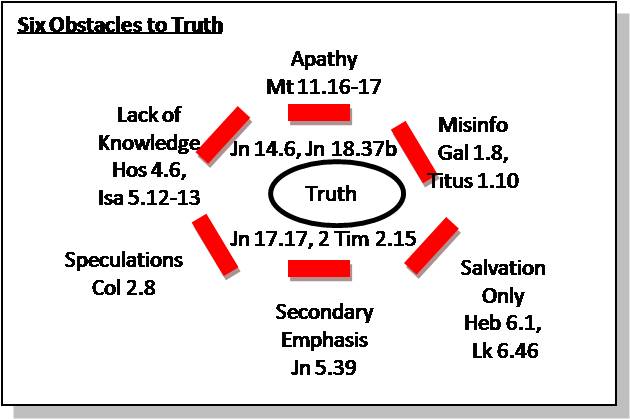
Illustration – 6 Obstacles to Truth

Many times I see young disciples getting deflected by lesser things. Sometime even the good gets in the way of the best. This is a devotional I use to illustrate the obstacles to truth. Ultimately, I want these disciples to major on the Word of God as it points to the person of Jesus Christ who is Truth.

For questions or comments drop me a line at charleswood1@gmail.com or click the envelope below to send this post to a friend…

Salt and Light – Being Radically Different

Read Mt 5.13-16

“Let your light shine before men in such a way that they may see your good works, and glorify your Father who is in heaven.
(Matthew 5:16)

Jesus preaches that we are to be salt and light in the world.

The admonition to be salt and light comes in the context of the Sermon on the Mount and in particular right after the beatitudes. Our saltiness is tasted by the world because we are seasoned with the goodness of God. Our shining light is a reflection like a full moon which can’t go unnoticed in the darkness. The lifestyle of Jesus’ way is so radically different we stand out. We are the reflection of Jesus Christ and that is not often seen in this world.

And this is the goal of discipleship, helping men and women be like Christ. As they become like Jesus, their words and deeds are so radically different from the culture, they cannot hide. They are intentionally shining that light for God and man’s sake alike (Mt 5.16). As Disciplemakers we model what it means to be salt and light in the world. But somehow we are missing this in our witnessing. I often see Christians using intimidation or manipulation to try and convert people. But in the context of the beatitudes I see that light and salt, the difference, is not anger or pride but love and humility. We need to teach and model that lost people need to be approached with the love of Christ rather than my theological arrogance. Do they need to hear the truth of sin and judgment, you bet. But a “Turn or Burn” placard doesn’t seem to communicate Jesus’ love very effectively. In fact, I think it’s a pretty cowardly way to share the gospel. Jesus meant His disciples to be on the offense but not necessarily offensive. How do I teach a young disciple to be this kind loving living witness? Answer: By witnessing the way Jesus did. (Note: there’s a big difference in the way Jesus spoke to the common people and the way He spoke to self-righteous religious leaders, do not confuse the two)FJ78

For questions or comments drop me a line at charleswood1@gmail.com or click the envelope below to send this post to a friend…

Blessed are Those who Swim Against the Current

Read Mt 5.3-12, Lk 6.20-26

He opened His mouth and began to teach them, saying,
(Matthew 5:2)

Jesus preaches the beatitudes to the people.

Can you imagine what the people were thinking when Jesus preached this sermon. Sure you can. What were you thinking the first time you heard or read this. I’m not talking about all the times since that you have glossed over it, thinking well that’s just Jesus. No, I’m talking about the first time you let these words impact your logic and registered with your emotions. “Wait a minute Jesus, are you serious?” I believe He is. His ways are so counter-cultural, so un-natural you are jolted by His expectations for real spirituality. He is looking for these attributes in His disciples; poor in spirit, mourning, gentleness, hunger and thirsting for righteousness, merciful, pure in heart, peacemaking, enduring persecution. What? You’re not there yet? You are in good company my friend. We all are in process but the process is real. He does have expectations of us but there is no way we could ever pull this off in the flesh. We are desperate for help if we are going to live our lives in keeping with the beatitudes. We need His Word, His example, His Spirit living powerfully within us. I think prayer and fellowship with likeminded people also play a huge role in swimming against the current of the world. If this weren’t hard enough, I believe this is part of making disciples. We are not only to live the beatitudes ourselves, we are supposed to help others do the same.

For questions or comments drop me a line at charleswood1@gmail.com or click the envelope below to send this post to a friend…

Testimony 1: In the Beginning

The Testimony of Chaplain (Retired) Chuck Wood

Chapter 1

Where can I go from your Spirit? Where can I flee from your presence? If I go up to the heavens, you are there; if I make my bed in the depths, you are there. If I rise on the wings of the dawn, if I settle on the far side of the sea, even there your hand will guide me; Your right hand will hold me fast. (PSALM 139:7-10)

But Jesus said, “Let the children alone, and do not hinder them from coming to Me; for the kingdom of heaven belongs to such as these.”
(Matthew 19:14)

As long as I can remember I’ve always known there was a God. Even when I went through the throes of rebellion during a season of my life, I could not deny that there was Something, Someone watching over us. I was less than three years old living in California. It was a bright sunny day and I was playing in the backyard. My dart gun had malfunctioned (I always knew I’d be a soldier as well) and the spring was lost somewhere in the tall grass. Dart guns are pretty important to little boys and I couldn’t have a full and productive life without one. I panicked and searched frantically for this tiny spring in (what I thought at the time was) a huge backyard. I don’t know how I thought to pray about this tragedy, but I did. And through tears of my little eyes, I found the missing spring. Coincidence? That’s just the beginning. It was my first recollection of praying and (more importantly) thinking that there must be a God.

Testimony 1: In the Beginning
Testimony 2: Jesus is Watching You
Testimony 3: Paratrooper Religion
Testimony 4: Afraid of being Left Behind
Testimony 5: The Geographical Solution
Testimony 6: The Geographical Solution Fails
Testimony 7: The Seed is Planted
Testimony 8: Spiritual Melee
Testimony 9: Seeing the Light
Testimony 10: Receiving God’s Plan for My Life
Testimony 11: A New Creature
Testimony 12: What about You?
Testimony 13: A Little Miracle
Testimony 14: An Apostle to the Soldier
Testimony 15: First Steps toward Growth
Testimony 16: Being Discipled

For questions or comments drop me a line at charleswood1@gmail.com or click the envelope below to send this post to a friend…

The Orbit Illustration (My Relationship with the World)

I use this illustration to help men to understand their relationship to the world and the dangers of being isolated verses insulated from the world.

Get too close to the world and your burn in. Get too far, you become so heavenly minded you’re no earthly good.

It takes some calculations to get the right distance and achieve orbit.

For questions or comments drop me a line at charleswood1@gmail.com or click the envelope below to send this post to a friend…

Methods in Disciplemaking

Mt 5.1-2, Lk 6.12-19

It was at this time that He went off to the mountain to pray, and He spent the whole night in prayer to God. And when day came, He called His disciples to Him and chose twelve of them, whom He also named as apostles: Simon, whom He also named Peter, and Andrew his brother; and James and John; and Philip and Bartholomew; and Matthew and Thomas; James the son of Alphaeus, and Simon who was called the Zealot; Judas the son of James, and Judas Iscariot, who became a traitor. Jesus came down with them and stood on a level place; and there was a large crowd of His disciples, and a great throng of people from all Judea and Jerusalem and the coastal region of Tyre and Sidon,
(Luke 6:12-17)

Jesus prays all night and in the morning chooses 12 to appoint as apostles from a large crowd of His disciples.

There are three distinct groups of people in this passage; the 12, the large crowd of disciples, and great throng of people from the extended region. Since this is a study in discipleship, we need make a few observations and ask a couple of questions. Observations: First, the 12 were disciples before there were appointed as apostles. Second, they were chosen for a large crowd of disciples. Questions: How did Jesus get so many disciples and what was His primary method for making these disciples?

This passage gives us a good picture of how Jesus made disciples. The 12 were not set apart to be made into disciples, they were already followers of Jesus. Jesus had been making disciples for at least a year to this point. Some, Jesus asked to follow Him and others took the initiative and requested to be His disciple (Jn 1.35-51, Lk 9.47-52). There were disciples who followed Him everywhere and those who were more static. There were disciples who quit following Jesus (Jn 6.66) and secret disciples (Jn 19.38).

The fact of the matter is that Jesus had made many more disciples than the 12. You may be wondering why I am belaboring this point. I think some people are under the impression that the only way to make a disciple is to do what Jesus did with the 12 (others have gone as far as to say one on one is the only way to make disciples). Not according to Jesus’ methods. On the other hand, in modern American Christianity we are trying to make disciples by preaching at them and anyone with integrity would have to assess this method as a dismal failure in most Christian’s lives. They are not following Christ as a result of the myriad of messages they have heard. In fact they have become inoculated to the message. In order to make disciples we need to take a closer look at Jesus’ objective. The object should always drive the method, not the method the objective. His primary method was to invite people to follow Him. His objective was to help people get to know and become like Him (Mt 10.24-25a, Lk 6.60, 1 Jn 2.6). These men and women became disciples by listening to His preaching, watching His ministry, discussing Him in their communities, and seeing His miraculous signs. The main issue is not necessarily the method but the outcome. They were following Jesus, getting to know Him, and becoming like Him. That is the objective (Lk 6.40, 1 Jn 2.6, Mt 28.18-20).

If preaching alone was helping people become vibrant passionate followers of Christ, then I would practice this method more zealously. But the facts are that preaching, although a healthy component of the discipleship process, usually falls woefully short of accomplishing the objective when it is the only component of discipleship. The proof is in the pudding. Preaching was a part Jesus’ strategy for making disciple, but His methods were much more comprehensive than a sermon Sunday morning. This is where Sunday School, Music, Small Groups, One on One, and so many other methods we practice are so important. They are all components (methods) used in order to accomplish the overall objective. So here’s the question for us and modern American Christianity; do we believe Jesus has commanded us to produce His disciples? Do we see passionate followers of Jesus Christ coming out of our ministries? Are we in fact accomplishing this objective? If not, we may need to take a closer look at our methods. FJ76

For questions or comments drop me a line at charleswood1@gmail.com or click the envelope below to send this post to a friend…

Choosing the 12 (Part 6) – Failure

Read Mk 3.13-19, Lk 6.12-16

And He appointed twelve, so that they would be with Him and that He could send them out to preach,
(Mark 3:14)

Jesus appointed 12 fallible men as Apostles

Jesus appointed men whom He knew would fail Him. Judas is the most obvious example but the 11 also failed, not only during the hours surrounding the crucifixion, but in the months and years that led to the cross. They tried to stop crucial ministry from happening (Mk 9.38-39, Mt 19.13-14), they lacked faith and the prayer life to perform certain types of ministry (Mt 17.14-21), they failed to understand and apply Jesus’ teaching (Mt 15.16, Mk 8.17). Ultimately, their failure would manifest itself in abandonment and betrayal. They failed and yet Jesus chose them in spite of their failures which He knew before hand (Jn 6.64; 17.12, Mt 26.31, Lk 22.31-32) . Failure was an option under Jesus’ leadership.

We don’t need divine insight in order to know that people will fail. It is in our DNA. And we don’t have to go any further than the mirror to prove it. This is a huge part of discipleship. First, we must expect and accept failure. It is a reality and how we respond to a disciple’s failure will often determine how effective the mentoring relationship will be in the future. Both truth and grace must be administered in these situations. Secondly, where there is no room for failure there is no room for self discovery (which by the way is 100 times more valuable than our preaching). People need room to try and fail. But if we control every situation or leave no room to fail, the disciple may fail to try. When we leave room for failure, we leave room for initiative and creativity. As a discipler, I expect failure. This is especially true of young laborers and leaders. Third, I can’t let failure go unnoticed. Although I expect failure, I have the responsibility to both correct and encourage proper actions. I am a safe place to express failure but I am also part of the solution for their success in the future. Finally, I am not the prefect Son of God. I am failing right along with the younger disciple. When I express these failures it does not undermine the relationship, it actually strengthens it. I need to have integrity in ministry and express my strengths as well weaknesses. When I fail to express my failure I potentially discourage the young follower of Jesus and put on the same mask worn by the Pharisees. Failure is an Option.

For questions or comments drop me a line at charleswood1@gmail.com or click the envelope below to send this post to a friend…

Choosing the 12 (Part 5) – Apostolic Leadership

Read Mk 3.13-19, Lk 6.12-16

And when day came, He called His disciples to Him and chose twelve of them, whom He also named as apostles:
(Luke 6:13)

Jesus appointed the 12 as Apostles.

Apostolic leadership was Jesus’ aim for these 12 men. He would teach them, model for them and ultimately die for them in order to launch the Church. The Church would need leaders who were mobile, versatile, global, and authoritative. Jesus poured His life into these men and taught them the meaning of apostolic leadership through His own example (Jn 17.18, Heb 3.1). And He began to imprint the apostolic trade mark on them as “sent ones” when He first invited them to follow Him (Mt 4.19). He continues to infuse this vision throughout His ministry up to His death (Jn 17.18). And after the resurrection, He again emphasizes sending them into the world through the Great Commission (Mt 28.18-20, Act 1.8). From the time He chose them until the day He commissioned them to reach the world, He was training them to be “sent out.”

By definition an apostle is “one who is sent.” (I do believe the word apostle can be biblically defined in a broader manner but I’ll save that for another article) Not all disciples will function as apostles but I do believe all disciples are “sent” into the world. They may not be mobile, versatile, global, and authoritative. But they can go to their families, neighborhoods, work places, and yes, even their churches to have an impact for Christ. As a part of the disciplemaking process we should be raising people to be “sent” into the world armed with the gospel of Jesus Christ. Jesus started instilling this vision from the very beginning. He always emphasized an outward focus. He constantly reminded them of their responsibilities to their fellow man. We need to train men and women in the same manner. We need to get them out of our Christian bunkers and on the front lines. We need to send them out to personally advance the Kingdom of Jesus Christ. FJ74

If you’d like me to write more about the definition and roles of an Apostle, drop me a line.

For questions or comments drop me a line at charleswood1@gmail.com or click the envelope below to send this post to a friend…