Can’t Teach an Old Dog New Tricks

Read Mt 9.14-17, Mk 2.18-22, Lk 5.33-39

And He was also telling them a parable: “No one tears a piece of cloth from a new garment and puts it on an old garment; otherwise he will both tear the new, and the piece from the new will not match the old. “And no one puts new wine into old wineskins; otherwise the new wine will burst the skins and it will be spilled out, and the skins will be ruined. “But new wine must be put into fresh wineskins. “And no one, after drinking old wine wishes for new; for he says, ‘The old is good enough.'” (Luke 5:36-39)

After being questioned, Jesus describes the Pharisees’ root problem; they were stuck in the old ways and could not embrace the new. They were unteachable.

A disciple is a learner. Teachability is a primary characteristic that Jesus is looking for in His followers. The disciple must remain pliable and alert to the new lessons the Father brings into his life. One of the common mistakes for young disciples is that they often reinforce new found knowledge with rebar and concrete only to dig up many of these “convictions” later. Ultimately, the Word of God is their authority not a Disciplemaker. They must always stand ready to change based on the new information they get from the Word of God (Act 17.11).

This principle applies to Disciplemakers as well. We should be setting the pace for younger disciples by increasing in knowledge, wisdom, and application. We model the art of teachability by becoming lifelong learners, eager to seek Jesus on new levels and different angles. As Howard Hendricks says, “The disciple who has stopped learning has stopped living.”

Teachability is also a primary consideration for me in determining whom I will engage in a mentoring relationship. My resources are limited. I can only mentor so many people. If a person is unwilling to learn and apply the principles I am teaching, it is a waste of God given resources (Notice I said mentoring not helping. Jesus helped many, He mentored few). I am looking for hungry people. I feed based on appetite. Jamming food down someone’s throat usually just makes a mess. I have another saying, “You can’t push a rope.” The disciple must be willing to learn.

Tips for Teachability:
· Set the example of being a lifelong learner
· Challenge learning but don’t force learning
· Let people simmer if they need to
· Always have the radar up for the teachable moment
· Help disciples learn from different people and sources
· Ask a lot of questions
· Leave room for self discovery
· Recognize there are different techniques (you may learn something!)

FJ61

For questions or comments drop me a line at charleswood1@gmail.com or click the envelope below to send this post to a friend…

The Disciplines and Motives

Read Mt 9.14-17, Mk 2.18-22, Lk 5.33-39


Mat 9.14 Then the disciples of John *came to Him, asking, “Why do we and the Pharisees fast, but Your disciples do not fast?” 15 And Jesus said to them, “The attendants of the bridegroom cannot mourn as long as the bridegroom is with them, can they? But the days will come when the bridegroom is taken away from them, and then they will fast.

The Disciples of John the Baptist and the Pharisees want to know why Jesus’ disciples are not practicing the spiritual discipline of fasting. They considered fasting a key element to spirituality.

Jesus can always turn ritual into reality, religion into relationship. John’s disciples and the Pharisees had fallen into the trap of dead religion. They were practicing spiritual disciplines for the sake of the disciplines themselves rather than developing their relationship with God. They were, quite frankly, checking the blocks. Jesus draws the distinction between practicing a good spiritual discipline in the wrong way. Fasting, according to Jesus, is inappropriate when the one you desire to relate to is physically with you. It is a time of celebration and joy. As one would not put on sack cloth and ashes for a wedding, neither should one be fasting in the very presence of the Jesus. But there would come a time where fasting would be very appropriate, when the Bridegroom (Jesus) is taken away.

The principle for disciplemaking is quite clear. Jesus acknowledges that the disciplines are important but how and why they are practiced, are just as important. As we instruct young disciples on the practices of being in the Word, prayer, fellowship, sharing the faith, worship, and yes, even fasting, we need to add instruction on the importance of the objective of the discipline. To have a Quiet Time for the sake of just having one or to be able to share some finding with another is not the intended affect (although this may be where a person begins). Ultimately, all spiritual disciplines should lead us to loving God and loving people. Anything less is to completely miss the purpose of the disciplines and to fall into the same trap as the Pharisees.

This is a very tricky area for the disciplemaker. We are venturing into the very murky waters of motives. Some would completely throw the disciplines out because they are being practiced for the wrong reasons. This is like never going outside because you got sunburned once. In my opinion this is as dangerous as practicing the disciplines with bad motives. The young disciple may now be completely cut off from the very source that is able to transform their motives (example – Heb 4.12). On the other hand, if a disciple is not called into accountability as to why they are practicing the disciplines (which Jesus did all the time), then they are practicing all for not (example – Jn 5.39). This is why disciplemaking is a process of helping people become like Jesus and not a six week program. It is a growth process of transformation into Christ’s likeness and not just practicing spiritual disciplines. FJ60

Tips for helping people practice the disciplines for the right reason:
· Pray for them
· Share not only the How but the Why
· Don’t keep count (verses memorized, minutes in prayer, times read the Bible)
· Ask the person why they practice the disciplines
· Watch for spiritual pride and confront it
· Set the example
· Share your own short comings in the area
· Recognize that the disciple is in process (Motives mature as well)

For questions or comments drop me a line at charleswood1@gmail.com or click the envelope below to send this post to a friend…

To End the Comparison Game

Read Mat 9.9-13, Mk 2.13-17, Lk 5.27-32

After that He went out and noticed a tax collector named Levi sitting in the tax booth, and He said to him, “Follow Me.” And he left everything behind, and got up and began to follow Him.
(Luke 5:27-28)

Jesus calls Matthew the Tax Collector to be part of His evangelistic team.

Can you imagine what enlisting Matthew did to the team dynamics? We know how this addition of a social pariah affected the religious leaders, the Pharisees. They didn’t even try to conceal their distain of such an association. But what impact would this have on His closest disciples? No doubt the Fishermen had paid their taxes to Matthew at some point in time as he was taxing commerce along the road near the Sea of Galilee. And yet Jesus takes this huge risk. Why? It is obvious that this was not only meant for Matthew’s personal relationship with Jesus but also to send a clear message. He would accept anyone who would follow Him in repentance and sincerity (Act 10.34-35, Rom 2.11). This underscored the striking contrast between those who need Jesus and those who think they don’t. The difference is not found in occupation, status, or even morality. The only place the real disparity exists is in their attitude. When Jesus said it is the “sick that need a physician,” He was not implying the Pharisees were not sick. They were sinners of the same caliber but just did not acknowledge it. Matthew had no trouble acknowledging He needed the physician.

As Disciplemakers, we need to help people understand that there is no such thing as an “exciting testimony.” No one’s sins got them any closer to the flames of Hell than another’s, whether it be homosexuality or white lies (Rom 3.23). And no one has received any more grace than that which was poured out by Jesus on the cross (1 Pet 3.18). In the economy of sin and grace we all stand on a level playing field. It is our attitude toward the Judge of sin and the Giver of grace, the Lord Jesus Christ, which will ultimately determine our relationship with Him. Put an end to the comparison game. FJ59

For questions or comments drop me a line at charleswood1@gmail.com or click the envelope below to send this post to a friend…

The Main Thing is to keep the Main Thing the Main Thing

Read Mat 9.1-8, Mk 2.1-12, Lk 5.17-26

And Jesus seeing their faith *said to the paralytic, “Son, your sins are forgiven.”
(Mark 2:5)

The four men aggressively brought the paralyzed man to Jesus for a physical healing and Jesus forgives the man’s sins.

Can you imagine what a shocker this must have been?! The total bewilderment at Jesus’ words after this amazing act of boldness, audacity and faith (not to mention the destruction of private property by digging a hole in someone’s roof). Think of how awkward this moment in time must have been. The Pharisees are thrown immediately into a theological conundrum. I can imagine the disciples going into the usual “protective mode” by whispering to Jesus behind a cupped hand, “Uh…Jesus…the man’s paralyzed.” The crowd in the room, “What did he just say?” And then there’s the demolition squad and their immobile buddy looking at each other as if to say, “You’re kidding, right?” What an absolute lack of situational awareness…on every body’s part…except Jesus.

Jesus heals the man’s spiritual infirmity before He heals his physical brokenness. He very clearly spells out the priority. He came to heal man’s cancerous sin first and foremost. His primary objective was spiritual, then physical. How often do we miss this personally and as disciplemakers. God is frying bigger fish in our lives. He is trying to get to the core issues and most of the time the physical is simply a vehicle. We must learn to look behind the veil of the physical and ask, “What is the Holy Spirit really after in these circumstances?” If we want to be like Jesus, we need to think spiritually in the midst of a very material world.

How to think spiritual before physical
· What are the eternal implications vs the temporal
· No suffering catches God off guard
· Providing physical needs is a means to the spiritual needs
· Sin is not a trifle to Jesus, it’s fatal
· Forgiving others is priority over my comfort
· I spend time with the Father before I eat (Mt 4.4, Job 23.12)
FJ58

For questions or comments drop me a line at charleswood1@gmail.com or click the envelope below to send this post to a friend…

Team Discipleship

Read Mat 9.1-8, Mk 2.1-12, Lk 5.17-26

And they *came, bringing to Him a paralytic, carried by four men. Being unable to get to Him because of the crowd, they removed the roof above Him; and when they had dug an opening, they let down the pallet on which the paralytic was lying.
(Mark 2:3-4)

Four men are so committed to their paralyzed friend that they bring him to Jesus on a stretcher. They bypass the crowd by climbing on the roof and digging a hole to lower the man down in front of the Great Physician.

To what extremes would we go to help someone? These four men loved their buddy so much that they punched a huge hole in a person’s roof! And it was a team effort, not only in carrying their paralyzed friend to the Savior but in their faith that Jesus could heal him. Three key ingredients are seen in this instance that led to healing and salvation; faith, commitment, and team work. As disciplemakers, do we corporately believe that Jesus can change lives? Do our heads, hearts, and hands work together with confidence in the Messiah’s ability to heal people? Are we mutually committed to people and the process beyond expedience and comfort? Do we press through the many obstacles that litter the battle field of following Jesus for another person’s sake? Are we part of a disciplemaking team that is dedicated to restoring someone to spiritual health? Do we leverage the synergy of TEAM for the sake of an individual or are we a “lone ranger disciplemaker?”

Tips for developing a disciplemaking team;
· Avoid the “my man” syndrome
· Enlist others to pray for the man or woman you are discipling
· Enlist others to meet with the man or woman you are helping
· Mix it up and occasionally meet two on one
· Practice the advantages of “a discipleship community”


One summer while Jamie Fisher was helping in our ministry, he noticed we did not have “exclusive rights” on the person we were discipling. Instead, he saw the power of several people meeting one on one with a single person. He coined a new phrase which we now use to describe our team approach to helping a person follow Jesus; “Discipleship by the Village.” FJ57

For questions or comments drop me a line at charleswood1@gmail.com or click the envelope below to send this post to a friend…

Staying in the Lines for Other’s Sake

Read Mt 8.2-4, Mk 1.40-45, Lk 5.12-16

And He stretched out His hand and touched him, saying, “I am willing; be cleansed.” And immediately the leprosy left him. And He ordered him to tell no one, “But go and show yourself to the priest and make an offering for your cleansing, just as Moses commanded, as a testimony to them.”
(Luke 5:13-14)

When Jesus heals the Leper He sends him to the priests. This is in keeping with the Mosaic Law (Lev 14.2-32). The priests were not so much physicians as they were to authenticate its existence or it’s healing. As the priest made his determination there were appropriate actions to be taken to insure this very contagious disease did not spread to the rest of the community and that there was the proper celebration for a real healing. Jesus commanded the man to subject himself to this part of the Law.

When Jesus healed the man’s leprosy, I’m sure He did not doubt the man was completely cured. So there was no need for this healing to be authenticated by a priest, unless Jesus was trying to send a message. I think Jesus was more concerned about communicating a greater truth rather than having a priest confirm His healing. Jesus stays within the Letter of the Law in order to help them see His identity. He uses these circumstances more as a “testimony” to them. It was meant to authenticate who Jesus was rather than a physical healing.

There are times when, for the sake of our testimony, we should “stay in the lines.” We may sacrifice our personal rights and freedoms by following rules we know are not required by the Father in order to gain a hearing. The Apostle Paul expresses the same principle when he talks about eating meat scarified to idols (1 Cor 10.23-31). Rules like not drinking, smoking, wearing certain clothing, etc… are all cultural regulations rather than spiritual principles. And although we have the freedom to disregard such rules, we may stay within the “lines” in order to express a testimony to those that follow them. As a disciplemaker, are you willing to forfeit your rights to spiritual freedom in order rescue others in spiritual bondage? Jesus did. FJ56

For questions or comments drop me a line at charleswood1@gmail.com or click the envelope below to send this post to a friend…

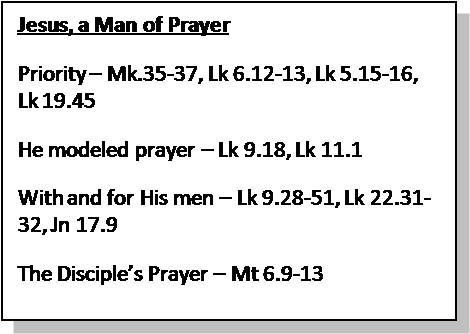
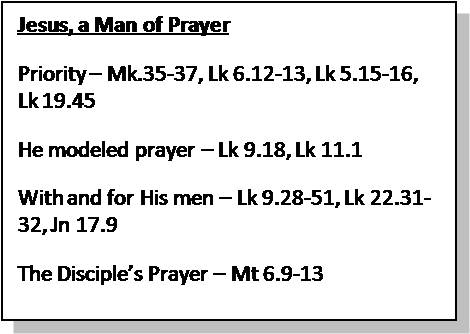
Jesus, a Man of Prayer

This is a short devotional I use to emphasize following Jesus in prayer. As we teach the basic disciplines to young disciples (and old), it’s much more powerful to use Jesus as the example. A person who is convinced that Jesus knew how to relate to the Father will practice the same disciplines He modeled. Now prayer is a means to develop a relationship with God rather than a dry obligation to earn acceptance. If discipleship is becoming like Jesus then we need to pray like Jesus.

For questions or comments drop me a line at charleswood1@gmail.com or click the envelope below to send this post to a friend…

Risky Business

Read Mt 8.2-4, Mk 1.40-45, Lk 5.12-16

While He was in one of the cities, behold, there was a man covered with leprosy; and when he saw Jesus, he fell on his face and implored Him, saying, “Lord, if You are willing, You can make me clean.” And He stretched out His hand and touched him, saying, “I am willing; be cleansed.” And immediately the leprosy left him.
(Luke 5:12-13)

The Leper came to Jesus with an attitude of humility and faith, “if you as willing, You can make me clean.” Jesus response to him with confidence and compassion; touching the leper and saying “I am willing be cleansed.”

I am amazed at how an attitude of humility and faith will move the Son of God to respond confidently and compassionately every time. It’s almost as though these are the two irresistible traits Jesus is compelled to honor in any person. And when He does act in compassion, it seems so personal. He touched the Leper. You’re not supposed to do that. You can end up with the disease yourself. Meeting people’s needs is the risky business of the disciplemaking. What if all this guy wants is physical healing? Maybe he will become co-dependent. Perhaps he will drag me down with some hidden agenda. All these things and more can happen. But isn’t helping a person become whole in Jesus Christ worth the risk? And if we are doing ministry like Jesus we too should look for an attitude of humility and faith. These two character traits usually mitigate the risks associated with helping a people. Is there some risky person in your life who believes you can help them? Reach out and touch them.

Other questions for your meditation:

· How many people could Jesus help at one time? How many did He? Why?
· What limitations did Jesus have in helping people?
· Did Jesus ever force His help on others?
· Did Jesus challenge those who thought they didn’t need help?
· Was training the 12 Apostles a risky propitiation?

FJ55

For questions or comments drop me a line at charleswood1@gmail.com or click the envelope below to send this post to a friend…