The Main Thing is to keep the Main Thing the Main Thing

Read Mat 9.1-8, Mk 2.1-12, Lk 5.17-26

And Jesus seeing their faith *said to the paralytic, “Son, your sins are forgiven.”
(Mark 2:5)

The four men aggressively brought the paralyzed man to Jesus for a physical healing and Jesus forgives the man’s sins.

Can you imagine what a shocker this must have been?! The total bewilderment at Jesus’ words after this amazing act of boldness, audacity and faith (not to mention the destruction of private property by digging a hole in someone’s roof). Think of how awkward this moment in time must have been. The Pharisees are thrown immediately into a theological conundrum. I can imagine the disciples going into the usual “protective mode” by whispering to Jesus behind a cupped hand, “Uh…Jesus…the man’s paralyzed.” The crowd in the room, “What did he just say?” And then there’s the demolition squad and their immobile buddy looking at each other as if to say, “You’re kidding, right?” What an absolute lack of situational awareness…on every body’s part…except Jesus.

Jesus heals the man’s spiritual infirmity before He heals his physical brokenness. He very clearly spells out the priority. He came to heal man’s cancerous sin first and foremost. His primary objective was spiritual, then physical. How often do we miss this personally and as disciplemakers. God is frying bigger fish in our lives. He is trying to get to the core issues and most of the time the physical is simply a vehicle. We must learn to look behind the veil of the physical and ask, “What is the Holy Spirit really after in these circumstances?” If we want to be like Jesus, we need to think spiritually in the midst of a very material world.

How to think spiritual before physical
· What are the eternal implications vs the temporal
· No suffering catches God off guard
· Providing physical needs is a means to the spiritual needs
· Sin is not a trifle to Jesus, it’s fatal
· Forgiving others is priority over my comfort
· I spend time with the Father before I eat (Mt 4.4, Job 23.12)
FJ58

For questions or comments drop me a line at charleswood1@gmail.com or click the envelope below to send this post to a friend…

Team Discipleship

Read Mat 9.1-8, Mk 2.1-12, Lk 5.17-26

And they *came, bringing to Him a paralytic, carried by four men. Being unable to get to Him because of the crowd, they removed the roof above Him; and when they had dug an opening, they let down the pallet on which the paralytic was lying.
(Mark 2:3-4)

Four men are so committed to their paralyzed friend that they bring him to Jesus on a stretcher. They bypass the crowd by climbing on the roof and digging a hole to lower the man down in front of the Great Physician.

To what extremes would we go to help someone? These four men loved their buddy so much that they punched a huge hole in a person’s roof! And it was a team effort, not only in carrying their paralyzed friend to the Savior but in their faith that Jesus could heal him. Three key ingredients are seen in this instance that led to healing and salvation; faith, commitment, and team work. As disciplemakers, do we corporately believe that Jesus can change lives? Do our heads, hearts, and hands work together with confidence in the Messiah’s ability to heal people? Are we mutually committed to people and the process beyond expedience and comfort? Do we press through the many obstacles that litter the battle field of following Jesus for another person’s sake? Are we part of a disciplemaking team that is dedicated to restoring someone to spiritual health? Do we leverage the synergy of TEAM for the sake of an individual or are we a “lone ranger disciplemaker?”

Tips for developing a disciplemaking team;
· Avoid the “my man” syndrome
· Enlist others to pray for the man or woman you are discipling
· Enlist others to meet with the man or woman you are helping
· Mix it up and occasionally meet two on one
· Practice the advantages of “a discipleship community”


One summer while Jamie Fisher was helping in our ministry, he noticed we did not have “exclusive rights” on the person we were discipling. Instead, he saw the power of several people meeting one on one with a single person. He coined a new phrase which we now use to describe our team approach to helping a person follow Jesus; “Discipleship by the Village.” FJ57

For questions or comments drop me a line at charleswood1@gmail.com or click the envelope below to send this post to a friend…

Staying in the Lines for Other’s Sake

Read Mt 8.2-4, Mk 1.40-45, Lk 5.12-16

And He stretched out His hand and touched him, saying, “I am willing; be cleansed.” And immediately the leprosy left him. And He ordered him to tell no one, “But go and show yourself to the priest and make an offering for your cleansing, just as Moses commanded, as a testimony to them.”
(Luke 5:13-14)

When Jesus heals the Leper He sends him to the priests. This is in keeping with the Mosaic Law (Lev 14.2-32). The priests were not so much physicians as they were to authenticate its existence or it’s healing. As the priest made his determination there were appropriate actions to be taken to insure this very contagious disease did not spread to the rest of the community and that there was the proper celebration for a real healing. Jesus commanded the man to subject himself to this part of the Law.

When Jesus healed the man’s leprosy, I’m sure He did not doubt the man was completely cured. So there was no need for this healing to be authenticated by a priest, unless Jesus was trying to send a message. I think Jesus was more concerned about communicating a greater truth rather than having a priest confirm His healing. Jesus stays within the Letter of the Law in order to help them see His identity. He uses these circumstances more as a “testimony” to them. It was meant to authenticate who Jesus was rather than a physical healing.

There are times when, for the sake of our testimony, we should “stay in the lines.” We may sacrifice our personal rights and freedoms by following rules we know are not required by the Father in order to gain a hearing. The Apostle Paul expresses the same principle when he talks about eating meat scarified to idols (1 Cor 10.23-31). Rules like not drinking, smoking, wearing certain clothing, etc… are all cultural regulations rather than spiritual principles. And although we have the freedom to disregard such rules, we may stay within the “lines” in order to express a testimony to those that follow them. As a disciplemaker, are you willing to forfeit your rights to spiritual freedom in order rescue others in spiritual bondage? Jesus did. FJ56

For questions or comments drop me a line at charleswood1@gmail.com or click the envelope below to send this post to a friend…

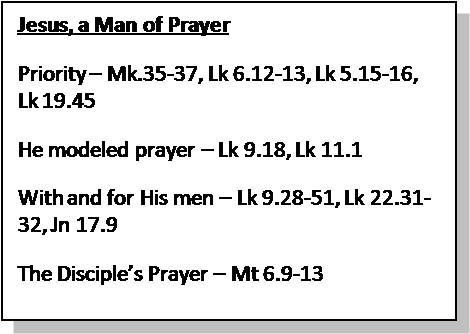
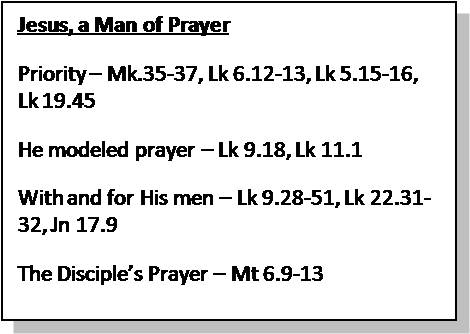
Jesus, a Man of Prayer

This is a short devotional I use to emphasize following Jesus in prayer. As we teach the basic disciplines to young disciples (and old), it’s much more powerful to use Jesus as the example. A person who is convinced that Jesus knew how to relate to the Father will practice the same disciplines He modeled. Now prayer is a means to develop a relationship with God rather than a dry obligation to earn acceptance. If discipleship is becoming like Jesus then we need to pray like Jesus.

For questions or comments drop me a line at charleswood1@gmail.com or click the envelope below to send this post to a friend…

Risky Business

Read Mt 8.2-4, Mk 1.40-45, Lk 5.12-16

While He was in one of the cities, behold, there was a man covered with leprosy; and when he saw Jesus, he fell on his face and implored Him, saying, “Lord, if You are willing, You can make me clean.” And He stretched out His hand and touched him, saying, “I am willing; be cleansed.” And immediately the leprosy left him.
(Luke 5:12-13)

The Leper came to Jesus with an attitude of humility and faith, “if you as willing, You can make me clean.” Jesus response to him with confidence and compassion; touching the leper and saying “I am willing be cleansed.”

I am amazed at how an attitude of humility and faith will move the Son of God to respond confidently and compassionately every time. It’s almost as though these are the two irresistible traits Jesus is compelled to honor in any person. And when He does act in compassion, it seems so personal. He touched the Leper. You’re not supposed to do that. You can end up with the disease yourself. Meeting people’s needs is the risky business of the disciplemaking. What if all this guy wants is physical healing? Maybe he will become co-dependent. Perhaps he will drag me down with some hidden agenda. All these things and more can happen. But isn’t helping a person become whole in Jesus Christ worth the risk? And if we are doing ministry like Jesus we too should look for an attitude of humility and faith. These two character traits usually mitigate the risks associated with helping a people. Is there some risky person in your life who believes you can help them? Reach out and touch them.

Other questions for your meditation:

· How many people could Jesus help at one time? How many did He? Why?
· What limitations did Jesus have in helping people?
· Did Jesus ever force His help on others?
· Did Jesus challenge those who thought they didn’t need help?
· Was training the 12 Apostles a risky propitiation?

FJ55

For questions or comments drop me a line at charleswood1@gmail.com or click the envelope below to send this post to a friend…

Quiet Time Illustration

As I help men and women start their devotional life I use the first three verses in the illustration as the motivation for having a Quiet Time. I emphases that the main goal is to know and become like Jesus in a personal relationship.

Secondly, I explain the mechanics of a QT as a Prayer Sandwich; Pray, Read, Pray. Initially, pray that God would give understanding and open my spiritual eyes and ears. Then I read in the scriptures looking for what the Father may speak to me personally. And then lastly, pray about what God has just showed me in the scriptures and for other concerns.

I generally do not tell them how to have a QT but show them. I actually pray, read the first chapter of Mark, have them put their finger on something that jumped out of the Word at them. Then we pray about that one thing got from the scriptures and a few family members and friends. It’s takes between 8 to 10 minutes.

I have found this to be the number one spiritual discipline in every godly man or woman’s life. It has certainly been the chief method for my personal transformation into Christ-likeness.

For questions or comments drop me a line at charleswood1@gmail.com or click the envelope below to send this post to a friend…

Don’t be a Ministry Hog

Read Lk 5.1-11

And He got into one of the boats, which was Simon’s, and asked him to put out a little way from the land. And He sat down and began teaching the people from the boat.
(Luke 5:3)

To avoid being pressed by the crowd, Jesus asks Peter if He could borrow His boat. Peter complies by assisting the Master. Jesus can now teach the crowds at a comfortable distance and Peter was able to participate in His ministry.

It can go unnoticed with a cursory reading but my friend Jim Cameron picked this up in a Quiet Time recently. It’s a Discipler’s simple act of great significance, ask for help. Jesus asked to use Peter’s boat. He provided Peter with an opportunity to participate in a very important event, the Rabbi’s teaching. This may seem trivial to the untrained eye but it has huge ramifications in relationship and ministry. I think most people want to be helpful, Christian or non. Asking for assistance can actually lead to a deeper level of relationship and trust. Peter didn’t seem to hesitate with the Rabbi’s request to use his boat. In fact, this was Peter’s first opportunity to demonstrate his allegiance to the Messiah. Often times we think, as Disciplemakers, we should be doing all the work and never asking for assistance. This would be a big mistake. Not even the Messiah had the “Messiah Complex.” If we don’t ask for help, we rob people of their chance to serve and more importantly miss a key opportunity to integrate them into ministry. This is also a way to prevent the “Hired Gun” syndrome where the clergy do all the ministry because they have been to cemetery…ah, I mean seminary. You’ve probably seen guys in sports who always want the ball. We call them “ball hogs.” If we aren’t careful we could do the same thing in ministry.
Tips for integrating people into ministry;
· When asked if they can help, say yes
· Start with small requests
· Delegate components of ministry
· Don’t do anything by yourself
· Affirm others as you speak and teach
· Get out of the way, let someone else do something
· Give feed back
· Always thank the person (publically, if you can)

Can you think of other ways to integrate people into ministry? Email me with your ideas. FJ54

For questions or comments drop me a line at charleswood1@gmail.com or click the envelope below to send this post to a friend…

Avoiding the Extremes

Read Mt 4.23-24, Mk 1.35-39, Lk 4.42-44

Jesus was going throughout all Galilee, teaching in their synagogues and proclaiming the gospel of the kingdom, and healing every kind of disease and every kind of sickness among the people. The news about Him spread throughout all Syria; and they brought to Him all who were ill, those suffering with various diseases and pains, demoniacs, epileptics, paralytics; and He healed them.
(Matthew 4:23-24)

The main of objective of Jesus’ job description was to proclaim the Gospel of the Kingdom of God. His method was healing and exercising people as He went. It was not His preaching that attracted most people, it was the secondary purpose of helping people that brought them out. He did not hesitate in healing their physical infirmities but He was mostly concerned for their spiritual brokenness. So the Kingdom message was always coupled with His service. Mark and Luke pick up on the Kingdom focus in their respective accounts.

Satan is the great mover of the pendulum to its extremes. I’ve seen people cross the oceans to help needy people who are unwilling to serve in their community. I’ve seen “Christian” deeds being done where not one spiritual word is said, not even the name of Jesus for fear that it will offend. I’ve witnessed the “be warm, be filled” that James talks about (Jam 2.16), and people with legitimate needs are turned away. I’ve watched the gospel be used as a weapon to repel the undesirable. How have I been so close to such spiritual atrocities? I am the one who committed them! Satan has a way of taking good and turning it into bad and I am often his vehicle. Watching Jesus share the Kingdom of God with others while serving them is the antidote to the extremes. Following His example keeps me from neglecting a person’s real needs while being able to address the main need, knowing Christ.

Tips for a balanced approach to sharing the Gospel

· Be an aggressive servant
· Keep your eyes open to people in need
· Don’t cross the ocean until you cross the street
· Have both first aid kits ready (Physical and Spiritual)
· Do not dress people in tuxedos to send them to Hell
· Give the reason for your kindness, Jesus
· Use the Word of God to salt your conversation
· Save some for tomorrow
· Use heart, brain, feet, hands, and mouth for the Kingdom

“The lifestyle without the Word is a mystery; the Word without the lifestyle is hypocrisy.” Chuck Swindoll
FJ53

For questions or comments drop me a line at charleswood1@gmail.com or click the envelope below to send this post to a friend…