
The Hunt is On – #24

ENGLISH / ESPAÑOL

Welcome Back! Today, we’ll be looking at the gospels of John and discovering the power of relational networks.

So let’s dive in.

(Click here to get a copy of the Gospel Sync document) 

John 1:35–51

The next day John was there again with two of his disciples. When he saw Jesus walking by, he said, “Look, the Lamb of God!” And when the two disciples heard him say this, they followed Jesus. Jesus turned and saw them following and He asked, “What do you want?” They said to Him, “Rabbi” (which means Teacher), “where are You staying?” He said to them, “Come and see.” So they went and saw where He was staying, and spent that day with Him because it was about the tenth hour. One of the two who heard John speak and followed Him, was Andrew, Simon Peter’s brother. He first found his brother Simon and told him, “We have found the Messiah” (which is translated as Christ). Andrew brought him to Jesus, who looked at him and said, “You are Simon son of John. You will be called Cephas” (which is translated as Peter).

The next day Jesus decided to set out for Galilee. Finding Philip, He told him, “Follow Me.” Now Philip was from Bethsaida, the same town as Andrew and Peter. Philip found Nathanael and told him, “We have found the One Moses wrote about in the Law, the One the prophets foretold—Jesus of Nazareth, the son of Joseph.” Nathanael said to him, “Can any good thing come out of Nazareth?” Philip said to him, “Come and see.” When Jesus saw Nathanael approaching, He said of him, “Here is a true Israelite, in whom there is no deceit.” “How do You know me?” Nathanael asked. Jesus replied, “Before Philip called you, I saw you under the fig tree.” “Rabbi,” Nathanael answered, “You are the Son of God! You are the King of Israel!” Jesus said to him, “Do you believe just because I told you I saw you under the fig tree? You will see greater things than these.” Then He declared, “Truly, truly, I tell you, you will all see heaven open and the angels of God ascending and descending on the Son of Man.”

Some Thoughts 

There are several discipleship principles that we can glean from this passage, but I want to focus on just two. Both of them have to do with finding potential mentees.
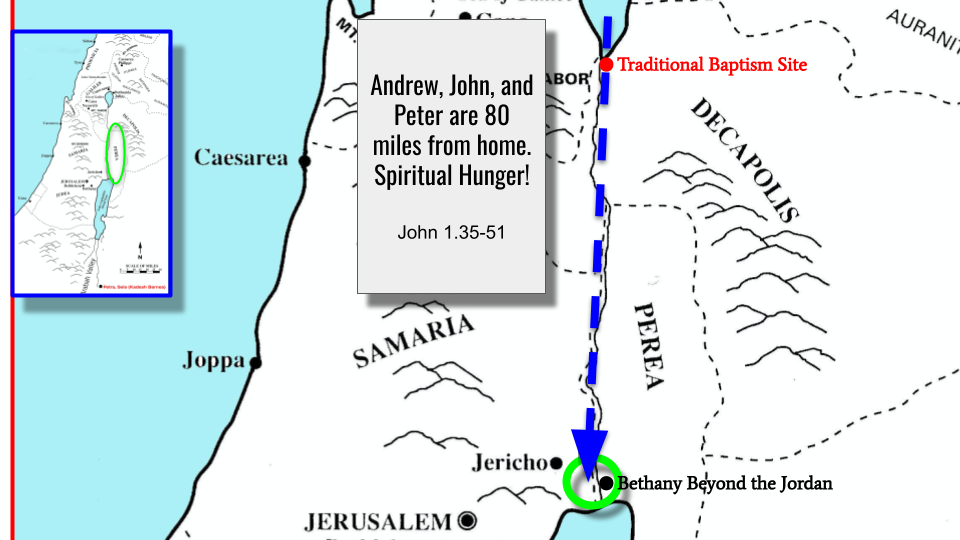
First, when you’re looking for people to disciple, you want to look for those who are spiritually hungry. John the Baptist and his disciples are hanging out at Bethany beyond the Jordan. The location is super significant because it’s 75-80 miles away from the fishermen’s hometown (not the traditional site just south of the Sea of Galilee; click here for a documentary). Now we have to ask the question: “What in the world are these guys doing this far from family, work, and home?” These disciples had a long way to travel to be baptized and discipled by John the Baptist. This shows a significant commitment from these blue-collar kind of guys to pursue God.

As disciple-makers, we should be looking for people who are spiritually hungry and willing to go the extra mile to follow Jesus. I call them the “Cats on the Screen Door.” They’re always hanging around waiting to be fed.

The second thought has to do with the relational networks of those who are spiritually hungry. Birds of a feather flock together. The spiritually hungry tend to hang out with each other. Are you looking for more spiritually hungry people to disciple? Tap into their relational network. Usually, when you find one, you’ll find more.

Looking at John 1:35-51 again, we see that these people were not strangers to each other. John the Baptist was Jesus’ cousin, Andrew was the brother of Peter, and the unnamed disciple was the Apostle John (we discover John’s identity later in the gospel and was the brother of James, who would also join the apostolic band). Jesus went to get Philip. Philip lived in the same town as Peter and Andrew and was a friend of Nathanael. These relationships were key connections for Jesus’ first followers.

As disciple-makers, we should be looking for those who are connected as family, friends, and acquaintances. This is how the gospel flows freely. It’s through natural relational networks.

My Story

A few years back, Kim moved into our home, and we started discipling her. As she reached out to others, she met with an old missionary friend from Egypt who introduced her to Merari. Kim started discipling Merari, who, in turn, started discipling her sister Belle. A couple of years later, Kim went back to Egypt, and Deb and I met with Merari for coffee. She wanted additional mentoring, so we started meeting with her and invited her and Belle to our new church start in our home. Kim was still meeting with Merari on Zoom once a week. A year and a half later, both Merari and Belle are consistently sharing the gospel and discipling a few folks in a coffee shop weekly. They would tell you that the discipleship they’ve received from Kim, Deb, and I in the past few years is radically transforming them into the likeness of Christ Jesus. Can you see how we found such committed disciples of Jesus? The power of looking for the spiritually hungry and tapping into their relational networks!

Our Action Plan

Here are some ideas to apply these discipleship principles:

  • Draw out a relational network map and ask, “Who’s the most spiritually hungry?”
  • Ask the people you’re discipling, “Who are you praying for, and who can you begin discipling?”
  • Answer the question, “What does spiritual hunger look like in my relational network?”

So we see two valuable insights: Look for the spiritually hungry, and in order to find more spiritually hungry people, tap into their relational network. It’s hard finding people to disciple, especially in the early stages of the ministry. But these two principles will definitely help you get some traction.

Until next time, keep making disciples of Jesus!

La Búsqueda en Marcha – #24

¡Bienvenido! Hoy, veremos los evangelios de Juan y descubriremos el poder de las redes relacionales.

Así que iniciemos.

Juan 1:35–51

El siguiente día otra vez estaba Juan, y dos de sus discípulos.  Y mirando a Jesús que andaba por allí, dijo: He aquí el Cordero de Dios.  Le oyeron hablar los dos discípulos, y siguieron a Jesús.  Y volviéndose Jesús, y viendo que le seguían, les dijo: ¿Qué buscáis? Ellos le dijeron: Rabí (que traducido es, Maestro), ¿dónde moras?  Les dijo: Venid y ved. Fueron, y vieron donde moraba, y se quedaron con él aquel día; porque era como la hora décima. Andrés, hermano de Simón Pedro, era uno de los dos que habían oído a Juan, y habían seguido a Jesús.  Este halló primero a su hermano Simón, y le dijo: Hemos hallado al Mesías (que traducido es, el Cristo). Y le trajo a Jesús. Y mirándole Jesús, dijo: Tú eres Simón, hijo de Jonás; tú serás llamado Cefas (que quiere decir, Pedro). Jesús llama a Felipe y a Natanael.

El siguiente día quiso Jesús ir a Galilea, y halló a Felipe, y le dijo: Sígueme.  Y Felipe era de Betsaida, la ciudad de Andrés y Pedro.  Felipe halló a Natanael, y le dijo: Hemos hallado a aquel de quien escribió Moisés en la ley, así como los profetas: a Jesús, el hijo de José, de Nazaret.  Natanael le dijo: ¿De Nazaret puede salir algo de bueno? Le dijo Felipe: Ven y ve.  Cuando Jesús vio a Natanael que se le acercaba, dijo de él: He aquí un verdadero israelita, en quien no hay engaño.  Le dijo Natanael: ¿De dónde me conoces? Respondió Jesús y le dijo: Antes que Felipe te llamara, cuando estabas debajo de la higuera, te vi. Respondió Natanael y le dijo: Rabí, tú eres el Hijo de Dios; tú eres el Rey de Israel. Respondió Jesús y le dijo: ¿Porque te dije: Te vi debajo de la higuera, crees? Cosas mayores que estas verás.  Y le dijo: De cierto, de cierto os digo: De aquí en adelante veréis el cielo abierto, y a los ángeles de Dios que suben y descienden sobre el Hijo del Hombre.

Algunas Reflexiones

Hay varios principios de discipulado que podemos extraer de este pasaje, pero quiero centrarme solo en dos. Ambos tienen que ver con la búsqueda de posibles discípulos.

Primero, cuando estás buscando personas para discipular, quieres buscar a aquellos que están espiritualmente hambrientos. Juan el Bautista y sus discípulos están pasando el rato en Betania, al otro lado del Jordán. La ubicación es súper significativa porque está a 75-80 millas de distancia de la ciudad natal de los pescadores (no es el sitio tradicional justo al sur del Mar de Galilea; haga clic aquí para ver un documental). Ahora tenemos que hacernos la pregunta: “¿Qué demonios están haciendo estos tipos tan lejos de la familia, el trabajo y el hogar?” Estos discípulos tuvieron un largo camino que recorrer para ser bautizados y discipulados por Juan el Bautista. Esto muestra un compromiso significativo de estos hombres de clase obrera para buscar a Dios.

Como hacedores de discípulos, debemos buscar personas que estén espiritualmente hambrientas y dispuestas a hacer un esfuerzo adicional para seguir a Jesús. Yo los llamo los “Gatos en . Siempre están dando vueltas, esperando ser alimentados.

El segundo pensamiento tiene que ver con las redes relacionales de aquellos que están espiritualmente hambrientos. Los pájaros de un mismo plumaje se juntan en bandadas. Los espiritualmente hambrientos tienden a pasar el rato unos con otros. ¿Estás buscando más personas espiritualmente hambrientas para discipular? Aprovecha su red relacional. Por lo general, cuando encuentras uno, encontrarás más.

Mirando de nuevo Juan 1:35-51, vemos que estas personas no eran extrañas entre sí. Juan el Bautista era primo de Jesús, Andrés era el hermano de Pedro, y el discípulo anónimo era el apóstol Juan (descubrimos la identidad de Juan más tarde en el evangelio y era el hermano de Santiago, quien también se uniría al grupo apostólico). Jesús fue a buscar a Felipe. Felipe vivía en la misma ciudad que Pedro y Andrés y era amigo de Natanael. Estas relaciones fueron conexiones clave para los primeros seguidores de Jesús.

Como hacedores de discípulos, debemos buscar a aquellos que están conectados como familiares, amigos y conocidos. Así es como el evangelio fluye libremente. Es a través de redes relacionales naturales.

Mi Historia

Hace unos años, Kim se mudó a nuestra casa y comenzamos a discipularla. Al tender la mano a otras personas, se encontró con un viejo amigo misionero de Egipto que le presentó a Merari. Kim comenzó a discipular a Merari, quien, a su vez, comenzó a discipular a su hermana Belle. Un par de años después, Kim regresó a Egipto, y Deb y yo nos reunimos con Merari para tomar un café. Ella quería mentoría adicional, así que comenzamos a reunirnos con ella y la invitamos a ella y a Belle a nuestra nueva iglesia en nuestra casa. Kim seguía reuniéndose con Merari en Zoom una vez a la semana. Un año y medio después, tanto Merari como Belle comparten constantemente el evangelio y discipulan semanalmente a algunas personas en una cafetería. Te dirían que el discipulado que han recibido de Kim, Deb y yo en los últimos años los está transformando radicalmente a la semejanza de Cristo Jesús. ¿Puedes ver cómo encontramos discípulos de Jesús tan comprometidos? ¡El poder de buscar a los espiritualmente hambrientos y aprovechar sus redes relacionales!

Nuestro Plan de Acción

He aquí algunas ideas para aplicar estos principios de discipulado                                                                                 ·   Dibuje un mapa de la red relacional y pregunte: “¿Quién tiene más hambre espiritual?” 

·   Pregúntale a las personas a las que estás discipulando: “¿Por quién estás orando y a quién puedes comenzar a discipular?”

·   Responde a la pregunta: “¿Cómo se ve el hambre espiritual en mi red relacional?”

Así que vemos dos ideas valiosas: buscar a los espiritualmente hambrientos, y para encontrar más personas espiritualmente hambrientas, aprovechar su red relacional. Es difícil encontrar personas para discipular, especialmente en las primeras etapas del ministerio. Pero estos dos principios definitivamente te ayudarán a obtener algo de tracción.

¡Hasta la próxima, sigan haciendo discípulos de Jesús!

A Lamb for the Lost – #23

ENGLISH / ESPAÑOL

Rather Listen? Click here…

Welcome Back! Today, we’ll be looking at the gospels of John and illuminating more of Jesus’ identity and purpose.

So let’s dive in.

(Click here to get a copy of the Gospel Sync document) 

John 1:19–34

This is the testimony of John, when the Jews sent to him priests and Levites from Jerusalem to ask him, “Who are you?” And he confessed and did not deny, but openly declared, “I am not the Christ.” “Then who are you?” they asked. “Are you Elijah?” He said, “I am not.” “Are you the Prophet?” He answered, “No.” So they said to him, “Who are you? We need an answer for those who sent us. What do you say about yourself?” John replied in the words of Isaiah the prophet:

“I am a voice of one calling in the wilderness, ‘Make straight the way for the Lord.’”

Now they had been sent from the Pharisees and they asked him, “Why then do you baptize, if you are not the Christ, nor Elijah, nor the Prophet?” John answered, “I baptize with water, but among you stands One you do not know. He is the One who comes after me, the straps of whose sandals I am not worthy to untie.”

All this happened at Bethany beyond the Jordan, where John was baptizing. The next day John saw Jesus coming toward him and said, “Look, the Lamb of God, who takes away the sin of the world! This is He of whom I said, “A man who comes after me who has a higher rank than me because He existed before me. I did not recognize Him, but the reason I came baptizing with water was that He might be revealed to Israel.” Then John testified, “I saw the Spirit descending from heaven like a dove and resting on Him. I did not recognize Him, but the One who sent me to baptize with water told me, ‘The man on whom you see the Spirit descend and rest is He who will baptize with the Holy Spirit.’ I have seen and testified that this is the Son of God.”

Some Thoughts 

In John 1:29, John the Baptist proclaims, “Look, the Lamb of God, who takes away the sin of the world!” This statement is a powerful affirmation of Jesus’ identity and purpose, as the long-awaited Messiah. John understood that Jesus was the fulfillment of Old Testament prophecies and symbols, particularly those related to the sacrificial lamb. A Lamb for the lost.

Throughout the Old Testament, the sacrificial lamb is a recurring symbol of atonement for sin. In Genesis, we see God killing animals and making coverings for Adam and Eve’s nakedness, foreshadowing the need for a sacrifice to cover their sin. Later, in Exodus, the Israelites were instructed to sacrifice a lamb and spread its blood on the doorposts of their homes, so that the angel of death would pass over them. This sacrifice was a symbol of their faith in God’s provision for their salvation.

In Isaiah 53, the prophet speaks of a suffering servant who would bear the sins of the people, likening him to a lamb that was led to the slaughter. This passage is a direct prophecy of Jesus’ sacrificial death on the cross, where he bore the sins of all humanity.

John recognized Jesus and His sacrificial death as the only way to salvation. But how does this relate to us as disciple makers?

As disciple makers, it’s essential that we understand the significance of this truth and how it relates to our work. First and foremost, we must remind ourselves and those we disciple that salvation is achieved by Jesus on the cross, not through our good works. He is the Lamb Who takes away the sins of the world. While obedience to God’s commands is essential for a Christian’s growth and maturity, it is not what saves us. We cannot earn our way into heaven through our actions; salvation is a free gift from God.

It’s easy to fall into the trap of “works-based salvation” when teaching obedience to God’s commands. We may inadvertently give the impression that our actions are what make us worthy of God’s love and grace. However, this is not the case. Our obedience to God’s commands should stem from gratitude for our salvation and love for Him.

As disciple makers, we must be careful not to lead our followers to jump through hoops to get into heaven. We should teach them to obey God’s commands because they love Him, not to earn His favor. This can be a delicate balance, but it’s crucial to get it right.

 My Story

Last Saturday in our Online Zoom Church (can you do church online?) we had a beautiful picture of disciples living in both grace and discipline. We laughed, listened, and cried together. It was rich! What made it so good, you ask? Well, we started by checking in and seeing how everyone was doing for about the first 30 minutes. Then we answered the question: “What are you getting out of the Word and how are you applying it?” For the next 40 minutes people shared what they were hearing from God through their personal reading, study, and memorization. I need to point out that everyone is knee deep in the Bible and developed this act of obedience over the years. They are convinced that this daily habit is essential to their growth in Christ. Our time ended with proclamations and prayers of us thanking the Father for Jesus’ death, burial, and resurrection and that without that, we would all be lost. Do you see the subtle but vital reality the church is walking in? We clearly see the grace of God as our only hope to a right relationship with Him but our time in the Word of God being a crucial discipline to know and love Him better. No one was thinking, “I read my Bible so God loves me more. I practiced this important spiritual discipline and now Jesus will let me into heaven.” No, they are in full realization of what the Apostle Paul wrote the Colossian church: 

Because of the hope laid up for you in heaven, of which you previously heard in the word of truth, the gospel which has come to you, just as in all the world also it is constantly bearing fruit and increasing, even as it has been doing in you also since the day you heard it and truly understood the grace of God (Colossians 1.5-6) 

Our Action Plan

So what are some ideas on how to apply the truth of the gospel? Salvation comes from Christ’s work on the cross. It is by grace alone. Here’s some suggestions;

  • Do an in depth Bible study on the “gospel” with those you are discipling.
  • Listen carefully to yourself and those you mentor. Are we thoroughly convinced that we can do nothing to merit salvation.
  • Spend an extended time praising God for the work He did to save you and reflect on His love, mercy, and grace.

As disciple makers it can be easy to jump the tracks and start putting our hope in what we do versus what He did. Let’s keep reminding ourselves and others that Jesus is the Lamb Who takes away sins not our good deeds or spiritual disciplines.

Until next time, keep making disciples of Jesus!

Un cordero para los que están perdidos – 23 

¡Bienvenido! Hoy, veremos los evangelios de Juan y profundizaremos más sobre la identidad y el propósito de Jesús.

Así que iniciemos.

Juan 1:19–34

Este es el testimonio de Juan, cuando los judíos enviaron de Jerusalén sacerdotes y levitas para que le preguntasen: ¿Tú, quién eres?  Confesó, y no negó, sino confesó: Yo no soy el Cristo. Y le preguntaron: ¿Qué pues? ¿Eres tú Elías? Dijo: No soy. ¿Eres tú el profeta? Y respondió: No.  Le dijeron: ¿Pues quién eres? para que demos respuesta a los que nos enviaron. ¿Qué dices de ti mismo?  

Dijo: Yo soy la voz de uno que clama en el desierto: Enderezad el camino del Señor, como dijo el profeta Isaías. 

Y los que habían sido enviados eran de los fariseos. Y le preguntaron, y le dijeron: ¿Por qué, pues, bautizas, si tú no eres el Cristo, ni Elías, ni el profeta Juan les respondió diciendo: Yo bautizo con agua; mas en medio de vosotros está uno a quien vosotros no conocéis. Este es el que viene después de mí, el que es antes de mí, del cual yo no soy digno de desatar la correa del calzado. Estas cosas sucedieron en Betábara, al otro lado del Jordán, donde Juan estaba bautizando.

El siguiente día vio Juan a Jesús que venía a él, y dijo: He aquí el Cordero de Dios, que quita el pecado del mundo.  Este es aquel de quien yo dije: Después de mí viene un varón, el cual es antes de mí; porque era primero que yo. Y yo no le conocía; mas para que fuese manifestado a Israel, por esto vine yo bautizando con agua. También dio Juan testimonio, diciendo: Vi al Espíritu que descendía del cielo como paloma, y permaneció sobre él.  Y yo no le conocía; pero el que me envió a bautizar con agua, aquel me dijo: Sobre quien veas descender el Espíritu y que permanece sobre él, ese es el que bautiza con el Espíritu Santo.  Y yo le vi, y he dado testimonio de que este es el Hijo de Dios.

Mis Pensamientos

En Juan 1:29, Juan el Bautista proclama: “¡He aquí el Cordero de Dios, que quita el pecado del mundo!” Esta declaración es una poderosa afirmación de la identidad y el propósito de Jesús, como el Mesías tan esperado. Juan entendió que Jesús era el cumplimiento de las profecías y símbolos del Antiguo Testamento, particularmente aquellos relacionados con el cordero sacrificial. Un Cordero para los que están perdidos.

A lo largo del Antiguo Testamento, el cordero sacrificial es un símbolo recurrente de expiación por el pecado. En Génesis, vemos a Dios matando animales y cubriendo la desnudez de Adán y Eva, presagiando la necesidad de un sacrificio para cubrir su pecado. Más tarde, en Éxodo, se instruyó a los israelitas que sacrificaran un cordero y esparcieran su sangre en los postes de las puertas de sus casas, para que el ángel de la muerte pasara por encima de ellos. Este sacrificio era un símbolo de su fe en la provisión de Dios para su salvación.

En Isaías 53, el profeta habla de un siervo sufriente que cargaría los pecados del pueblo, comparándolo con un cordero que fue llevado al matadero. Este pasaje es una profecía directa de la muerte sacrificial de Jesús en la cruz, donde cargó los pecados de toda la humanidad.

Juan reconoció a Jesús y su muerte sacrificial como el único camino a la salvación. Pero, ¿cómo se relaciona esto con nosotros como hacedores de discípulos?

Como hacedores de discípulos, es esencial que entendamos el significado de esta verdad y cómo se relaciona con nuestro ministerio. En primer lugar, debemos recordarnos a nosotros mismos y a aquellos a quienes discipulamos que la salvación es lograda por Jesús en la cruz, no a través de nuestras buenas obras. Él es el Cordero que quita los pecados del mundo. Aunque la obediencia a los mandamientos de Dios es esencial para el crecimiento y la madurez de un cristiano, no es lo que nos salva. No podemos ganarnos nuestro camino al cielo a través de nuestras acciones; la salvación es un regalo gratuito de Dios.

Es fácil caer en la trampa de la “salvación basada en obras” cuando se enseña obediencia a los mandamientos de Dios. Sin darnos cuenta, podemos dar la impresión de que nuestras acciones son las que nos hacen dignos del amor y la gracia de Dios. Sin embargo, este no es el caso. Nuestra obediencia a los mandamientos de Dios debe provenir de la gratitud por nuestra salvación y del amor por Él.

Como hacedores de discípulos, debemos tener cuidado de no llevar a nuestros seguidores a pasar por aros para entrar en el cielo. Debemos enseñarles a obedecer los mandamientos de Dios porque lo aman, no para ganarse Su favor. Este puede ser un equilibrio delicado, pero es crucial hacerlo bien.

 Mi historia

El sábado pasado en nuestra iglesia en línea por Zoom (¿puedes hacer iglesia en línea?) tuvimos una hermosa imagen de discípulos viviendo tanto en gracia como en disciplina. Reímos, escuchamos y lloramos juntos. ¡Era hermoso! ¿Qué lo hizo tan bueno? Bueno, empezamos por comprobar cómo estaba todo el mundo durante los primeros 30 minutos. Luego respondimos a la pregunta: “¿Qué estás obteniendo de la Palabra y cómo la estás aplicando?” Durante los siguientes 40 minutos, las personas compartieron lo que estaban escuchando de Dios a través de su lectura personal, estudio y memorización. Debo señalar que todos están metidos hasta las rodillas en la Biblia y desarrollaron este acto de obediencia a lo largo de los años. Están convencidos de que este hábito diario es esencial para su crecimiento en Cristo. Nuestro tiempo terminó con proclamación y oraciones de agradecimiento al Padre por la muerte, sepultura y resurrección de Jesús y que sin eso, todos estaríamos perdidos. ¿Ves la realidad sutil pero vital en la que camina la iglesia? Vemos claramente la gracia de Dios como nuestra única esperanza para una relación correcta con Él, pero nuestro tiempo en la Palabra de Dios es una disciplina crucial para conocerlo y amarlo mejor. Nadie estaba pensando: “Leo mi Biblia para que Dios me ame más. Practicé esta importante disciplina espiritual y ahora Jesús me dejará entrar en el cielo”. No, las Escrituras están en plena realización de lo que el apóstol Pablo escribió a la iglesia colosense:

A causa de la esperanza que os está guardada en los cielos, de la cual ya habéis oído por la palabra verdadera del evangelio, que ha llegado hasta vosotros, así como a todo el mundo, y lleva fruto y crece también en vosotros, desde el día que oísteis y conocisteis la gracia de Dios en verdad,… (Colosenses 1:5-6) 

Nuestro Plan de Acción

Entonces, ¿cuáles son algunas ideas sobre cómo aplicar la verdad del Evangelio? La salvación viene de la obra de Cristo en la cruz. Es solo por gracia. Aquí hay algunas sugerencias;

–          Haz un estudio bíblico profundo sobre el “evangelio” con aquellos a quienes estás discipulando.

–          Escúchate a ti mismo y a aquellos a quienes asesoras. ¿Estamos completamente convencidos de que no podemos hacer nada para merecer la salvación?

–          Dedica un tiempo prolongado a alabar a Dios por la obra que hizo para salvarte y reflexiona sobre Su amor, misericordia y gracia.

Como hacedores de discípulos, puede ser fácil saltar las vías y comenzar a poner nuestra esperanza en lo que hacemos en comparación con lo que Él hizo. Sigamos recordándonos a nosotros mismos y a los demás que Jesús es el Cordero quien quita los pecados, no así nuestras buenas obras ni nuestras disciplinas espirituales.

¡Hasta la próxima, sigan haciendo discípulos de Jesús!

Saturated – #22

ENGLISH / ESPAÑOL

Rather Listen? Click here…

Welcome Back! Today, we will sync the gospels of Matthew, Mark, and Luke to examine how Jesus used the Word of God to resist temptation.

So let’s dive in.

(Click here to get a copy of the Gospel Sync document) 

Matthew 4:1–11, Mark 1:12–13, Luke 4:1–13

Then Jesus, full of the Holy Spirit, returned from the Jordan and was impelled by the Spirit to go into the wilderness to be tempted by Satan, the devil. After fasting forty days and forty nights, He was hungry. The tempter (the devil) came to Him and said, “If You are the Son of God, tell these stones to become bread.” But Jesus answered, “It is written: ‘Man shall not live on bread alone, but on every word that comes from the mouth of God.’”

Then the devil took Him to Jerusalem, the holy city and set Him on the pinnacle of the temple. “If You are the Son of God,” he said, “throw Yourself down. For it is written: ‘He will command His angels concerning You to guard You carefully; and they will lift You up in their hands, so that You will not strike Your foot against a stone.’” Jesus replied, “It is also written: ‘Do not put the Lord your God to the test.’”

Again, the devil took Him to a very high mountain, a high place and showed Him in an instant all the kingdoms of the world and their glory. He said, I will give You authority over all these kingdoms and all their glory,” “For it has been relinquished to me, and I can give it to anyone I wish. So if You fall down and worship me, it will all be Yours.” Jesus declared, “Away from Me, Satan! For it is written: ‘Worship the Lord your God and serve Him only.’”

When the devil had finished every temptation, he left Him until an opportune time. He was with the wild animals, and the angels came and ministered to Him.

My Thoughts 

“I always say, “If you poke Jesus, the Word of God will come out.” Well, it’s true! Look at the passage. Satan poked Him three times, and what came out? The Word of God. During the first temptation, Jesus could have said, “Nope, not done with my fast yet.” Instead, He quotes Scripture as His defense, and on top of that, He emphasizes how important the Bible should be to all of us.

‘Man shall not live on bread alone but on every word that comes from the mouth of God.’

Once again, Satan pokes Jesus with another temptation, and once again, the Word comes out. This time, though, Satan is trying to fight fire with fire and use Scripture to tempt Him. But Jesus has studied enough of the Holy Script to know not only its context but the proper application.

Jesus replied, “It is also written: ‘Do not put the Lord your God to the test.’”

One final time, Satan tries to move Jesus off-center by offering all the kingdoms of the world (of which He created, already owned, and had all authority), and Jesus quotes Scripture to combat him.

Jesus declared, “Away from Me, Satan! For it is written: ‘Worship the Lord your God and serve Him only.’

Three times Jesus parries Satan’s thrusts with “It is written.” Now Jesus didn’t have the convenience of an app on His smartphone. Nor did He carry the huge scrolls of the day into the desert with Him. But Jesus had an immediate response to each temptation because He had heard, read, and memorized the Scriptures. Then there’s the proper interpretation and application of the Word. In order for Jesus to pull that off, He must have logged some serious hours of study and meditation in the Bible. What I’m trying to point out here is that Jesus was saturated with the Word of God. That shouldn’t surprise us because Jesus obeyed every command, including this one:”

These words, which I am commanding you today, shall be on your heart. You shall teach them diligently to your sons and shall talk of them when you sit in your house and when you walk by the way and when you lie down and when you rise up. You shall bind them as a sign on your hand and they shall be as frontals on your forehead. You shall write them on the doorposts of your house and on your gates. (Deuteronomy 6.6-9)

That’s some pretty intense time in the Word! Why do you think God the Father would give such a command and God the Son would so clearly model obeying this command? I think that God was trying to protect us from the thousand voices in our ears on a daily basis. We have our normal relationships like family, friends, and associates but we also get a tidal wave of information from TV, the internet, Billboards, and the list goes on. And is the message consistent with God’s design and desires? NO WAY! And that is why God commanded and Jesus modeled a lifestyle of being saturated in the Word of God. We need the truth to serve as the breakers against the overwhelming tide of deception that inundates our world. 

As disciple-makers, this is one of our highest priorities: To be saturated in the Word of God ourselves and help others do the same. But how? Here’s a method I’ve been using for years. Start them reading one chapter in the Gospel of Mark daily. Why? First, they’ll be reading about Jesus, and second, it’s a quick win. Mark has only 16 chapters, and if they read one chapter a day, they will have read their first book in a little over a week. Focus on Jesus and a Quick Win. Then I have them start reading another Gospel, and if they have the stamina, I have them start reading another chapter in the book of Acts. Now they are reading two chapters a day. Once they get the hang of that, I have them read a chapter in the Old Testament, starting in Genesis. Now they are reading three chapters daily: One in the OT, the Gospels, and the NT. To put the icing on the cake, I have them start reading in Psalms. Now they’re up to four chapters, and they continue to cycle through the Bible this way, and they have begun the saturation process. See this video on the Cornerstone Method of reading the Bible for further information.  The Cornerstone

My Story

I’m so thankful that the men who discipled me saw the importance of being saturated with the Word of God. I started out slowly by reading a chapter in the Bible daily. I was listening to the Word preached on Sundays and attending a weekly Bible study. And I was doing my best to memorize Scripture (that was a hard discipline for years). I started the journey of being saturated and was thinking (meditating) about the Word several times a day.

The key to my saturation was consistency. I developed a daily rhythm of getting some of the Bible in my heart and mind. Then, as I grew stronger in the discipline, I began to increase the volume. Over the years, I noticed a very cool thing happening. Not only had my life radically transformed, but I was also able to “connect the dots” a lot easier on Biblical concepts. My ability to make disciples using the Word and counsel from a Biblical perspective increased tremendously. After 40 years of consistent saturation in the Scriptures, I can say without hesitation that it was a wise investment.

Our Action Plan

So let’s talk about some possible applications for us as disciple makers. Here are some ideas:

  • Think through what it would take to develop the conviction within the people you disciple to be saturated in the Scriptures daily, come rain or shine.
  • Help people get a handle on consistency and volume in the Word over time.
  • Consider how daily routines impact daily intake of the Scriptures.

As disciple makers, we have an exceptional privilege and responsibility to help others consume the Word in a way that is both informative and transformative. Until next time, keep making disciples of Jesus.

Saturado – 22

¡Bienvenido otra vez! Hoy, sincronizaremos los evangelios de Mateo, Marcos y Lucas para examinar cómo Jesús usó la Palabra de Dios para resistir la tentación.

Así que vamos a sumergirnos. Bienvenido

Mateo 4:1–11, Marcos 1:12–13, Lucas 4:1–13

Entonces Jesús fue llevado por el Espíritu al desierto, para ser tentado por el diablo. Y después de haber ayunado cuarenta días y cuarenta noches, tuvo hambre. Y vino a él el tentador, y le dijo: Si eres Hijo de Dios, di que estas piedras se conviertan en pan.  Él respondió y dijo: Escrito está: No solo de pan vivirá el hombre, sino de toda palabra que sale de la boca de Dios. Entonces el diablo le llevó a la santa ciudad, y le puso sobre el pináculo del templo,  y le dijo: Si eres Hijo de Dios, échate abajo; porque escrito está: A sus ángeles mandará acerca de ti, y, en sus manos te sostendrán, para que no tropieces con tu pie en piedra. Jesús le dijo: Escrito está también: No tentarás al Señor tu Dios. 

 Otra vez le llevó el diablo a un monte muy alto, y le mostró todos los reinos del mundo y la gloria de ellos,  y le dijo: Todo esto te daré, si postrado me adorares.  Entonces Jesús le dijo: Vete, Satanás, porque escrito está: Al Señor tu Dios adorarás, y a él sólo servirás. 

 El diablo entonces le dejó; y he aquí vinieron ángeles y le servían.

Mis pensamientos

“Siempre digo: “Si pullas a Jesús, la Palabra de Dios saldrá”. ¡Pues es verdad! Fíjate en el pasaje. Satanás lo pulló tres veces, ¿y qué salió? La Palabra de Dios. Durante la primera tentación, Jesús podría haber dicho: “No, aún no he terminado mi ayuno”. En cambio, Él cita las Escrituras como Su defensa, y además de eso, enfatiza cuán importante debería ser la Biblia para todos nosotros.

“No solo de pan vivirá el hombre, sino de toda palabra que salga de la boca de Dios”.

Una vez más, Satanás pulla a Jesús con otra tentación, y una vez más, la Palabra sale. Esta vez, sin embargo, Satanás está tratando de combatir el fuego con fuego y usar las Escrituras para tentarlo. Pero Jesús ha estudiado lo suficiente de la Santa Escritura para conocer no solo su contexto, sino también la aplicación adecuada.

Jesús le respondió: “También está escrito: “No pongas a prueba al Señor tu Dios”.

Una última vez, Satanás trata de descentrar a Jesús ofreciéndole todos los reinos del mundo (de los cuales Él creó, ya poseía y tenía toda la autoridad), y Jesús cita las Escrituras para combatirlo.

Jesús declaró: “¡Aléjate de mí, Satanás! Porque escrito está: ‘Adora al Señor tu Dios y sírvele solo a Él'”.

Tres veces Jesús detiene las embestidas de Satanás con “Escrito está”. Ahora Jesús no tenía la comodidad de una aplicación en su teléfono inteligente. Tampoco llevó consigo los enormes pergaminos disponibles en esos días al desierto. Pero Jesús tenía una respuesta inmediata a cada tentación porque había escuchado, leído y memorizado las Escrituras. Luego está la correcta interpretación y aplicación de la Palabra. Para que Jesús lograra eso, debe haber registrado algunas horas serias de estudio y meditación en la Biblia. Lo que estoy tratando de señalar aquí es que Jesús estaba saturado con la Palabra de Dios. Eso no debería sorprendernos porque Jesús obedeció todos los mandamientos, incluyendo este:”

Y estas palabras que yo te mando hoy, estarán sobre tu corazón;  y las repetirás a tus hijos, y hablarás de ellas estando en tu casa, y andando por el camino, y al acostarte, y cuando te levantes.  Y las atarás como una señal en tu mano, y estarán como frontales entre tus ojos;  y las escribirás en los postes de tu casa, y en tus puertas. (Deuteronomio 6.6-9)

¡Ese es un tiempo bastante intenso en la Palabra! ¿Por qué creen que Dios el Padre daría tal mandamiento y Dios el Hijo modelaría tan claramente la obediencia a este mandamiento? Creo que Dios estaba tratando de protegernos de las mil voces que suenan en nuestros oídos a diario. Tenemos nuestras relaciones normales como familiares, amigos y asociados, pero también recibimos una ola de información de la televisión, Internet, de carteleras, y la lista continúa. ¿Y es el mensaje coherente con el diseño y los deseos de Dios? ¡NO ES POSIBLE! Y es por eso que Dios mandó y Jesús modeló un estilo de vida de estar saturado en la Palabra de Dios. Necesitamos que la verdad sirva como rompedores contra la abrumadora marea de engaño que inunda nuestro mundo.

Como hacedores de discípulos, esta es una de nuestras más altas prioridades: estar saturados de la Palabra de Dios nosotros mismos y ayudar a otros a hacer lo mismo. ¿Pero cómo? Este es un método que he estado usando durante años. Comience a leer un capítulo del Evangelio de Marcos todos los días. ¿Por qué? Primero, leerán acerca de Jesús, y segundo, es una victoria rápida. Marcos tiene solo 16 capítulos, y si leen un capítulo al día, habrán leído su primer libro en poco más de una semana. Concéntrate en Jesús y en una victoria rápida. Luego les pido que comiencen a leer otro Evangelio, y si tienen la resistencia, les pido que comiencen a leer otro capítulo del libro de los Hechos. Ahora leen dos capítulos al día. Una vez que aprenden eso, les pido que lean un capítulo del Antiguo Testamento, comenzando en Génesis. Ahora leen tres capítulos diarios: uno en el Antiguo Testamento, los Evangelios y el Nuevo Testamento. Para poner el glaseado en el pastel, les pido que empiecen a leer los Salmos. Ahora tienen hasta cuatro capítulos, y continúan recorriendo la Biblia de esta manera, y han comenzado el proceso de saturación. Vea este video sobre el Método de la Piedra Angular para leer la Biblia para más información.  The Cornerstone.

Mi Historia

Estoy muy agradecido de que los hombres que me discipularon vieran la importancia de estar saturado de la Palabra de Dios. Empecé poco a poco leyendo un capítulo de la Biblia todos los días. Escuchaba la Palabra predicada los domingos y asistía a un estudio bíblico semanal. Y yo estaba haciendo lo mejor que podía para memorizar las Escrituras (esa fue una disciplina difícil durante años). Inicié mi proceso de saturación y estaba pensando (meditando) en la Palabra varias veces al día.

La clave de mi saturación fue la constancia. Desarrollé un ritmo diario de tener algo de la Biblia en mi corazón y en mi mente. Luego, a medida que me fui fortaleciendo en la disciplina, comencé a aumentar la cantidad. A lo largo de los años, me di cuenta de que sucedía algo muy interesante. No solo mi vida se había transformado radicalmente, sino que también pude “conectar los puntos” mucho más fácilmente con los conceptos bíblicos. Mi capacidad de hacer discípulos usando la Palabra y el consejo desde una perspectiva bíblica aumentó enormemente. Después de 40 años de constante saturación en las Escrituras, puedo decir sin dudarlo que fue una sabia inversión.

Nuestro Plan de Acción

Así que hablemos de algunas posibles aplicaciones para nosotros como hacedores de discípulos. Aquí tienes algunas ideas:

–          Piensa en lo que se necesitaría para desarrollar la convicción dentro de las personas a las que discipulas de estar saturadas de las Escrituras diariamente, llueva o truene.

–          Ayuda a las personas a comprender la consistencia y la cantidad de la Palabra a lo largo del tiempo.

–          Considera cómo las rutinas diarias influyen en el consumo diario de las Escrituras.

Como hacedores de discípulos, tenemos el privilegio y la responsabilidad excepcionales de ayudar a otros a consumir la Palabra de una manera que sea tanto informativa como transformadora. Hasta la próxima, sigan haciendo discípulos de Jesús.

The Big Three-O – #21

ENGLISH / ESPAÑOL

Welcome Back! Today, we’ll be looking at the Gospel of Luke and asking the question; “What is the significance of turning thirty.”

So let’s dive in.

(Click here to get a copy of the Gospel Sync document) 

The Gospel – Luke 3:23-38

Jesus was about thirty years old when He began His ministry. He was regarded as the son of Joseph, the son of Heli, the son of Matthat, the son of Levi, the son of Melchi, the son of Jannai, the son of Joseph, the son of Mattathias, the son of Amos, the son of Nahum, the son of Esli, the son of Naggai, the son of Maath, the son of Mattathias, the son of Semein, the son of Josech, the son of Joda, the son of Joanan, the son of Rhesa, the son of Zerubbabel, the son of Shealtiel, the son of Neri, the son of Melchi, the son of Addi, the son of Cosam, the son of Elmadam, the son of Er, the son of Joshua, the son of Eliezer, the son of Jorim, the son of Matthat, the son of Levi, the son of Simeon, the son of Judah, the son of Joseph, the son of Jonam, the son of Eliakim, the son of Melea, the son of Menna, the son of Mattatha, the son of Nathan, the son of David, the son of Jesse, the son of Obed, the son of Boaz, the son of Sala, the son of Nahshon, the son of Amminadab, the son of Admin, the son of Arni, the son of Hezron, the son of Perez, the son of Judah, the son of Jacob, the son of Isaac, the son of Abraham, the son of Terah, the son of Nahor, the son of Serug, the son of Reu, the son of Peleg, the son of Eber, the son of Shelah, the son of Cainan, the son of Arphaxad, the son of Shem, the son of Noah, the son of Lamech, the son of Methuselah, the son of Enoch, the son of Jared, the son of Mahalalel, the son of Cainan, the son of Enosh, the son of Seth, the son of Adam, the son of God.

Some Thoughts 

Full disclosure: I’ve rounded the corner of the “Big Three-O” twice now, so don’t feel the need to wish me a happy birthday. But it’s interesting that Jesus started His ministry at the age of 30. In the Old Testament, there are several references to people starting their ministries at the age of 30 as well. The Levites and priests were instructed by God to begin their service in the tabernacle at 30 (Numbers 4:3, 23). Joseph was thirty years old when he became the second-in-command to Pharaoh in Egypt (Genesis 41:46). Similarly, David was thirty years old when he began to reign as king over Israel (2 Samuel 5:4). Now at the beginning of the New Testament, Jesus begins his public ministry at the age of thirty (Luke 3:23).

Coincidence? I don’t think so. There are significant life events and transitions that happen at the age of thirty. Not for everyone, mind you, but I would say it’s normal to see major changes happening in people’s lives when they hit the “Big Three O.” We would consider an 18-year-old an adult but not a “mature adult” (with the exception of all 18-year-olds reading this right now. Of course, you’ve beaten the odds). By the time you’re 30, you probably have a steady job, gotten married, had some kids, and learned that the universe doesn’t revolve around you (well, most 30-year-olds). You’ve also made some great decisions and some not-so-good ones. You’ve had good leaders you’d like to emulate and some not so much. And maybe you’ve even been the kind of leader people like to emulate and not so much. You’ve lived a good bit of life and learned from many (and I mean many) successes and failures.

The significance of age in different areas of life, such as work, relationships, and personal development, has been a subject of study for sociologists. Through their research, they have observed that substantial changes tend to occur by the time an individual reaches the age of thirty, thanks to the maturity that comes with age. I’m not saying this is every 30 year old’s experience but these seem to be the general trends. People can develop at different rates and may experience significant life events at different ages.

Here’s some interesting facts about famous people when they turned thirty;

Ernest Hemingway: Hemingway published his first novel, “The Sun Also Rises,” which went on to become a classic of modern literature.

Neil Armstrong: Armstrong was selected to join the NASA Astronaut Corps, which eventually led to him becoming the first person to walk on the moon.

Serena Williams: Williams won her fourth Wimbledon singles title and became the oldest woman to win a Grand Slam singles title in more than 25 years.

Steve Jobs: Jobs co-founded Apple Inc. with Steve Wozniak and helped to revolutionize the computer industry.

Napoleon Bonaparte: Napoleon was appointed commander-in-chief of the French Army in Italy, where he won several key battles and established himself as a military genius.

Katherine Johnson: Johnson, who turned 30 in 1958, was an African-American mathematician who worked for NASA and played a critical role in the success of the first manned spaceflights.

Albert Einstein: Einstein published his theory of special relativity, which revolutionized our understanding of time, space, and the nature of the universe.

Martin Luther King Jr.: King became the leader of the Montgomery Bus Boycott, which was a pivotal moment in the civil rights movement and helped to bring attention to issues of racial injustice in America.

Rosalind Franklin: Franklin, who turned 30 in 1950, was a British biophysicist who played a critical role in the discovery of the structure of DNA.

Julius Caesar: Caesar was appointed governor of the province of Spain and began to establish himself as a powerful political figure in Rome.

Marie Curie: Curie completed her doctoral thesis on the properties of radioactive materials, which laid the foundation for her groundbreaking work in the field of radioactivity.

And how does turning 30 have anything to do with discipleship? Have you ever noticed how ambitious a 20-year-old can be when they find the Lord and want to turn the world upside down for Jesus (today!)? Uh, yeah, I was one of those. As disciple-makers, we often work with younger folks who are all spark but little flame. We have to remind them that things take time. I like to remind them that intelligence does not equal wisdom. Intelligence + Time + Experience + the fear of God = Wisdom. There’s a process that Jesus went through, and there’s a process of maturity that we need to go through as well. I have found that God is just as interested in the process as the product, in our character as our ministry. Sure, there have been some young people who have set the world on fire, but most of us need to get our reps in.

My Story

I had been in the Army for thirteen years, married my beautiful bride Deb, and had two sons. I was probably a little overconfident, but reality had slapped me in the face enough times to know not to be too cocky. Then, in 1989, I turned 30, and out of the blue, I received a calling from God to be an Army Chaplain. What did that mean? Firstly, I didn’t like chaplains, so being one wasn’t all that appealing. Secondly, I was leaving a well-paying career from which I could retire in only seven years. And thirdly, I would have to complete a bachelor’s and master’s degree, with my only previous academic success being completing a GED to stay in the Army. But it was the call of God and a chance to practice radical faith. So, with a loyal wife, a two-year-old, and a two-month-old, and everyone else wondering if we were crazy, we took the leap. We got out of the Army and started school on academic probation. It all happened at 30.  Six years later, I was appointed an Army Chaplain, served for ten amazing years, and retired with a full pension. The experience not only set us up for greater effectiveness in ministry but also drew us into deeper waters with Jesus. Turning the “Big Three O” was a pretty significant year for me.

Our Action Plan

“As we consider the significance of turning 30, we can apply this realization in several ways:

  • Firstly, we should remember that this is a general trend and not a hard-and-fast rule. It is important not to discourage or criticize younger individuals who have not yet reached this milestone.
  • For those of us who have yet to turn 30, knowing this concept can alleviate some pressure as we manage our expectations and set goals for personal growth.
  • As seasoned individuals, we can guide and mentor younger individuals, reminding them that the Christian journey is a marathon, not a sprint.

By recognizing the importance of the “Big Three O,” we can be more effective in our role as disciple-makers. We can help others prepare for this significant transition, manage their expectations, and ultimately increase their effectiveness in ministry.

Until next time, let’s keep making disciples for Jesus!”

Los Tres Grandes-O – 21

¡Bienvenido nuevamente! Hoy, vamos a ver el Evangelio de Lucas y hacer la pregunta; —¿Cuál es el significado de cumplir treinta años?

Lucas 3:23-38

Jesús mismo al comenzar su ministerio era como de treinta años, hijo, según se creía, de José, hijo de Elí, hijo de Matat, hijo de Leví, hijo de Melqui, hijo de Jana, hijo de José, hijo de Matatías, hijo de Amós, hijo de Nahum, hijo de Esli, hijo de Nagai,  hijo de Maat, hijo de Matatías, hijo de Semei, hijo de José, hijo de Judá,  hijo de Joana, hijo de Resa, hijo de Zorobabel, hijo de Salatiel, hijo de Neri,  hijo de Melqui, hijo de Adi, hijo de Cosam, hijo de Elmodam, hijo de Er,  hijo de Josué, hijo de Eliezer, hijo de Jorim, hijo de Matat,  hijo de Leví, hijo de Simeón, hijo de Judá, hijo de José, hijo de Jonán, hijo de Eliaquim,  hijo de Melea, hijo de Mainán, hijo de Matata, hijo de Natán,  hijo de David, hijo de Isaí, hijo de Obed, hijo de Booz, hijo de Salmón, hijo de Naasón, hijo de Aminadab, hijo de Aram, hijo de Esrom, hijo de Fares, hijo de Judá,  hijo de Jacob, hijo de Isaac, hijo de Abraham, hijo de Taré, hijo de Nacor,  hijo de Serug, hijo de Ragau, hijo de Peleg, hijo de Heber, hijo de Sala,  hijo de Cainán, hijo de Arfaxad, hijo de Sem, hijo de Noé, hijo de Lamec,  hijo de Matusalén, hijo de Enoc, hijo de Jared, hijo de Mahalaleel, hijo de Cainán,  hijo de Enós, hijo de Set, hijo de Adán, hijo de Dios.

Mis pensamientos

Revelación completa: he doblado la esquina de las “Tres Grandes O” dos veces, así que no sientas la necesidad de desearme un feliz cumpleaños. Pero es interesante que Jesús comenzó su ministerio a la edad de 30 años. En el Antiguo Testamento, también hay varias referencias a personas que comienzan sus ministerios a la edad de 30 años. Los levitas y sacerdotes fueron instruidos por Dios para comenzar su servicio en el tabernáculo a los 30 años (Números 4:3, 23). José tenía treinta años cuando se convirtió en el segundo al mando del faraón en Egipto (Génesis 41:46). De manera similar, David tenía treinta años cuando comenzó a reinar como rey sobre Israel (2 Samuel 5:4). Ahora, al comienzo del Nuevo Testamento, Jesús comienza su ministerio público a la edad de treinta años (Lucas 3:23).

¿Coincidencia? No creo. Hay eventos y transiciones importantes de la vida que ocurren a la edad de treinta años. No para todos, pero yo diría que es normal ver cambios importantes en la vida de las personas cuando llegan a las “Tres Grandes O”. Consideraríamos a un joven de 18 años un adulto, pero no un “adulto maduro” (con la excepción de todos los jóvenes de 18 años que están leyendo esto en este momento. Por supuesto, has vencido las probabilidades). Para cuando tengas 30 años, probablemente tengas un trabajo estable, te hayas casado, hayas tenido algunos hijos y hayas aprendido que el universo no gira en torno a ti (bueno, la mayoría de las personas de 30 años). También has tomado algunas decisiones buenas y otras no tan buenas. Has tenido buenos líderes a los que te gustaría emular y otros no tanto. Y tal vez incluso hayas sido el tipo de líder que a la gente le gusta emular y no tanto. Has vivido una buena parte de la vida y has aprendido de muchos (y quiero decir muchos) éxitos y fracasos.

La importancia de la edad en diferentes áreas de la vida, como el trabajo, las relaciones y el desarrollo personal, ha sido un tema de estudio para los sociólogos. A través de sus investigaciones, han observado que los cambios sustanciales tienden a ocurrir cuando un individuo llega a la edad de treinta años, gracias a la madurez que viene con la edad. No estoy diciendo que esta sea la experiencia de todas las personas de 30 años, pero estas parecen ser las tendencias generales. Las personas pueden desarrollarse a diferentes ritmos y pueden experimentar eventos significativos de la vida a diferentes edades.

Aquí hay algunos datos interesantes sobre personas famosas cuando cumplieron treinta años;

Ernest Hemingway: Hemingway publicó su primera novela, “The Sun Also Rises”, que se convirtió en un clásico de la literatura moderna.

Neil Armstrong: Armstrong fue seleccionado para unirse al Cuerpo de Astronautas de la NASA, lo que finalmente lo llevó a convertirse en la primera persona en caminar sobre la luna.

Serena Williams: Williams ganó su cuarto título individual de Wimbledon y se convirtió en la mujer de mayor edad en ganar un título individual de Grand Slam en más de 25 años.

Steve Jobs: Jobs cofundó Apple Inc. con Steve Wozniak y ayudó a revolucionar la industria informática.

Napoleón Bonaparte: Napoleón fue nombrado comandante en jefe del ejército francés en Italia, donde ganó varias batallas clave y se estableció como un genio militar.

Katherine Johnson: Johnson, que cumplió 30 años en 1958, fue una matemática afroamericana que trabajó para la NASA y desempeñó un papel fundamental en el éxito de los primeros vuelos espaciales tripulados.

Albert Einstein: Einstein publicó su teoría de la relatividad especial, que revolucionó nuestra comprensión del tiempo, el espacio y la naturaleza del universo.

Martin Luther King Jr.: King became the leader of the Montgomery Bus Boycott, which was a pivotal moment in the civil rights movement and helped to bring attention to issues of racial injustice in America.

Rosalind Franklin: Franklin, who turned 30 in 1950, was a British biophysicist who played a critical role in the discovery of the structure of DNA.

Julius Caesar: Caesar was appointed governor of the province of Spain and began to establish himself as a powerful political figure in Rome.

 Marie Curie: Curie completed her doctoral thesis on the properties of radioactive materials, which laid the foundation for her groundbreaking work in the field of radioactivity.

¿Y qué tiene que ver cumplir 30 años con el discipulado? ¿Alguna vez has notado lo ambicioso que puede ser un joven de 20 años cuando encuentra al Señor y quiere poner el mundo patas arriba para Jesús (¡hoy!)? Uh, sí, yo era uno de esos. Como hacedores de discípulos, a menudo trabajamos con personas más jóvenes que son todo chispa, pero poca llama. Tenemos que recordarles que las cosas llevan su tiempo. Me gusta recordarles que la inteligencia no es igual a la sabiduría. Inteligencia + Tiempo + Experiencia + el temor de Dios = Sabiduría. Hay un proceso por el que Jesús pasó, y hay un proceso de madurez por el que nosotros también tenemos que pasar. He descubierto que Dios está tan interesado en el proceso como en el producto, en nuestro carácter como en nuestro ministerio. Claro, ha habido algunos jóvenes que han incendiado el mundo, pero la mayoría de nosotros necesitamos hacer nuestras repeticiones.

My Story

Había estado en el ejército durante trece años, ya me había casado con mi hermosa novia Deb y tenía dos hijos. Probablemente era un poco demasiado confiado, pero la realidad me había dado suficientes bofetadas en la cara como para saber que no debía ser demasiado arrogante. Luego, en 1989, cumplí 30 años y, de la nada, recibí un llamado de Dios para ser Capellán del Ejército. ¿Qué significaba eso? En primer lugar, no me gustaban los capellanes, así que ser uno no era tan atractivo para mi. En segundo lugar, dejaba una carrera bien remunerada de la que podría jubilarme en solo siete años. Y en tercer lugar, tendría que completar una licenciatura y una maestría, y mi único éxito académico previo sería completar un GED para permanecer en el Ejército. Pero era el llamado de Dios y una oportunidad para practicar una fe radical. Entonces, con una esposa leal, un niño de dos años y otro de dos meses, y todos los demás preguntándose si estábamos locos, dimos el salto. Salimos del Ejército y comenzamos la escuela en período de prueba académica. Todo sucedió a los 30 años.  Seis años más tarde, fui nombrado Capellán del Ejército, serví durante diez increíbles años y me jubilé con una pensión completa. La experiencia no solo nos preparó para una mayor efectividad en el ministerio, sino que también nos llevó a aguas más profundas con Jesús. Asi que al llegar a los “Tres Grandes O” fue un año bastante significativo para mí.

Nuestro Plan de Acción

“Al considerar la importancia de cumplir 30 años, podemos aplicar esta comprensión de varias maneras:

·       En primer lugar, debemos recordar que esta es una tendencia general y no una regla estricta. Es importante no desanimar ni criticar a las personas más jóvenes que aún no han alcanzado esta edad.

·       Para aquellos de nosotros que aún no hemos cumplido 30 años, conocer este concepto puede aliviar algo de presión a medida que manejamos nuestras expectativas y establecemos metas para el crecimiento personal.

·       Como personas experimentadas, podemos guiar y asesorar a las personas más jóvenes, recordándoles que el viaje cristiano es un maratón, no una carrera de velocidad.

Al reconocer la importancia de las “Tres Grandes O”, podemos ser más eficaces en nuestro papel como hacedores de discípulos. Podemos ayudar a otros a prepararse para esta transición significativa, manejar sus expectativas y, en última instancia, aumentar su efectividad en el ministerio.

¡Hasta la próxima, sigamos haciendo discípulos para Jesús!”