
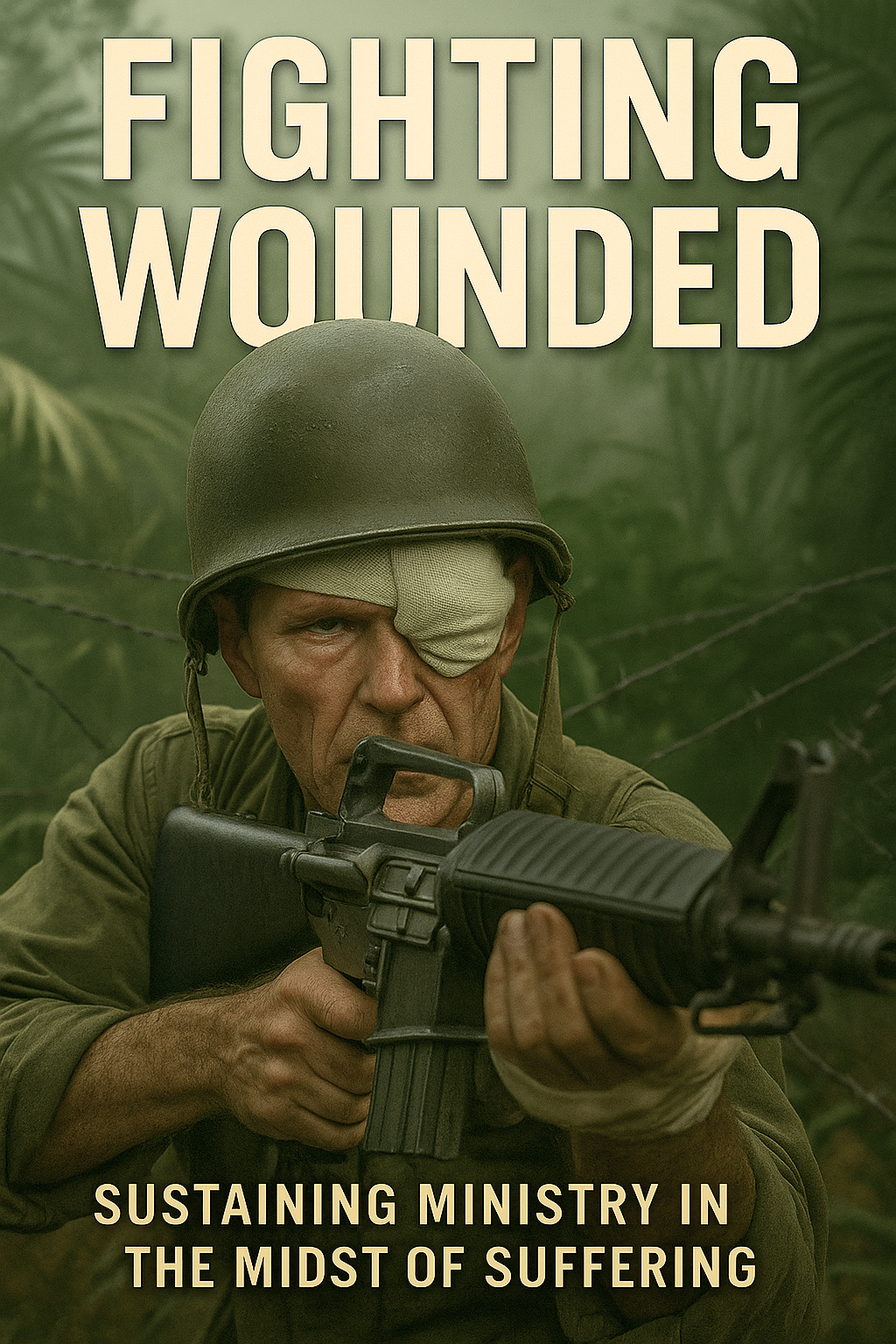
Sustaining Ministry in the Midst of Suffering
Introduction
“Suffer hardship with me, as a good soldier of Christ Jesus. No soldier in active service entangles himself in the affairs of everyday life, so that he may please the one who enlisted him as a soldier.”
(2 Timothy 2:3-4)
Firebase Echo
The jungle breathed around them like a living thing, its humid darkness pressing against Firebase Echo with the weight of a thousand secrets. In the trenches and bunkers, American soldiers waited with the peculiar stillness that comes before violence—that electric moment when every nerve stands at attention, when the smallest sound might herald death.
For three days, intelligence reports had whispered of something coming. A major assault. The kind that left bases as nothing more than smoking craters and casualty reports. The men of the infantry platoon knew the arithmetic of war: they were outnumbered, outgunned, and fighting an enemy that knew every root and shadow of this hostile green world.
They went through the rituals of preparation—cleaning weapons that were already clean, checking ammunition that had been checked a dozen times, sharing C-rations and quiet jokes that might be their last. Some wrote letters they hoped would never need to be mailed. Others simply stared into the impenetrable blackness beyond the wire, willing their eyes to pierce the veil that hid their fate.
At precisely 0200 hours, the night exploded.
The first mortar rounds fell like thunder from a malevolent spirit, tearing the silence into screaming fragments. The earth convulsed beneath their feet as the jungle erupted in a symphony of destruction—the sharp crack of small arms fire, the deeper boom of rocket-propelled grenades, the primal shouts of men locked in mortal combat.
Sergeant Wilson was manning the perimeter when the shell found him. The blast wave hit like an invisible fist, lifting him from his feet and slamming him into the mud. His ears rang with a high, piercing whine that seemed to come from inside his skull. Hot metal fragments had torn through his right arm, but it was his hand that told the true story of the night’s cruelty—his trigger finger was gone, simply erased by the indifferent mathematics of war.
The platoon medic materialized through the smoke and chaos, his hands steady despite the melee unfolding around them. He worked with practiced efficiency, wrapping Wilson’s mangled hand in field dressings that bloomed red almost immediately.
“You’re done, Sarge,” the medic said, his voice barely audible above the cacophony. “We need to get you out of here.”
Wilson looked at the medic with eyes that had seen too much but refused to close. Around them, the firebase was being overrun. Dark figures moved through the wire like deadly shadows, and the defensive line was buckling under the relentless assault. There was no evacuation, no rear area to retreat to. There was only here, now, and the terrible choice between fighting and dying.
“No,” Wilson said, his voice hoarse but determined. “Not yet.”
With his right hand useless, Wilson picked up his rifle with his left. The weapon felt alien in his grip, the balance all wrong, but necessity has a way of making the impossible merely difficult. He braced himself in the trench, squinting through the smoke to identify targets among the chaos.
Around him, wounded men made the same impossible choice. A private with a bandaged head rose from where he’d been knocked down, blood streaming down his face but his rifle steady. A corporal with shrapnel in his leg limped to his position, gritting his teeth against the pain. Some men, overwhelmed by wounds or shock, couldn’t continue—but most understood the brutal equation of survival: fight or die.
The night became a kaleidoscope of violence. Muzzle flashes strobed like deadly lightning, illuminating faces streaked with mud and blood. Wilson’s voice cut through the chaos, steady and sure, directing fire and encouraging his men. Despite his injury, despite the pain that shot up his arm with every movement, he held the line.
“Left flank! Movement in the wire!” he shouted, his left-handed shots finding their mark. “Johnson, cover the gap! Martinez, watch your six!”
His leadership became a beacon in the darkness, a steady point around which the defense could rally. Men looked to him and found courage they didn’t know they possessed. If their sergeant could fight one-handed, bleeding and battered, then they could find the strength to continue.
The battle raged through the darkest hours before dawn, each minute an eternity of violence and survival. When the first pale light finally crept across the horizon, it revealed a scene of devastation—the firebase battered but unbroken, the ground torn and scarred but still held by American hands.
Later, in the antiseptic environment of a field hospital, they would pin the Silver Star to Wilson’s chest. The citation spoke of extraordinary heroism, of leadership under fire, of actions above and beyond the call of duty. When reporters asked him about that night, about what drove him to fight with such determination despite his wounds, Wilson’s response was characteristically simple.
“It wasn’t about medals,” he said, his left hand unconsciously flexing where his right could no longer feel. “It was about staying alive. All of us.”
The story of Firebase Echo lived on in the telling, passed from soldier to soldier, from generation to generation. It became more than just another battle report—it became a testament to the human capacity for courage in the face of impossible odds, for adaptation when everything familiar falls away, and for the will to fight when fighting seems futile.
In the end, it wasn’t about the medals or the citations or the official recognition. It was about ordinary men who found extraordinary strength when their world came apart, who chose to stand and fight when every instinct screamed to run. It was about the night when Firebase Echo proved that when the mission demands our all, we can and will fight wounded.
The School of Hard Knocks
I learned to endure physical and mental suffering as a young child. Coming from a broken home where survival meant staying invisible and disappointment was the only constant. There are no badges or awards for such endurance. In fact, it is so common today, people barely notice the devastating turmoil infidelity, divorce, sexual and physical abuse, and neglect has on children. They are expected to muscle through it like any other adult, carrying wounds that never quite heal, learning to smile through the pain because nobody wants to hear about it.
By the time I dropped out of High School and joined the US Army I had already been through “Hard Knocks 101” and was ready for 201. But this time I would actually be paid to suffer and even get some shiny trinkets to pin on my uniform. Sleepless nights, subjected to the elements, real hunger, and a constant barrage of profanity that could peel the paint off of a Jeep were all par for the course and normal life. At least now the suffering had purpose, structure, and camaraderie. I wasn’t alone in it anymore.
By the time I gave my life to Christ, I was pretty well numb to the 101 and 201 suffering that comes with military life, but I would realize that God was actually preparing me for 301 and something far more significant – to bring Him glory through ministry. Shortly after I committed to being Jesus’ disciple I was carrying an extremely heavy backpack and slipped a disc in my back (I would suffer with the injury for the rest of my career in the Army). As a squad leader I was supposed to be with my men as they conducted maneuvers in the dead of winter but I was confined to a desk taking pain pills every four hours. My back was not the only thing hurting. My pride had been severely damaged when as a “Big Bad Airborne Ranger” I could barely walk let alone lead my soldiers. And to top it all off I was driving home after pulling guard duty all night, painkillers making me all the more drowsy, I totaled my car having fallen asleep at the wheel.
I don’t know about you but I kind of thought being a Christian would make life easier, not harder. Wasn’t faith supposed to be a shield against trouble? Some kind of divine insurance policy? Fortunately I was reading my Bible every day and after I washed the blood from my nose from the tangle with my steering wheel, I thought it might be best to bring some grievances before God. My reading for the day was 1 Corinthians chapter 16. As I read having a semi-pity party, I came across verse 13:
Be on the alert, stand firm in the faith, act like men, be strong. (1 Corinthians 16:13)
The words jumped off the page at me. It wasn’t a slap in the face. The Holy Spirit knew I didn’t need insult added to injury. But it was the reassuring firmness of a Father who understood but was exhorting me to endure. I felt strangely understood and above all loved. The challenge was both strengthening and encouraging.I suddenly grasped something profound in my early faith journey – the Creator of the entire universe actually noticed me personally. Among all the vastness of creation, on this tiny planet Earth, He saw and cared about one small human being named Chuck Wood. The thought that an infinite God would give me such personal attention absolutely blew me away!
I wish I could say that suffering is a “one and done” lesson and once you get enough of it you pass the class. Nope. Jesus has great things planned for our lives and suffering, trials, and tribulations is one of the primary ways He accomplishes those plans. It’s His strange curriculum for character development.
But there’s a lot of books written on suffering, do we really need another one? I think we do. Not just a book on suffering but a book on how to continue to make disciples while we’re going through the ringer. I’ve seen believers wade through hard times with patience and civility. But what is rare is when Christians actually steward their ministries while going through said suffering. Many simply “tap out” because they are going through a rough patch.
Life’s inevitable hardships – illness, broken relationships, financial strain, family crises – have a way of turning our focus inward. When we’re hurting, it feels natural, even justified, to pull back from others and concentrate on our own healing. Suffering seems to grant us a “free pass” from the normal expectations of loving, caring, and nurturing those around us. Sometimes this withdrawal is absolutely necessary for our recovery and restoration. But at some point, we must learn what Paul called “the secret” – how to comfort others with the same comfort we’ve received from God (2 Corinthians 1:3-4). The danger lies in using our pain as a permanent excuse to abandon our calling to serve others.
Yet there’s another category of suffering that cuts even deeper than personal hardship – the unique pain that comes from ministry itself. As the saying goes, “There’s no hurt like church hurt.” And I get it. Ministry suffering cuts deeper than personal suffering. When you’re pouring your life into people and they turn on you, betray your trust, or walk away from the faith entirely – that’s a special kind of heartbreak. When politics tear apart what you’ve built, when your own leadership questions your methods, when financial stress threatens your family because you chose ministry over a “real job” – the temptation to quit becomes overwhelming. When people you’ve baptized, married, and buried their loved ones suddenly treat you like a stranger, when your teenage kids resent the ministry because it “stole” their dad or mom, when your spouse begins to question whether this calling was really from God – these are the moments when even the strongest soldiers consider desertion.
Or maybe you feel like God Himself has abandoned you – or even worse, deliberately cut you off at the knees out of spite or anger. The silence from heaven feels deafening when you’re desperate for His voice. You’ve undoubtedly heard many sermons about “Divine Appointments” – those moments when God orchestrates circumstances for His purposes. But I want to remind you that there are also what I call “Divine Disappointments.” These are the times when you feel like God has failed to bring justice to a glaringly unfair situation, when it seems He’s broken a promise He clearly made, or when He appears to ignore prayers that were specifically crafted to bring Him glory.
Maybe you prayed for healing for a faithful saint who died anyway. Perhaps you begged God to save your marriage, your ministry, or your wayward child, only to watch everything crumble despite your desperate pleas. You might have trusted Him with a vision He gave you, only to see it collapse spectacularly. You know intellectually that God is good, faithful, and just – your theology is sound. But your heart is screaming something entirely different. The disconnect between what you know about God and what you’re experiencing feels like it might tear you apart. In these moments, even seasoned believers find themselves questioning not just God’s methods, but His very character.
This small booklet is meant for those who are knee deep in ministry and wrestling with suffering at this very moment or sensing it’s waiting around the corner. Simply put, I want to encourage you to “Fight Wounded.” As the Apostle Paul encouraged his young protégé:
Fight the good fight of faith; take hold of the eternal life to which you were called… (1 Timothy 6:12)
Paul wasn’t writing to someone living in comfort and ease. Timothy was facing real opposition, genuine hardship, and the kind of ministry challenges that make you question everything. Yet Paul’s command was clear: keep fighting, even when you’re hurt. Don’t retreat. Don’t quit. Fight wounded.
In the pages that follow, we’ll walk alongside biblical heroes who mastered this art – from Moses leading a rebellious nation while nursing his own disappointments, to Paul planting churches from prison cells, to David worshiping God even when running for his life. We’ll examine the Scriptures that sustained them through their darkest hours and discover the theological foundations that make fighting wounded not just possible, but essential to our calling. You’ll also hear from modern-day warriors who’ve learned to minister effectively while their own hearts were breaking – pastors, missionaries, and ministry leaders who chose to keep serving others even when everything in them wanted to quit.
This isn’t about denial or pretending everything is fine. It’s about discovering how to remain faithful to your calling when faithfulness feels impossible. It’s about learning to comfort others with the comfort you’ve received from God, even when that comfort feels distant. Most importantly, it’s about understanding that your greatest ministry often happens not in spite of your wounds, but because of them.
 ToBeLikeJesus