
Mt 5.1-2, Lk 6.12-19
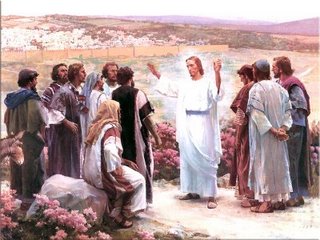
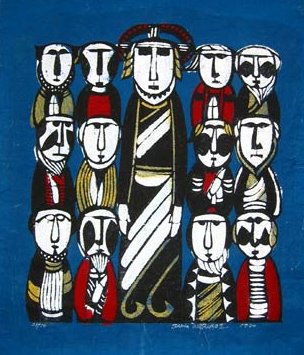
It was at this time that He went off to the mountain to pray, and He spent the whole night in prayer to God. And when day came, He called His disciples to Him and chose twelve of them, whom He also named as apostles: Simon, whom He also named Peter, and Andrew his brother; and James and John; and Philip and Bartholomew; and Matthew and Thomas; James the son of Alphaeus, and Simon who was called the Zealot; Judas the son of James, and Judas Iscariot, who became a traitor. Jesus came down with them and stood on a level place; and there was a large crowd of His disciples, and a great throng of people from all Judea and Jerusalem and the coastal region of Tyre and Sidon,
(Luke 6:12-17)
Jesus prays all night and in the morning chooses 12 to appoint as apostles from a large crowd of His disciples.
There are three distinct groups of people in this passage; the 12, the large crowd of disciples, and great throng of people from the extended region. Since this is a study in discipleship, we need make a few observations and ask a couple of questions. Observations: First, the 12 were disciples before there were appointed as apostles. Second, they were chosen for a large crowd of disciples. Questions: How did Jesus get so many disciples and what was His primary method for making these disciples?
This passage gives us a good picture of how Jesus made disciples. The 12 were not set apart to be made into disciples, they were already followers of Jesus. Jesus had been making disciples for at least a year to this point. Some, Jesus asked to follow Him and others took the initiative and requested to be His disciple (Jn 1.35-51, Lk 9.47-52). There were disciples who followed Him everywhere and those who were more static. There were disciples who quit following Jesus (Jn 6.66) and secret disciples (Jn 19.38).
The fact of the matter is that Jesus had made many more disciples than the 12. You may be wondering why I am belaboring this point. I think some people are under the impression that the only way to make a disciple is to do what Jesus did with the 12 (others have gone as far as to say one on one is the only way to make disciples). Not according to Jesus’ methods. On the other hand, in modern American Christianity we are trying to make disciples by preaching at them and anyone with integrity would have to assess this method as a dismal failure in most Christian’s lives. They are not following Christ as a result of the myriad of messages they have heard. In fact they have become inoculated to the message. In order to make disciples we need to take a closer look at Jesus’ objective. The object should always drive the method, not the method the objective. His primary method was to invite people to follow Him. His objective was to help people get to know and become like Him (Mt 10.24-25a, Lk 6.60, 1 Jn 2.6). These men and women became disciples by listening to His preaching, watching His ministry, discussing Him in their communities, and seeing His miraculous signs. The main issue is not necessarily the method but the outcome. They were following Jesus, getting to know Him, and becoming like Him. That is the objective (Lk 6.40, 1 Jn 2.6, Mt 28.18-20).
If preaching alone was helping people become vibrant passionate followers of Christ, then I would practice this method more zealously. But the facts are that preaching, although a healthy component of the discipleship process, usually falls woefully short of accomplishing the objective when it is the only component of discipleship. The proof is in the pudding. Preaching was a part Jesus’ strategy for making disciple, but His methods were much more comprehensive than a sermon Sunday morning. This is where Sunday School, Music, Small Groups, One on One, and so many other methods we practice are so important. They are all components (methods) used in order to accomplish the overall objective. So here’s the question for us and modern American Christianity; do we believe Jesus has commanded us to produce His disciples? Do we see passionate followers of Jesus Christ coming out of our ministries? Are we in fact accomplishing this objective? If not, we may need to take a closer look at our methods. FJ76
For questions or comments drop me a line at charleswood1@gmail.com or click the envelope below to send this post to a friend…






 ToBeLikeJesus