Kingdom Kernel #32 – The Pearl of Great Price

Unveiling the Kingdom’s Supreme Worth

Kingdom Kernel Collection

“Again, the kingdom of heaven is like a merchant seeking fine pearls, and upon finding one pearl of great value, he went and sold all that he had and bought it.” (Matthew 13:45-46 NASB95)

Introduction

The Parable of the Pearl of Great Price, found in Matthew 13:45-46, is a succinct yet profound illustration of the kingdom of heaven’s incomparable value. Spoken by Jesus amidst a series of parables, it portrays a merchant who, upon finding a pearl of “great value,” sells all he possesses to acquire it. This narrative, set in the context of Jesus’ teachings on the kingdom, underscores the radical commitment required to embrace God’s reign. The terms “great value” and “sold all” serve as linguistic and theological anchors, revealing the kingdom’s worth and the response it demands. This essay explores these terms’ linguistic roots, their theological significance, and their prophetic connection to Jesus as Messiah and King, emphasizing His present and eternal Lordship.

Key Words and Phrases

The phrase “great value” in Matthew 13:46 derives from the Greek polytimos (Strong’s G4186), meaning “very costly” or “of great price.” Etymologically, poly (much) and timē (price, honor) suggest something of immense worth, surpassing ordinary valuation. This term, used only twice in the New Testament (here and in 1 Peter 2:7), underscores the pearl’s supreme desirability, pointing to the kingdom’s divine preciousness. The phrase “sold all” involves the Greek pipraskō (Strong’s G4097), meaning “to sell” or “exchange,” and panta (Strong’s G3956), meaning “all things.” Together, they convey total divestment, a complete surrender of possessions for the pearl’s acquisition. These terms frame the kingdom as both priceless and demanding absolute commitment.

Theological Significance: The Kingdom and Christ’s Lordship

Theologically, the pearl symbolizes the kingdom of heaven, which is inseparable from Jesus Himself as its King. The merchant’s pursuit mirrors the seeker’s journey to find Christ, the “one thing of greatest value” Philippians 3:8. The act of selling all reflects the cost of discipleship, echoing Jesus’ call to forsake all for Him Luke 14:33. This radical exchange reveals divine attributes: God’s kingdom is of infinite worth, freely offered yet requiring total surrender. The parable points to God’s redemptive plan, where Christ, the pearl, is both the treasure and the price paid through His atoning death 1 Corinthians 6:20. Prophetically, it foreshadows Christ’s eternal reign, where His Lordship is fully realized Revelation 11:15. Yet, Jesus’ kingship is not merely future; His Lordship is real in this age, transforming lives through submission to His rule Romans 14:9.

Implications for Disciples Today

In its first-century context, the parable challenged not only materialistic values, but all values, urging listeners to prioritize the kingdom over earthly concerns. It’s expressed fully in 1 John;

Do not love the world nor the things in the world. If anyone loves the world, the love of the Father is not in him. For all that is in the world, the lust of the flesh and the lust of the eyes and the boastful pride of life, is not from the Father, but is from the world.” (1 John 2:15-16)

Disciple-makers should exemplify this by demonstrating joy in surrender and guiding others to discover the kingdom’s worth. The parable’s interconnectedness with other scriptures, like the Parable of the Hidden Treasure Matthew 13:44, reinforces the theme of sacrificial pursuit, weaving a cohesive biblical narrative of God’s redemptive invitation.

Conclusion: Transformative Power of the Pearl

The Parable of the Pearl of Great Price illuminates Jesus’ kingship and the kingdom’s eternal expanse. By selling all for the pearl, believers embrace Christ’s present Lordship, experiencing transformation through surrender. This act of faith aligns with God’s redemptive plan, pointing to the day when Christ’s reign is fully manifested. For contemporary Christians, the parable inspires a life of radical commitment, reflecting the kingdom’s supreme value in every decision. As disciple-makers model this pursuit, they testify to Jesus, the Pearl, whose worth demands all yet offers infinite satisfaction.

Disciple-Makers Short Story

The Pearl Worth Finding

The jewelry store settled into afternoon stillness, with only the measured heartbeat of a wall clock marking time. Terry traced circles on a glass display case, his reflection wavering among diamond prisms and gold bands. At thirty-two, he had found his anchor in faith—a calling that transformed even the most ordinary moments into opportunities for purpose.

The bell above the door sighed, and a man stepped inside—silver threading his temples, shoulders carrying invisible weight, eyes holding stories Terry could only guess at.

“Welcome,” Terry said, offering warmth in a simple word. “Something special brings you in today?”

“Zach,” the man offered with a slight nod. “It’s our thirtieth anniversary. I need a pearl necklace for my wife.” His voice carried a quiet determination beneath the surface, as if this gift represented more than celebration—perhaps redemption.

Terry guided him toward a display where pearls gleamed under careful light. “A perfect choice for thirty years,” he said, arranging several strands with gentle precision. “Pearls are born from adversity—beauty crafted through endurance. Like a marriage that’s weathered storms.”

Zach’s fingers hovered above a strand of luminous spheres, not quite touching. “Beauty from adversity,” he repeated, something shifting behind his eyes. “That’s fitting. We’ve traveled a long road to reach this milestone.”

Terry tilted his head slightly. “There’s a story there.”

Zach hesitated, then released a breath as if letting go of something heavy. “We married young, drunk on dreams. Then life sobered us—jobs, children, mistakes. Mine, mostly.” He looked away. “For a while, it seemed we wouldn’t make it. We did, but something essential slipped away during those years. Faith, maybe. We’ve been talking about finding our way back.”

“What was your relationship with faith before?” Terry asked, careful not to press too hard.

“Church was childhood—something we outgrew when we left home.” Zach’s mouth tightened. “Beginning to think that was where we went wrong.”

Terry nodded, feeling a familiar stirring. “Your choice of pearls reminds me of something Jesus once said—about a merchant searching for fine pearls who discovers one of extraordinary value. He sells everything to possess it. That’s what God’s kingdom resembles: worth everything because it is everything.”

Curiosity flickered across Zach’s face. “The kingdom of God—you mean heaven?”

“Both the future and the present,” Terry said, leaning slightly against the counter. “It’s life under God’s governance with Christ as sovereign. Not just eternity, but transformation now—changing how we love, forgive, perceive. I chased countless things before discovering that Christ himself is the treasure that reorders all other values.”

Something softened in Zach’s expression. “We’ve been considering returning to church, finding solid ground again. But the path isn’t clear to me.”

Terry recognized the opening—subtle but unmistakable. “Have you encountered the heart of the gospel? That God’s love sent His Son to live among us, perfect where we fail, paying our debt through His death? That He conquered death itself and now reigns? That’s the beginning and culmination—living in His kingdom now and forever. He is that pearl of incomparable worth.”

Zach’s brow furrowed. “Everything? That’s an enormous asking price.”

“It is,” Terry acknowledged. “But we prove daily that we’re searching in all the wrong places and coming up empty-handed. His kingship brings authentic peace—not some distant promise, but present reality. I once pursued success relentlessly until finding Christ revealed what truly matters.”

Questions tumbled from Zach, revealing deeper currents. “How can you be certain He’s worth such sacrifice? What if you surrender everything and He proves insufficient?” His voice revealed old wounds—a marriage once stretched to breaking.

Terry considered before answering. “For me, it’s the peace I’ve discovered, the sense of purpose. Christ gave everything first—His very life. That love draws me toward reflection of His character—patience, selflessness. The journey isn’t simple, but its value is unquestionable. Perhaps like your marriage? Difficult passages, yet here you stand, still fighting for what matters.”

Zach nodded, something like hope kindling in his eyes. “Yes. We need something far greater than what we’ve been scavenging for all these years.”

“Could we continue this conversation?” Zach asked, tentative but resolute. “Maybe over coffee?”

Terry smiled. “I’d like that. And if your wife is interested, perhaps my Julie could join us.” He extended his business card. “My cell and email are here.”

“This has been unexpected,” Zach said, hand closing around the card. “This necklace will mark our anniversary, but what you’re describing might save more than our marriage.”

“Yes,” Terry agreed. “Much more.”

As the door closed behind Zach, Terry felt quiet satisfaction settle over him. In this unremarkable afternoon, he had glimpsed the kingdom’s value mirrored in one man’s humble search—and perhaps offered a signpost toward the King.

Kingdom Kernel Collection

Kingdom Kernel #31 – Two Types of Fish

The Parable of the Dragnet: Unveiling Christ’s Kingship and His Judgment

Kingdom Kernel Collection

“Again, the kingdom of heaven is like a dragnet cast into the sea, and gathering fish of every kind; and when it was filled, they drew it up on the beach; and they sat down and gathered the good fish into containers, but the bad they threw away. So it will be at the end of the age; the angels will come forth and take out the wicked from among the righteous, and will throw them into the furnace of fire; in that place there will be weeping and gnashing of teeth.” (Matthew 13:47-50)

Introduction: Contextualizing the Parable

In Matthew 13:47-50, Jesus presents the Parable of the Dragnet, a vivid metaphor for the Kingdom of Heaven. Set within a series of kingdom parables, this passage likens the kingdom to a dragnet cast into the sea, gathering fish of every kind. At the end of the age, the angels sort the catch, keeping the good and throwing away the bad, with the wicked cast into a furnace of fire. This parable reveals the nature of Christ’s kingship, the reality of divine judgment, and the eternal scope of God’s redemptive plan, emphasizing Jesus’ present and future lordship.

Key Words and Phrases

Dragnet – σαγήνη (Strong’s G4522 – sagēnē) – refers to a large fishing net dragged across the sea to capture all in its path, derived from a root suggesting enclosure or sweeping inclusivity. This imagery underscores the kingdom’s universal reach, gathering both righteous and wicked.

Threw away – ἐκβάλλω (Strong’s G1544 – ekballō) – meaning to cast out or expel, carries a forceful connotation of rejection, often used for divine judgment (John 12:31).

End of the age – συντέλεια (Strong’s G4930 – synteleia) and αἰών (Strong’s G165 – aiōn) denotes the consummation of the current era, a time of divine reckoning (Matthew 24:3). These terms collectively paint a picture of Christ’s sovereign authority as the Messiah and King, orchestrating a final, discerning judgment.

Theological Significance: The Kingdom and Its King

The dragnet symbolizes the Kingdom of Heaven’s present inclusivity, where righteous and wicked coexist under Christ’s lordship (Matthew 13:24-30). Jesus, as the Messiah, is the King who reigns now through grace and will return in glory to judge (Revelation 19:11-16). His dual nature—loving yet just—is evident: He offers salvation to all but executes righteous judgment, separating the righteous for eternal life and the wicked for punishment (2 Corinthians 5:10). The angels’ role highlights Christ’s delegated authority, affirming His divine sovereignty (Matthew 25:31-32). The “end of the age” points to the eschatological fulfillment of God’s redemptive plan, where Christ’s eternal reign is fully realized in Daniel 7:14.

Christological Fulfillment: Jesus as Present and Future King

The parable reveals Jesus as the Messiah who reigns presently, calling all to repentance (Mark 1:15), yet His lordship awaits ultimate fulfillment. The dragnet’s gathering reflects the gospel’s universal call, while the sorting signifies Christ’s discerning judgment as King (John 5:22). His current reign transforms believers through the Holy Spirit, preparing them for the kingdom’s consummation. The act of “throwing away” the bad fish prefigures the final separation, where Christ’s justice ensures the wicked face divine consequence (Revelation 20:15), while His love preserves the righteous (John 10:28).

Implications for Believers: Transformative Power

For contemporary Christians, this parable underscores the urgency of living under Christ’s lordship now. Disciple-makers must teach the reality of judgment, the necessity of genuine faith (Matthew 7:21), and the consequences of unrepentance (Luke 13:3). The dragnet’s imagery encourages believers to embody righteousness amidst a mixed world, trusting in Christ’s redemptive grace (Galatians 6:9). By recognizing Jesus’ present kingship, believers are empowered to live as kingdom citizens, anticipating the eternal glory of His reign.

Conclusion: The Eternal Kingdom and Its King

The Parable of the Dragnet reveals Jesus as the sovereign King, whose lordship is real now and will be fully manifested at the end of the age. The terms sagēnē, ekbállō, and suntéleia aiōnos illuminate His inclusive yet discerning reign, balancing love and justice. This concept calls believers to urgent evangelism, genuine faith, and patient endurance, transforming their lives as they await Christ’s eternal kingdom (Revelation 22:5). Through this parable, Jesus’ kingship shines as both a present reality and a future hope, inviting all to submit to His redemptive rule.

Disciple-Maker’s Short Story

The Dragnet at Dusk

The sun dipped low over the bay, painting the water in hues of amber and violet as Lisa and Elly pedaled along the coastal road, their mountain bikes humming against the asphalt. The salty breeze carried the tang of the sea, mingling with the creak of fishing boats bobbing at the docks. Elly’s tires wobbled slightly as her gaze lingered on the boats, their nets draped like veils over weathered decks. Her mind drifted to the passage she’d read that morning—Matthew 13:47-50, the Parable of the Dragnet, where Jesus spoke of a net gathering fish of every kind, only to be sorted at the end of the age.

“Let’s take a break,” Elly called, slowing her bike near a rocky outcrop with a sweeping view of the ocean. The two women dismounted, leaning their bikes against a weathered bench. The horizon shimmered, a canvas of divine artistry, and Elly’s heart stirred with questions. She turned to Lisa, her friend and mentor, whose steady faith had always grounded her. “Lisa, I read about the good and bad fish this morning. The dragnet. What does it mean? It’s been stuck in my head all day.”

Lisa sat on the bench, her eyes tracing the waves. She was older, her face etched with lines of quiet wisdom, yet her presence radiated warmth. “The dragnet,” she began, her voice soft but deliberate, “is about the Kingdom of Heaven. Jesus said it’s like a net cast wide, pulling in everyone—righteous and wicked alike. But at the end, there’s a sorting. The good are kept; the bad are cast away.”

Elly frowned, kicking a pebble with her sneaker. “It sounds so final. Like there’s no room for mistakes.” Her life felt like a tangled net—moments of faith knotted with doubts, her temper flaring too often, her patience fraying with her coworkers. She wanted to be good, but the weight of her flaws made her wonder if she’d be “thrown away.”

Lisa’s gaze softened, reading Elly’s unspoken fears. “It’s not about being perfect, Elly. The parable shows Jesus as King—loving, just, and sovereign. He’s reigning now, not just at the end. The net’s still in the water, gathering us all. It’s why we’re called to become like Him, to let His Spirit shape us into the ‘good fish’—not by our strength, but by His grace.”

Elly hugged her knees, the ocean’s rhythm steadying her. “But how? I mess up all the time. I yelled at my boss last week. I’m not… righteous.”

Lisa leaned forward, her voice carrying the weight of conviction. “The righteous aren’t sinless. They’re the ones who trust Jesus, who let Him transform them. Look at John 10:28—He holds us, and no one can snatch us away. The sorting isn’t about earning your place; it’s about surrendering to His kingship now. Every choice to love, to forgive, to repent—it’s you becoming more like Him.”

The words sank deep, stirring a quiet resolve in Elly. She thought of Galatians 6:9—not growing weary in doing good. Maybe her small acts of kindness, her prayers for patience, were threads in a net being woven by a greater hand. The boats in the bay rocked gently, their nets a reminder of Christ’s inclusive call, yet also His promise of justice. She wanted to live for that King, to reflect His heart in a world of tangled nets.

As the last light faded, Elly stood, her bike ready. “I want to be like Him,” she said, almost to herself. “Not just for the end, but now.”

Lisa smiled, mounting her bike and turning on her headlamp. “That’s the Kingdom, Elly. It’s here, in you, growing. Let’s ride.”

Kingdom Kernel Collection

Kingdom Kernel #30 – The Keys to the Kingdom

Unlocking Christ’s Eternal Reign Through Authority, Discipline, and Power

Kingdom Kernel Collection

“And Jesus said to him, “Blessed are you, Simon Barjona, because flesh and blood did not reveal this to you, but My Father who is in heaven. “I also say to you that you are Peter, and upon this rock I will build My church; and the gates of Hades will not overpower it. “I will give you the keys of the kingdom of heaven; and whatever you bind on earth shall have been bound in heaven, and whatever you loose on earth shall have been loosed in heaven.”

Then He warned the disciples that they should tell no one that He was the Christ. From that time Jesus began to show His disciples that He must go to Jerusalem, and suffer many things from the elders and chief priests and scribes, and be killed, and be raised up on the third day. Peter took Him aside and began to rebuke Him, saying, “God forbid it, Lord! This shall never happen to You.” But He turned and said to Peter, “Get behind Me, Satan! You are a stumbling block to Me; for you are not setting your mind on God’s interests, but man’s.”

Then Jesus said to His disciples, “If anyone wishes to come after Me, he must deny himself, and take up his cross and follow Me. “For whoever wishes to save his life will lose it; but whoever loses his life for My sake will find it. “For what will it profit a man if he gains the whole world and forfeits his soul? Or what will a man give in exchange for his soul? “For the Son of Man is going to come in the glory of His Father with His angels, and WILL THEN REPAY EVERY MAN ACCORDING TO HIS DEEDS. “Truly I say to you, there are some of those who are standing here who will not taste death until they see the Son of Man coming in His kingdom.”” (Matthew 16:17-28 NASB95)

Introduction

In Matthew 16:17-28, Jesus delivers a profound revelation following Peter’s confession of Him as “the Christ, the Son of the living God” (v. 16). Set in Caesarea Philippi, a region saturated with pagan worship, Jesus declares, “Blessed are you, Simon Barjona, because flesh and blood did not reveal this to you, but My Father who is in heaven… I will give you the keys of the kingdom of heaven; and whatever you bind on earth shall have been bound in heaven, and whatever you loose on earth shall have been loosed in heaven” (v. 17-19, NASB95).

He concludes by promising that some disciples “will not taste death until they see the Son of Man coming in His kingdom” (v. 28), echoed in Mark 9:1 and Luke 9:27 as seeing the “kingdom of God come with power.” These passages collectively establish Jesus’ messianic identity, His delegation of authority to His church, and the present and future reality of His kingdom. This essay synthesizes the themes of the “keys of the kingdom,” “binding and loosing,” and “seeing the kingdom in power.”

Key Words and Phrases

The phrase “keys of the kingdom of heaven” hinges on kleis (Strong’s G2807), meaning “key,” derived from kleiō (to shut or lock). Kleis connotes authority to grant or deny access, rooted in the Jewish concept of stewardship (Isaiah 22:22). The “kingdom of heaven” (basileia tōn ouranōn, Strong’s G932) reflects God’s sovereign rule, both spiritual and eschatological, akin to the Hebrew malkuth (dominion). Basileia underscores Christ’s divine kingship, present now and culminating in eternity.

The terms “bind” (deō, Strong’s G1210) and “loose” (lyō, Strong’s G3089) denote tying/restricting and releasing/permitting, respectively. In rabbinic Judaism, these were idiomatic for authoritative decisions—prohibiting or permitting actions under God’s law. The periphrastic future perfect passive (estai dedemenon/lelumenon) in Matthew 16:19 suggests divine ratification of earthly decisions aligned with heaven’s will, linking deō and lyō to the stewardship symbolized by kleis.

The “rock” (petra, Strong’s G4073) upon which Christ builds His church signifies the revelation of Jesus’ divine sonship, not Peter himself, but the truth of His messiahship. In Matthew 16:28, Mark 9:1, and Luke 9:27, “see” (horaō, Strong’s G3708) implies not just physical sight but spiritual perception or experiential knowledge, as in recognizing divine authority (John 1:18). “Power” (dynamis, Strong’s G1411) in Mark 9:1 denotes miraculous strength or divine ability, associated with miracles (Luke 4:36), resurrection (Philippians 3:10), and the Spirit’s empowerment (Acts 1:8). Together, these terms frame Jesus’ authority, the church’s role, and the kingdom’s transformative reality.

Theological Significance and Christological Fulfillment

Theologically, the “keys of the kingdom” represent Christ’s delegation of authority to His church, rooted in His identity as Messiah, confessed by Peter (Matthew 16:16). The petra—the revelation of Jesus as “the Christ, the Son of the living God”—is the foundation of the church, which prevails against “the gates of Hades” (v. 18). The kleis empowers believers to proclaim salvation, opening the kingdom to those who accept Christ (Acts 2:38-39) and closing it to unrepentant hearts (2 Corinthians 7:9-10), reflecting God’s redemptive plan through Christ’s death and resurrection (Matthew 16:21).

“Binding and loosing” (deō and lyō) extend this authority to church discipline and instruction. In Matthew 18:15-18, Jesus applies these terms to confronting sin or restoring repentant members, balancing justice and mercy (1 Corinthians 5:4-5; John 20:23). This authority, exercised under Christ’s lordship, ensures the church’s holiness and advances the kingdom. Prophetically, the keys and binding/loosing point to Christ’s eternal reign, where He holds “the keys of death and Hades” (Revelation 1:18), fulfilling His role as the Davidic King (Isaiah 9:7).

The promise that some disciples would “see (horaō) the kingdom of God come with power (dynamis)” (Matthew 16:28; Mark 9:1; Luke 9:27) underscores the kingdom’s present and future reality. This was partially fulfilled in the transfiguration (Matthew 17:1-8), where Peter, James, and John witnessed Jesus’ divine glory, and at Pentecost (Acts 2), where the Spirit empowered the church. Theologically, this affirms the kingdom’s “already” presence through Christ’s death, resurrection, and ascension (Luke 11:20; Ephesians 1:20-23), and its “not yet” consummation at His return (Revelation 11:15). The dynamis of the kingdom—its transformative power—heals, saves, and judges, manifesting Christ’s active lordship today.

Transformative Power for Believers

For contemporary Christians, the kleis symbolizes stewardship of the gospel, empowering believers as priests (1 Peter 2:9) to share Christ’s message and foster kingdom growth. Binding and loosing call for responsible church discipline—confronting sin with grace (Galatians 6:1) and teaching sound doctrine (Titus 2:1)—reflecting Christ’s attributes of justice and mercy. The call to “see” (horaō) the kingdom with dynamis invites disciples to discern God’s redemptive work through the Spirit (Romans 14:17), living under Christ’s lordship now while anticipating His return (Matthew 16:27). This transformative power demands sacrificial living (Matthew 16:24), allegiance to Christ, and participation in His mission to proclaim salvation and advance His unshakable kingdom (Hebrews 12:28).

Conclusion

The “keys of the kingdom,” “binding and loosing,” and “seeing the kingdom in power” collectively illuminate Jesus as the Messiah who delegates authority to His church, governs it with divine justice, and manifests His reign with transformative power. Linguistically rooted in kleis, basileia, deō, lyō, petra, horaō, and dynamis, these concepts reveal Christ’s present and eternal lordship, empowering believers to open the kingdom through the gospel, maintain its holiness, and discern its reality. This truth inspires disciples to steward Christ’s message faithfully, embody His kingship, and live in the power of His unshakable kingdom—now and forever.

Disciple-makers Short Story

The Weight of the Keys

The diner smelled of grease and coffee, a comforting haze after the morning’s drills. Calvin and Owen slid into a cracked vinyl booth, their firemen’s jackets slung over the seats, still damp with sweat. The clatter of plates and the hum of conversation filled the air, but Calvin’s mind was elsewhere—on a passage that had been gnawing at him for weeks. Owen, his rookie partner, was nursing a Coke, his eyes heavy from the training but curious as Calvin leaned forward, Bible open on the table.

“Alright, Owen,” Calvin began, his voice low but steady, “you asked about that tough bit in Matthew 16. Peter’s confession, the keys, all that. It’s heavy stuff, but it’s worth unpacking.” He tapped the page. “This is where Jesus changes everything.”

Owen raised an eyebrow, swirling the ice in his glass. “Yeah, you said it’s about authority or something. But what’s with the ‘keys of the kingdom’? Sounds like a fairy tale.”

Calvin chuckled, but his eyes were serious. “It’s no fairy tale. It’s power—real power. Let’s start with Peter. He’s just a fisherman, right? Rough around the edges, impulsive. But in Caesarea Philippi, surrounded by pagan shrines, he says, ‘You are the Christ, the Son of the living God.’ That’s not just a guess, Owen. Jesus says it’s a revelation straight from God. That’s the rock—the truth of who Jesus is. Not Peter himself, but what he confessed.”

Owen nodded slowly, leaning in. “Okay, so Jesus is the Messiah. Got it. But what’s with the keys?”

Calvin’s fingers traced the verse. “Jesus tells Peter, ‘I will give you the keys of the kingdom of heaven.’ The Greek word for key is kleis—it’s about authority, like a steward who can open or lock a door. In Jewish tradition, keys meant you were trusted with something big, like running a household. Here, it’s the gospel itself. Jesus is saying, ‘You’re my steward, Peter. You get to open the kingdom to people—or close it.’”

Owen frowned, setting his glass down. “Close it? That sounds harsh.”

“It’s not about being a gatekeeper,” Calvin said, his voice softening. “It’s about responsibility. Jesus goes on: ‘Whatever you bind on earth shall have been bound in heaven, and whatever you loose on earth shall have been loosed in heaven.’ The words bind—deō—and loose—lyō—were rabbinic terms. They meant making decisions, like saying what’s allowed or forbidden under God’s law. For the church, it’s about guiding people—calling out sin, forgiving it, teaching truth. It’s justice and mercy, holding both together.”

Owen’s eyes flickered with recognition. “Like what we do at the station. You train us to make split-second calls—save a life, protect the team. It’s heavy, knowing your choice matters.”

“Exactly,” Calvin said, leaning back. “That’s what the keys are. A weight. You’re entrusted to act in line with God’s will. And it’s not just Peter. We’re all priests, Owen—1 Peter 2:9 says so. We carry the gospel, open doors for others to know Jesus. But it’s gotta be His way, not ours.”

The waitress dropped off their burgers, but Owen barely noticed, his mind turning. “Okay, but then Jesus says some of them won’t die till they ‘see the kingdom come with power.’ That’s in Matthew 16:28, right? And Mark and Luke. What’s that about?”

Calvin took a bite, chewing thoughtfully. “That’s the part that blew my mind. The Greek word for ‘see’ is horaō—it’s not just looking, it’s perceiving, understanding. And ‘power’ is dynamis—miraculous strength, like the Spirit’s work. Jesus is saying some disciples will witness His kingdom breaking in, right then. And they did—six days later, Peter, James, and John see Him transfigured, shining like the sun, talking with Moses and Elijah. It’s a glimpse of His glory, His reign. Then Pentecost comes, and the Spirit falls like fire. The kingdom’s not just future—it’s now, Owen.”

Owen’s burger sat untouched. “So… Jesus is king now? Not just waiting to come back?”

Calvin nodded, his voice earnest. “He’s reigning now. His death, resurrection, ascension—it’s all dynamis, power that changes everything. The church is His body, carrying that power to heal, save, transform. But it’s not easy. Jesus said, ‘Take up your cross’ right after this. Following Him means sacrifice, living like He did.”

The diner noise faded for Owen. He thought of the drills that morning—Calvin pulling him from a simulated blaze, steady under pressure. He thought of his own doubts, the way he froze sometimes, afraid to fail. “Calvin… how do you do it? You’re always so sure, so calm. Like you’ve got that dynamis yourself.”

Calvin’s face softened, but there was a flicker of pain. “I’m not always sure. Last year, we lost a kid in a house fire. I carried that weight for months, wondering if I could’ve done more. But Jesus… He’s the one who holds the keys of death and Hades. Revelation 1:18. He showed me I’m not the savior—He is. That’s why I want to be like Him, Owen. Not just to carry the keys, but to live with His heart—His justice, His mercy, His courage. It’s the only way to make sense of this life.”

Owen’s throat tightened. He saw it now—not just words on a page, but a call. The keys weren’t a fairy tale; they were a mission, a trust. He thought of the people he’d saved, the ones he couldn’t. Jesus was offering something bigger—a kingdom that didn’t falter, a power that didn’t fail. “I want that,” he said quietly. “To live like Him. To carry that weight and not break.”

Calvin smiled, clapping Owen’s shoulder. “Then start here. See Him—horaō. Know He’s king. Let His Spirit shape you. The keys are yours too, if you’re willing to follow.”

The diner buzzed on, but for Owen, the world shifted. The weight of the keys felt real, not crushing but grounding. He wanted to be like Jesus—not for glory, but to open doors, to bind and loose with grace, to see the kingdom’s power in every choice. As they paid the check, he felt a spark of dynamis within, a quiet resolve to live for the King who trusted him with His reign.

Kingdom Kernel Collection

The Depth Challenge 

Depth Charges in WWII Anti-Submarine Warfare

Depth charges were the primary anti-submarine weapon of World War II, undergoing significant tactical evolution throughout the conflict while presenting unique challenges in confirming their effectiveness.

At the war’s outset, Allied navies relied on basic barrel-shaped depth charges rolled off the stern of escort vessels. These contained 200-300 pounds of explosive set to detonate at predetermined depths. Early tactics were crude—ships would drop charges where a U-boat had last been detected, hoping for a lucky hit within the weapon’s roughly 20-foot lethal radius. The Battle of the Atlantic, however, drove rapid tactical and technological improvements that transformed these weapons from relatively ineffective to submarine killers.

Ships began dropping patterns of multiple charges to saturate an area, dramatically increasing hit probability. The innovative “creeping attack” emerged, where one ship held sonar contact while another crept in slowly to attack, preventing U-boats from hearing the approach. Forward-throwing weapons like the Hedgehog (1942) and Squid (1943) represented major advances, firing projectiles ahead of the ship to maintain continuous sonar contact during attack. These contact-fuzed weapons only exploded upon hitting a submarine, reducing false alarms. Depth settings also improved as U-boats learned to dive deeper; by war’s end, charges could reach 500+ feet. Long-range patrol aircraft became increasingly important after 1943, dropping depth charges on surfaced or shallow-running U-boats with devastating effect once the Atlantic “air gap” closed.

Confirming a U-boat kill, however, remained notoriously difficult throughout the war. The most convincing proof was physical evidence surfacing after an attack—oil slicks, hull fragments, wooden fittings, clothing, or personal effects. Large oil patches spreading over time were particularly persuasive, though clever U-boat commanders sometimes released oil and debris deliberately to fake their destruction while escaping.

Sonar operators listened for the distinctive sounds of a submarine breaking up—hull collapse, bulkheads failing, or internal explosions. If a previously active submarine suddenly went silent with no further contact despite extensive searching, crews claimed a “probable” kill. This uncertainty was deeply frustrating for crews who might spend hours in brutal attacks without knowing if they’d succeeded.

The difficulty in confirmation led to widespread overclaiming. Allied navies classified results as “confirmed,” “probable,” or “possible” kills, but actual success rates were often far lower than reported. Early in the war, it sometimes took over 100 depth charges per U-boat actually sunk. Intelligence from decoded German communications occasionally provided confirmation when U-boats failed to report in, but this couldn’t be shared with crews for security reasons.

Many wartime claims were only verified years later by comparing Allied attack records with German U-boat loss records. Despite these challenges, improved tactics, technology, and training transformed depth charges into effective weapons by 1943-44, contributing decisively to the defeat of the U-boat threat and Allied victory in the Battle of the Atlantic.

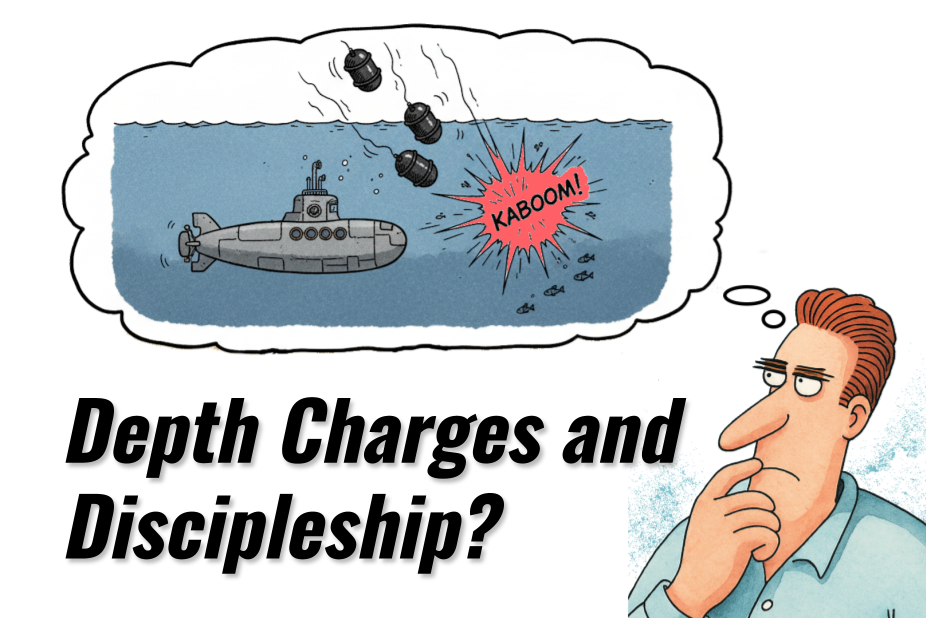
Depth Charges and Discipleship: Generational Assessment 

The challenge facing World War II naval commanders dropping depth charges into uncertain waters mirrors a contemporary challenge in disciple-making: how does a first generation disciple-maker accurately assess what is happening at multiple levels below them? In both cases, information must travel through layers—whether ocean depths or spiritual generations—and what surfaces determines understanding and action.

When Allied warships dropped depth charges against U-boats, they sent destructive force through multiple depth layers, waiting for evidence to surface that confirmed success. Sonar operators at various positions reported what they heard, lookouts scanned for debris, and commanders pieced together fragmentary information to assess whether they had achieved their objective. The uncertainty was maddening. Oil slicks might indicate a kill or a clever deception. Breaking-up noises heard at one depth might not be detected at another. Each level of observation contributed partial knowledge, but only the commander integrating all reports could attempt to see the complete picture.

Discipleship faces a parallel dynamic, but with an essential difference: the purpose is constructive rather than destructive. When a primary disciple-maker seeks to assess the health and progress of discipleship spanning multiple generations, they face the same challenge of penetrating multiple “depths” of leadership. Just as depth charges had to reach through layers of water to their target, assessment questions must travel through generations of disciple-makers—from the first generation disciple-maker, through second-generation disciples, to third-generation and beyond. Each generation represents a spiritual depth in the multiplication chain.

The critical parallel lies in responsibility at each level. Just as naval crews had to accurately report what they observed at their position—sonar contacts, visual confirmation, acoustic evidence—each disciple-maker must faithfully transmit information both up and down through the assessment system. An intentional process can serve as the modern equivalent of sonar, providing the mechanism for information flow, but it only functions effectively if each generation faithfully pushes data upstream to leadership and downstream to those they disciple. The primary disciple-maker at the beginning of the stream, like a naval commander, sees the complete picture aggregated from all depths, but depends entirely on the timeliness, integrity, and accuracy of feedback at each intermediate level.

Where depth charges brought destruction, discipleship assessment must bring construction. The goal is not to destroy but to build up the body of Christ—identifying where discipleship is thriving, where it needs support, where spiritual “pressure” exists in the form of challenges or needs at various depths. The information that surfaces through an intentional process should reveal spiritual vitality, multiplication patterns, obstacles to growth, and opportunities for encouragement. When a third-generation disciple-maker reports struggles, and that information travels faithfully through the second generation to the first generation disciple-maker, the response should be resources, prayer, and support flowing back down through the same channels.

The dangers, however, echo those faced by WWII crews. Communication can break down. Information can be filtered by fear or pride at intermediate levels. Just as some U-boat commanders released fake debris to deceive pursuers, disciple-makers might report inflated success to please leadership above them especially if they perceive their salaries or resources are contingent on their performance. Conversely, they might suppress troubling information to avoid appearing unsuccessful. The intentional process of gathering information provides the mechanism, but cannot guarantee transparency.

This is where the comparison reveals its most important lesson: multiple verification points proved essential in naval warfare, and they remain essential in discipleship assessment. The first generation disciple-maker cannot rely solely on what bubbles up through official channels. They need direct relationships, periodic face-to-face contact, and cultural norms that reward honest reporting over optimistic fiction. Just as naval intelligence eventually compared attack reports with intercepted enemy communications to verify kills, wise primary leaders create feedback loops—visiting downstream generations, encouraging peer-to-peer communication, and modeling vulnerability about their own challenges.

The ultimate goal transforms the comparison entirely. Depth charges succeeded when they destroyed their target. Discipleship assessment succeeds when it strengthens every generation of disciple-makers—when the first generation disciple-maker gains accurate understanding, when intermediate generations feel supported rather than merely monitored, and when the newest disciples at the deepest levels know their reality matters to leadership even though they may never meet face-to-face. The intentional process of assessment downstream becomes not a weapon sent into the depths, but a lifeline connecting generations, ensuring that assessment remains constructive, that information flows freely in both directions, and that the entire generational chain grows stronger through transparent, faithful communication across every spiritual generation.

Biblical Examples

Jesus established the pattern of commissioning disciples, sending them into ministry, and receiving their reports. In Matthew 10 and Luke 9, He focused on the Twelve, giving them authority and specific instructions before sending them out, then gathering them afterward to hear what had happened. Later, in Luke 10, He expanded this approach by sending seventy-two disciples in pairs, who returned with joy to report that even demons submitted to them in His name (Luke 10:17). Jesus didn’t send His disciples into the harvest and abandon them to figure things out alone—He created a rhythm of sending, assessing, and responding. His prayer in John 17 reveals the generational scope of His vision: He prayed not only for the disciples He had personally trained, but also “for those who will believe in me through their message” (John 17:20)—acknowledging multiple spiritual generations flowing from His original investment. His final commission made this generational multiplication explicit: “Go and make disciples of all nations…teaching them to obey everything I have commanded you” (Matthew 28:19-20), which necessarily includes the command itself to make disciples, creating an unbroken chain until He returns.

Paul replicated this same pattern throughout his apostolic ministry, maintaining active assessment across the churches and leaders he had established. He regularly sent co-workers like Timothy, Titus, and Epaphroditus to assess situations and report back (Philippians 2:19-30; 2 Corinthians 8:16-24), while also receiving reports from church members about both encouraging developments and troubling conduct. The Corinthian correspondence reveals this dynamic clearly—Paul responds to oral reports from “Chloe’s household” (1 Corinthians 1:11) and written questions from the church, addressing specific issues at multiple depths of their community life. He didn’t wait for problems to surface accidentally; he intentionally created channels for information to flow.

Moreover, Paul trained those he mentored to practice the same assessment principles in their own spheres of leadership. He instructed Timothy to carefully evaluate potential elders (1 Timothy 3:1-7; 5:22), to assess the effectiveness of different workers (2 Timothy 2:2—”entrust to reliable people who will also be qualified to teach others”), and to pay attention to how teaching was being received and applied (2 Timothy 2:14-19). To Titus, he gave similar directives about appointing elders in every town and addressing false teaching that was disrupting “whole households” (Titus 1:5-11), requiring Titus to assess not just individual leaders but the ripple effects of their influence through family and community networks. Both Jesus and Paul understood that faithful multiplication required more than initial training—it demanded ongoing assessment, honest reporting, and responsive care across every generation of disciple-makers.

Potential Application

5 Step Process:

  1. Identify & List: Identify and list your top ten discipleship elements
  2. Select & Ask: Choose one discipleship element and ask one of the people you are discipling the associated question during your regular meeting
  3. Engage & Equip: Listen, encourage, and coach based on what you hear—then ask them to do the same with someone they’re discipling
  4. Surface & Synthesize: Each generation reports key insights upstream in their next meeting (2-3 sentences max)
  5. Pray & Respond: Disciple-makers up and down the chain review, pray, send encouragement/resources back downstream

Key Suggestions for Implementation:

Make it Conversational, Not Clinical:

  • Embed the question naturally in existing discipleship meetings—don’t create a separate “assessment meeting”
  • Frame it as “I’m curious about…” rather than “I need to assess…”
  • The question should spark genuine conversation, not data collection

Simplify Information Flow:

  • Each person only passes upstream: (1) their own answer, (2) one memorable insight from downstream
  • Avoid lengthy reports—think “headline + story” not “comprehensive analysis”
  • Use voice messages or quick texts between meetings if something significant surfaces

Rotate Elements Organically:

  • Establish regular rhythms (e.g., “Love God” one week, “Prayer” in another)
  • Let the first generation disciple-maker choose the next element based on what surfaced in the previous cycle
  • This makes it responsive rather than mechanical

Build in Multiple Verification:

  • First generation disciple-maker periodically asks the same question directly to 2nd or 3rd generation disciples perhaps in a 1-3-9 meeting (bypassing layers)
  • Compare: Does what they say match what was reported upstream?
  • These relational meetings filters information without creating surveillance culture

Create Psychological Safety:

  • Explicitly celebrate “I’m struggling with…” reports more than “Everything’s great!” reports
  • Share your own struggles first before asking downstream
  • If salaries or resources are involved, expect it to muddy the waters in your assessment

Additional Pitfalls to Avoid:

  • Going too deep too fast – Start with just 2-3 generations until the rhythm is established
  • Forgetting to close the loop – If someone shares a struggle and never hears back, trust evaporates
  • Making it one-directional – Downstream generations should also ask the first generation disciple-maker the same questions periodically
  • Losing the “why” – Regularly remind everyone: “We do this to strengthen each other, not monitor each other”
  • Collecting without connecting – Information without relationship breeds cynicism

The Simplest Version:

One question → One conversation → One insight upstream → One response downstream → Repeat when natural

The power isn’t in the system’s complexity—it’s in the consistency of care it reveals.

Example – First Generation Disciple-Maker’s Assessment Notes

Discipleship Element: The Word
Question: “What are your rhythms in getting in the Word of God?”
Date: September 30, 2025
Stream: John (me) → Marcus → Al  → David


Generation 1 (John – Me)

My own answer first:

  • Morning coffee + OT/Gospel/NT (one chapter each) – consistent 7 days a week
  • Struggling with depth – Sometimes I’m on autopilot and don’t get much from my reading
  • Need to spend some concerted time in Bible study (2-3 hours a week)

Generation 2 (Marcus)

What I heard from Marcus:

  • Reading through Matthew right now, 15-20 min during lunch break at work
  • Uses audio Bible during commute (30 min)
  • Said he’s feels like he’s getting plenty of time in the Word

What Marcus reported from downstream:

  • Al mentioned he’s all over the place with it

Generation 3 (Al)

What Marcus heard from Al:

  • Tries to read before bed but often too exhausted
  • Sometimes goes 3-4 days without opening his Bible
  • When he does read, it’s “just a verse or two from a devotional app”

What Al reported from downstream:

  • David is actually doing better than he is—reading with his roommate

Generation 4 (David)

What Al heard from David:

  • New believer (8 months), reading through John with his roommate Jake (also new believer)
  • They meet 3x/week at breakfast, read a chapter, talk about what confuses them
  • Misses days when his roommate travels for work but loves discovering new things

Observations & Patterns

Strengths:

  • David has built-in accountability and freshness of a new believer
  • Marcus has multiple touchpoints (visual + audio)
  • Everyone has some rhythm, even if inconsistent

Challenges:

  • Al is isolated in his struggle—very little accountability 
  • Marcus and I both sense we’re going through motions (mature believer drift)
  • Weekend gaps, bedtime struggles for Al, travel disruptions for David

Surprises:

  • The newest believer has the most joy and consistency
  • The “problem” isn’t lack of discipline—it’s lack of engagement/freshness (me & Marcus) or sustainable structure (Al)

Prayer & Response Plan

Prayer Focus:

  • Al: Needs encouragement and accountability. Pray and suggest integrating into a morning routine.
  • Marcus: Pray for renewed hunger, not just habit.
  • David: Protect his enthusiasm, help him build depth and daily consistency.
  • Me: Ask God to break through my mechanical approach and draw some folks into a deeper Bible study.

Downstream Encouragement:

To Marcus: “Thanks for your honesty about ‘checking the box.’ I’m feeling that too. What if we both tried asking God one question each week: ‘What do You want me to see that I’m missing?’ Let’s ask each other what we are getting out of the Word when we meet.”

Marcus to Al: “Tell Al I’m proud he was honest about his struggle. Ask if he’d be willing to try something: read one chapter a day beginning in the Gospel of Mark for the next 16 days in the morning with coffee instead of at bedtime. In 16 days you’ll have finish your first book in the Bible. A quick win!”

Al to David: “Tell David his question about him and his buddy reading together made my day. His hunger is a gift. Encourage him to write down his questions as he reads—they’re gold. Maybe Al could meet with him and Jake once to answer some of those questions? That might help both of them.”


Kingdom Kernel #28 – The Divine Commission – Pray, Appoint, and Send (Luke 10:1-12)

Kingdom Kernel Collection

Now after this the Lord appointed seventy others, and sent them in pairs ahead of Him to every city and place where He Himself was going to come. And He was saying to them, “The harvest is plentiful, but the laborers are few; therefore beseech the Lord of the harvest to send out laborers into His harvest. Go; behold, I send you out as lambs in the midst of wolves. Carry no money belt, no bag, no shoes; and greet no one on the way. Whatever house you enter, first say, ‘Peace be to this house.’ If a man of peace is there, your peace will rest on him; but if not, it will return to you. Stay in that house, eating and drinking what they give you; for the laborer is worthy of his wages. Do not keep moving from house to house. Whatever city you enter and they receive you, eat what is set before you; and heal those in it who are sick, and say to them, ‘The kingdom of God has come near to you.’ But whatever city you enter and they do not receive you, go out into its streets and say, ‘Even the dust of your city which clings to our feet we wipe off in protest against you; yet be sure of this, that the kingdom of God has come near.’ I say to you, it will be more tolerable in that day for Sodom than for that city. (Luke 10:1-12)

Introduction: Contextualizing the Mission

In Luke 10:1-12, Jesus, the Messiah and King, expands His kingdom mission by appointing seventy “others” to go ahead of Him, preparing the way for His arrival in every city and place. This follows the earlier sending of the Twelve (Luke 9:1-6), revealing a pattern of divine delegation rooted in God’s redemptive plan. The passage highlights key actions—appointing, beseeching, and sending—intertwined with praying and going, which illuminate Jesus’ lordship and the Kingdom of God’s nearness. This essay analyzes these terms linguistically and theologically, connecting them to Christ’s eternal reign and their transformative power for believers today.

Linguistic Roots: Defining the Terms

The Greek terms in Luke 10 provide a foundation for understanding this commission. “Appointed” (ἀνέδειξεν, anedeixen, Strong’s G322) derives from ana (up) and deiknumi (to show), meaning to lift up or designate publicly. Jesus visibly sets apart the seventy, marking them for a purpose tied to His authority as King. “Beseech” (δεήθητε, deēthēte, Strong’s G1189) from deomai (to beg or petition) conveys urgent, dependent prayer, as the disciples implore the Lord of the harvest to act. “Sent/send” (ἀπέστειλεν, apesteilen, Strong’s G649) stems from apostellō, blending apo (from) and stellō (to set in order), signifying a deliberate dispatch with divine commission, echoing the apostolic mission of the Twelve.

Etymologically, these words emphasize intentionality and authority. Anedeixen suggests a royal appointment, deēthēte a reliance on divine power, and apesteilen a purposeful extension of Christ’s mission. Together, they frame the seventy’s role as an outflow of Jesus’ messianic kingship, preparing the world for His presence.

Theological Significance: The Kingdom in Action

The appointment of the seventy mirrors the sending of the Twelve, expanding the scope of God’s kingdom proclamation. This dual commission prophetically points to Christ’s reign over all mankind and how the kingdom would spread, fulfilling God’s redemptive plan (Isaiah 49:6). Jesus, as the Lord of the harvest, orchestrates this mission, revealing His divine attributes: omniscience in knowing the need, omnipotence in empowering laborers, and mercy in offering peace and healing (Luke 10:9).

Prayer (deēthēte) and going (apesteilen) are inseparable. The command to beseech the Lord for laborers underscores human dependence on divine initiative, while sending them as “lambs among wolves” (Luke 10:3) demonstrates faith in action. This duality reflects the Kingdom of God’s nearness—present in power yet requiring participation. The message, “The kingdom of God has come near” (Luke 10:9, Luke 10:11), ties directly to Jesus’ identity as Messiah, whose presence inaugurates God’s reign, a reality both now and not yet fully consummated (Matthew 4:17).

Christological Fulfillment: Jesus as King

Jesus’ lordship shines through this passage. He appoints with authority, directs prayer to Himself as the harvest’s Lord, and sends with a mission that prefigures His eternal reign (Revelation 11:15). Unlike earthly kings, His rule is marked by vulnerability and provision, as seen in the command to carry no resources (Luke 10:4), trusting the King who supplies all needs (Philippians 4:19). This lordship is not merely future; it is real today, transforming believers into laborers who extend His reign in this age, even as we await its ultimate fulfillment.

Transformative Power: Living the Commission

For contemporary Christians, this concept inspires a life of purpose and dependence. Being appointed calls us all as priests (1 Peter 2:9) to recognize our divine calling under Christ’s kingship. Beseeching fuels prayer for kingdom expansion, while being sent compels us to go boldly, trusting God amid rejection or reception (Luke 10:10-11). The interconnectedness of Scripture—seen in the Twelve’s mission (Luke 9), the Great Commission (Matthew 28:18-20), and the harvest imagery (John 4:35-38)—reveals a unified narrative of God’s unstoppable kingdom. Embracing this transforms disciples into active heralds, reflecting Jesus’ eternal reign and the expansive nature of His rule, both now and forever.

Conclusion

The appointment and sending of the seventy in Luke 10:1-12 unveil Jesus as the Messiah who reigns with purpose and power. Through anedeixen, deēthēte, and apesteilen, we see a King who delegates, invites prayer, and commissions laborers to proclaim His near kingdom. This passage bridges ancient text to modern faith, affirming Christ’s lordship as a present reality with eternal promise, urging believers to pray and go as reflections of His redemptive plan.

Disciple-Maker’s Short Story

The Weight of the Call

The late afternoon sun spilled golden light across the park, threading through the budding branches of ancient oaks. Ed’s sneakers crunched against the gravel path as he walked beside the outreach team, their voices rising in soft prayer. The air carried the scent of damp earth and the faint tang of blooming azaleas. Every Saturday, they came here—prayer walking through the local park, sharing the gospel with joggers, dog walkers, anyone who’d listen. Today, though, Ed’s attention wasn’t on the strangers they approached. It lingered on Felix, who, as always, hung back with the prayer team, his hands shoved deep into his jacket pockets, his eyes fixed on the ground.

Felix was a wiry man in his late twenties, all sharp angles and quiet intensity. He’d joined the church a year ago, drawn in by the community, but Ed had noticed this pattern early on. When the team fanned out to talk to people, Felix stayed rooted, murmuring prayers under his breath. At first, Ed figured it was just his way—some people were talkers, others intercessors. But lately, it gnawed at him. Felix wasn’t shy; he’d banter with the team over coffee or fix a kid’s bike tire without any problem. So why this hesitation?

The next day, Ed found Felix at the bike shop where he worked part-time. The bell above the door jingled as Ed stepped inside, the space humming with the metallic clink of tools and the faint hum of a radio playing classic rock. Felix was hunched over a derailleur, his fingers deftly threading a cable, his brow furrowed in concentration. Ed leaned against the counter, watching for a moment before clearing his throat.

“Hey, Felix,” he started, his tone light but steady. “Got a sec?”

Felix glanced up, wiping his hands on a rag. “Yeah, sure. What’s up?”

Ed shifted his stance, choosing his words with care. “I’ve seen you out there with us—prayer walking, lifting up the team. You’re solid, man. You’ve got the training, too—those evangelism workshops we did last fall. You aced the role-plays. So I’ve been wondering… why don’t you ever step out and share?”

Felix’s shoulders stiffened, his gaze dropping to the greasy rag in his hands. He twisted it once, twice, before answering. “I’m not really built for that, you know? Evangelism’s a gift, right? Some people have it—guys like you who can just walk up to anybody and start talking about Jesus. I don’t. I figure my part’s praying for you all. That’s what I’m good at.”

Ed nodded slowly, letting the words settle. He’d heard this before—people carving out their roles, dodging what scared them by calling it a “gift.” But something in Felix’s voice, a faint tremor beneath the excuse, told Ed there was more. He leaned forward, resting his elbows on the counter.

“Fair enough,” he said. “But let me ask you this: when you signed up for this team, didn’t you commit to sharing the gospel? Not just praying, but going out with us?”

Felix’s jaw tightened, and he tossed the rag onto the workbench. “Yeah, I guess. But like I said, I don’t have the gift. I’m not off the hook or anything—I just think God’s got other people for that job.”

Ed straightened, his voice softening but carrying a quiet weight. “Felix, you know the Great Commission, right? Matthew 28:18-20—Jesus tells the disciples to go, make disciples, teach them to obey everything He commanded. And that includes Mark 16:15—‘preach the gospel to all creation.’ He didn’t say, ‘Only if you’ve got the gift.’ He said it to all of us. You, me, the whole church. Prayer’s vital, don’t get me wrong—but it’s not a substitute for going.”

Felix didn’t respond right away. He turned back to the bike, fiddling with the chain, but his hands moved slower now, less sure. Ed waited, the silence stretching between them like a taut wire. Finally, Felix let out a breath, his voice barely above a whisper.

“It’s not about gifts, okay? I’m… I’m scared, Ed. What if I mess it up? What if I say the wrong thing and push someone away from God instead of toward Him? I’d rather pray and let you guys handle it.”

There it was—the real thing, raw and jagged. Ed felt a pang of recognition; he’d wrestled with that fear himself years ago. He stepped closer to Felix, his tone gentle but firm.

“I get it. I’ve been there. But here’s the thing: Jesus didn’t send us out because we’re fearless or perfect. He sent us because He’s with us. Look at Luke 10—the seventy He appointed weren’t superheroes. They were just people, like us, told to go as lambs among wolves. And you know what? He went with them. He goes with us, too. How about this: next week, you come with me. I’ll share first, show you how I do it. You just watch. No pressure.”

Felix met his eyes, uncertainty flickering there, but he gave a small nod. “Okay. I’ll try.”

The following Saturday, the park buzzed with life—kids shrieking on the playground, a guy strumming a guitar under a pavilion. Ed and Felix walked side by side, the outreach team scattering ahead. Felix’s hands were back in his pockets, his posture tense, but he stayed close. Ed scanned the path and spotted a man sitting alone on a bench, scrolling on his phone—a wiry guy in a hoodie, maybe mid-thirties.

“Watch this,” Ed murmured to Felix, then approached the man with an easy smile. “Hey, we’re sharing a story that changed our lives. Mind if I tell you mine?”

The guy glanced up, shrugged. “Free country.”

Ed settled beside him, leaving space, and started his story;

Well there was a time in my life when I was angry and alone. One day this guy approached me like I did you and told me how God loved me so much He sent His Son Jesus to the earth, He lived a perfect life and then Jesus died on a cross for everything I’ve ever done wrong. The man said if I surrendered my life to Jesus as my King, my Boss, He would give me true life. I did that by telling God I believed what this man said and I wanted to start living my life His way not mine. My life radically changed from that point on. I was much happier and had people that really cared about me. Have you ever had an experience with Jesus that changed your life?”

The man snorted, but it wasn’t hostile. “Not really. Church isn’t my thing.”

“Fair enough,” Ed said, unfazed. “I wasn’t big on it either till I figured out it’s not about the building. It’s about a relationship with Jesus”

The man paused, then shrugged again. “I’m not very religious.”

Ed pulled out a small tract and gave it to the man, “ Well if you ever change your mind, my contact info is on the back and this is just something to chew on.”

The guy took it, nodded, and Ed stood, clapping Felix on the shoulder as they walked away. Felix’s eyes were wide, his voice hushed. “That’s it? You just… talked to him? Like it was nothing?”

“It’s not nothing,” Ed said. “It’s everything. But yeah—it’s simple. Tell them who Jesus is, what He’s done for you, and let Him do the rest. You ready to try?”

Felix swallowed hard, but something shifted in his stance—a spark of resolve. He nodded. Ahead, a woman sat on a picnic blanket, reading a book. Felix took a shaky breath and stepped forward, Ed trailing just behind.

“Uh, hi,” Felix started, his voice cracking slightly. “Mind if I interrupt for a sec?”

She looked up, surprised but not annoyed. “Sure, what’s up?”

“I’m Felix. I’m here with my friend Ed, and… I’ve been telling people a story that changed our lives.Would you like to hear mine?” Felix started with his simple story that bled into a meaningful conversation that lasted twenty minutes.

The woman wanted to know more. Felix blinked, startled by her openness, then fumbled for one of the cards Ed had given him. “Here—this has some info if you’re curious.”

She smiled faintly, taking it. “Thanks, Felix.”

As they walked away, Felix turned to Ed, his face lit with a mix of shock and exhilaration. “Oh, I can do this! It’s not… it’s not as hard as I thought.”

Ed laughed, slinging an arm around his shoulders. “Told you. It’s not about being slick or fearless. It’s about being like Him—Jesus went to people, met them where they were. You just did that, too.”

Felix grinned, the weight lifting from his frame. For the first time, he saw it—not just the call, but the One who’d called him. And he wanted to be more like Him, one shaky step at a time.

Kingdom Kernel Collection

Kingdom Kernel #27 – Grace Empowered Obedience as the Foundation of Kingdom Entrance: A Theological Analysis of Matthew 7:15-27

Kingdom Kernel Collection

“Beware of the false prophets, who come to you in sheep’s clothing, but inwardly are ravenous wolves. You will know them by their fruits. Grapes are not gathered from thorn bushes nor figs from thistles, are they? So every good tree bears good fruit, but the bad tree bears bad fruit. A good tree cannot produce bad fruit, nor can a bad tree produce good fruit. Every tree that does not bear good fruit is cut down and thrown into the fire. So then, you will know them by their fruits.

“Not everyone who says to Me, ‘Lord, Lord,’ will enter the kingdom of heaven, but he who does the will of My Father who is in heaven will enter. Many will say to Me on that day, ‘Lord, Lord, did we not prophesy in Your name, and in Your name cast out demons, and in Your name perform many miracles?’ And then I will declare to them, ‘I never knew you; DEPART FROM ME, YOU WHO PRACTICE LAWLESSNESS.’

“Therefore everyone who hears these words of Mine and acts on them, may be compared to a wise man who built his house on the rock. And the rain fell, and the floods came, and the winds blew and slammed against that house; and yet it did not fall, for it had been founded on the rock. Everyone who hears these words of Mine and does not act on them, will be like a foolish man who built his house on the sand. The rain fell, and the floods came, and the winds blew and slammed against that house; and it fell—and great was its fall.”

Matthew 7:15-27

Introduction

Matthew 7:15-27 concludes Jesus’ Sermon on the Mount with a sobering discourse on authentic discipleship. Within this passage, three pivotal concepts – enter (εἰσέρχομαι, G1525), does the will (θέλημα, G2307), and acts on them (ποιέω, G4160) – reveal a tension between professed faith and lived obedience. Set against warnings about false prophets and the parable of two builders, Jesus establishes that verbal allegiance alone cannot secure entry into God’s kingdom. This essay explores how these terms linguistically and theologically underscore the necessity of grace-empowered obedience to Christ’s lordship.

Key Words and Phrases

Enter (εἰσέρχομαι, G1525): This compound Greek term (eis = “into,” erchomai = “come”) denotes intentional movement across a threshold. In Jewish eschatology, “entering the kingdom” (Matt 7:21) implied participation in God’s redemptive reign. Unlike passive admission, the term carries covenantal overtones – one actively aligns with divine authority.

Does the Will (θέλημα, G2307): Thelēma refers to God’s determined purpose, distinct from human whims. In the Septuagint, it often translates rāṣôn (“pleasure”), emphasizing God’s sovereign desire (Ps 40:8). Jesus redefines obedience as participation in the Father’s redemptive agenda rather than legalistic observance.

Acts On Them (ποιέω, G4160): Meaning “to make, do, or practice,” poieō implies habitual action. The wise builder “acts” (Matt 7:24) by embodying Christ’s teachings, contrasting with the folly of mere hearing.

Theological Significance

1. The King’s Authority and Judgment

Jesus presents Himself as the Messianic arbiter who discerns true allegiance (Matt 7:22-23). The shocking rejection of those performing miracles in His name (v22) exposes a critical distinction: external works devoid of internal submission constitute “lawlessness” (ἀνομία, G458). This aligns with His earlier warning against wolves in sheep’s clothing (7:15) – outward religiosity masks spiritual bankruptcy.

2. Kingdom Ethics: Grace and Obedience Intertwined

The passage resolves the faith-works paradox: salvation is by grace (Eph 2:8-9), yet genuine faith inevitably produces “fruit” (Matt 7:16-20). Christ’s lordship demands transformative obedience, as exemplified in His own fulfillment of the Father’s will (Heb 10:7). The ability to obey stems from the New Covenant promise: “I will put my law within them, and I will write it on their hearts” (Jer 31:33).

3. Christological Fulfillment

Jesus embodies the “rock” foundation (7:25), fulfilling Isaiah’s prophecy of a tested cornerstone (Isa 28:16). His teachings transcend Moses’ law (Matt 5:17), establishing a kingdom where love and humility define righteousness. The rejection of false followers (7:23) parallels Luke 13:27 (““And He will say, ‘I tell you, I do not know where you are from; depart from Me, all you evildoers.’”), asserting His divine authority.

Contemporary Implications

1. Lordship in the Present Age

Christ’s kingship is not deferred to eternity; believers now live under His active reign (Col 1:13). The call to “build on the rock” (7:24) demands daily obedience, enabled by God’s empowerment (Phil 2:12-13). Modern discipleship must confront cultural Christianity that prioritizes verbal confessions over sacrificial love.

2. Transformative Power of Grace

Augustine noted, “God crowns not your merits but His own gifts.” The ability to obey – itself a grace – dismantles pride and fosters dependence. As Bonhoeffer warned, “Cheap grace is grace without discipleship”; costly grace compels action.

Conclusion

Matthew 7:15-27 dismantles performative religion, revealing Grace empowered obedience as the hallmark of kingdom citizenship. Through careful linguistic analysis and theological reflection, we see Christ not merely as a future judge but as the present foundation for life. His words, when enacted through Spirit-empowered faith, create an unshakable identity that withstands life’s storms. This passage ultimately points to the gospel’s heart: we are saved by grace for obedience (Eph 2:10), participants in a kingdom where the King’s will becomes our joy.

Disciple-Maker’s Short Story

Chai and the Cornerstone

The apartment smelled of cardamom and cinnamon, a warm haze curling from the steaming chai in chipped ceramic cups. Sally sat cross-legged on a woven rug, her Bible open on her lap, its pages creased from years of thumbing. Across from her, three women—Fatima, Aisha, and Priya—nestled into mismatched cushions, their dark eyes flickering between curiosity and quiet skepticism. The late afternoon sun slanted through the window of Priya’s modest apartment, gilding the edges of a faded tapestry on the wall. A ceiling fan whirred lazily overhead, stirring the spiced air.

They’d been meeting like this for weeks, these discovery Bible studies, peeling back layers of scripture with questions that hung heavy between sips of tea. Today, they’d reached Matthew 7:15-27, Jesus’ words slicing through the text like a blade through silk. Sally had just finished reading aloud, her voice steady but soft, letting the weight of “Depart from me, you who practice lawlessness” settle into the room.

Priya tilted her head, her braid slipping over her shoulder. Her voice, lilting with the cadence of Hyderabad, broke the silence. “Sally, this Jesus, He says only those who do His Father’s will, will enter the kingdom. Then why do I see American Christians no live this way? They say ‘Lord, Lord,’ but I see fighting, greed, so much noise. Where is this obedience?”

The question wasn’t accusatory, but it carried an ache, a thread of disillusionment woven into her words. Fatima nodded faintly, her fingers tracing the rim of her cup, while Aisha’s gaze dropped to the rug, as if searching its patterns for an answer.

Sally exhaled, feeling the weight of Priya’s observation settle into her chest. She set her Bible down, letting her hands rest on her knees. “You’re right to notice that,” she said, her tone gentle but unflinching. “It’s a paradox, isn’t it? Jesus warns us about this exact thing—people who look like they belong to Him but don’t live it out. He calls them wolves in sheep’s clothing, or houses built on sand that collapse when the storms come.”

She paused, glancing at each of them, their faces a mosaic of doubt and longing. “But here’s the thing: being a follower of Jesus isn’t about what we say or even what we do on our own strength. It’s about grace. We’re saved by faith—by trusting Him, not by earning it. But that faith, if it’s real, changes us. It’s like He gives us the ability to obey, to build our lives on His words, because He’s the rock that holds us up.”

Fatima’s brow furrowed, her voice barely above a whisper. “So, you’re saying it’s not just rules? Not like… a list we follow to be good?”

“No,” Sally said, leaning forward slightly. “It’s deeper than that. It’s about knowing Him, letting His love and His will become yours. Those people Jesus rejects—they did miracles, big things, but their hearts weren’t His. They didn’t want Him as Lord, just as a name to use. True followers, though? They’re not perfect, but they’re being shaped by Him, step by step.”

Aisha looked up now, her eyes sharp with something unspoken. “But how do you know? How do you know if you’re the wise one or the foolish one?”

Sally smiled faintly, a flicker of vulnerability crossing her face. “That’s the sober part, isn’t it? Jesus says we’ll know by the fruit—the way we live, the love we show, the obedience that grows out of trusting Him. It’s not about judging others; it’s about looking at ourselves. I ask myself that question too, Aisha. Am I building on the rock? Or am I just hearing and not doing?”

The room grew quiet, the hum of the fan blending with the distant clatter of pots from a neighbor’s kitchen. Priya sipped her chai, her gaze distant. “I like this Jesus,” she said finally, her voice low. “He sees the heart. But it’s hard. To live that way—it’s not what I see around me.”

Sally nodded, her own cup warm against her palms. “It is hard. And I won’t pretend it’s not. But here’s the encouragement: if you want to follow Him, really follow Him, He doesn’t leave you to do it alone. He promises to put His law in your heart, to give you His Spirit. It’s not about being strong enough—it’s about wanting to be like Him, and letting Him make you that way.”

Fatima shifted, her scarf slipping slightly as she met Sally’s eyes. “Like Him,” she echoed, the words tasting new on her tongue. “You mean… kind? Forgiving? The way He was with people?”

“Yes,” Sally said, her voice softening with a quiet fire. “And obedient to His Father, even when it cost Him everything. That’s the rock we build on—His life, His love. I want that too. Every day, I’m asking Him to help me be more like Him, because I can’t do it on my own.”

Priya set her cup down, her fingers lingering on its edge. “Then maybe we should ask that too,” she said, almost to herself. “To be like this Jesus. Not just to hear, but to do.”

The air shifted, a subtle tension giving way to something fragile and alive. Outside, the sun dipped lower, casting long shadows across the rug. Sally picked up her Bible again, but she didn’t open it—not yet. For now, it was enough to sit there, the chai cooling between them, as the words of the Carpenter from Galilee lingered like an invitation.

Kingdom Kernel Collection

Kingdom Kernel #25 – Proclaiming the Nearness of God’s Kingdom

Eschatological Urgency and Christological Authority

Kingdom Kernel Collection

Introduction

The command to “preach” and “proclaim” the kingdom of God as “at hand” forms the backbone of Jesus’ commissioning of His disciples in Matthew 10:7, Luke 9:2, and Luke 10:1–12. These passages emphasize both the immediacy of God’s reign and the authority vested in Christ’s messengers. By analyzing the Greek terms for “preach” (κηρύσσω) and “proclaim” (διαγγέλλω, προκηρύσσω), their etymological roots, and their theological implications, this essay explores how Jesus’ ministry inaugurated the kingdom’s presence while pointing to its future consummation.

Linguistic Foundations: The Vocabulary of Proclamation

Preach (κηρύσσω)

The Greek term κηρύσσω (G2784) means “to herald” or “proclaim publicly,” often with the urgency of a town crier. In Luke 9:2, Jesus commissions the Twelve to “proclaim the kingdom of God” (κηρύσσειν τὴν βασιλείαν τοῦ θεοῦ), linking their authority to His messianic mission. The act of κηρύσσω implies official, authoritative announcement, akin to a royal decree.

Proclaim (διαγγέλλω, προκηρύσσω)

Διαγγέλλω (G1229): Derived from διὰ (“through”) and ἀγγέλλω (“announce”), this term signifies a thorough, widespread declaration. In Luke 9:60, Jesus commands a would-be-disciple to “go and proclaim [διαγγέλλω] the kingdom,” emphasizing comprehensive dissemination.

Προκηρύσσω (G4296): Combining πρό (“before”) and κηρύσσω, it denotes heralding in advance. Matthew 3:1–3 uses it for John the Baptist’s preparatory role, framing Jesus’ arrival as the fulfillment of covenantal promises.

These terms collectively underscore the disciples’ role as authorized heralds announcing the kingdom’s inbreaking.

Theological Significance: The Kingdom “At Hand”

Immediacy and Spatial Nearness

The phrase “ἤγγικεν ἡ βασιλεία” (“the kingdom has come near”) in Matthew 10:7 and Luke 10:9 carries spatial and temporal weight. The Greek ἐγγίζω (“draw near”) suggests proximity, not merely futurity. Jesus’ miracles (Luke 10:9) and teachings demonstrated the kingdom’s tangible presence, challenging listeners to repent and realign with God’s rule.

Christ as the Kingdom’s Embodiment

Jesus’ declaration that the kingdom is “at hand” (Mark 1:15) centers on His identity as the Davidic Messiah. He is the autobasileia—the “kingdom in person”—whose authority to forgive sins (Luke 5:24) and defeat evil (Luke 10:17–20) confirms His lordship. The disciples’ healing ministry (Luke 9:2) authenticated their message, showing the kingdom’s power operative through Christ.

Already-Not Yet Tension

While the kingdom’s fullness awaits Christ’s return, its “nearness” signifies its transformative intrusion into the present age. Rejecting the message (Luke 10:10–12) carries eternal consequences, as the kingdom’s arrival demands decisive response.

Christological Fulfillment and Redemptive Plan

Messianic Herald and King

Jesus’ use of προκηρύσσω in Luke 10:1–12 ties His disciples’ mission to John the Baptist’s preparatory work (Matthew 3:2; Acts 13:24). Yet, Jesus transcends John’s role: He is both the Herald and the King, inaugurating the kingdom through His death and resurrection.

Covenantal Continuity

The kingdom’s language echoes Old Testament promises (e.g., Daniel 2:44; Isaiah 52:7). By healing and preaching, the disciples enact Isaiah’s vision of restoration (Luke 4:18–19), positioning Jesus as the covenant-keeping Messiah.

Transformative Power for Believers

Living Under Christ’s Present Reign

Paul notes that believers are “transferred” into the kingdom (Colossians 1:13), a present reality demanding allegiance to Christ’s lordship. The kingdom’s ethics (Matthew 5–7) and communal life (Acts 2:42–47) reflect its countercultural nature.

Mission as Kingdom Witness

Disciple-makers today embody the kingdom by:

  1. Proclaiming Christ’s Authority: Preaching centers on Jesus’ resurrection and reign (Acts 17:6–7).
  2. Demonstrating Kingdom Power: Prayer, healing, and justice work signal the Spirit’s activity (Luke 10:9).
  3. Urging Response: The kingdom’s nearness calls for repentance and faith (Matthew 4:17).

Conclusion

The proclamation “the kingdom of God has come near” encapsulates the gospel’s heart: in Jesus, God’s reign has dawned, demanding repentance and offering redemption. The Greek terms’ urgency and authority challenge the church to preach Christ’s lordship unapologetically, live as kingdom citizens, and anticipate its consummation. As both present reality and future hope, the kingdom transforms believers into heralds of the King who is “near to all who call on Him” (Psalm 145:18).

Disciple-Makers Short Story

The King of Light

The backyard was a kaleidoscope of colors—streamers fluttered in the breeze, balloons bobbed against the sky, and the laughter of children rang out like tiny bells. Lydia sat under the shade of the porch, a cool glass of lemonade in her hand. Her daughters were darting across the lawn, their giggles mingling with the other children’s as they played tag. It was a perfect day—sun-dappled and warm, with just enough breeze to keep the heat at bay.

The women gathered around her were chatting amiably, their voices weaving in and out of conversation topics: recipes, school schedules, and summer plans. Lydia smiled as she listened, grateful for these moments of connection. She had prayed for opportunities to share her faith in natural, meaningful ways, and today felt like one of those moments waiting to unfold.

As the conversation meandered, one of the women—Claire—leaned back in her chair and asked, “Do you believe in guardian angels?” Her tone was casual, but her eyes sparkled with curiosity.

Lydia paused for a moment, considering her response. She didn’t want to come across as preachy or dismissive, but she also felt a nudge in her spirit to speak truthfully. “Maybe,” she said thoughtfully. “I think guardian angels are possible. But there’s someone much more powerful than guardian angels.”

The group grew quiet, their attention shifting to Lydia. Claire tilted her head. “Who’s that?”

“Jesus,” Lydia said simply, her voice steady but warm. “He’s not just powerful—He’s the King.”

A ripple of surprise passed through the group. Lydia could see it in their faces—the mix of intrigue and hesitation that often came when spiritual matters were brought into everyday conversation. But she pressed on gently, sensing that this was a moment God had prepared.

“You see,” she continued, “there are two kingdoms in this world: the kingdom of darkness and the kingdom of light. Jesus is the King of light, and He has our best interests at heart. Satan—the ruler of darkness—doesn’t care about us at all. He wants to deceive us and lead us away from what’s good.”

Claire frowned slightly but didn’t interrupt. Another woman, Sarah, leaned forward with a curious expression. “So you’re saying Jesus is like…what? A protector?”

Lydia smiled softly. “Not just a protector—though He does protect us—but also a Savior and a King who loves us deeply. He came to rescue us from the kingdom of darkness so we could live in His light forever.” She glanced toward her daughters playing on the lawn and added, “That’s why I want my girls to know Him—not just as someone who helps them when they’re scared but as someone who leads them into what’s good and true.”

The women exchanged glances, their expressions ranging from skeptical to thoughtful. Claire broke the silence first. “I’ve always thought about God as…distant, you know? Like He’s up there somewhere but not really involved in our lives.”

Lydia nodded empathetically. “I used to think that too,” she admitted. “But then I realized that Jesus didn’t stay distant—He came down to be with us. He lived among us, showed us what God is like, and even gave His life so we could be part of His kingdom.” Her voice softened as she added, “He’s not far away; He’s near to anyone who calls on Him.”

Sarah smiled faintly but didn’t say anything right away. Claire looked down at her hands, turning her wedding ring absently around her finger. The moment hung in the air like a held breath—fragile yet full of possibility.

One of the children ran up to Lydia then—a little girl with strawberry-blonde curls and chocolate smudged on her cheek. “Mommy!” she exclaimed breathlessly. “Can we have cake now?”

Lydia laughed and ruffled her daughter’s hair. “Of course,” she said warmly before turning back to the group. “Let’s talk more later if you’d like.” She met Claire’s gaze briefly before standing up to help with the cake.

As she walked toward the dessert table with her daughter skipping beside her, Lydia felt a quiet joy settle over her heart—a sense that seeds had been planted today. She didn’t know how or when they might grow, but she trusted that God would water them in His time.

Her motivation to share Jesus wasn’t just about words; it was about becoming more like Him—living out His love in every interaction, every moment of grace-filled truth-telling. And as she watched her daughters laugh and play under the bright afternoon sun, Lydia whispered a silent prayer: “Please Lord, help these ladies hear, see, and feel Your kingdom presence in their midst and ask Jesus to show them the way. The way to You”

The party continued around her—balloons bobbing in the breeze, laughter echoing through the yard—but Lydia’s heart was fixed on something eternal: the kingdom of light breaking through into this ordinary backyard moment.

And it was beautiful beyond words.

Kingdom Kernel Collection

Kingdom Kernel #24 – The Paradox of Greatness

The Paradox of Greatness: John the Baptist, the Kingdom of God, and Christ’s Lordship

Kingdom Kernel Collection

“Truly I say to you, among those born of women there has not arisen anyone greater than John the Baptist! Yet the one who is least in the kingdom of heaven is greater than he. “From the days of John the Baptist until now the kingdom of heaven suffers violence, and violent men take it by force. (Matthew 11:11-12)

“I say to you, among those born of women there is no one greater than John; yet he who is least in the kingdom of God is greater than he.” (Luke 7:28)

Introduction

In Matthew 11:11 and Luke 7:28, Jesus declares, “Among those born of women no one greater than John the Baptist has appeared, yet the least in the kingdom of heaven is greater than he.” This paradoxical statement hinges on two Greek terms: μείζων (meizōn, G3187) for “greater” and μικρότερος (mikroteros, G3398) for “least.” By examining their linguistic roots, theological implications, and connection to Jesus’ messianic mission, we uncover how Christ’s kingdom redefines greatness through humility and inaugurated eschatology.

Linguistic Foundations: Unpacking “Greater” and “Least”

μείζων (G3187): The Greatness of John

Derived from μέγας (megas, “great”), meizōn reflects John’s unparalleled role as the final Old Testament prophet (Luke 16:16) and herald of the Messiah. The term’s Proto-Indo-European root (méǵh₂s) denotes magnitude, aligning with John’s prophetic stature (Malachi 3:1). Yet this greatness remains tethered to the old covenant, where prophets prepared Israel for the coming King.

μικρότερος (G3398) and Ἐλάχιστος (G1646): The Surprising “Least”

The comparative mikroteros (“lesser”) and superlative elachistos (“smallest”) invert human metrics of value. Elachistos appears in James 3:4 for the “smallest” rudder, illustrating disproportionate impact. In Luke 16:10, faithfulness “in very little” (en elachistō) mirrors Jesus’ emphasis on humility as the pathway to exaltation (Luke 14:11).

Theological Significance: The Kingdom’s Inaugurated Reality

John as the Pinnacle of the Old Covenant

Jesus affirms John’s supremacy among prophets (Matthew 11:9–10) but clarifies that even “the least” in the new covenant surpasses him. This shift marks the arrival of God’s kingdom through Christ, where participation in redemption eclipses preparation for it. John, though “born of women” (natural birth), stands outside the kingdom’s fullness inaugurated at Pentecost (Acts 2), where believers are “born of the Spirit” (John 3:5–6).

Christ as the Archetype of Kingdom Greatness

Jesus embodies the paradox: the King who serves (Mark 10:45). His lordship, already present (Luke 17:21), redefines power as self-emptying love (Philippians 2:6–8). The “least” in His kingdom share this identity—not by merit but by grace (Ephesians 2:8–9). As the true greater one, Jesus fulfills the Law and Prophets (Matthew 5:17), granting believers a status surpassing John’s.

The Kingdom’s Dual Nature: “Now and Not Yet”

Present Authority and Future Fulfillment

The “violence” in Matthew 11:12 (βίαζεται, biazetai) reflects the kingdom’s contested advance: persecuted yet unstoppable (Acts 14:22). Jesus’ resurrection inaugurates His reign (Colossians 1:13), but its consummation awaits His return (Revelation 11:15). Thus, the “least” experience the kingdom’s present power while anticipating its future glory.

Implications for Discipleship

Embrace Servanthood: Follow Christ’s model of humility (John 13:14–15).

Pursue Spiritual Zeal: The kingdom demands wholehearted pursuit (Matthew 6:33).

Live in inaugurated Hope: Rejoice in current citizenship (Philippians 3:20) while laboring for its fullness.

Conclusion: Redefining Greatness in Christ’s Image

Jesus’ words dissolve earthly hierarchies, revealing a kingdom where the meek inherit the earth (Matthew 5:5). By linking John’s greatness to the old covenant and the “least” to the new, He underscores the transformative power of His lordship—a reality both present and eternal. For believers, this truth compels a life of radical humility, anchored in the certainty that “the last will be first” (Matthew 20:16). In Christ, greatness becomes a gift, not a conquest, illuminating the heart of God’s redemptive plan.

Disciple-Maker’s Short Story

A Different Kind of Leadership

The aroma of sizzling bacon cheese burger and fresh coffee filled the air as Chuck and Deb settled into their favorite corner booth at the local diner. The place had a comforting charm—checkered tablecloths, faded posters of classic movies, and the hum of quiet conversations. Chuck stirred his coffee absentmindedly, his brow furrowed as he tried to organize his thoughts.

Deb watched him for a moment before breaking the silence. “You’ve been quiet since we got here. What’s on your mind?”

Chuck sighed, setting his spoon down. “I’m just… tired, Deb. Tired of chasing something that always seems out of reach.”

Chuck leaned back against the worn cushion of the booth, his gaze fixed on the swirling steam rising from his cup. “I scheduled a meeting with that visionary leader I told you about,” he began. “His approach sounded promising—flat leadership, community-focused, no hierarchies. But when I read through the material he sent me beforehand, it was the same old thing: demographics, interviews with church leaders, profiles to fit the team… It’s all so polished and professional, but it always ends up being top-down leadership wrapped in a new package.”

Deb nodded thoughtfully, her fork paused mid-air over her salad. “You were hoping for something different—something closer to how Jesus led.”

“Exactly!” Chuck exclaimed, leaning forward. “Jesus didn’t come with org charts or recruitment profiles. He didn’t pick people based on their credentials or who fit some mold. He chose fishermen and tax collectors—people society overlooked—and He led by serving them. That’s what I’ve been searching for: leadership that looks like Him.”

Chuck hesitated before continuing, his voice quieter now. “But maybe I’m just being unrealistic. Maybe I’m a weirdo for thinking there’s a better way—a way that reflects the new covenant Jesus talked about.”

Deb set her fork down and looked at him earnestly. “Chuck, you’re not a weirdo,” she said firmly. “Jesus did teach a different kind of leadership—a servant leadership rooted in humility and love. Remember what He said about John the Baptist? ‘No one greater has been born of women, yet the least in the kingdom is greater than he.’ Jesus flipped every expectation upside down. Greatness in His kingdom isn’t about power or position; it’s about humility and serving others.”

Chuck nodded slowly, her words sinking in. “But where do I even start? How do I find people who share that vision?”

Deb smiled gently, sensing the spark of hope reigniting in him. “Start by looking for people who value relationship over systems—people who care more about serving than leading. Jesus didn’t build His kingdom with strategies; He built it with love and sacrifice. And if you want to lead like Him, you need to follow Him first.”

Her words reminded Chuck of something he’d read recently: ‘The last will be first.’ Jesus had lived that truth every day—washing His disciples’ feet (John 13:14), welcoming children (Matthew 19:14), eating with outcasts (Luke 15:1–2). His leadership wasn’t flashy or strategic; it was deeply personal and profoundly humble.

As their lunch wrapped up, Chuck felt a quiet resolve settling over him. He didn’t need to chase polished systems or visionary leaders anymore; he needed to chase Jesus—to learn from Him how to lead by serving others and valuing the least over the greatest.

Deb reached across the table and squeezed his hand gently. “Keep looking for people of like heart,” she said softly. “And keep becoming like Jesus yourself.”

Chuck smiled for the first time that day—a genuine smile filled with hope instead of frustration. Maybe he wasn’t a weirdo after all; maybe he was just starting to understand what it meant to lead like Christ.

As they walked out of the diner into the crisp afternoon air, Chuck felt lighter somehow—as though a burden had been lifted from his shoulders. His search wasn’t over, but now he knew where to begin: not with systems or strategies but with humility, love, and a heart fixed on Jesus.

For Chuck, greatness wasn’t about climbing higher; it was about stooping lower—serving others as Christ had served him—and trusting that God’s kingdom would flourish through faithfulness rather than ambition.

In that moment, Chuck realized something profound: true leadership doesn’t start at the top; it starts at the feet of those you serve. And in following Jesus’ example, he could finally find what he’d been searching for all along—a different kind of leadership rooted in the paradoxical greatness of humility in God’s kingdom.

Kingdom Kernel Collection

Kingdom Kernel #23 – A Kingdom Divided

The Unassailable Kingdom: Christ’s Logic of Divine Unity

Kingdom Kernel Collection

And knowing their thoughts Jesus said to them, “Any kingdom divided against itself is laid waste; and any city or house divided against itself will not stand. If Satan casts out Satan, he is divided against himself; how then will his kingdom stand? If I by Beelzebul cast out demons, by whom do your sons cast them out? For this reason they will be your judges. But if I cast out demons by the Spirit of God, then the kingdom of God has come upon you. (Matthew 12:25–28)

Introduction

In Matthew 12:25–28, Mark 3:22–30, and Luke 11:17–23, Jesus dismantles accusations of demonic collusion not by asserting Satan’s internal division but by exposing the absurdity of such a premise. The Greek term διαμερίζω (diamerizō), meaning “to divide” or “rend apart,” becomes the linchpin of His argument: if Satan’s kingdom were divided, it would collapse—a reality antithetical to Christ’s unified, divine mission. This emphasizes Jesus’ logical defense of His authority and the present reality of His lordship.

Key Words and Phrases: A Conditional Argument

Jesus employs διαμερίζω (Strong’s G1266) in a hypothetical conditional clause (εἰ + aorist passive, “if Satan were divided”) to refute the Pharisees’ charge. The term’s passive voice (diameristhē) in Luke 11:18 underscores a theoretical scenario, not an observed fact. By framing division as a self-annihilating impossibility, Jesus reveals Satan’s kingdom cannot logically oppose itself while maintaining power. The Pharisees’ accusation collapses under the weight of this syllogism:

Satan’s dominion relies on cohesion to endure.

If Satan were divided (διαμερίζω), his kingdom would self-destruct.

Since Satan’s kingdom persists, Christ’s power must originate elsewhere—the Spirit of God (Matthew 12:28).

Theological Implications: Satan’s kingdom is Doomed

Jesus’ exorcisms—acts of “plundering the strong man’s house” (Mark 3:27)—prove Satan’s kingdom remains externally besieged, not internally divided. The Enemy’s authority is intact but inferior, as Christ’s miracles demonstrate God’s kingdom is already “upon you” (Luke 11:20).

Christological Focus: The Binding of the Strong Man

Jesus’ lordship operates in two dimensions:

Present Subjugation: By casting out demons “by the finger of God” (Luke 11:20), Jesus enacts Isaiah 49:24–25, binding Satan (the “strong man”) to liberate captives. This is not a future hope but a current reality (Colossians 2:15), affirming His authority in this age.

Eternal Reign: The kingdom’s ultimate fulfillment—a “new heaven and earth” (Revelation 21:1)—rests on Christ’s undivided unity with the Father (John 10:30).

The Pharisees’ accusation inadvertently highlights Satan’s strategic coherence: his kingdom endures precisely because it remains united in opposition to God. Jesus’ rebuttal thus elevates His divine authority, not Satan’s disarray.

Transformative Truth for Believers

Unity as Identity: Just as God’s kingdom thrives on Trinitarian unity (John 17:21), the Church must reject division (1 Corinthians 1:10), embodying Psalm 133:1’s “good and pleasant” harmony.

Spiritual Warfare Clarity: Satan’s undivided front demands vigilance (1 Peter 5:8), but Christ’s victory assures believers they “overcome by the blood of the Lamb” (Revelation 12:11).

Proclaiming Present Authority: Disciple-makers must declare that Christ’s reign is now—binding evil (Matthew 16:19), healing brokenness, and gathering disciples (Luke 11:23).

Conclusion

Jesus’ conditional statement—“if Satan were divided”—serves not to diagnose the Enemy’s condition but to highlight the irrefutable logic of divine power. In a world where Satan’s kingdom persists through malignant unity, Christ’s undivided lordship offers liberation and purpose. The Church, as the “pillar of truth” (1 Timothy 3:15), stands unshaken, not by denying spiritual conflict but by resting in the King whose kingdom—already advancing and eternally secure—cannot be divided.

Disciple-Maker’s Short Story – A Divided Kingdom?

The aroma of dark roast and quiet chatter filled “The Daily Grind,” Eric’s usual sanctuary after morning prayer walks. Today, the comforting atmosphere did little to quell the frustration simmering within him as he absently swirled the remaining foam in his cup.

“Rough morning?” Rodney’s voice, warm and perceptive, cut through Eric’s brooding. His mentor settled into the worn armchair opposite him with the ease of longtime friendship.

Eric sighed heavily. “You wouldn’t believe it, Rodney. I met this guy, John, on my walk. Seemed genuinely open. I started sharing the gospel, everything flowing naturally, when I mentioned my church—and suddenly, it was like hitting a wall.”

Rodney raised an eyebrow, inviting elaboration.

“He’s a Christian,” Eric explained, incredulity edging his voice. “Professing and all. But because I wasn’t part of his denomination, because our interpretations differed on some peripheral doctrines, he completely shut down. Said we couldn’t possibly have a meaningful conversation.” Eric’s knuckles whitened around his cup. “I was reading Matthew this morning—’a kingdom divided against itself cannot stand.’ If we, Christ’s body, are this fractured, this unwilling to even listen across our self-made barriers, how can God’s kingdom possibly endure?”

Rodney leaned forward, compassion softening his weathered features. “That’s a weighty question, Eric, and your frustration is legitimate. But let’s examine that verse in context.”

Eric frowned. “Isn’t Jesus emphasizing unity?”

“He is,” Rodney nodded thoughtfully, “but in that passage, Jesus was refuting the Pharisees who accused him of casting out demons through demonic power. His point was logical: would Satan undermine his own authority? Of course not.”

Rodney’s gaze intensified. “The kingdom of God isn’t as vulnerable as we fear. It’s not a political entity that collapses under internal discord. It’s anchored in Christ himself, the unshakable cornerstone. Our flaws can wound others, impede our growth, and mar the church’s witness—but they cannot fundamentally fracture what God has established. His kingdom transcends our divisions.”

“So what’s the solution?” Eric pressed. “How do we navigate these theological chasms while presenting a united witness, especially with fellow believers?”

Rodney smiled, wisdom gleaming in his eyes. “It begins with humility—acknowledging our understanding is filtered through personal experience and bias. It demands genuine listening, even in disagreement. It means prioritizing our faith’s core tenets—God’s love, Christ’s sacrifice, the Spirit’s power—above the secondary issues that typically divide us.”

“But doesn’t truth matter?” Eric challenged.

“Absolutely,” Rodney affirmed. “But truth wielded without love becomes merely a weapon. Ephesians calls us to speak truth in love—engaging in respectful dialogue seeking understanding, not victory. Remember, we’re parts of one body striving toward the same mission: making disciples of all nations.”

He paused, sipping his coffee. “Think of God’s kingdom as a mighty river. It encounters rapids, bends, even debris on its surface, but flows unstoppably toward its destination. Our divisions are like those obstacles—they may create turbulence but cannot halt the river’s course.”

Eric pondered this, his frustration gradually receding. “What about John then?”

“Pray for him,” Rodney suggested. “Ask God to soften his heart and grant you wisdom to engage truthfully yet lovingly. Remember that Christ’s love compels us toward reconciliation. Try to find some common ground and discuss that. And ask God to use even your disagreements as demonstrations of His grace.”

“What drives you to live this way—to be like Jesus?” Eric asked.

Rodney’s expression deepened with profound purpose. “I want to reflect Jesus because I witnessed how he loved people. He could stand among religious leaders plotting his death and still offer them only love and truth.”

Eric nodded slowly, a fresh resolve forming within him. His encounter with John wasn’t a failure but an opportunity—to practice humility, extend grace, and demonstrate Christ’s unifying love. Pursuing unity wasn’t merely about minimizing division; it was about embodying God’s very nature. It was about becoming more like Jesus.

As they stepped out into the morning sunshine breaking through clouds, Eric felt renewed purpose. God’s kingdom stood unshakable not through human effort, but through Christ’s steadfast love—a force capable of bridging any divide.

Kingdom Kernel Collection

Kingdom Kernel #22 – The Kingdom Conflict

The Spiritual Warfare Between God and Evil in Daniel 7:9-28

Kingdom Kernel Collection

9 “I kept looking until thrones were set up, and the Ancient of Days took His seat; His vesture was like white snow, and the hair of His head like pure wool. His throne was ablaze with flames, its wheels a burning fire. 10 A river of fire was flowing and coming out from before Him; thousands upon thousands were attending Him, and myriads upon myriads were standing before Him; the court sat, and the books were opened. 11 Then I kept looking because of the sound of the boastful words which the horn was speaking; I kept looking until the beast was slain, and its body was destroyed and given to the burning fire. 12 As for the rest of the beasts, their dominion was taken away, but an extension of life was granted to them for an appointed period of time. 13 I kept looking in the night visions, and behold, with the clouds of heaven one like a Son of Man was coming, and He came up to the Ancient of Days and was presented before Him. 14 And to Him was given dominion, glory, and a kingdom, that all the peoples, nations, and men of every language might serve Him. His dominion is an everlasting dominion which will not pass away; and His kingdom is one which will not be destroyed. 15 As for me, Daniel, my spirit was distressed within me, and the visions in my mind kept alarming me. 16 I approached one of those who were standing by and began asking him the exact meaning of all this. So he told me and made known to me the interpretation of these things: 17 ‘These great beasts, which are four in number, are four kings who will arise from the earth. 18 But the saints of the Highest One will receive the kingdom and possess the kingdom forever, for all ages to come.’ 19 Then I desired to know the exact meaning of the fourth beast, which was different from all the others, exceedingly dreadful, with its teeth of iron and its claws of bronze, and which devoured, crushed, and trampled down the remainder with its feet, 20 and the meaning of the ten horns that were on its head and the other horn which came up, and before which three of them fell, namely, that horn which had eyes and a mouth uttering great boasts and which was larger in appearance than its associates. 21 I kept looking, and that horn was waging war with the saints and overpowering them 22 until the Ancient of Days came and judgment was passed in favor of the saints of the Highest One, and the time arrived when the saints took possession of the kingdom. 23 Thus he said: ‘The fourth beast will be a fourth kingdom on the earth, which will be different from all the other kingdoms and will devour the whole earth and tread it down and crush it. 24 As for the ten horns, out of this kingdom ten kings will arise; and another will arise after them, and he will be different from the previous ones and will subdue three kings. 25 He will speak out against the Most High and wear down the saints of the Highest One, and he will intend to make alterations in times and in law; and they will be given into his hand for a time, times, and half a time. 26 But the court will sit for judgment, and his dominion will be taken away, annihilated and destroyed forever. 27 Then the sovereignty, the dominion, and the greatness of all the kingdoms under the whole heaven will be given to the people of the saints of the Highest One; His kingdom will be an everlasting kingdom, and all the dominions will serve and obey Him.’ 28 At this point the revelation ended. As for me, Daniel, my thoughts were greatly alarming me and my face grew pale, but I kept the matter to myself.” (Daniel 7:9-28)

Introduction: Context of Daniel 7:9-28

Daniel 7:9-28 presents a prophetic vision of a cosmic struggle between divine authority and the forces of evil. The passage is rich with apocalyptic imagery, including the “Ancient of Days” (God), the “Son of Man” (Christ), and the “fourth beast” with its blasphemous “horn.” This vision symbolizes the ultimate triumph of God’s eternal kingdom over all earthly and spiritual opposition. At its core, the passage illustrates spiritual warfare—a battle between good and evil that transcends human history and points to Christ’s messianic reign.

Defining Spiritual Warfare: Linguistic Roots

The term warfare in this context can be understood through the Hebrew and Aramaic words used in Daniel. The word “wage war” in Daniel 7:21, rendered from Aramaic as qarab (Strong’s H7128), denotes conflict or battle. Its root carries connotations of drawing near for confrontation, emphasizing the direct opposition between the horn (evil) and the saints (God’s people). Similarly, the Greek term strateia (used in New Testament contexts like 2 Corinthians 10:4) refers to spiritual conflict, highlighting that this warfare is not physical but deeply rooted in divine versus demonic forces.

Theological Significance of Spiritual Warfare

The concept of spiritual warfare in Daniel 7 reveals profound theological truths about God’s sovereignty, justice, and redemptive plan. The “Ancient of Days” is depicted as a majestic judge seated on a fiery throne, symbolizing His ultimate authority to judge evil (Daniel 7:9-10). The “books were opened” (v.10), signifying divine omniscience and accountability. This judgment culminates in the destruction of the beast and the horn (v.11, 26), affirming God’s power to decisively defeat evil.

The warfare also underscores the temporary nature of evil’s dominion. The horn’s persecution of the saints for “a time, times, and half a time” (v.25) reflects God’s sovereign control over history, allowing evil only limited influence before divine intervention.

Christological Fulfillment: Jesus as the Son of Man

The “Son of Man” in Daniel 7:13-14 is a direct messianic reference to Jesus Christ. This title, which Jesus frequently applied to Himself (e.g., Matthew 26:64), signifies His role as both divine King and human representative. In Daniel’s vision, the Son of Man approaches the Ancient of Days and receives everlasting dominion, glory, and a kingdom that will never be destroyed (v.14). This scene prophetically points to Christ’s victory over sin and death through His crucifixion and resurrection.

Jesus embodies the perfect example of spiritual warfare. In His earthly ministry, He confronted Satan directly during His temptation in the wilderness (Matthew 4:1-11), using Scripture as His weapon. On the cross, He disarmed principalities and powers, triumphing over them (Colossians 2:15). His victory assures believers that evil has been defeated, even as we await its ultimate eradication at His second coming.

Divine Attributes Revealed in Spiritual Warfare

  1. Sovereignty: God’s control over history is evident in His timing—allowing evil to prevail temporarily but ensuring its ultimate defeat.
  2. Justice: The judgment scene highlights God’s commitment to righteousness and accountability.
  3. Faithfulness: The promise of an eternal kingdom for the saints (v.18, 27) reflects God’s covenant faithfulness to His people.

Implications for Understanding God’s Kingdom

The warfare described in Daniel 7 illuminates key aspects of God’s kingdom:

  • It is eternal and indestructible (v.14).
  • It is inclusive, encompassing “all peoples, nations, and people of every language” who will serve Christ (v.14).
  • It integrates believers into its reign; they are co-heirs with Christ who will possess the kingdom forever (v.27).

This vision challenges believers to view Christ’s lordship not merely as a future reality but as an active truth today. Though not yet fully realized, Jesus’ reign is already present through His resurrection power and the work of the Holy Spirit.

Transformative Power for Believers

For Christians today, understanding spiritual warfare equips us to live victoriously amidst trials:

  1. Christ-Centered Identity: Recognizing Jesus as our victorious King empowers us to resist evil with confidence.
  2. Spiritual Readiness: Like Jesus, believers are called to wield spiritual weapons such as prayer, Scripture, and faith (Ephesians 6:10-18).
  3. Hope in Tribulation: The certainty of God’s judgment against evil provides hope amidst persecution or suffering.

Conclusion: Jesus’ Kingship Now and Forever

Daniel 7:9-28 reveals that spiritual warfare is not just a cosmic struggle but a testament to God’s sovereignty and Christ’s kingship. Jesus’ victory over evil assures believers that His lordship is both a present reality and an eternal promise. As we await His ultimate reign, we are called to live as faithful participants in His kingdom—empowered by His Spirit to overcome darkness with light.

This transformative truth invites us into deeper worship and service under Christ’s lordship, knowing that His eternal dominion will one day be fully realized when every knee bows before Him as King of kings.

Disciple-Maker’s Short Story – The End of All Wars

The desert sun blazed relentlessly, its heat shimmering over the endless expanse of sand. Patti wiped the sweat from her brow, her fingers brushing against the grit that clung to her skin. Beside her, Tisha heaved another crate into the MILVAN, her movements sharp, her expression grim.  

“Will the wars never end?” Tisha muttered, her voice low but laced with frustration. She straightened, brushing sand from her fatigues. “Every time we think we’re done, another conflict flares up. What’s the point?”  

Patti paused, her hands resting on the edge of the crate. She’d heard the weariness in Tisha’s voice before, but today it seemed heavier, almost suffocating. She glanced at her friend, noticing the shadows under her eyes, the way her shoulders slumped as if carrying the weight of the world.  

“I was reading something this morning,” Patti began, her tone gentle but deliberate. “Daniel 7. It’s about a vision of the end times—of a kingdom that will never end.”  

Tisha raised an eyebrow, her skepticism evident. “Another prophecy? Sounds like more of the same.”  

“Not exactly,” Patti replied, her voice steady. “It talks about a time when all the wars, all the suffering, will finally be over. There’s this beast—a symbol of evil—and it looks unstoppable. But then the Ancient of Days steps in. He’s God, sitting on a throne of fire, and He judges the beast. It’s destroyed, and the Son of Man—Jesus—is given an everlasting kingdom.”  

Tisha crossed her arms, her gaze fixed on the horizon. “Sounds nice, but what does that have to do with us? We’re stuck here, packing up gear, while people are still fighting out there.”  

Patti stepped closer, her voice softening. “It’s a reminder that we’re on the winning side, Tisha. As disciples of Jesus, subjects of God’s kingdom, no matter how bad things look now, no matter how much evil seems to be winning, it’s temporary. One day, Jesus will reign, and all this—the wars, the pain, the suffering—it’ll end. Forever.”  

Tisha’s eyes flicked to Patti, a flicker of something—hope? doubt?—crossing her face. “How can you be so sure?”  

“Because it’s not just a story,” Patti said, her conviction unwavering. “It’s a promise. And promises like that don’t get broken. We might not see the end of it here, but we’re part of something bigger. Something eternal.”  

For a moment, silence hung between them, broken only by the distant hum of machinery. Then Tisha sighed, her shoulders relaxing slightly. “I want to believe that. I really do. But it’s hard to see past all this.”  

“I know,” Patti said, placing a hand on Tisha’s shoulder. “But that’s why we keep going. Why we keep fighting. Not just for the battles here, but for the kingdom that’s coming. And when it does, we’ll be on the right side of it.”  

Tisha nodded slowly, her gaze drifting back to the horizon. “I guess it’s something to hold onto.”  

Patti smiled, a small but genuine expression. “It’s everything to hold onto.”  

As they returned to their work, the heat of the desert seemed less oppressive, the weight of their fatigue a little lighter. For in that moment, they weren’t just soldiers packing equipment; they were warriors of faith, standing firm in the promise of a kingdom where wars would cease, and peace would reign. And though the battles around them raged on, they knew—deep down—that the ultimate victory was already assured.

Kingdom Kernel Collection