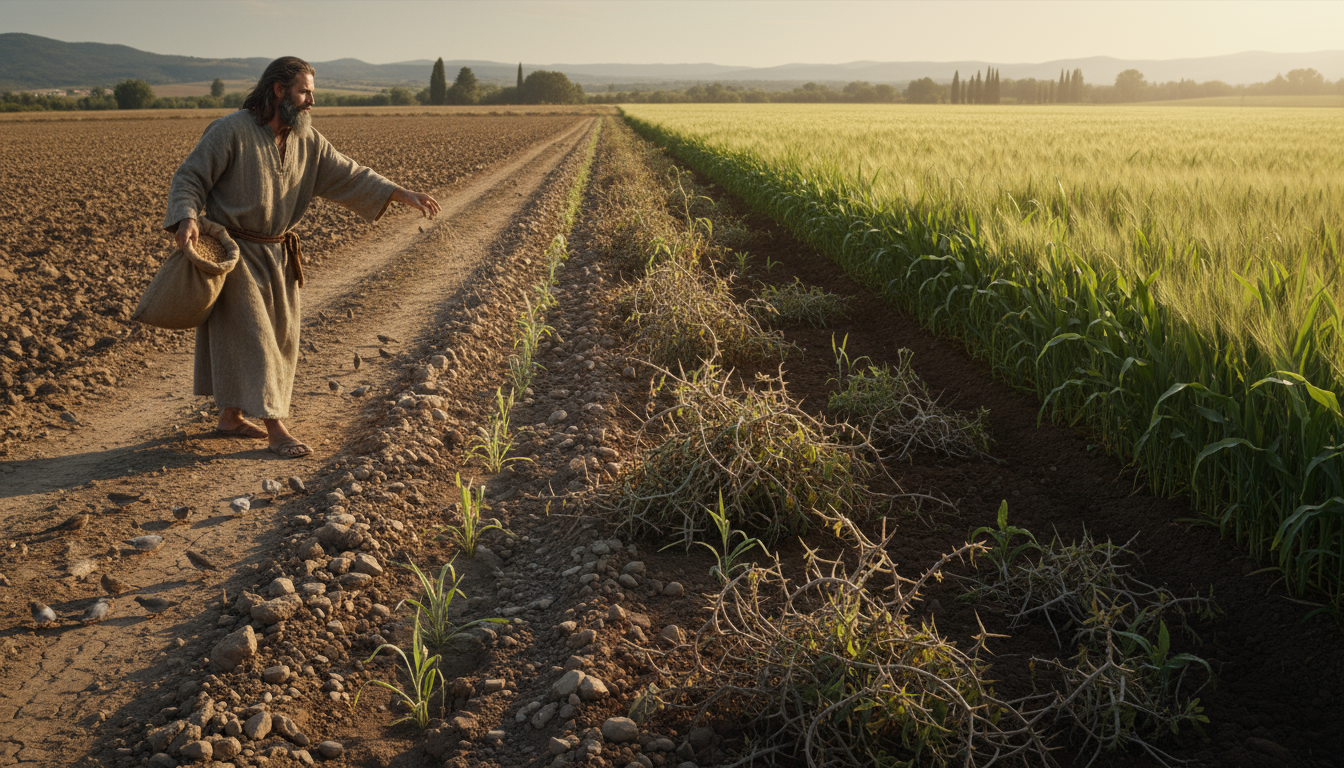
Kingdom Kernel #29 – Unveiling the Kingdom: The Parable of the Sower and the Mystery of God’s Reign

Kingdom Kernel Collection

He began to teach again by the sea. And such a very large crowd gathered to Him that He got into a boat in the sea and sat down; and the whole crowd was by the sea on the land. And He was teaching them many things in parables, and was saying to them in His teaching, “Listen to this! Behold, the sower went out to sow; as he was sowing, some seed fell beside the road, and the birds came and ate it up. Other seed fell on the rocky ground where it did not have much soil; and immediately it sprang up because it had no depth of soil. And after the sun had risen, it was scorched; and because it had no root, it withered away. Other seed fell among the thorns, and the thorns came up and choked it, and it yielded no crop. Other seeds fell into the good soil, and as they grew up and increased, they yielded a crop and produced thirty, sixty, and a hundredfold.” And He was saying, “He who has ears to hear, let him hear.” (Mark 4:1-9)

Introduction

The Parable of the Sower (Matthew 13:1–23, Mark 4:1–20, Luke 8:4–15) stands as a hermeneutical key to understanding the “mystery” (Greek: μυστήριον, mustérion, Strong’s G3466) of God’s kingdom. This term, rooted in the Greek mueó (“to initiate into secrets”), transcends its Hellenistic cultural context of esoteric rituals to describe divine truths revealed only through God’s grace. In the Gospels, Jesus employs this parable to unveil how the kingdom operates in a hidden yet transformative manner, centering on receptive hearts and the power of God’s Word.

Linguistic Roots: Defining the Terms

The Greek mustérion signifies a divine secret once concealed but now disclosed to those initiated by God. Unlike pagan mysteries guarded by exclusivity, Jesus democratizes access to this truth: the kingdom’s arrival is not through political force but through the sowing of the “word of God” (Luke 8:11). The term’s etymology underscores initiation—not into human rituals, but into God’s redemptive plan. Isaiah’s prophecy (Isaiah 6:9–10, cited in Matthew 13:14–15) frames this mystery as a divine paradox: the same message that hardens some hearts softens others, fulfilling God’s sovereign design.

The Parable as Revelation of Kingdom Dynamics

Jesus’ parable illustrates four responses to the “word of the kingdom” (Matthew 13:19):

The hardened heart (pathway soil): Satan snatches the Word, preventing understanding.

The shallow heart (rocky soil): Initial joy withers under trials.

The distracted heart (thorny soil): Worldly cares choke spiritual growth.

The receptive heart (good soil): The Word flourishes, yielding exponential fruit.

Here, the “mystery” lies in the kingdom’s unexpected manifestation—its growth depends not on human merit but on soil conditions (hearts) prepared by God. As Jesus explains to His disciples, “To you has been given the mystery of the kingdom of God, but to those outside, everything comes in parables” (Mark 4:11). The parable both reveals and conceals, separating earnest seekers from the spiritually indifferent.

Christological Fulfillment and Present Lordship

Jesus, as the divine Sower and incarnate Word, embodies the mystery. His teaching fulfills Isaiah’s prophecy, confirming His role as Messiah-King who inaugurates the kingdom in humility. The parable’s focus on hearing and perseverance (Luke 8:15) underscores that the kingdom is both a present reality and a future hope. While its ultimate consummation awaits Christ’s return, its power is active now: the Word transforms lives, and the Spirit enables believers to “bear fruit with perseverance.” (Luke 8:15)

Transformative Implications for Believers

The mystery of the kingdom reshapes discipleship. Believers are called to:

Sow indiscriminately, trusting God to prepare hearts. (Matthew 13:3–9)

Cultivate receptive soil by rooting out distractions and deepening faith. (Mark 4:18–19)

Anticipate spiritual multiplication, as good soil yields “thirty, sixty, or a hundredfold.” (Mark 4:20)

This parable also reaffirms Christ’s present lordship. Though His reign is contested, the Word’s efficacy proves His authority. As Paul later articulates, the mystery hidden for ages is “Christ in you, the hope of glory” (Colossians 1:26–27)—a present indwelling that prefigures eternal fulfillment.

Conclusion: The Eternal Word and Kingdom Expansion

The Parable of the Sower reveals that the kingdom advances not through coercion but through the Spirit-empowered Word. By defining mustérion as God’s gracious disclosure, Jesus invites His followers into a participatory role: as sowers, hearers, and bearers of fruit. This mystery, centered on Christ’s redemptive work, transforms hearts today while pointing toward a harvest of cosmic renewal. In a world of shallow faith and divided allegiances, the parable calls believers to persevere as “good soil,” assured that the Sower’s promise will yield an eternal crop.

Disciple-Maker’s Short Story

The Sower’s Circle

In the soft glow of early spring, Pastor Tom and Anna’s living room hummed with quiet anticipation. The clock ticked toward 7 p.m., and the small group—Q-A-A, Questions, Answers, and Application—settled into mismatched chairs and a sagging couch. A faint breeze carried the scent of blooming lilacs through an open window, mingling with the warmth of coffee and Anna’s homemade lemon bars.

The Parable of the Sower, preached that morning, lingered in their minds like a seed waiting to take root.

Tom, lean and graying, sat in a wooden chair brought from the dining room, his Bible open to Matthew 13. Anna, her smile as steady as the lamplight, passed a plate of snacks. The group—eight in all, from college students to retirees—began with a recap of the sermon: the sower, the seeds, the soils, and the mysterious yields of thirty, sixty, a hundredfold. Tom’s voice, gentle but deliberate, invited them to dig deeper. “What stood out to you today? What questions do you have?”

The first to speak was Rachel, a barista with a nose ring and a notebook full of scribbled thoughts. “Why doesn’t Jesus just tell it straight?” she asked, her brow furrowing. “Parables feel like riddles. Why make it so hard to get?”

Tom leaned forward, but instead of answering, he turned to the group. “What do you think? Why parables?” Silence hung for a moment, then Marcus, a retired mechanic with hands like worn leather, cleared his throat. “Maybe it’s like a oil filter. You know, like filtering oil for dirt and debris. The ones who really want to understand stick around and ask, like the disciples did.” Heads nodded. Sarah, a shy college freshman, added, “It’s like he’s inviting us to chase the truth. If it was all laid out, we might not care as much.”

Tom smiled, his eyes crinkling. “That’s good. Jesus himself says in Matthew 13:11, ‘To you it has been granted to know the mysteries of the kingdom, but to them it has not been granted.’ Parables separate the curious from the casual. They’re not just stories—they’re a call to lean in, to seek. And when we do, like Marcus said, we get initiated into something deeper.” Rachel jotted a note, her face softening as if a knot had loosened.

Next came Jamal, a high school teacher whose tie was still knotted from the morning service. “Okay, but the fourth soil—the good soil—feels so rare,” he said, his voice tinged with frustration. “The path, the rocks, the thorns… that’s most people, right? How much seed—how much of the Word—has to be sown to find that good soil?”

Again, Tom deflected to the group. “What do you make of that? How much sowing is enough?” Anna spoke up, her voice steady. “I think it’s not about counting the seeds. The sower in the story just keeps scattering, no matter the ground. It’s like he trusts the seed to do its work, even if most of it doesn’t take.” Peter, a wiry landscaper, chimed in. “Yeah, in my job, I plant a lot of seeds that don’t make it. You don’t stop planting—you just keep going, hoping for the ones that do.”

Tom nodded, flipping to Mark 4:20. “Exactly. Jesus says the good soil ‘hears the word and accepts it and bears fruit.’ It’s rare, sure, but the sower doesn’t discriminate. He sows everywhere, trusting God to prepare the hearts. Our job isn’t to judge the soil—it’s to keep sowing, keep sharing, keep praying. The yield’s up to Him.”

The room grew quieter as Ellen, a grandmother with a soft Southern drawl, raised her hand. “Tom, is this parable why you started Q-A-A?” Her question landed like a stone in still water, rippling through the group. Tom’s eyes met Anna’s, and a flicker of something—memory, maybe—passed between them.

“Let’s hear from you first,” Tom said, his voice softer now. “What do you think?” Ellen smiled faintly. “Well, this group feels like good soil to me. A place where we can ask hard questions, dig into the Word, and figure out how to live it. Maybe you started it to help us be that fourth soil.”

Others murmured agreement. Rachel added, “Yeah, it’s like we’re learning to sow, too—not just hear the Word, but spread it.” Tom leaned back, his smile broadening. “Exactly! When Anna and I started this, we’d been through some rocky years—ministry struggles, doubts, distractions. We saw how easy it was for the Word to get snatched away or choked out. We wanted a space to cultivate good soil, for ourselves and others. This parable? It’s a reminder that the Word works, but it takes time, questions, and persistence. Like Jesus, we’re called to sow generously and trust the harvest to God.”

The group fell silent, the weight of the parable settling in. Tom shifted gears. “Let’s close with applications. How’s this parable challenging you to live differently? To be more like Jesus?”

Peter spoke first, his voice rough but earnest. “I’m gonna start talking about my faith at work. I’ve been too quiet, worried about the ‘rocks’ or ‘thorns’ in people’s lives. But Jesus didn’t hold back. I want to sow like He did.”

Rachel, flipping through her notebook, said, “I need to stop overthinking and just listen to the Word with an open heart. Be that good soil, you know? Jesus was always seeking the Father’s will—I want that kind of focus.” Jamal, his earlier frustration softened, added, “I’m gonna keep teaching my students about truth, even when it feels like it’s not sticking. Jesus kept sowing, no matter the odds. I want His patience.”

As the group shared, Anna’s eyes glistened. She spoke last, her voice barely above a whisper. “I want to be like Jesus in how He saw people—not as bad soil, but as potential for a harvest. He never gave up on anyone. That’s the heart I want.”

The clock struck 8:30, and the group prayed, their voices weaving together like roots reaching deep. Outside, the spring night was alive with possibility, as if the seeds of their words were already taking hold, waiting for the Sower’s hand to bring the yield.

Kingdom Kernel Collection

Dealing with Counterfeits – #77

ENGLISH / ESPAÑOL

Welcome Back! Today, we’ll be looking at the Gospel of Matthew to see how Jesus addressed the fact that counterfeits will be among us and what we should do about it.   

So let’s dive in.

(Click here to get a copy of the Gospel Sync document) 

Matthew 13:36-43

Then Jesus dismissed the crowds and went into the house. His disciples came to Him and said, “Explain to us the parable of the weeds in the field.” He replied, “The One who sows the good seed is the Son of Man. The field is the world, and the good seed represents the sons of the kingdom. The weeds are the sons of the evil one, and the enemy who sows them is the devil. The harvest is the end of the age, and the harvesters are angels. As the weeds are collected and burned in the fire, so will it be at the end of the age. The Son of Man will send out His angels, and they will weed out of His kingdom every cause of sin and all who practice lawlessness. And they will throw them into the fiery furnace, where there will be weeping and gnashing of teeth. Then the righteous will shine like the sun in the kingdom of their Father. He who has ears, let him hear.

My Thoughts 

Jesus explains a parable He had told the crowd earlier and it comes in handy for all disciple-makers, then and now. The bottom line is that there will be counterfeits in the kingdom and God will deal with them in the end. 

So why is this so important? I’ve always thought this parable was about us not judging others. But Jesus isn’t talking about our judgment of others. If anything, He’s warning the angels not to judge too soon. No, Jesus is simply stating that God knows who the counterfeits are and will have His angels execute judgment at the appropriate time and in the appropriate way. 

So what does this parable mean for us as disciples and disciple-makers? It means we are going to have to live with the fact that there are counterfeits in our midst. Some we will spot easily and some we won’t. What’s really interesting is that when Jesus told the parable to the crowd, He made this statement;

And he said to them, ‘An enemy has done this!’ The slaves said to him, ‘Do you want us, then, to go and gather them up?’ But he said, ‘No; for while you are gathering up the tares, you may uproot the wheat with them.  (Matthew 13:28-29)

One has to wonder how removing the counterfeits could damage the real disciples!? How in the world could living with a bunch of posers benefit the real deal?

I can think of five ways living with counterfeit Christians would be to our benefit;

  1. God is testing us – As in the Old Testament, God used the counterfeits to test our desire and determination to search out the truth. (Deuteronomy 13:1-3)
  2. To create self-examination – It challenges true believers to continually examine and strengthen their own faith, ensuring they remain rooted in authentic belief. (2 Corinthians 13:5)
  3. It teaches us how to treat carnal “Christians” – It gives us an opportunity to heed the warnings given to us in Scripture for those we may doubt are really in the kingdom. (1 Corinthians 5:11-13, Matthew 7:15-23, 2 Timothy 3:5, Titus 3:10-11)
  4. We learn more about the patience of God – He is waiting for them to turn and wants all people to come to repentance and be saved. (2 Peter 3:9)
  5. We learn more about the absolute justice of God – In the end, God will pour out His wrath on those who do not receive His Son, repent of their sins, and enter the kingdom of grace. (Matthew 13:24-50, 25:31-46)

Certainly, we’ve all heard sermons using this passage to exhort us not to judge others. But there’s a polar opposite admonition here. Be on the alert for false teachers and carnal people who claim to be in the kingdom.  The Scriptures warn us to steer clear of such people.

I’d like to invite my readers to a Q&A session on July 27th at 9:30 am CST on Zoom. If you’d like to join in, click this link or see the link in the video description below.

My Story

When I was a full time pastor, I taught a Sunday School class of about 30 older singles (Thirties to Forties). On more than one occasion a well spoken, well put together guy would find his way into the class and I would think to myself, “Now here’s a guy I’d like to disciple!” Only to find out weeks later he was just a wolf on the prowl for a single lady and didn’t have a spiritual bone in his body. And, by the way, there were some wolvettes too.

When we figured out who these people were and what they were doing, we had to warn the folks in the Sunday School Class and ask the predators to leave. It wasn’t easy and I’m sure there were mistakes made and feelings hurt. But, as disciple-makers, we are not only entrusted with the instruction of the flock but the protection of the flock as well. I learned how to spot the wolves and wolvettes early and how to ask questions that would expose them and run them off. Here’s a few of my lessons learned and what to look for;

  • Don’t be fooled by good looks
  • Don’t be fooled by super spiritual talk
  • Their knowledge is superficial
  • They twist truth and scripture to fit their own agenda
  • Their actions don’t match their words
  • Monitor what activities they tend to show up at
  • See if they avoid the leadership of the church
  • They refuse accountability and react defensively to criticism
  • They seek power and control rather than empowering others
  • They use emotions like guilt, shame, and fear to control others
  • They are experts at deception and manipulation
  • Ask “What brings you to our fellowship?”
  • Ask “Why did you leave your previous fellowship?”
  • They leave a trail of hurt people behind them

Our Action Plan

Have you ever run into a wolf or wolfette? Here’s some ideas to help you protect yourself and those you are discipling.  

  • Be knee deep in the truth (the Word) and you’ll be able to spot the lie. (John 17:17)
  • Stay within your relational capacity so you know the condition of the flock. (Proverbs 27:23)
  • Know yourself and be open to critique and accountability. (1 Timothy 4:16, Proverbs 27:17)

Counterfeits will be among us by design. As disciple-makers we need to be able to respond appropriately and protect the flock.

Lidiando Con las Falsificaciones – #77

¡Bienvenido! Hoy, veremos el Evangelio de Mateo para ver cómo Jesús abordó el hecho de que las falsificaciones estarán entre nosotros y qué debemos hacer al respecto.

Así que comencemos

Mateo 13:36-43

Entonces, despedida la gente, entró Jesús en la casa; y acercándose a él sus discípulos, le dijeron: Explícanos la parábola de la cizaña del campo.  Respondiendo él, les dijo: El que siembra la buena semilla es el Hijo del Hombre.  El campo es el mundo; la buena semilla son los hijos del reino, y la cizaña son los hijos del malo. El enemigo que la sembró es el diablo; la siega es el fin del siglo; y los segadores son los ángeles. De manera que como se arranca la cizaña, y se quema en el fuego, así será en el fin de este siglo.  Enviará el Hijo del Hombre a sus ángeles, y recogerán de su reino a todos los que sirven de tropiezo, y a los que hacen iniquidad,  y los echarán en el horno de fuego; allí será el lloro y el crujir de dientes.  Entonces los justos resplandecerán como el sol en el reino de su Padre. El que tiene oídos para oír, oiga.

Mis Pensamientos

Jesús explica una parábola que le había contado a la multitud antes y que es útil para todos los hacedores de discípulos, en aquel entonces y los de ahora. La conclusión es que habrá falsificaciones cerca  del reino y Dios se ocupará de ellas al final.

Entonces, ¿por qué es esto tan importante? Siempre he pensado que esta parábola se trataba de que no juzguemos a los demás. Pero Jesús no está hablando de nuestro juicio sobre los demás. En todo caso, está advirtiendo a los ángeles que no juzguen demasiado pronto. No, Jesús simplemente está declarando que Dios sabe quiénes son los falsificadores y que Él hará que Sus ángeles ejecuten juicio en el momento apropiado y de la manera apropiada.

Entonces, ¿qué significa esta parábola para nosotros como discípulos y hacedores de discípulos? Significa que vamos a tener que vivir con el hecho de que hay falsificaciones entre nosotros. Algunos los detectaremos fácilmente y otros no. Lo que es realmente interesante es que cuando Jesús contó la parábola a la multitud, hizo esta declaración;

Él les dijo: Un enemigo ha hecho esto. Y los siervos le dijeron: ¿Quieres, pues, que vayamos y la arranquemos?  Él les dijo: No, no sea que al arrancar la cizaña, arranquéis también con ella el trigo. (Mateo 13:28-29)

Uno tiene que preguntarse cómo eliminar las falsificaciones podría dañar a los verdaderos discípulos. ¿Cómo es posible que convivir con un grupo de farsantes pueda ser de beneficio para lo que son verdaderos seguidores?

 Puedo pensar en cinco formas en que convivir con cristianos falsos sería para nuestro beneficio;

1.  Dios lo pone como prueba: como en el Antiguo Testamento, Dios usó las falsificaciones para probar nuestro deseo y determinación de buscar la verdad. (Deuteronomio 13:1-3)

2.  Para crear un autoexamen: desafía a los verdaderos creyentes a examinar y fortalecer continuamente su propia fe, asegurándose de que permanezcan arraigados en la creencia auténtica. (2 Corintios 13:5.)

3.  Nos enseña cómo tratar a los “cristianos” carnales: nos da la oportunidad de prestar atención a las advertencias que se nos dan en las Escrituras para aquellos que podemos dudar que estén realmente en el reino. (1 Corintios 5:11-13, Mateo 7:15-23, 2 Timoteo 3:5, Tito 3:10-11)

4.  Aprendemos más sobre la paciencia de Dios: Él está esperando que se conviertan y quiere que todas las personas se arrepientan y sean salvas. (2 Pedro 3:9).

5. Aprendemos más sobre la justicia absoluta de Dios – Al final, Dios derramará Su ira sobre aquellos que no reciban a Su Hijo, se arrepientan de sus pecados y entren en el reino de la gracia. (Mateo 13:24-50, 25:31-46.) 

Ciertamente, todos hemos escuchado sermones que usan este pasaje para exhortarnos a no juzgar a los demás. Pero aquí hay una advertencia opuesta. Estén alerta por los falsos maestros y las personas carnales que afirman estar en el reino.  Las Escrituras nos advierten que nos mantengamos alejados de tales personas.

Mi Historia

Cuando era pastor de tiempo completo, enseñé una clase de escuela dominical de unos 30 solteros mayores (aquellos entre treinta y cuarenta años). En más de una ocasión, un tipo muy elocuente y bien formado encontró el camino a nuestra clase y yo pensé: “¡Ahora aquí hay un tipo a quien me gustaría discipular!” Solo para descubrir semanas después que era solo un lobo al acecho de alguna dama soltera y él no tenía ni un hueso espiritual en su cuerpo. Y, por cierto, también habían algunas lobitas.

Cuando descubrimos quiénes eran estas personas y qué estaban haciendo, tuvimos que advertir a la gente de la clase de escuela dominical y pedirles a los depredadores que se fueran. No fue fácil y estoy seguro de que se cometieron errores y se hirieron los sentimientos de algunos. Pero, como hacedores de discípulos, no solo se nos confía la instrucción del rebaño, sino también la protección del rebaño. Aprendí a detectar a los lobos y las lobas temprano y a hacer preguntas que los expondrían y los ahuyentaran. Estas son algunas de mis lecciones aprendidas y qué buscar:

–          No te dejes engañar por la buena apariencia exterior

–          No te dejes engañar por la charla súper espiritual

–          Su conocimiento es superficial

–          Tuercen la verdad y las escrituras para que se ajusten a su propia agenda

–          Sus acciones no coinciden con sus palabras

–          Supervisa las actividades en las que tienden a aparecer

–          Fíjate si evitan el liderazgo de la iglesia

–          Se niegan a rendir cuentas y reaccionan a la defensiva ante las críticas

–          Buscan poder y control en lugar de empoderar a otros

–          Usan emociones como la culpa, la vergüenza y el miedo para controlar a los demás

–          Son expertos en engaño y manipulación

–          Pregunta: “¿Qué te trae a nuestro grupo?

–          Pregunta: “¿Por qué dejó su enseñanza anterior?”

–          Dejan un rastro de personas heridas detrás de ellos

Nuestro Plan de Acción

¿Alguna vez te has encontrado con un lobo o un lobo? Aquí hay algunas ideas para ayudarlo a protegerse a sí mismo y a aquellos a quienes está discipulando.

–          Está sumergido hasta las rodillas en la verdad (la Palabra) y podrás detectar la mentira

       (Juan 17:17).                      

–     Mantente dentro de tu capacidad relacional para conocer la condición del rebaño. (Proverbios 

       27:23).

–          Conócete a ti mismo y mantente abierto a la crítica y la responsabilidad. (1 Timoteo 4:16, 

       Proverbios 27:17). 

Las falsificaciones estarán entre nosotros por diseño. Como hacedores de discípulos, debemos ser capaces de responder adecuadamente y proteger al rebaño.

Because it Grows – #76

ENGLISH / ESPAÑOL

Welcome Back! Today, we’ll be combining the Gospels of Matthew and Mark and considering what Jesus said about kingdom growth.  

So let’s dive in.

(Click here to get a copy of the Gospel Sync document) 

Matthew 13:31-33; Mark 4:30-32

He put before them another parable: He asked, “To what can we compare the kingdom of God? Then With what parable shall we present it?

“The kingdom of heaven is like a mustard seed that a man planted in his field. Although it is the smallest of all seeds, sown upon the earth yet it grows into the largest of all garden plants and becomes a tree, and puts forth great branches, so that the birds of the air come and nest in the shade of its branches.”

He told them still another parable: “The kingdom of heaven is like leaven that a woman took and mixed into three measures of flour, until all of it was leavened.”

My Thoughts 

I always loved the way the late Steve Smith used to approach these parables. He would ask, “If you were an eight year old boy or girl, what would you say this parable is about?” I like that question because it gets after what Jesus was trying to communicate rather than some theological detour that completely misses the point.

So what would an eight year old boy or girl say this parable is about? I think they would say, “the kingdom grows like a tree. Duh!”

So here’s my 65 year old response, “Why don’t we believe what Jesus said?” Maybe I’m the only one who’s become impatient and wants to speed things up. If Jesus said the kingdom grows like a plant, a slow steady process, why do I want to put it in a microwave when it’s really like a crockpot. Plants take time to grow. The farmer doesn’t hunch over the little sprouts and tug on them to hurry them along. What does he do? As in the previous parable in Mark 4:26-29, he simply goes to sleep. What? Where’s your sense of commitment!? Where’s the urgency!? 

Have you ever noticed that God loves the process as much as He loves the product? I mean, wouldn’t it be easier if He just culled out those “chosen sense the foundation of the world” and be done with it? Nope, God likes watching things grow and we should enjoy watching His kingdom grow alongside Him.

I’d like to invite my readers to a Q&A session on July 27th at 9:30 am CST on Zoom. If you’d like to join in, click this link or see the link in the video description below.

My Story

Yesterday Deb and I had the privilege of sending Mike and Rachel Castlen off to their next assignment in St. Louis. They’ve been leading the Dicopoulos Church for over two years now and they passed leadership on to Mike and Perla Stegall. It’s exciting to see the next generation step up to shepherd the oldest church in San Antonio. Well, the oldest church Deb and I have had the pleasure of being a part of 🙂.

The church was started a little over ten years ago when Daniel Aspenwall, Deb and I were out sharing the gospel. We approached two ladies attending a garden in the back of an apartment complex. (We must have looked like the brute squad coming up on these women, the three of us and Daniel being over six feet tall.) As we shared the good news, one of the ladies, Debbie, was interested in hearing more about Jesus. We were going out of town so we gave the assignment of starting the church to Daniel and had him invite Brett and Abigail Wilson to help. Debbie was baptized soon afterwards by Abigail.

Brett and Abigail shepherded that church for more than eight years and were discipling the Castlen’s along the way. Before heading off to Germany the Wilson’s handed the reins to Mike and Rachel. And now they have handed the church off to Mike and Perla. That’s four generations of laborer’s hands that little church has passed through; The Wood’s to the Wilson’s to the Castlen’s to the Stegall’s.

I recently heard a pastor lament that he was getting old but had no one to entrust the flock to as he aged. That makes me sad. No one wants to step up and be a part of the kingdom’s growing process? That’s why when we plant a church we start discipleship and leadership development at the same time, DAY ONE!

Our Action Plan

Now we’ll look at some ideas on how to help us as disciple-makers train others for leadership in the kingdom.

  • Start treating every disciple as a disciple-maker
  • Mentor in such a way that you use the 3Ds; Discover, Develop, Deploy
  • Challenge people to own their privilege and right to be a priest (1 Peter 2:9)

As we look forward to the kingdom’s growth, let’s steward discipleship in a manner that empowers individuals to become the “growth agents” they are designed to be.

Porque Crece – #76

¡Bienvenido! Hoy, combinaremos los Evangelios de Mateo y Marcos y consideraremos lo que Jesús dijo sobre el crecimiento del reino.

Así que comencemos.

Mateo 13:31-33; Marcos 4:30-32

Otra parábola les refirió, diciendo: El reino de los cielos es semejante al grano de mostaza, que un hombre tomó y sembró en su campo;  el cual a la verdad es la más pequeña de todas las semillas; pero cuando ha crecido, es la mayor de las hortalizas, y se hace árbol, de tal manera que vienen las aves del cielo y hacen nidos en sus ramas.

Otra parábola les dijo: El reino de los cielos es semejante a la levadura que tomó una mujer, y escondió en tres medidas de harina, hasta que todo fue leudado.

Mis Pensamientos

Siempre me encantó la forma en que el difunto Steve Smith solía abordar estas parábolas. Él preguntaba: “Si fueras un niño o una niña de ocho años, ¿de qué dirías que se trata esta parábola?” Me gusta esa pregunta porque se basa en lo que Jesús estaba tratando de comunicar en lugar de un desvío teológico que pierde completamente el punto.

Entonces, ¿de qué diría un niño o una niña de ocho años que se trata esta parábola? Creo que dirían: “el reino crece como un árbol. ¡Obvio!”

Así que aquí está mi respuesta a mis 65 años: “¿Por qué no creemos lo que dijo Jesús?” Tal vez soy el único que se ha impacientado y quiere acelerar las cosas. Si Jesús dijo que el reino crece como una planta, un proceso lento y constante, ¿por qué quiero ponerlo en un microondas cuando en realidad es como una olla de cocción lenta? Las plantas tardan en crecer. El granjero no se encorva sobre los pequeños brotes y tira de ellos para apresurarlos. ¿Qué hace? Como en la parábola anterior en Marcos 4:26-29, simplemente se va a dormir. ¿Qué? ¿Dónde está tu sentido de compromiso? ¿Dónde está la urgencia?

¿Alguna vez has notado que Dios ama el proceso tanto como ama el producto? Quiero decir, ¿no sería más fácil si Él simplemente eliminó a aquellos “elegidos que sienten el fundamento del mundo” y terminara con eso? No, a Dios le gusta ver crecer las cosas y deberíamos disfrutar viendo crecer Su reino junto a Él.

Mi Historia

Ayer, Deb y yo tuvimos el privilegio de enviar a Mike y Rachel Castlen a su próxima iglesia en St. Louis. Ellos han estado dirigiendo la Iglesia Dicopoulos durante más de dos años y ahora pasaron el liderazgo a Mike y Perla Stegall. Es emocionante ver a la próxima generación dar un paso adelante para pastorear la iglesia más antigua de San Antonio. Bueno, la iglesia más antigua de la que Deb y yo hemos tenido el placer de ser parte 🙂.

La iglesia se inició hace poco más de diez años cuando Daniel Aspenwall, Deb y yo estábamos compartiendo el evangelio. Nos acercamos a dos señoras que asistían a un jardín en la parte trasera de un complejo de apartamentos. (Debimos haber parecido el escuadrón bruto que se acercaba a estas mujeres, nosotros tres y Daniel quien medía más de seis pies de altura). Mientras compartíamos las buenas noticias, una de las señoras, Debbie, estaba interesada en escuchar más sobre Jesús. Íbamos a salir de la ciudad, así que le dimos la tarea de comenzar la iglesia a Daniel y le pedimos que invitara a Brett y Abigail Wilson para ayudar. Debbie fue bautizada poco después por Abigail.

Brett y Abigail pastorearon esa iglesia durante más de ocho años y fueron discipulando a los Castlen en el camino. Antes de partir a Alemania, los Wilson entregaron las riendas a Mike y Rachel. Y ahora han entregado la iglesia a Mike y Perla. Son cuatro generaciones de manos de obreros por las que ha pasado esa pequeña iglesia; de los Wood (nosotros) a los Wilson, a los Castlen y a los Stegall.

Recientemente escuché a un pastor lamentarse de que estaba envejeciendo pero no tenía a nadie a quien confiar el rebaño a medida que envejecía. Eso me entristece. ¿Nadie quiere dar un paso al frente y ser parte del proceso de crecimiento del reino? Es por eso que cuando plantamos una iglesia comenzamos el discipulado y el desarrollo del liderazgo al mismo tiempo, ¡DÍA UNO!

Nuestro plan de acción

Ahora veremos algunas ideas sobre cómo ayudarnos a nosotros, como hacedores de discípulos, a capacitar a otros para el liderazgo en el reino.

–       Comienza a tratar a cada discípulo como un hacedor de discípulos

–       Mentor de tal manera que uses las 3 Ds; Descubre, Desarrolla, Despliega

–       Desafiar a las personas a reconocer su privilegio y derecho a ser sacerdotes (1 Pedro 2:9)

Mientras esperamos el crecimiento del reino, administremos el discipulado de una manera que capacite a las personas para que se conviertan en los “agentes de crecimiento” para lo que están diseñados.

Being Brilliantly Vague – #75

Index for all posts in the Gospel Sync Series

ENGLISH / ESPAÑOL

Welcome Back! Today, we’ll be looking at the Gospel of Matthew to see how Jesus used vague stories to cull out the hungry. 

So let’s dive in.

(Click here to get a copy of the Gospel Sync document) 

Matthew 13:24-30

Jesus put before them another parable: “The kingdom of heaven is like a man who sowed good seed in his field. But while everyone was asleep, his enemy came and sowed weeds among the wheat, and slipped away. When the wheat sprouted and bore grain, then the weeds also appeared. The owner’s servants came to him and said, ‘Sir, didn’t you sow good seed in your field? Where then did the weeds come from?’ ‘An enemy did this,’ he replied. So the servants asked him, ‘Do you want us to go and pull them up?’ ‘No,’ he said, ‘if you pull the weeds now, you might uproot the wheat with them. Let both grow together until the harvest. At that time I will tell the harvesters: First collect the weeds and tie them in bundles to be burned; then gather the wheat into my barn.’”

My Thoughts 

Jesus continues to instruct the crowd on the kingdom using parables. He would explain the parable later to His disciples privately. Think about this for a second. How does this stack up to our teaching or preaching today? Do we leave people hanging in suspense or do we try to make sure everyone understands to the nth degree? Or do we provide a space after our preaching or teaching to ask questions, wrestle with the concepts, and gain more clarity? Or is it a “One and Done” proposition. (I’m actually convicting myself as I’m writing this.) 

I think if we taught like Jesus we would have the same results He did. Yeah, a bunch of people wouldn’t get it but we would also have a handful of ferociously hungry people that would crawl a mile over broken glass to know the King.

In light of this, I’d like to invite my readers to a Q&A session on July 27th at 9:30 am CST on Zoom. If you’d like to join in, click this link or see the link in the video description below.

My Story

I once had a mentor that was brilliant but had a really tough time getting his point across. You’d have to hear him teach the subject several times and ask questions in order to extract the gold he was alluding to. 

I invited a guy I was discipling to a conference where my mentor was the keynote speaker. I warned my new friend; “Now, the speaker at this conference is going to seem like he’s speaking pure gibberish. Hang in there with him, ask good questions, and I promise you by the end of this weekend you’ll walk away being extremely encouraged and challenged.” 

Sure enough after the first session, my friend came up to me and said, “I didn’t understand a single thing that guy was talking about.” I exhorted him to hang in there.

On our drive home he was extremely quiet and I thought maybe I had made a promise I couldn’t keep. I asked him what his big take away was from the weekend. He said, “You were right. After the first session, I was wondering why I even came this weekend. But by the third, I fell under heavy conviction that I need to be making disciples myself. That guy was spot on!”

That mentor taught more like Jesus than anyone I’ve ever known. Maybe not intentionally but the effect was the same.

Our Action Plan

Now it’s time for application. Here’s some ideas.

  • Share the stories Jesus shared (without explanation)
  • Save time for Q&A at the end of your teaching
  • Provide a space and time to discuss the topic later

We have a lot of good resources that instruct us on how to be effective teachers. I’ve never read one that said, “As you teach, remain vague in order to cull out the hungry.” But the greatest Teacher to ever live gave us a model for finding that needle in a haystack.

Index for all posts in the Gospel Sync Series

Ser Brillantemente Vago – #75

Bienvenidos de nuevo! Hoy analizaremos el Evangelio de Mateo para ver cómo Jesús usó historias vagas para ayudar a los hambrientos.

Así que vamos a comenzar.

Mateo 13:24-30

Jesús entonces les refirió otra parábola, diciendo: El reino de los cielos es semejante a un hombre que sembró buena semilla en su campo;  pero mientras dormían los hombres, vino su enemigo y sembró cizaña entre el trigo, y se fue. Y cuando salió la hierba y dio fruto, entonces apareció también la cizaña.  Vinieron entonces los siervos del padre de familia y le dijeron: Señor, ¿no sembraste buena semilla en tu campo? ¿De dónde, pues, tiene cizaña?  Él les dijo: Un enemigo ha hecho esto. Y los siervos le dijeron: ¿Quieres, pues, que vayamos y la arranquemos? Él les dijo: No, no sea que al arrancar la cizaña, arranquéis también con ella el trigo.  Dejad crecer juntamente lo uno y lo otro hasta la siega; y al tiempo de la siega yo diré a los segadores: Recoged primero la cizaña, y atadla en manojos para quemarla; pero recoged el trigo en mi granero.”

Mis Pensamientos

Jesús continúa instruyendo a la multitud sobre el reino usando parábolas. Más tarde explicaría la parábola a sus discípulos en privado. Piense en esto por un segundo. ¿Cómo se compara esto con nuestra enseñanza o predicación de hoy? ¿Dejamos a la gente colgando en suspenso o tratamos de asegurarnos de que todos entiendan hasta el enésimo grado? ¿O proporcionamos un espacio después de nuestra predicación o enseñanza para hacer preguntas, luchar con los conceptos y obtener más claridad? ¿O es una propuesta de “Un sermón y listo”? (De hecho, me estoy convenciendo a mí mismo mientras escribo esto).

Creo que si enseñáramos como Jesús, tendríamos los mismos resultados que Él. Sí, un montón de gente no lo entendería, pero también tendríamos un puñado de personas ferozmente hambrientas que se arrastrarían una milla sobre vidrios rotos para conocer al Rey.

A la luz de esto, me gustaría invitar a mis lectores a una sesión de preguntas y respuestas el 27 de agosto a las 9:30 am CST en Zoom. Si desea unirse, haga clic en este enlace o vea el enlace en la descripción del video a continuación.

Mi Historia

Una vez tuve un mentor que era brillante, pero me costó mucho transmitir su punto de vista. Tendrías que escucharlo enseñar el tema varias veces y hacer preguntas para extraer el oro al que estaba aludiendo.

Invité a un chico al que estaba discipulando a una conferencia en la que mi mentor era el orador principal. Advertí a mi nuevo amigo; “Ahora, el orador en esta conferencia va a parecer que está hablando puro galimatías. Aguanta con él, haz buenas preguntas y te prometo que al final de este fin de semana te irás muy animado y desafiado”.

Efectivamente, después de la primera sesión, mi amigo se acercó a mí y me dijo: “No entendí nada de lo que estaba hablando ese tipo”. Lo exhorté a aguantar.

En nuestro camino a casa estaba extremadamente callado y pensé que tal vez había hecho una promesa que no podía cumplir. Le pregunté cuál fue su gran conclusión del fin de semana. Él dijo: “Tenías razón. Después de la primera sesión, me preguntaba por qué vine este fin de semana. Pero a la tercera, caí bajo una fuerte convicción de que yo mismo necesitaba hacer discípulos. ¡Ese tipo dio en el clavo!”

Ese mentor enseñó más como Jesús que cualquier otra persona que haya conocido. Tal vez no intencionalmente, pero el efecto fue el mismo.

Nuestro Plan de Acción

Ahora es el momento de la solicitud. Aquí hay algunas ideas.

–       Comparte las historias que Jesús compartió (sin explicación)

–       Ahorra tiempo para preguntas y respuestas al final de su enseñanza

–       Proporciona un espacio y tiempo para discutir el tema más tarde 

Tenemos muchos buenos recursos que nos instruyen sobre cómo ser maestros efectivos. Nunca he leído uno que diga: “Mientras enseñas, permanece vago para seleccionar a los hambrientos”. Pero el Maestro más grande que jamás haya existido nos dio un modelo para encontrar esa aguja en un pajar.

Traducción por Norma Klingler

I Don’t Know – #74

Index for all posts in the Gospel Sync Series

ENGLISH / ESPAÑOL

Welcome Back! Today, we’ll be looking at the Gospel of Mark to discover the attitude we should have as we advance God’s kingdom.  

So let’s dive in.

(Click here to get a copy of the Gospel Sync document) 

Mark 4:26-29

Jesus also said, “The kingdom of God is like a man who scatters seed on the ground. Night and day he sleeps and wakes, and the seed sprouts and grows, though he knows not how. All by itself the earth produces a crop—first the stalk, then the head, then grain that ripens within. And as soon as the grain is ripe, he swings the sickle, because the harvest has come.”

My Thoughts 

Jesus continues to teach His disciples about the kingdom of God. He says it’s like a man, a farmer planting seeds in his field. It’s a pretty normal view of agricultural activities except for one aspect. The farmer has no clue how his crop is growing. It’s a mystery to him how a few little seeds can mature into healthy plants and bear fruit.

Now, today with all our advances in science and technology we think we know so much more than a simple Judean farmer in the first century AD or a 30 year old Jewish Rabbi who was a carpenter. And we absolutely do know more today than that farmer (but probably not the Jewish carpenter who is omniscient).  If you do a Google search “Have we solved all the mysteries of how plants grow?” you’ll get a hundred links to mysteries we have solved with modern technology and knowledge over the past few years. But that only proves the parables point, the “farmer,” past or present, is still learning and he doesn’t “really know” how it grows, not completely anyways. There’s still a lot of mystery.

Listen to Sujata Gupta, author of an article entitled “Scientists should report results with intellectual humility” and describes a problem with scientific findings that undermines our assumption that “we know it all.”

“Because scientists’ careers often hinge on publishing research papers in top-tier journals, Hoekstra says, they can feel pressure to exaggerate their findings. Scientists might hype the novelty of a study, tinker with statistics to obscure uncertainties in the data, gloss over failed experiments or imply that theoretical results are closer to real-life application than they actually are. Problematically, Hoekstra says, the publication process rewards this behavior. Journal editors and paper reviewers who green-light studies tend to prioritize clear narratives over more nuanced ones.” 

Now we know honest mistakes are made by even the smartest people. But what she is referring to is when people intentionally stretch the truth to make things look better than they actually are. In this case it’s the scientist looking “smarter” than they are. Before we start dogpiling on scientists we need to admit that the same integrity problems exist in every field of work and study. I’ve known theologians and disciple-makers who do the same thing! And this brings me to my point; We need to acknowledge that we don’t know as much as we think we do about kingdom growth. In other words, with all our theological knowledge, all our methods and traditions, all our tactics and strategies, it’s still a mystery and all the credit goes to God. Listen to how the Apostle Paul echoes the trues of Jesus’s assessment of the farmer;

I planted, Apollos watered, but God was causing the growth. So then neither the one who plants nor the one who waters is anything, but God who causes the growth.  (1 Corinthians 3:6-7)

Notice how Paul, even with our human contribution, attributes the growth to God. I think that is the point Jesus is getting at when He says the farmer doesn’t know how the crops grow. The kingdom of God grows because it is a work of God not a result of our intellectual prowess or exceptional skills. We need to stay humble.

My Story

I love to tell the story about two of my friends who went to India to observe a “movement of the gospel.” Hundreds of people were coming to Christ every month. They were blown away by the amazing kingdom growth. They asked the missionary, “What tools are working here?” To which he nonchalantly replied, “All of them.” My friends responded, “No, no, what methods are you using that are leading to so many people receiving the gospel?” Again he replied, “All of them.” 

My friends were dumbfounded and to be honest, so was I. We had to admit that it wasn’t necessarily a method of sharing the gospel or a style, it was God who was doing the work through His servants in the ways He chose to do it. This immediately puts the credit for ministry where it belongs. And we have to acknowledge that we don’t know as much as we thought we did.

As disciple makers we need to embrace several things;

  1.  Avoid getting married to our tools
  2. Teach Biblical principles as the foundation, not methods  
  3. Let those we are discipling adapt their methods to their context and situations
  4. Acknowledge God is really the One doing the work and give Him glory

“God can use crooked sticks to hit straight licks.” Jeff Sundell

Our Action Plan

What are the tools or methods you enjoy using? Here’s some ideas to help you separate the principles from the methods and avoid methodolatry and stay humble.  

  • Spend some time in prayer asking God for wisdom in this area
  • List all your “tools” and categorize them by the Biblical principle they fulfill
  • Teach those you’re discipling the difference between principles and methods

We know a lot and we are learning more everyday. But do we know it all? This reminds us to stay humbly dependent on the One who does and at the end of the day, give Him the credit.

Index for all posts in the Gospel Sync Series

No Sé – #74

¡Bienvenido! Hoy, veremos el Evangelio de Marcos para descubrir la actitud que debemos tener al avanzar en el reino de Dios.

Así que vamos a comenzar.

Marcos 4:26-29

Decía además: Así es el reino de Dios, como cuando un hombre echa semilla en la tierra;  y duerme y se levanta, de noche y de día, y la semilla brota y crece sin que él sepa cómo.  Porque de suyo lleva fruto la tierra, primero hierba, luego espiga, después grano lleno en la espiga;  y cuando el fruto está maduro, en seguida se mete la hoz, porque la siega ha llegado.

Mis Pensamientos

Jesús continúa enseñando a Sus discípulos sobre el reino de Dios. Dice que es como un hombre, un agricultor que planta semillas en su campo. Es una visión bastante normal de las actividades agrícolas, con una excepción importante. El agricultor no tiene ni idea de cómo está creciendo su cultivo. Es un misterio para él cómo unas pocas semillas pequeñas pueden madurar y convertirse en plantas sanas y dar frutos.

Ahora, hoy, con todos nuestros avances en ciencia y tecnología, creemos que sabemos mucho más que un simple agricultor judío en el siglo I D.C. o un rabino judío de 30 años que era carpintero. Y sabemos absolutamente más hoy que ese agricultor (pero probablemente no el carpintero judío que es omnisciente).  Si haces una búsqueda en Google “¿Hemos resuelto todos los misterios de cómo crecen las plantas?” Obtendrás cien enlaces a misterios que hemos resuelto con tecnología moderna y conocimiento en los últimos años. Pero eso solo prueba el punto de las parábolas, el “agricultor”, pasado o presente, todavía está aprendiendo y no “sabe realmente” cómo crece la semilla, al menos no completamente. Todavía hay mucho misterio en ello.

Escuche a Sujata Gupta, autora de un artículo titulado  “Los científicos deben informar los resultados con humildad intelectual” y describe un problema con los hallazgos científicos que socava nuestra suposición de que “lo sabemos todo.”

“Debido a que las carreras de los científicos a menudo dependen de la publicación de artículos de investigación en revistas de primer nivel, dice Hoekstra, pueden sentirse presionados para exagerar sus hallazgos. Los científicos pueden exagerar la novedad de un estudio, jugar con las estadísticas para ocultar las incertidumbres en los datos, pasar por alto experimentos fallidos o insinuar que los resultados teóricos están más cerca de la aplicación en la vida real de lo que realmente están. Problemáticamente, dice Hoekstra, el proceso de publicación recompensa este comportamiento. Los editores de revistas y los revisores de artículos que dan luz verde a los estudios tienden a priorizar las narrativas claras sobre las que tienen diferencias”.

Ahora sabemos que incluso las personas más inteligentes cometen errores honestos los. Pero a lo que se refiere es a cuando las personas intencionalmente estiran la verdad para hacer que las cosas se vean mejor de lo que realmente son. En este caso, es el científico parece ser “más inteligente” de lo que es. Antes de comenzar a perseguir a los científicos, debemos admitir que existen los mismos problemas de integridad en todos los campos de trabajo y estudio. ¡He conocido teólogos y hacedores de discípulos que hacen lo mismo! Y esto me lleva a mi punto: necesitamos reconocer que no sabemos tanto como creemos que sabemos sobre el crecimiento del reino. En otras palabras, con todo nuestro conocimiento teológico, todos nuestros métodos y tradiciones, todas nuestras tácticas y estrategias, sigue siendo un misterio y todo el crédito es para Dios. Escuche cómo el apóstol Pablo hace eco de las verdades de la evaluación de Jesús sobre el agricultor:

Yo planté, Apolos regó; pero el crecimiento lo ha dado Dios. Así que ni el que planta es algo, ni el que riega, sino Dios, que da el crecimiento.  (1 Corintios 3:6-7).

Observe cómo Pablo, incluso con nuestra contribución humana, atribuye el crecimiento a Dios. Creo que ese es el punto al que Jesús se refiere cuando dice que el agricultor no sabe cómo crecen los cultivos. El reino de Dios crece porque es una obra de Dios, no el resultado de nuestra destreza intelectual o habilidades excepcionales. Necesitamos mantenernos humildes.

Mi Historia

Me encanta contar la historia de dos de mis amigos que fueron a la India para observar un “movimiento del Evangelio”. Cientos de personas venían a Cristo cada mes. Quedaron impresionados por el asombroso crecimiento del reino. Le preguntaron al misionero: “¿Qué herramientas están funcionando aquí?” A lo que él respondió con indiferencia: “Todos”. Mis amigos respondieron: “No, no, ¿qué métodos están usando para que tantas personas reciban el evangelio?”. De nuevo respondió: “Todos”.

Mis amigos estaban estupefactos y, para ser honesto, yo también. Tuvimos que admitir que no era necesariamente un método para compartir el evangelio o un estilo, era Dios quien estaba haciendo el trabajo a través de Sus siervos de la manera que Él eligió hacerlo. Esto inmediatamente pone el crédito por el ministerio donde pertenece. Y tenemos que reconocer que no sabemos tanto como pensábamos.

Como hacedores de discípulos, debemos abrazar varias cosas:

– Evitar “casarse” con nuestras herramientas

-Enseñar principios bíblicos como fundamento, y no como métodos

-Dejar que aquellos a quienes estamos discipulando adapten sus métodos a su contexto y situaciones

-Reconocer que Dios es realmente el que hace el trabajo y darle gloria 

“Dios puede usar palos torcidos para dar golpes rectos”. Jeff Sundell

Nuestro Plan de Acción

¿Cuáles son las herramientas o métodos que te gusta usar? Aquí hay algunas ideas para ayudarte a separar los principios de los métodos, evitar la metodolatría y así mantenerte humilde.

–       Pasa algún tiempo en oración pidiéndole a Dios sabiduría en esta área

–       Haz una lista de todas tus “herramientas” y clasifícalas según el principio bíblico que cumplen

–       Enseña a aquellos a quienes estás discipulando la diferencia entre principios y métodos 

Sabemos mucho y estamos aprendiendo más cada día. Pero, ¿lo sabemos todo? Esto nos recuerda que debemos permanecer humildemente dependientes de Aquel que lo sabe todo y, al final del día, darle el crédito.

Translation by Norma Klingler

Showing Others How to Sow – #73

Index for all posts in the Gospel Sync Series

ENGLISH / ESPAÑOL

Welcome Back! Today, we’ll be combining the Gospels of Matthew, Mark, and Luke to observe how Jesus trained others to sow the seeds of the gospel.  

So let’s dive in.

(Click here to get a copy of the Gospel Sync document) 

Matthew 13:18-23; Mark 4:13-20; Luke 8:9,11-15

Then His disciples asked Him what this parable meant. Then Jesus said to them, “Do you not understand this parable? Then how will you understand any of the parables? Now this is the meaning of the parable of the sower:

The seed is the word of God. The farmer sows the word. Some are like the seeds along the path, where the word is sown. When anyone hears the message of the kingdom but does not understand it, because the devil, Satan, the evil one, comes and snatches away the word sown in their hearts, so that they may not believe and be saved. This is the seed sown along the path.

Some are like seed sown on rocky ground is the one who hears the word and at once receives it with joy. But since he has no root, he remains for only a season. In the time of testing, when trouble or persecution comes because of the word, they quickly fall away.

The seed sown among the thorns is the one who hears the word, but as they go on their way, the worries of this life and the deceitfulness of wealth and the desire for other things choke the word. Their fruit does not mature and it becomes unfruitful.

But the seed sown on good soil is the one who hears the word, these are those with a noble and good heart. They receive and cling to it. They understand it and by persevering, he indeed bears fruit and produces a crop—thirtyfold, sixtyfold, or a hundredfold.”

My Thoughts 

Two blog posts ago I made the point that Jesus used simple stories to make disciples. This is my absolute favorite parable! It’s a simple story with huge implications for ministry.

I used to teach this parable with a focus on the soils. I think it certainly has application for identifying ourselves and others with the various soils but notice Jesus calls His story the Parable of the Sower. In other words, the emphasis is more on the messenger and the message than it is on the receivers of the seed. This makes perfect sense when we consider a few things.

First, remember Jesus told His disciples at the very beginning that He would “make them become fishers of men.” (Matthew 4:19). He was training them in evangelism with this story. Secondly, He would, in a short time, be sending them out to do just what He promised and had been modeling for quite some time. (Matthew 4:23, 9:35). Jesus put a lot of time and effort into training these men by setting the example. And lastly, this parable was mostly a lesson for them as sowers of the seed, apparent from the context. Jesus was coaching them on what kind of reception they would receive when they entered the harvest fields. 

So why is this so significant? Well because we tend to see everything through a lens of self improvement rather than ministry. It’s a much more popular sermon when we ask the congregation “Which soil are you?” rather than “As you have shared the gospel this week, what soils did you encounter?” The first question is challenging but the second is a preposterous expectation of the casual church attender. But if we are going to be like Jesus, we need to not only become fishers of men ourselves but teach others how to be fishers of men as well. As disciple makers we are training others to share the Word and become reproducing Seed Sowers.

My Story

I was so proud of our church in the months of April and May! Instead of our regular meeting, we went to a local mall to share the gospel in the food court. We call this “Church in the Harvest.” Everyone in the church participated at one time or another.  Everyone had a chance to share the gospel. When we gathered for the debrief at the end, they were so full of joy and excitement. Disclaimer: Our church is pretty small but we always had more than 50% show up and usually there was someone new to train. 

We saw Jesus’s parable in action as we encountered the various soils. And we had a lot of cool stories where God was obviously working in people’s lives. But the coolest story happened on the last night. When two of our women shared with one gal she responded; “This is the seventh time I’ve heard this story about Jesus this week!” God is at work and so are His laborers in the harvest. Praise God! We are training our church to sow the seed and apparently, other churches are doing the same!

Our Action Plan

Now we’ll look at some ideas on how to help us as disciple-makers train others to become sowers of the seed.

  • Choose one simple way to present the gospel. (See this video)
  • Train everyone in your church how to share this simple gospel presentation.
  • Take those you are discipling into the harvest and model this gospel presentation for them.

If we are going to disciple like Jesus, we need to put a priority on training others to share the gospel. That’s what He did!

Index for all posts in the Gospel Sync Series

Mostrando a Otros Cómo Sembrar – #73

¡Bienvenido! Hoy, combinaremos los Evangelios de Mateo, Marcos y Lucas para observar cómo Jesús entrenó a otros para sembrar las semillas del evangelio.

Así que vamos comenzar

Mateo 13:18-23; Marcos 4:13-20; Lucas 8:9,11-15

Entonces sus discípulos le preguntaron qué significaba esta parábola. Entonces Jesús les dijo: «¿No entendéis esta parábola? Entonces, ¿cómo entenderás alguna de las parábolas? Ahora bien, este es el significado de la parábola del sembrador:

La semilla es la palabra de Dios. El agricultor siembra la palabra. Algunos son como las semillas a lo largo del camino, donde se siembra la palabra. Cuando alguno oye el mensaje del reino y no lo entiende, porque viene el diablo, Satanás, el maligno, y arrebata la palabra sembrada en su corazón, para que no crea y se salve. Esta es la semilla sembrada a lo largo del camino.

Algunos son como la semilla sembrada en terreno pedregoso es el que oye la palabra y al instante la recibe con alegría. Pero como no tiene raíz, permanece solo por una temporada. En el tiempo de la prueba, cuando vienen problemas o persecución a causa de la palabra, rápidamente se apartan.

La semilla sembrada entre los espinos es la que oye la palabra, pero a medida que avanzan, las preocupaciones de esta vida y el engaño de las riquezas y el deseo de otras cosas ahogan la palabra. Su fruto no madura y se vuelve infructuoso.

Pero la semilla sembrada en buena tierra es el que oye la palabra, estos son los que tienen un corazón noble y bueno. Lo reciben y se aferran a él. Ellos lo entienden y, perseverando, realmente da fruto y produce una cosecha: treinta, sesenta o cien veces más”.

Mis Pensamientos

Hace dos publicaciones de blog señalé que Jesús usó historias simples para hacer discípulos. ¡Esta es mi parábola favorita! Es una historia simple con enormes implicaciones para el ministerio.

Solía enseñar esta parábola con un enfoque en los suelos. Creo que ciertamente tiene aplicación para identificarnos a nosotros mismos y a los demás con los diversos suelos, pero observe que Jesús llama a su historia la parábola del sembrador. En otras palabras, el énfasis está más en el mensajero y el mensaje que en los receptores de la semilla. Esto tiene mucho sentido cuando consideramos algunas cosas.

Primero, recuerde que Jesús les dijo a sus discípulos desde el principio que Él “los haría pescadores de hombres” (Mateo 4:19). Los estaba entrenando en evangelismo con esta historia. En segundo lugar, en poco tiempo los enviaría a hacer exactamente lo que prometió y había estado modelando durante bastante tiempo. (Mateo 4:23, 9:35). Jesús dedicó mucho tiempo y esfuerzo capacitando a estos hombres y dando el ejemplo. Y, por último, esta parábola fue principalmente una lección para ellos como sembradores de la semilla, evidente por el contexto. Jesús los estaba entrenando sobre qué tipo de recepción recibirían cuando entraran en los “campos de cosecha.”

Entonces, ¿por qué es esto tan significativo? Bueno, porque tendemos a ver todo a través de una lente de superación personal en lugar de ministerio. Es un sermón mucho más popular cuando le preguntamos a la congregación “¿Qué suelo eres?” en lugar de “Como has compartido el evangelio esta semana, ¿qué suelos encontraste?” La primera pregunta es desafiante, pero la segunda es una expectativa absurda hacia el asistente casual de la iglesia. Pero si vamos a ser como Jesús, no solo debemos convertirnos en pescadores de hombres, sino también enseñar a otros cómo ser pescadores de hombres. Como hacedores de discípulos, estamos entrenando a otros para que compartan la Palabra y se conviertan en sembradores de semillas reproductores.

Mi Historia

¡Estaba tan orgulloso de nuestra iglesia en los meses de abril y mayo! En lugar de nuestras reuniones semanales, fuimos a un centro comercial local para compartir el evangelio en el patio de comidas. A esto lo llamamos “Iglesia en la cosecha”. Todos en la iglesia participaron en un momento u otro.  Todos tuvieron la oportunidad de compartir el Evangelio. Cuando nos reunimos para el informe al final, estaban tan llenos de alegría y emoción. Descargo de responsabilidad: Nuestra iglesia es bastante pequeña, pero siempre se presentó más del 50% y, por lo general, había alguien nuevo para capacitar.

Vimos la parábola de Jesús en acción cuando nos encontramos con los diversos suelos. Y teníamos muchas historias geniales en las que Dios obviamente estaba trabajando en la vida de las personas. Pero la historia más genial sucedió la última noche. Cuando dos de nuestras mujeres compartieron con una chica, ella respondió; “¡Esta es la séptima vez que escucho esta historia sobre Jesús esta semana!” Dios está obrando y también sus obreros en la cosecha. ¡Alabado sea Dios! ¡Estamos entrenando a nuestra iglesia para sembrar la semilla y, aparentemente, otras iglesias están haciendo lo mismo!

Nuestro Plan De Acción

Ahora veremos algunas ideas sobre cómo ayudarnos a nosotros, como hacedores de discípulos, a capacitar a otros para que se conviertan en sembradores de la semilla.

  • Elige una forma sencilla de presentar el Evangelio. (Ver este video)
  • Capacite a todos en su iglesia sobre cómo compartir esta sencilla presentación del evangelio.
  • Tome a los que está discipulando en la cosecha y modele esta presentación del evangelio para ellos.

Si vamos a discipular como Jesús, debemos dar prioridad a capacitar a otros para compartir el evangelio. ¡Eso es lo que hizo!

Traducción por Norma Klingler

Unlocking Mysteries – #72

Index for all posts in the Gospel Sync Series

ENGLISH / ESPAÑOL

Welcome Back! Today, we’ll be combining the Gospels of Matthew, Mark, and Luke to discover what Jesus said unlocks the mysteries of the kingdom of God.  

So let’s dive in.

(Click here to get a copy of the Gospel Sync document) 

Matthew 13:10-17, 34-35; Mark 4:10-12, 21-25, 33-34; Luke 8:10, 16-18

As soon as Jesus was alone with the Twelve and those around Him, the disciples came to Jesus and asked, “Why do You speak to the people in parables?” He replied, “The knowledge of the mysteries of the kingdom of God has been given to you, but not to them. To those on the outside everything is expressed in parables, Whoever has will be given more, and he will have an abundance. Whoever does not have, even what he has will be taken away from him. This is why I speak to them in parables: ‘Though ever seeing, they do not see; though ever hearing, they do not hear or understand, otherwise they might turn and be forgiven.’”

Jesus also said to them, “Does anyone bring in a lamp to put it under a basket or under a bed? Doesn’t he set it on a stand? No one lights a lamp and covers it with a jar or puts it under a bed. Instead, he sets it on a stand, so those who enter can see the light. In them the prophecy of Isaiah is fulfilled: ‘You will be ever hearing but never understanding; you will be ever seeing but never perceiving. For this people’s heart has grown callous; they hardly hear with their ears, and they have closed their eyes. Otherwise they might see with their eyes, hear with their ears, understand with their hearts, and turn, and I would heal them.’ For there is nothing hidden that will not be disclosed, and nothing concealed that will not be made known and brought to light.

But blessed are your eyes because they see, and your ears because they hear. For truly I tell you, many prophets and righteous men longed to see what you see but did not see it, and to hear what you hear but did not hear it. If anyone has ears to hear, let him hear.” He went on to say, “Pay attention to what you hear and how you listen. With the measure you use, it will be measured to you, and even more will be added to you. For whoever has will be given more. But whoever does not have, even what he has or thinks he has will be taken away from him.”

Jesus spoke many such parables and spoke the word to the crowds in parables to the extent that they could understand. He did not tell them anything without using a parable but privately He explained everything to His own disciples. So it was fulfilled what was spoken through the prophet: “I will open My mouth in parables; I will utter things hidden since the foundation of the world.”

My Thoughts 

Why did Jesus speak in parables? It seems He was only doing what the prophet Isaiah foretold long before the Messiah appeared. The prophet warned that even though people have eyes and ears, they wouldn’t see or hear what God was saying. But Jesus announces that a unique person would hear and see, those who were spiritually hungry and thirsty! To those who were seeking to understand, to those who were spiritually hungry enough to simply ask questions, He would open their eyes and ears to truths that had long since been a mystery.

He goes on to give an explanation that sounds much like a blessing and a curse; 

For those who do seek to understand, more will be given. And for those who are spiritually lethargic, even what they have will be taken away. 

I used to think that Jesus was intentionally muddying the waters to those who did not earnestly seek what He was giving. But it is their own lethargy that was blinding them to the light. Because Jesus plainly states that “no one lights a light and puts it under a bed or basket, but puts it on a stand for everyone to see.” In other words the truth is hidden in plain sight. The spiritually hungry see it because they want to see it. The mysteries are unlocked for them. Just like faith opens grace, spiritual hunger opens the truth.

He also includes the Biblical principle of “like measure.” Like measure is a truth that informs the hearer that “what they put into it, is what they will get out of it and more.” So if we put a lot into understanding the Word of God, we will not only get what our efforts desire but even more than what we deserve. If we are lazy and only put in the minimal effort to understand, we will reap little and even what we think we understand will be taken away. This principle of “like measure” is both exciting and scary at the same time!

But I like how simple it is to use this principle to gain even more understanding. You just have to care enough to ask questions! That’s as simple as it gets! But over the years of making disciples I’ve found it very rare to find people who ask questions (let alone good ones). And this is key for us as disciple makers; We need to teach people how to ask questions! It takes intentionality, coaching, and patience. Most Christians are accustomed to monolog style of teaching. Discussion is quite foreign to them. That’s why we as disciple-makers need to be purposeful about training people to ask questions and thereby unlocking mysteries for themselves. 

My Story

I had such a good mentor when I was a young believer. He taught me the art of looking at Jesus and imitating Him. One of the areas he pointed out to me was how much Jesus asked questions. Jesus would even answer questions with a question. It only makes sense that as we become more like Jesus, we become more like God the Father (Ephesians 5:1). 

Think about it for a second. In Genesis 3, God asks four questions of Adam and Eve when they were hiding in the garden. That’s the Omniscient Creator, who knows everything, asking questions! My mentor impressed on me that if God the Father and God the Son are asking questions, I ought to condition myself to do the same. He would have me come to our times together with three questions ready to ask him. And in typical “Jesus Fashion” he would usually ask me a question to answer my question. He even had me asking questions of visiting missionaries and conference speakers. 

If you ask the people I’m discipling today, “What is one of Chuck’s strengths?” They would probably say; “The guy asks a lot of questions!” And may I say with great excitement, enthusiasm and a little humility, “I’ve unlocked a lot of spiritual mysteries for myself and others in doing so.”

Our Action Plan

Now it’s time for application. Here’s some ideas.

  • Develop a list of three sure fire question you would want to ask every disciple
  • Listen closely to those you are discipling. Are they asking questions?
  • Develop a plan to teach disciples to ask good questions

It’s an exciting prospect to know that Jesus is ready and willing to illuminate spiritual truths for us. Let’s come to Him as our Rabbi, eager and curious enough to ask questions and learn about the kingdom of God.

Index for all posts in the Gospel Sync Series

Desbloqueando Misterios #72

¡Bienvenido nuevamente! Hoy, combinaremos los Evangelios de Mateo, Marcos y Lucas para descubrir lo que dijo Jesús que desvela los misterios del reino de Dios.

Así que vamos a comenzar.

Mateo 13:10-17, 34-35; Marcos 4:10-12, 21-25, 33-34; Lucas 8:10, 16-18

Tan pronto como Jesús estuvo a solas con los Doce y los que lo rodeaban, los discípulos se acercaron a Jesús y le preguntaron: “Él respondiendo, les dijo: Porque a vosotros os es dado saber los misterios del reino de los cielos; mas a ellos no les es dado.  Porque a cualquiera que tiene, se le dará, y tendrá más; pero al que no tiene, aun lo que tiene le será quitado. De manera que se cumple en ellos la profecía de Isaías, que dijo: De oído oiréis, y no entenderéis; y viendo veréis, y no percibiréis. Porque el corazón de este pueblo se ha engrosado, y con los oídos oyen pesadamente, y han cerrado sus ojos; para que no vean con los ojos, y oigan con los oídos, y con el corazón entiendan, se conviertan, yo los sane.” Por eso les hablo por parábolas: porque viendo no ven, y oyendo no oyen, ni entienden, de lo contrario, podrían volverse y ser perdonados.”

Jesús también les dijo: “Nadie que enciende una luz la cubre con una vasija, ni la pone debajo de la cama, sino que la pone en un candelero para que los que entran vean la luz. Porque nada hay oculto, que no haya de ser manifestado; ni escondido, que no haya de ser conocido, y de salir a luz.” 

Pero bienaventurados vuestros ojos porque ven, y vuestros oídos porque oyen. Porque en verdad os digo que muchos profetas y justos desearon ver lo que vosotros veis, y no lo vieron, y oír lo que oís, pero no lo oyeron. Si alguno tiene oídos para oír, que oiga”. Continuó diciendo: “Presta atención a lo que escuchas y cómo escuchas. Con la medida que uses, se te medirá, y se te agregará aún más. Porque al que tiene, se le dará más. Pero al que no tiene, incluso lo que tiene o cree que tiene se le quitará”.

Jesús habló muchas de esas parábolas y habló la palabra a las multitudes en parábolas en la medida en que pudieron entender. No les dijo nada sin usar una parábola, sino que en privado les explicó todo a sus propios discípulos. Así se cumplió lo dicho por medio del profeta: “Abriré mi boca en parábolas; Diré cosas ocultas desde la fundación del mundo”.

Mis Pensamientos

¿Por qué habló Jesús en parábolas? Parece que solo estaba haciendo lo que el profeta Isaías predijo mucho antes de que apareciera el Mesías. El profeta advirtió que aunque las personas tengan ojos y oídos, no verían ni escucharían lo que Dios estaba diciendo. ¡Pero Jesús anuncia que una persona única escucharía y vería; aquellos que tenían hambre y sed espiritualmente! A los que buscaban entender, a los que estaban lo suficientemente hambrientos espiritualmente como para simplemente hacer preguntas; a ellos Él les abría los ojos y los oídos a verdades que desde hacía mucho tiempo habían sido un misterio.

Continúa dando una explicación que suena muy parecida a una bendición y una maldición;

A los que buscan entender, se les dará más. Y para aquellos que están espiritualmente letárgicos, incluso lo que tienen les será quitado.

Solía pensar que Jesús estaba enturbiando intencionalmente las aguas a aquellos que no buscaban sinceramente lo que Él estaba dando. Pero es su propio letargo lo que los mantiene ciegos a la luz. Porque Jesús declara claramente que “nadie enciende una luz y la pone debajo de la cama o de una vasija, sino que la pone en un candelero para que todos la vean”. En otras palabras, la verdad está oculta a plena vista. Los espiritualmente hambrientos lo ven porque quieren verlo. Los misterios se desbloquean para ellos. Así como la fe abre la gracia, el hambre espiritual abre la verdad.

Él también incluye el principio bíblico de “medida igual”. Como medida es una verdad que informa al oyente que “lo que ponen en ello, es lo que obtendrán de él y más”. Entonces, si ponemos mucho en entender la Palabra de Dios, no solo obtendremos lo que nuestros esfuerzos desean, sino incluso más de lo que merecemos. Si somos perezosos y solo hacemos el mínimo esfuerzo para entender, cosecharemos poco e incluso lo que creemos que entendemos nos será arrebatado. ¡Este principio de “medida similar” es emocionante y aterrador al mismo tiempo!

Pero me gusta lo simple que es usar este principio para obtener aún más comprensión. ¡Solo tienes que preocuparte lo suficiente como para hacer preguntas! ¡Eso es tan simple como parece! Pero a lo largo de los años de hacer discípulos, he encontrado muy raro encontrar personas que hagan preguntas (y mucho menos buenas). Y esto es clave para nosotros como hacedores de discípulos; ¡Necesitamos enseñar a la gente a hacer preguntas! Se necesita intencionalidad, entrenamiento y paciencia. La mayoría de los cristianos están acostumbrados al estilo de enseñanza monólogo. La discusión es bastante extraña para ellos. Es por eso que nosotros, como hacedores de discípulos, debemos tener el propósito de capacitar a las personas para que hagan preguntas y, por lo tanto, desbloqueen misterios por sí mismos.

Mi Historia

I had such a good mentor when I was a young believer. He taught me the art of looking at Jesus and imitating Him. One of the areas he pointed out to me was how much Jesus asked questions. Jesus would even answer questions with a question. It only makes sense that as we become more like Jesus, we become more like God the Father (Ephesians 5:1). 

Piénsalo por un segundo. En Génesis 3, Dios hace cuatro preguntas a Adán y Eva cuando se escondían en el jardín. ¡Ese es el Creador Omnisciente, que lo sabe todo, haciendo preguntas! Mi mentor me inculcó que si Dios el Padre y Dios el Hijo están haciendo preguntas, yo debería condicionarme a hacer lo mismo. Me haría venir a nuestros tiempos juntos con tres preguntas listas para hacerle. Y en la típica “moda de Jesús”, por lo general me hacía una pregunta para responder a mi pregunta. Incluso me hizo hacer preguntas a los misioneros visitantes y a los oradores de las conferencias.

Si le preguntas a las personas que estoy discipulando hoy, “¿Cuál es una de las fortalezas de Chuck?” Probablemente dirían; “¡El tipo hace muchas preguntas!” Y permítanme decir con gran emoción, entusiasmo y un poco de humildad: “He desbloqueado muchos misterios espirituales para mí y para otros al hacerlo”.

Nuestro Plan de Acción

Ahora es el momento de la aplicación. Aquí hay algunas ideas.

–       Desarrolla una lista de tres preguntas seguras que le gustaría hacerle a cada discípulo

–       Escucha atentamente a aquellos a quienes está discipulando. ¿Están haciendo preguntas?

–       Desarrolla un plan para enseñar a los discípulos a hacer buenas preguntas

Es una perspectiva emocionante saber que Jesús está listo y dispuesto a iluminar verdades espirituales para nosotros. Vengamos a Él como nuestro Rabino, lo suficientemente ansiosos y curiosos como para hacer preguntas y aprender sobre el reino de Dios.

A Simple Story – #71

ENGLISH / ESPAÑOL

Welcome Back! Today, we’ll be combining the Gospels of Matthew, Mark, and Luke to see the impact of the simple stories Jesus told.

So let’s dive in.

(Click here to get a copy of the Gospel Sync document) 

Matthew 13:1-9; Mark 4:1-9; Luke 8:4-8

That same day Jesus went out of the house and sat by the sea and once again began to teach. People were coming to Jesus from town after town. Such large crowds gathered around Him that He got into a boat and sat down, while all the people crowded along the shore. And He told them many things in parables.

Jesus said, “Listen! A farmer went out to sow his seed. And as he was sowing, some seed fell along the path, where it was trampled, and the birds of the air came and devoured it. Some fell on rocky ground, where it did not have much soil. It sprang up quickly because the soil was shallow. But when the sun rose, the seedlings were scorched, and they withered because they had no root or moisture. Other seed fell among thorns, which grew up with it and choked the seedlings and they yielded no crop. Still other seed fell on good soil where it sprouted, grew up, and produced a crop—one bearing thirtyfold, another sixtyfold, and another a hundredfold. As Jesus said this, He called out, “He who has ears to hear, let him hear.”

My Thoughts 

Story Telling, it has become a big part of Deb and I’s discipleship toolbox. We probably should have picked up on this sooner because we are so committed to becoming like Jesus. But for some reason it eluded us for years. Then in 2011, we heard about missionaries using storytelling as a strategy to reach people for Christ. The reports were incredible so Deb and I decided to try storytelling here in the States. Although the results have not been as spectacular as those overseas, we have seen the transformative effects on the people we teach. So much so, we have been using this technique ever since. 

It makes so much sense for several reasons;

  • It was part of Jesus strategy
  • It’s so simple
  • It elicits thought, emotion, and action
  • It creates healthy discussion
  • It’s so reproducible
  • Did I mention Jesus used stories 🙂

It’s certainly not the only tool for teaching but it has become one of our most valued ones. We have used a story set for years now and we are amazed at the response and applications that come from our discussions. Here’s a link to one of our story sets we use to help people respond to Jesus in a way that leads to salvation; Seven Stories of Hope

My Story

I recently used this very story, the Parable of the Sower, with two young men when I was out witnessing. I told the story about the seed following on four types of soil and instead of explaining what each element meant, I asked them questions; “What do you think the lesson is for this story? Who told this story? What do you think the seed represents? What about the four different types of soil?” Then I asked the key question; “Would you like to know who told the story and its meaning?” They both enthusiastically said yes!

That was the beginning of meeting every Sunday for ten weeks, just telling Bible stories and using the HEAD, HEART, HANDS questions; “What did you learn? How did the story make you feel? What does the story make you want to do?” They both made professions of faith and one was baptized. And they both started sharing the stories with others. I’m so glad we learned this tool for our discipleship toolbelt!

Our Action Plan

What stories do you use to train others to communicate Biblical truths? Here’s some ideas to help you develop story-sets for particular areas of discipleship;

  • Study Jesus’s storytelling techniques and put them into practice
  • Answer the question; “Why did Jesus use storytelling?”
  • Develop sets of Biblical stories to address different elements of discipleship like Repentance, Faith, Obedience, Grace, etc…

It is very apparent that Jesus was a master storyteller and used stories extensively in His ministry. Let’s take a cue from Him and add storytelling to our discipleship toolbox.

Index for all posts in the Gospel Sync Series

Una Historia Simple – #71

¡Bienvenido! Hoy, combinaremos los Evangelios de Mateo, Marcos y Lucas para ver el impacto de las historias sencillas que contó Jesús.

Así que comencemos.

Mateo 13:1-9; Marcos 4:1-9; Lucas 8:4-8

Aquel día salió Jesús de la casa y se sentó junto al mar. Y se le juntó mucha gente; y entrando él en la barca, se sentó, y toda la gente estaba en la playa. Y les habló muchas cosas por parábolas, diciendo: He aquí, el sembrador salió a sembrar.  Y mientras sembraba, parte de la semilla cayó junto al camino; y vinieron las aves y la comieron.  Parte cayó en pedregales, donde no había mucha tierra; y brotó pronto, porque no tenía profundidad de tierra;  pero salido el sol, se quemó; y porque no tenía raíz, se secó.  Y parte cayó entre espinos; y los espinos crecieron, y la ahogaron.  Pero parte cayó en buena tierra, y dio fruto, cuál a ciento, cuál a sesenta, y cuál a treinta por uno.  El que tiene oídos para oír, oiga

Mis Pensamientos

La narración de historias se ha convertido en una gran parte de la caja de herramientas de discipulado de Deb y yo. Probablemente deberíamos habernos dado cuenta de esto antes, porque estamos muy comprometidos a llegar a ser como Jesús. Pero por alguna razón nos eludió durante años. Luego, en 2011, escuchamos que los misioneros usaban la narración de historias como una estrategia para alcanzar a las personas para Cristo. Los reportajes eran increíbles, así que Deb y yo decidimos probar la narración aquí en los Estados Unidos. Aunque los resultados no han sido tan espectaculares como los del extranjero, hemos visto los efectos transformadores en las personas a las que enseñamos. Tanto es así, que hemos estado usando esta técnica desde entonces.

Tiene mucho sentido por varias razones;

-Era parte de la estrategia de Jesús

-Es tan simple

-Provoca pensamiento, emoción y acción

-Crea una discusión saludable

-Es tan reproducible

– ¿Mencioné que Jesús usó historias?🙂

Ciertamente esta no es la única herramienta para la enseñanza, pero se ha convertido en una de las más valoradas. Hemos utilizado un conjunto de historias durante años y estamos sorprendidos por la respuesta y las aplicaciones que surgen de nuestras discusiones. Aquí hay un enlace a uno de nuestros conjuntos de historias que usamos para ayudar a las personas a responder a Jesús de una manera que conduce a la salvación; Siete historias de esperanza

Mi Historia

Recientemente usé esta misma historia, la parábola del sembrador, con dos jóvenes a quienes presentábamos el Evangelio. Les conté la historia sobre la semilla y lo que seguía al caer en los cuatro tipos de suelo, y en lugar de explicar lo que significaba cada elemento, les hice preguntas; “¿Cuál crees que es la lección para esta historia? ¿Quién contó esta historia? ¿Qué crees que representa la semilla? ¿Qué pasa con los cuatro tipos diferentes de suelo?” Luego hice la pregunta clave; “¿Te gustaría saber quién contó la historia y su significado?” ¡Ambos dijeron que sí con entusiasmo!

Ese fue el comienzo de reunirnos todos los domingos durante diez semanas, simplemente contando historias bíblicas y usando las preguntas de CABEZA, CORAZÓN, MANOS; “¿Qué aprendiste? ¿Cómo te hizo sentir la historia? ¿Qué te hace querer hacer la historia?” Ambos hicieron profesiones de fe y uno fue bautizado. Y ambos comenzaron a compartir las historias con otros. ¡Estoy muy contento de haber aprendido esta herramienta para nuestro cinturón de herramientas para el discipulado!

Nuestro Plan de Acción

¿Qué historias usas para capacitar a otros para comunicar verdades bíblicas? Aquí hay algunas ideas para ayudarte a desarrollar conjuntos de historias para áreas particulares del discipulado;

–       Estudia las técnicas de narración de Jesús y ponlas en práctica

–       Responde a la pregunta: “¿Por qué Jesús usó la narración de historias?”

–       Desarrolla conjuntos de historias bíblicas para abordar diferentes elementos de discipulado como el Arrepentimiento, la Fe, la Obediencia, la Gracia, etc.

Es muy evidente que Jesús fue un maestro narrador y que en su ministerio usó historias ampliamente. Sigamos el ejemplo de Él y agreguemos narración a nuestra caja de herramientas para el discipulado.