The Calling – Chapter 35 – The Lab

Link to all Chapters – Text & Audio

Accordingly, whatever you have said in the dark will be heard in the light, and what you have whispered in the inner rooms will be proclaimed upon the housetops.

Luke 12:3

The Grim Circle

The cabin’s lone table groaned under the weight of four hunched figures, their shadows flickering against the log walls as the fire spat embers into the dim. Two days of recon had left Wade, Kristen, Jay, and Mayumi hollow-eyed but wired, their voices overlapping in a tangle of exhaustion and urgency. The slate between them bore a fresh sketch—a perfect circle, twenty feet high, jagged with Skravak bones, a single ten-meter gap yawning like a wound. In the center of it, a rough sketch of a comm array, its dishes frozen mid-shift, loomed over their words.

Wade leaned forward, elbows planted on the table, his pulse pistol a silent sentinel at his hip. “Two days watching that thing, and I still can’t square it,” he said, his voice low and deliberate, the cadence of a man wrestling with the impossible. “A perimeter of Skravak skeletons—stacked, not scattered—twenty feet of calcified menace, precise as a bulkhead. And that access point—ten meters wide, clean-edged, leading to a door that’s been open so long the dust’s a carpet.”

Kristen tapped the slate, her finger tracing the circle’s arc, her brow furrowed under a streak of alien dirt. “It’s not random, Wade,” she said, her tone sharp with conviction. “Those bones aren’t wind-piled—someone, something, built that wall or stopped them in their tracks. And the door? Decades, maybe centuries, untouched. No tracks, no wind-shift. Whatever happened here, it’s been dead a long time.”

Jay snorted, slumping back with a restless twitch, his hands drumming the table’s edge. “Dead, sure, but not quiet,” he said, his voice carrying a jagged edge of unease. “That comm array’s alive—six-hour shifts, regular as a chronometer. We watched it tilt yesterday, sunlight glinting off the main dish like a beacon. Mechanical as all get out, but Mayumi’s scanner says it’s mute—no signal, no EM pulse. Just gears grinding for nobody.”

Mayumi nodded, her sharp eyes flicking to the scanner resting beside her—a battered relic of their scout ship, its screen cracked but glowing faintly. “He’s right,” she said, her words clipped, precise, a technician’s clarity cutting through the murk. “I ran a full sweep. Nothing. No carrier wave, no handshake protocol. It’s a ghost system, cycling on a timer, built to talk to the stars but saying zilch. Tech like that doesn’t just sit idle—not without purpose.”

Wade scrubbed a hand over his stubbled jaw, his gaze narrowing as he stared at the slate’s skeletal ring. “Purpose is the kicker,” he muttered, half to himself. “Skravak don’t build like this—perimeters, yeah, but not art projects. Stack a wall of their own dead? That’s not their style—too organized, too… human. And that array—human design, no question. Clean lines, modular mounts. But it’s old, outdated. A century behind the rigs we’ve seen on their ships.”

Kristen’s hand brushed his arm, a fleeting anchor, before she leaned in, her voice dropping low. “Old, but powered,” she said. “That hum we caught—faint, steady, like a reactor on standby. Whatever’s feeding it hasn’t quit in all this time. And the door—open, inviting, but no one’s walked through. It’s a trap, a tomb, or a time capsule. Pick your poison.”

Jay barked a laugh, short and bitter, his fingers stilling on the table. “Tomb’s my bet,” he said. “Skravak bones outside, human tech inside? Sounds like a last stand—some poor losers got overrun, left their toys running. But if it’s a trap, who’s it for? Us? Something else? That array’s ticking like it’s waiting.”

Mayumi’s frown deepened, her mind visibly churning as she tapped the scanner’s edge. “Waiting’s the problem,” she said. “No signal doesn’t mean no function. Could be a relay—dormant, coded, something we can’t ping without the right key. Or it’s broadcasting on a band we don’t have. Point is, it’s active, and we’re blind to why. That’s not frozen in time—that’s poised.”

Wade straightened, his eyes sweeping the crew—his wife, his friends, his lifeline on this hostile paradise moon. “Poised or not, we’re not cracking it from here,” he said, his tone firming into command. “Two days recon gave us the shape—circle, door, array—but no answers. We’ve got a site that’s half mausoleum, half machine, and it’s been sitting there longer than any of us have been breathing. Splitting up’s off the table—too many unknowns, too little firepower. We go in together, all four of us.”

Kristen nodded, her gaze locking with his, a Ranger’s agreement layered over a wife’s trust. “Together’s the only play,” she said. “Pairs can’t cover that gap—ten meters is a kill zone if anything’s watching. Four sets of eyes, two pistols, bows for backup. We move slow, sweep it, figure out what we’re dealing with.”

Jay grinned, a flicker of his usual fire sparking through the tension. “Fine by me,” he said. “I’m itching to see inside that door—bones outside, secrets in. Just don’t ask me to wipe my feet on the welcome mat.”

Mayumi squeezed his arm, her lips twitching faintly before she turned serious again. “We need a plan beyond stepping in,” she said. “That array’s the key—mechanical or not, it’s the heartbeat. We disable it first, cut any chance of it waking up something we can’t handle. Then we dig.”

Wade tapped the slate once, decisive, the sound sharp in the quiet. “Agreed,” he said. “We pack light, move at dawn. Array first—kill its clock if we can. Then we search. No heroics, no risks we don’t have to take.” He paused, his voice softening as he met their eyes. “And we stick tight. Whatever built that circle, whatever left that door open, it’s not getting us cheap.”

Commo Down

The alien dawn broke in muted pinks and reds, casting long shadows across the skeletal circle as Wade led the crew toward the ten-meter gap. Their boots whispered over the mossy ground, each step measured, bows at the ready and pulse pistols gripped tight. The wall of Skravak bones loomed twenty feet high on either side—ribcages and skulls piled in a random tangle, a grim testament to some long-forgotten surge. Wade’s eyes narrowed as he caught two small probes, each a meter tall, jutting from the soil at the gap’s edges like silent sentinels. Their matte-black casings gleamed faintly, unmarred by time. Then he noticed one every ten meters in perfect alignment with the skeletal circle.

“Probes,” he murmured, voice barely above a breath, signaling a halt with a raised fist. “Flanking the entrance. Mayumi—sweep ‘em.”

Mayumi crouched low, her scanner humming faintly as she angled it toward the devices. Her brow furrowed, fingers dancing over the cracked screen. “Nothing,” she said, her tone clipped, analytical. “No power, no emissions—dead as the bones. Could be sensors, dormant or burned out. We’re blind either way.”

Wade edged closer, his gaze flicking between the probes and the half-open door beyond—it looks like these probes had something to do with these dead Skravak…all except this gap. This part of their perimeter failed I would guess.”

“That would be some handy tech for the fight, we should retrieve one of the probes when we have time.” Mayumi said, her voice steady but taut. “Let’s not wake anything up.”

“Single file, slow.” Wade said, “I’ll take point.”

His pulse pistol a steady weight in his hand as he advanced, the crew falling in behind—Kristen, then Mayumi, with Jay bringing up the rear. The gap stretched wide, a kill zone if anything stirred, but the silence held, broken only by the faint crunch of dust underfoot. They reached the door, a slab of alloy wedged ajar, dust piled against its base like a gray tide and its surface pitted with age. Wade nudged it with his boot. It creaked faintly, revealing a sliver of dimness within. The air wafted out—stale, dry, with a hint of metal, but no rot, no death-stink to gag them.

“Stale, not foul,” Wade said, peering inside. “Lights are low—our eyes’ll adjust. Let’s move in, stay tight.”

They slipped through, the half-open door scraping the floor as they passed. The interior unfolded in shadows—desks overturned in a jagged arc, forming a makeshift barricade. Skravak skeletons sprawled across the floor, limbs twisted. Beyond the desks, human remains lay in tatters—military fatigues shredded, bones gouged and splintered. Kristen’s breath caught as she traced the scene, her mind piecing it together.

“Fighting position,” she said, nodding at the desks. “They held here—humans, soldiers. The Skravak broke through and tore ‘em apart. There’s no decay smell—means it’s old, real old.”

Jay’s eyes darted past the carnage, landing on a ladder bolted to the far wall, its rungs leading to a hatch in the ceiling. “Roof access,” he said, a spark of his usual energy cutting through the gloom. “That’s our shot at the comm array—up close, no guessing. We need to see it, kill it if we can.”

Wade’s gaze followed, then swept the room again, assessing. “Good call,” he said, decisive. “But we don’t split wide—two up, two down. Jay, you and me hold security here. Kris, Mayumi, take the roof. Keep your eyes sharp, report everything.”

Kristen gave him a quick nod, her hand brushing his arm—a flicker of trust—before she headed for the ladder, Mayumi close behind. The rungs creaked under their weight, but held, and they pushed the hatch open with a groan. Cold air rushed down as they emerged onto the roof, the comm array sprawling before them—six dishes, each twentyfive feet across, their surfaces dulled by decades of neglect. The main reflector gleamed faintly, frozen mid-shift, its mechanical hum a low pulse in the stillness.

Mayumi knelt beside the nearest dish, her scanner sweeping its base. “Six-inch cable,” she said, tracing a thick line from the dish’s control link to a central feed. “Runs to the hub—twist-lock connector, simple design. Unplug it here, it’s death to the system.”

Kristen crouched beside her, testing the cable’s fit with a firm twist. It resisted, then gave with a soft click, the dish’s hum fading to silence. “Old tech, but smart,” she said, her voice low. “One down—five to go. If this cuts the cycle, we’ve got control.”

They moved methodically, dish to dish, unplugging each cable with a practiced turn. The roof grew quieter with every disconnection, the mechanical heartbeat slowing to a stop. Mayumi paused at the last one, her sharp eyes meeting Kristen’s. “No signal before, no power now,” she said. “If it was talking to something, it’s mute—unless there’s a backup we can’t see.”

“Better than guessing,” Kristen replied, straightening. “Let’s tell the boys.”

They descended the ladder, dust motes swirling in their wake, and found Wade and Jay still posted—Wade near the door, pistol ready, Jay scanning the room’s shadows. Kristen stepped off the rungs, her voice cutting the quiet. “Array’s down,” she said. “Six cables, all unplugged—simple twist-locks at the base. No hum, no motion. It’s a corpse now.”

Wade’s shoulders eased a fraction, though his grip on the pistol didn’t slacken. “Good work,” he said, his tone warm but firm. “No backup buzz?”

“None we caught,” Mayumi said, joining them. “Scanner’s clean—could be deeper systems, but the dishes are offline. Step one’s done.”

Jay grinned, a flicker of relief breaking his tension. “One less thing twitching out there,” he said. “Now what—dig in here, or haul something back?”

Wade’s eyes lingered on the human skeletons, then flicked to the hatch. “We’ve cut the voice,” he said. “Next, we find its brain. Let’s look for the hub—something we can move. Answers don’t stay here—they come with us.”

The crew tightened their formation, the silenced array above a small victory in the vast unknown. The room’s grim history pressed close, but they’d taken the first swing—and landed it.

They pressed into the hall in the rear of the facility. The crew feeling a silence so thick it pressed against their ears—no clatter, no hum, just the faint echo of their own steps. The hall emptied into a sprawling maintenance bay, its high ceiling lost in shadow, where stillness clung like damp rot. Vehicles gouged with claw marks, their tires dry-rotted and rims on the floor. But the real story lay in the fallen. A soldier’s skeleton slumped over the hood of an ATV, helmet cracked. Nearby, a mechanic in shredded coveralls clutched a wrench, skull caved in, his other hand frozen on a pulse rifle with a drained cell. Skravak skeletons sprawled in heaps, spines arched, claws sunk into the floor as if halted mid-lunge. A toppled tool cart spilled wrenches and bolts, glinting dully beside a scientist’s corpse—her white coat splayed like wings, a data slate clutched to her chest, its screen black and shattered. The air hung heavy, unstirred for decades, the silence screaming of a stand that ended in slaughter.

Log Retrieval

The facility’s corridors stretched before the crew like the veins of some ancient beast, dim and silent under flickering emergency lights. Wade took point, his pulse pistol a steady extension of his arm, its faint hum a lifeline in the gloom. Kristen flanked him, bow at the ready but more relaxed, while Mayumi and Jay followed, her scanner buzzing softly and his eyes darting to every shadow. The air hung heavy—stale, metallic, tinged with the dust of decades—but the absence of decay kept their nerves on edge. Two days of recon had brought them here, but the sprawling lab complex defied quick answers.

“Too big,” Wade muttered, pausing at a junction where three halls branched off, each lined with sealed doors. “Weeks to clear this place—months, maybe. No power, no shortcuts. We’re picking needles from a haystack.”

Kristen peered into the nearest room through a cracked viewport—test tubes glinted faintly, flanked by cages sized for Skravak and smaller Earth creatures, their bars rusted but intact, starved carcusses inside. “Bioengineering,” she said, her voice low, analytical. “Look at this—vats, gene-splicers, the works. They were cooking something here, and not just Skravak mods.”

Jay nudged open another door with his boot, revealing a chamber of synthetic printers and half-assembled machinery—sleek, but dated. “Synth lab,” he said, a wry edge to his tone. “Military-grade, too—those are pulse-rifle casings, old patterns. Century behind what we’ve seen on Skravak ships, but still nasty in its day.”

Mayumi’s scanner swept the room, its faint glow casting her face in sharp relief. “Don’t touch anything,” she said, her voice cutting through the quiet with a technician’s precision. “Last time we poked Skravak AI, it woke up—self-protect mode, locked us out, nearly killed us. This place might be dormant, but it’s not dead. One wrong move, and we’re lit up for anything listening.”

Wade nodded, his jaw tight as they pressed deeper. The halls gave way to more grim tableaux—soldiers in tattered fatigues, skeletons slumped against walls, rifles still clutched in bony hands. Scientists and lab techs lay scattered, white coats stained with long-dried blood, while Skravak remains sprawled among them, claws frozen mid-strike. The story was clear: a massacre, sudden and brutal, locked in time.

“Plenty of hardware,” Wade said, eyeing a soldier’s rifle—a heavy, blocky design, its barrel pitted with age. “We could grab one and boost our firepower. We’re thin as it is.”

Jay snorted, crouching beside a fallen trooper to inspect the weapon. “Pass,” he said, shaking his head. “These relics are a hundred years past their prime—barrels corroded, power cells probably brittle. Pull the trigger, and it’s as likely to blow your head off as fire straight.”

Kristen paused at a desk, her fingers hovering over a foil-wrapped bar—its faded label proclaiming it a candy ration, a century old. She smirked faintly, then pulled back. “Tempting,” she said, “but I’m not that desperate. Focus—logs are the prize. We need what this place knew, not its snacks.”

“Logs mean comms,” Mayumi said, her sharp eyes already roving ahead. “Central server’s our bet—something tied to that array. If there’s a brain here, it’s got the memory.” She led them on, her scanner guiding the way through a maze of labs and death until they reached a reinforced door, its panel dark but intact.

Inside, the communication room was deathly silent—no power, but the promise of secrets. Consoles lined the walls, screens blank, while a squat, rectangular unit sat at the center—thirty centimeters long, twenty wide, fifteen deep, its matte-gray casing scuffed and etched with a faded serial code. Mayumi knelt beside it, her scanner confirming its purpose. “Comm hub,” she said, her voice steady but edged with excitement. “Shoebox-sized, but heavy—encrypted drives inside, I’d bet my life on it. This is the log keeper.”

Wade crouched beside her, his gaze tracing the device’s ports. “No lights or juice running,” he said. “Is it safe to pull?”

“Safe as we can make it,” Mayumi replied, her fingers tracing a bundle of cables to their connection points. “No live circuits—its dormant but not dead. We can take it whole, crack it back at camp. No risks here.”

Kristen and Jay kept watch as Mayumi worked, her hands deft and methodical, unplugging the hub with a soft click. She hefted it—compact, but dense with potential—and tucked it under her arm. “Got it,” she said. “Treasure and threat in one. Let’s move.”

Hub’s Whisper

The march back to camp was tense and silent, with the hub resting quietly in Mayumi’s firm grasp. The skeletal circle loomed behind them as they crossed the ten-meter gap, probes still dormant. As they wearily strowed into camp, the cabin’s log walls greeted them like a fortress. Inside, they cleared the table, rigging salvaged scout ship gear—auxiliary batteries and a cracked display—around the hub. Mayumi connected the final lead, her hands steady despite the stakes.

“Moment of truth,” she said, her voice low, meeting each pair of eyes—Kristen’s resolve, Jay’s restless spark, Wade’s quiet confidence. “This thing’s a century old, but it’s got a story. Logs’ll tell us what slaughtered this place—and maybe what’s coming for us.”

She powered the setup, the display flickering to life with a faint whine. Lines of encrypted text scrolled briefly, unreadable yet tantalizing. “It’s intact,” she said, a rare grin tugging her lips. “Data’s here—locked, but I’ll break it. I’ll start with the last entry and work my way back. This is what I get paid the big bucks for.” The team laughed nervously.

Jay leaned in, anticipation crackling off him. “A window to what—salvation or a bigger mess?”

“Both, maybe,” Kristen said, “Whatever’s in there, it’s ours now. We’ll figure it out together.”

The hub hummed quietly, its secrets poised to spill, and the crew braced for the unraveling—a dark history, an AI’s betrayal, and threats that might stretch beyond this moon. The logs would speak soon, and they’d listen, ready or not.

Link to all Chapters – Text & Audio

Chapter 28 – Flight and the Final Tests

Link to all Chapters – Text & Audio

They will mount up with wings like eagles.

Isaiah 40:31

Flight School

The morning sun painted Reynard 3’s sky in shades of amber and rose, casting long shadows across the fertile fields surrounding the base. Wade inhaled deeply, letting the rich scent of damp soil fill his lungs. Around him, the whine of anti-grav engines and the thunderous roar of atmospheric thrusters created a familiar symphony – one that had once filled him with childlike awe. Now, each sound carried a different weight, each vessel overhead a reminder of missions yet to come.

Beside him at the edge of the landing pad, Jay and Metro stood in contemplative silence. The moss beneath their boots released its earthy fragrance with each shift of their weight. Metro’s fingers absently traced the raised scar tissue on his forearm – a permanent reminder of their firefight on Carthis 7. The gesture wasn’t lost on Wade; every mark they carried told a story of survival, of lessons learned in blood and fire.

“Three months,” Metro murmured, his voice barely audible above the ambient hum of the base. “Feels like three lifetimes.” The words hung in the air, heavy with shared memories of lost comrades and near misses.

The barracks welcomed them with the sterile efficiency of military quarters, their gear stowed with the practiced precision that had become second nature. When dawn broke the next day, they found themselves facing a different kind of challenge. Gone were the thundering voices and predatory stares of their previous instructors. This phase of Ranger training carried a deceptive gentility, but Wade knew better – sometimes the deadliest predators wore the most disarming smiles.

Their first test waited below on the practice course: the Badger hovercraft. Its sleek hull caught the alien sunlight like liquid mercury, beautiful and lethal in equal measure. Wade’s pulse quickened at the sight. He’d survived combat drops and close-quarters firefights, yet something about this elegant machine made his mouth go dry. Perhaps it was the way it demanded perfection, offering no margin for the brute force solutions that had sometimes served him in training and combat.

“Sergeant Kovacs.” The instructor’s voice carried the calm assurance of someone who had seen countless recruits face this moment. “Show us what you got.”

The Badger’s cockpit enveloped Wade like a second skin, familiar yet foreign. His fingers found the controls, feeling the subtle vibrations that spoke of barely contained power. No violent shaking like the drop pods, no brutal impact of atmospheric entry – this was a dance of precision, of finesse.

The craft lifted with a whisper, responding to his touch like a living creature. Wade felt sweat bead on his forehead as he guided it forward, the rocky course stretching before him like an obstacle course designed by a sadistic enemy. A massive boulder formation loomed ahead, its jagged surface a challenge he would have once approached with hesitation.

But the Corps had changed him. Where he once saw obstacles, he now saw opportunities. The Badger responded to his subtle adjustments, banking against the natural curve of the rocks. He wasn’t fighting the terrain anymore – he was partnering with it, using the formation’s own geometry to maintain his momentum while bleeding off excess speed.

“Better,” the instructor’s voice crackled through his helmet, carrying a note of approval that meant more than any shouted praise. “But remember, Kovacs – she’s not a weapon to be wielded. She’s a partner in the dance. Let her lead sometimes.”

From their position in the observation stand, Jay and Metro watched with the knowing eyes of men who had shared suffering and success. Metro’s fingers tapped an unconscious rhythm against his leg, his body tensed as if he could feel every adjustment Wade made. They’d seen this side of him before, in moments when split-second decisions meant the difference between life and death. It wasn’t just skill they were watching – it was the quiet confidence of a born leader.

The F2-90 Stellar Scout

The days blurred together as they mastered the Badger, each session building on the last until the craft felt like an extension of their will. Then came the transition to the F2-90 Stellar-Scout simulators. The cockpit welcomed Wade and Jay like an old friend, its neural interface headset settling against their temples with intimate familiarity. This wasn’t just about flying anymore – it was about fusion, about two minds working as one.

“Pilots,” the instructor’s voice carried through the PA system, “you’ve proven you can handle the basics. Now we’ll see if you can dance in the devil’s ballroom. This neutron star field simulation has humbled better crews than yours. Remember – out there, pride kills faster than any enemy.”

The simulation erupted around them in a symphony of light and shadow. Gravimetric warnings screamed across Wade’s console like banshees, but beneath the chaos, he felt something clicking into place. This wasn’t about raw calculations anymore – it was about rhythm, about feeling the ship’s pulse and anticipating Jay’s next move before he made it.

“Gravitational shear spiking,” Jay reported, his voice carrying the same steady calm he’d maintained during their worst circumstances in training and combat. His hands moved across the controls with surgical precision, threading their way between competing gravity wells that could tear their ship apart in seconds. “Need new vectors, Wade.”

Wade’s mind raced through possibilities, combat instincts merging with mathematical precision. Perfect solutions could get you killed – he’d learned that lesson watching better men die while chasing optimal outcomes. “Feeding you new vectors… now.”

The Stellar-Scout responded like a creature born to dance among the stars, riding gravitational currents with ethereal grace. Warning indicators cascaded from danger to safety, but neither man celebrated. They weren’t just surviving anymore – they were transcending.

Hours bled into days, days into weeks, each session building not just skill but understanding. Every simulation reinforced what combat had already taught them: that trust wasn’t just about faith in each other’s abilities, but about reading the microscopic tensions in a shoulder, the subtle shifts in breathing that telegraphed intentions before words could form.

Late one night, reviewing flight logs in his quarters, Wade found himself smiling at a realization. The eager recruit who had first arrived on Rinart 3 would have seen these challenges as hurdles to overcome, tests to pass. Now he understood – they weren’t obstacles at all, but gifts. Each simulation, each flight, was another chance to refine the skills that would keep his team alive when theory gave way to brutal reality.

The familiar terrain of Reynard 3 hadn’t changed, but its meaning had. Every field, every training course, every moment in the cockpit wasn’t just about personal achievement anymore. It was about preparation for the moment when skill and trust would mean the difference between bringing everyone home or adding more names to the memorial wall.

The moment of truth arrived when they finally got to tour an actual F2-90 Stellar Scout. Lieutenant Commander Goering, a veteran Navy Flight Instructor with weather-worn features and sharp eyes, met them at the landing pad where the sleek spacecraft waited.

“Gentlemen,” he said, running a hand along the Scout’s polished hull, “this beauty is going to become your second home. She’s built for deep space exploration and reconnaissance – the kind where you might not see another human face for months.”

Wade watched Jay’s eyes light up as they approached the vessel. The morning sun caught the Scout’s aerodynamic curves, highlighting its military precision while hinting at something more elegant.

Goering led them to a recessed panel in the hull. With a practiced gesture, he pressed his palm against the access pad, and a section of the hull smoothly retracted, revealing a compact lift system. “Primary access point,” he explained as they stepped inside. “Gets you directly to the main deck. There’s emergency access hatches too, but this is your day-to-day entry.”

The lift hummed softly as it carried them upward, depositing them just aft of the Central Command Station. “CCS is your nerve center,” Goering said, stepping into the cockpit. “Two-person crew configuration – pilot and nav/comms. Everything within arm’s reach, no wasted motion.”

“Twin VTOL engines,” he continued, gesturing to the holographic displays. “She’ll lift off and land smooth as silk on just about any terrain you can imagine. Those retractable landing struts aren’t just for show – they’ll adapt to everything from crystalline ice fields to volcanic rock.”

Moving aft, he opened a sealed compartment. “And here’s something you’ll want to get familiar with – stasis pods. Latest generation cryo-sleep systems. For those extra-long hauls where even Rangers need to conserve resources. Four pods, medical-grade monitoring systems. They’ll keep you fresh for the deep space legs of your mission.”

“Armament seems light,” Wade observed, noting the modest weapon systems on a nearby display.

Goering nodded. “She’s not built for slugging it out with hostiles. But don’t let that fool you – she’s got enough teeth to get you out of a pinch. Remember, your job is to observe and report, not pick fights.”

“What about communications range?” Jay asked, his technical curiosity evident.

Goering smiled. “Thought you’d ask. State-of-the-art microwave antenna array and military-grade encryption suite. You could probably call home from the edge of known space – assuming Command lets you.”

They explored the galley and common area, where clever storage solutions and transforming furniture showed the Scout’s dual nature as both military vessel and exploration craft. “Every cubic centimeter serves a purpose,” Goering explained. “Take the crew quarters – six individual berths, but they don’t feel cramped. The designers knew Rangers spend months out there. Had to make it livable.”

A narrow stairwell led them to the lower deck, where the lab and specimen storage spaces waited. “This is where the real science happens,” Goering said, gesturing to the advanced analysis equipment. “You’re not just Marines out there – you’re explorers.”

At last, they reached the rear cargo bay. Goering touched another control panel, and the massive rear ramp began to lower, hydraulics humming smoothly. Sunlight streamed in, illuminating a rugged Badger secured in its berth. “And here’s your ground transport,” he said, patting the vehicle. “Because sometimes the only way to explore is to get your boots dirty.”

Standing at the base of the ramp, looking back at the Scout, Wade felt a new appreciation for the vessel. Goering’s voice carried the weight of experience as he concluded, “The F2-90 isn’t the biggest or most powerful ship in the fleet. But for what you Rangers do – pushing the boundaries of known space, facing the unknown – there’s nothing better. Treat her right, and she’ll bring you home.”

Their transition from simulators to the actual F2-90 Stellar-Scout proved smoother than even their instructors anticipated. The countless hours spent in virtual training had built muscle memory that translated seamlessly to the real craft. Where most trainees required six weeks to achieve basic proficiency, Wade and Jay demonstrated advanced maneuvering capabilities in just three. Their natural synchronization in the cockpit drew attention from the senior instructors, who began using their flight recordings as teaching materials for other crews. The duo’s ability to anticipate each other’s actions and maintain perfect coordination during complex maneuvers spoke to something beyond mere technical skill – it was the kind of intuitive trust that couldn’t be taught, only earned through shared experiences both in combat and training.

The familiar had indeed become new again, transformed not by time or circumstance, but by the weight of purpose that now infused every action, every decision, every breath.

Romance and Revelations

The barracks’ overhead lights had dimmed to their night-cycle setting, casting long shadows across the titanium-alloy floor panels. Wade’s boots barely made a sound as he returned from his evening maintenance shift, mind still churning over the day’s training flights. He stopped short at the familiar cadence of a voice – soft, melodic, Japanese accent distinctly out of place in the utilitarian surroundings.

“I can’t say I miss all that adventure but I sure miss you,” Mayumi’s holographic message flickered in the dim light. “I even miss your terrible jokes.”

Wade froze, suddenly feeling like an intruder. Through the half-open door, he caught a glimpse of Jay sitting on his bunk, head bowed toward the projection, a smile playing at the corners of his mouth that Wade had never seen before. It wasn’t the practiced grin Jay wore during training or the fierce determination that emerged in combat – this was something entirely different, something private.

“I keep asking Commander Chen when our security status is going to be downgraded and I would be up for reassignment,” Mayumi continued, her translucent image seeming to glow with warmth. “She told me there’s no telling when, but…” She paused, her expression softening. “Just make sure you stay in one piece, okay? The stars aren’t quite as beautiful without you here to name all the constellations wrong.”

Wade backed away silently, his mind racing through calculations of a different sort. How long had this been going on? The Jay he knew from training was all precision and protocol – seeing this other side of him was like discovering a new dimension to a familiar star chart.

His thoughts shifted to Kristen. Could she still be waiting for him? Is there any possible way she saw through the ruse of him being dead? He had to believe that the promises they made to one another as they trusted God for their relationship had to be his resting place. He reminded himself; “Always.”

Hours later, in the quiet corner of the station’s observation deck, Wade found Jay staring out at Rinart 3’s three moons. The aurora painted sheets of green and purple across the star studded sky.

“So,” Wade said, settling against the railing. “You and Mayumi?”

Jay’s shoulders tensed for a moment before relaxing. He turned, and in the shifting light from the aurora, Wade could see both embarrassment and pride warring on his friend’s face. “After what you told me about her reassignment in the Delphi Quadrant, I tracked her down and sent her a message. Just to check in, you know? I know I shouldn’t be trying to connect with the security risk and all, but then…”

“One message became two, became twenty?” Wade finished, remembering his own fumbling attempts at trying to pace himself when he was dating Kristen, trying not to seem too obsessed.

“Something like that.” Jay’s fingers traced the handrail as he leaned toward the stars. “She understands things – not just the quantum mechanics she works with, but…” he struggled for words, unusual for someone so precise in the cockpit. “She gets what it means to be out here, on the edge of everything. To love the void as much as you fear it. And Wade, her relationship with Jesus has grown leaps and bounds. It’s very…attractive.”

Wade nodded, letting the silence stretch comfortably between them. He thought about their shared history – the terror of the Skravak ship, the grueling training that followed, sharing the gospel and leading her to Christ, the way life had carried them all in unexpected directions. Yet here they were, still finding new ways to surprise each other.

“You know what’s funny?” Jay said finally, his reflection overlapping with the stars beyond. “All our training, all the simulation hours, everything we’ve survived in combat… and sending that first message to her was still the scariest thing I’ve done since enlisting.”

Wade clapped his friend’s shoulder, feeling the familiar weight of their shared experiences and this new dimension of their friendship. “Well, for what it’s worth, now I know why your landing approaches have been a little off lately. Maybe you’re a little twitterpated?”

Jay’s laugh echoed into the darkness, genuine and unguarded. “Don’t you worry bro. Even twitterpated, I’m a better pilot than you.” Playfully punching Wade in the chest.

Jay’s expression turned serious. ‘Have you tried to contact Kristen at all? Since… you know.’

Wade’s shoulders slumped. ‘You know I can’t, Jay. Not with everything that’s happened. The security protocols are there for a reason.’

‘But surely there’s some way—’ Jay started.

‘No,’ Wade cut him off firmly, though his voice carried a weight of sadness. ‘I won’t put her at risk. Not even a chance of it. The conspiracy we uncovered… it runs deep. Until everything’s fully exposed and dealt with, contacting her would be selfish.’

Jay studied his friend’s face. ‘You really love her, don’t you?’

‘Yeah,’ Wade admitted quietly, flexing his prosthetic hand. ‘That’s why I have to protect her, even if it means staying away. But I haven’t lost hope. I’m trusting God’s timing on this one.’

‘Well,’ Jay said, bumping Wade’s shoulder with his own, ‘then I’ll keep praying. This isn’t the end of the story.'”

As they stood there, watching Rinart 3’s moons slowly set beneath the horizon, Wade realized that some of the most important discoveries in space weren’t made on distant planets among the stars. They happened in these quiet moments, when the Holy Spirit reminded you that even in the vastness of space, the human heart could still chart unexpected courses.

Exploration Training

The holographic alien landscape shimmered around them, so detailed that Wade could smell what seemed like rotting vegetation. The simulation had rendered a jungle world with triple-gravity and a toxic atmosphere – exactly the kind of environment Rangers were expected to handle. Sweat trickled down his spine inside the environment suit, each movement requiring conscious effort against the crushing gravitational pull.

“Contact, two o’clock,” Jay’s voice crackled through the comm, steady despite the strain. “Biological signature. Nothing in the database matches.”

Wade’s heads-up display highlighted the movement – something serpentine sliding through the phosphorescent underbrush. Their squad had already lost two holographic members to similar unknowns. The simulation was brutally effective at teaching survival priorities: analyze, adapt, or die.

“Hold position,” Wade commanded, forcing his breathing to steady as he activated his suit’s biological analysis suite. The crushing gravity made even the smallest movements exhaust precious oxygen reserves. “Running spectral analysis.”

The creature emerged into the clearing – a writhing mass of tentacles and what appeared to be photoreceptors. Wade’s scanner beeped a warning: highly acidic secretions detected. He remembered their xenobiology instructor’s words: “Out there, everything wants to kill you. Your job is to figure out how…before it succeeds.”

“Pattern analysis suggests predatory behavior,” Metro reported from his position, the words coming in short bursts as he fought against the gravity. “Similar to the Skravak Sliders we studied from the Cygnus sector.”

Jay had already adjusted his position, using the terrain to create a crossfire zone. Three months ago, he would have just opened fire. Now, he waited, gathering data. Rangers weren’t just Marines; they were explorers, scientists, and when necessary, executioners of hostile life forms.

“Acid-based neurotoxin from the twin venom glands nestled beneath its iridescent carapace, it projects with laser-like precision.” Wade announced on the comms, watching the creature’s movements through his scope. “Similar to the Skravak’s secondary defense tactics. Metro, remember the countermeasures we developed during our last dance at the Zoo?”

“Already on it.” Metro’s suit dispensed a stream of base chemicals, creating a protective barrier around their position. The training scenarios weren’t random – they built upon real experiences, forcing the Rangers to apply past lessons to new threats.

The creature lunged, faster than its mass suggested possible. Wade’s squad responded with surgical persision, their movements economic in the crushing gravity. Their coordinated response wasn’t just about survival – it was about data collection, threat assessment, and preservation of valuable xenobiological samples.

“Clear,” Jay called out as the holographic creature dissipated. “But we’ve got atmospheric degradation incoming. Looks like this planet’s sun is about to go nova.”

Wade checked his suit’s readings. They had seventeen minutes of oxygen remaining, a damaged sample collection unit, and five kilometers of hostile terrain between them and their extraction point. In other words, a typical day in Ranger training.

“Status check,” he ordered, already calculating their optimal route.

“Suit integrity at sixty percent,” Metro reported. “But I saved the biological samples.”

“Nav system’s glitching from magnetic interference,” Jay added. “Going to have to do this old school.”

Wade allowed himself a grim smile behind his faceplate. Three months ago, this scenario would have seemed impossible. Now it was just another challenge to overcome. “Metro, take center with the samples. Jay, take point and plot us a course using stellar positioning. I’ll watch our six.”

As they moved through the hostile landscape, Wade reflected on how far they’d come. Flight school had taught them to master their vessels, but exploration training was teaching them to master themselves. Every challenge forced them to combine their skills in new ways – Jay’s intuitive grasp of spatial navigation, Metro’s encyclopedic knowledge of xenobiology, Wade’s tactical expertise.

The extraction ship appeared as a distant speck in the purple sky, a testament to their successful navigation. As the simulation faded around them, Wade caught Jay’s eye. They didn’t need words to express their shared understanding: this wasn’t just training anymore. This was preparation for a future where humanity would need every skill they were learning, and probably a few they hadn’t imagined yet.

The instructors had a saying: “In space, you improvise, adapt, and overcome or… you die. Rangers are masters of the first three.” With each passing day, Wade understood that philosophy more deeply. They were trained to the hilt and ready to graduate. They had passed the most extreme military gauntlet the Confederation had to offer. They were qualified Deep Space Rangers.

Link to all Chapters – Text & Audio

Chapter 27 – Florida Phase

Link to all Chapters – Text & Audio

Save me, O God, For the waters have threatened my life. I have sunk in deep mire, and there is no foothold; I have come into deep waters, and a flood overflows me. I am weary with my crying; my throat is parched; My eyes fail while I wait for my God.

Psalm 69:1-3

The Swamps

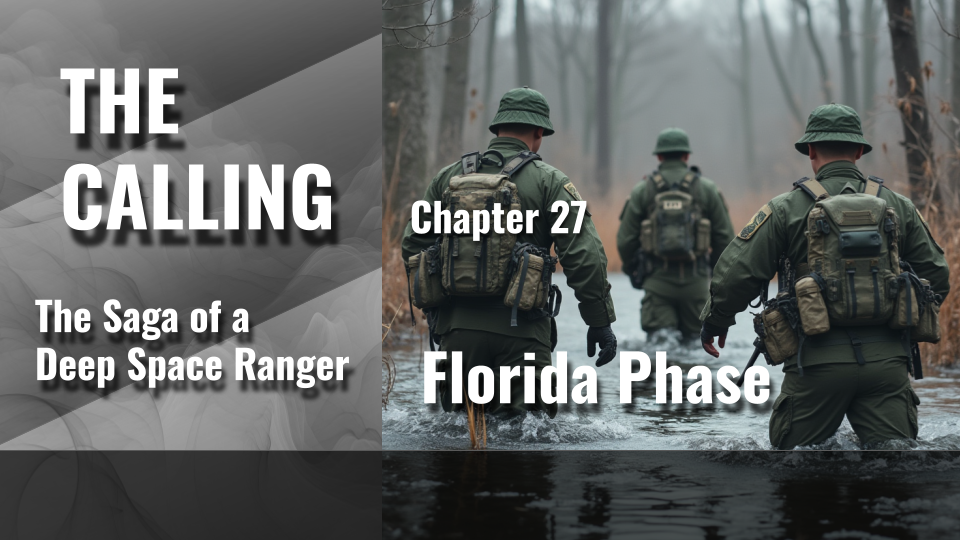
A bitter wind whipped across the Florida swamps as Wade, Jay, and Metro inserted into their dropzone. The frigid air caught them off guard – this wasn’t the balmy weather they’d expected from the panhandle. Their boots sank into the dark water, each step releasing bubbles of swamp gas that carried the scent of decay. As they began their five-day platoon operation, the cold crept beneath their wet uniforms, numbing fingers and clouding thoughts. The weight of their rucksacks seemed to increase with every passing hour, the straps digging into shoulders already raw from weeks of constant wear.

Wade and Jay found their rhythm quickly, their mountain phase experience serving them well. The endless hours spent navigating steep terrain had taught them to read the land, to find the path of least resistance even in this alien environment. They passed their patrols in the first two days, demonstrating the leadership and tactical prowess that had carried them this far. Each successful mission brought them closer to the tab they’d fought so hard to earn, their movements growing more confident with each passing hour.

Metro watched his friends lead, studying their techniques, waiting for his own chance to prove himself. He made mental notes of how Wade handled his troops, how Jay managed the tactical challenges that arose. The swamp seemed to resist their every move, but Metro remained determined, pushing through the discomfort with gritted teeth and steely resolve.

On the third day, the swamp seemed to come alive with malice. The water had turned to ice in their canteens, and the wind cut through their wet uniforms like razor blades. Each step brought a new challenge – hidden roots that threatened to snap ankles, sucking mud that tried to claim boots, the bone-deep chill that refused to relent. The platoon moved in silence, save for the occasional splash or muffled curse as someone lost their footing.

Hypothermia

Metro’s movements grew sluggish, his normally sharp eyes taking on a glazed look. Wade noticed first, seeing how his Ranger Buddy’s steps had become uncertain, how his responses to simple commands had slowed. Before he could intervene, Metro crumpled into the murky water, his body temperature plummeting to dangerous levels. The speed of his collapse shocked everyone – one moment he was trudging along with the rest of them, the next he was face-down in the swamp, his rifle half-submerged beside him.

“Medevac! Now!” Sergeant Hunt’s command cut through the swamp’s oppressive silence. His voice carried the weight of urgent authority, spurring the platoon into immediate action. As one of the students radioed for evacuation, Wade and Jay huddled around their fallen friend, their hearts pounding with fear they couldn’t afford to show. The rest of the platoon established a defensive perimeter, their training taking over despite their concern for their fellow Ranger.

Wade and Jay placed their hands on Metro’s shoulders and bowed their heads in prayer, just as they had during the mountain phase. Their whispered words seemed to carry through the chaos of the emergency response, a quiet counterpoint to the urgent radio traffic and Hunt’s rapid-fire orders. The cold seemed to intensify around them, as if the swamp itself was trying to claim Metro for its own.

Miraculous Healing

Then, like a scene from a revival tent, Metro’s eyes fluttered open. Color flooded back into his pale cheeks, starting as a faint pink and deepening to healthy warmth. He sat up, looking dazed but alert – a transformation so sudden it left even the hardened Sergeant Hunt speechless. The change defied medical explanation, but none could deny what they’d witnessed. Despite Metro’s miraculous recovery, Hunt insisted on protocol: “Still getting you checked out, Ranger. No exceptions out here.”

The platoon watched as Metro was evacuated, their faces showing a mixture of relief and lingering concern. Hunt used the moment as a teaching opportunity, gathering the Rangers for a quick class on cold weather injuries and the importance of buddy checks. The lesson was hardly necessary – seeing one of their own go down had driven the point home more effectively than any instruction could have.

At the infirmary, the Physician Assistant ran every test available, his confusion growing with each normal result. There was no trace of the hypothermia that should have put Metro in serious danger, no indication of the severe exposure that everyone had witnessed. The medical staff exchanged puzzled looks as they reviewed the results, unable to explain the rapid recovery.

When he rejoined Wade and Jay, Metro’s familiar grin had returned, though it couldn’t quite hide the lingering fatigue in his eyes. “Should’ve asked for half a healing,” he quipped, adjusting his gear. “A warm hospital bed wouldn’t have been so bad.” The joke broke the tension, drawing tired laughs from his friends, but they all knew how close they’d come to losing one of their own to the merciless swamp.

Communion in the Chaos

Back at Camp Rudder, the brief respite between operations drew the Rangers to an unexpected source of comfort – the chaplain’s service. The gathering was a stark portrait of Ranger School’s toll: gaunt faces, hollow eyes, bodies pushed far beyond normal limits. These were no longer the cocky Marines who’d started the course; exhaustion and challenge had stripped away all pretense, leaving only the raw essence of who they were.

The chapel itself was little more than a cleared space with folding chairs, but it felt like sanctuary to the weary Rangers. Many dozed off during the service, their bodies taking advantage of any chance to rest, but Wade and Jay remained alert, their recent experience with Metro still fresh in their minds. The chaplain moved among them as he spoke, his voice carrying to every corner of the room, speaking of Jesus’ forty days in the wilderness.

He drew parallels to their own trials, speaking of hunger, exhaustion, and temptation. His words about using faith as a weapon against adversity resonated deeply with the assembled Rangers, at least the ones who were still awake. Each of them had faced their own demons during the course – moments of doubt, anger, and despair that tested not just their bodies but their spirits.

When communion came, the visual struck them all – their blackened, bleeding hands reaching for pure white wafers, dipping them in blood-red wine. The metaphor wasn’t subtle: purity meeting wretchedness, sacrifice meeting need. The Rangers moved forward one by one, each lost in their own thoughts, their own prayers. Some had tears in their eyes, though whether from exhaustion or emotion, none could say.

Droning Out

The final operation loomed before them – an 18-kilometer movement to assault an objective. Wade carried a secret: Sergeant Hunt had pulled him aside earlier, hinting at possible Distinguished Honor Graduate selection. This patrol would decide it, would determine if Wade had truly distinguished himself among his peers. But Wade kept quiet when his friends asked, deflecting with vague assurances about Hunt’s support for them all. The weight of potential honor sat uneasily on his shoulders, adding to the burden of leadership he already carried.

The march tested them in ways that made previous challenges seem mild in comparison. The cold returned with a vengeance, turning their uniforms into frozen shells that cracked with every movement. Exhaustion, hunger, and relentless terrain conspired to strip away coherent thought. Wade found himself leading his platoon in circles, lost in a hypothermic haze, until a Ranger Instructor had to take control. The night became a blur of stumbling steps and mumbled commands, each Ranger pushing forward on nothing but stubborn will and ingrained training.

The raid that followed was a lesson in humility. Confusion reigned as sleep-deprived Rangers struggled to maintain tactical coherence. Communications broke down, positions were missed, and friendly fire incidents peppered the operation. Their opponent, comprised of well-rested instructors, exploited every mistake with professional efficiency. What should have been a coordinated assault devolved into a series of disjointed actions, each team struggling to accomplish their part of the mission without clear understanding of the overall situation.

In the harsh debrief that followed, Wade knew his shot at Distinguished Honor Graduate had evaporated like morning mist over the swamp. But as he stood with Jay and Metro, listening to the instructors outline their failures, he felt something stronger than disappointment: brotherhood forged in shared struggle, hardened by common trial. The instructors’ words were sharp, but their eyes held understanding – they had all been where these Rangers were, had all faced the moment when exhaustion overcame training.

The Florida Phase had tested them in ways they never expected, forcing them to confront not just physical limitations, but the deeper questions of faith, leadership, and resilience. As they prepared for their final evaluation at the Zoo, they carried with them lessons learned in prayer and pain, in failure and friendship. The swamp had tried to break them, had nearly succeeded more than once, but they had emerged stronger, more humble, and more united than ever before.

Back to the Zoo

The transport that would carry them to their final challenge waited on the landing pad, its engines humming with promise and threat. As they boarded, each Ranger carried not just their physical gear, but the weight of experience earned in the merciless Florida swamps. They had learned that sometimes victory meant simply enduring, that leadership often meant admitting weakness, and that faith could manifest in ways that defied explanation. These were lessons that would serve them well in the challenges ahead, both at the Zoo and in the wider war that awaited them.

The interplanetary transport carved through the void of space, its hull vibrating with the nervous energy of its passengers. They would spend three days of recovery at Ramsey Station – days filled with hot meals and actual beds and then the Ranger students faced their final crucible: a platoon-sized live fire exercise in the heart of Carthis 7’s notorious “Zoo.” The name itself carried weight, spoken in whispers by veterans who’d survived its horrors.

Wade stood at rigid parade rest on the observation deck, his reflection ghostlike in the reinforced viewport. Below, Carthis 7 grew from a distant orb to a scarred monster of a world. Its surface told stories of endless conflict – impact craters from orbital bombardments, the twisted wreckage of alien war machines, and the ever-shifting ruins of what had once been thriving colonies. Beside him, Jay maintained his characteristic stoic demeanor, but Wade noticed the subtle tells of tension: the slight clench of his jaw, the tightening around his eyes, the way his fingers occasionally brushed the grip of his rifle.

The ship’s internal atmosphere recyclers hummed a constant backdrop to scattered conversations – each Ranger sharing Zoo stories with each other, tactical officers reviewing mission parameters, medical staff checking emergency protocols. The air felt thick with anticipation and barely contained fear.

“Gear up, ladies and gentlemen,” Sergeant Major Vickers’ command cut through the murmur like a plasma round through armor. “We touch down in five.” His voice carried the weight of experience – he’d survived the Zoo more times than most of the instructors combined. The cargo bay transformed into organized chaos as Rangers donned their cutting-edge combat armor, each piece a testament to humanity’s determination to survive in this hostile universe.

Metro worked with methodical precision at his communications gear, his new role as Radio Telephone Operator (RTO) demanding nothing less than perfection. He triple-checked every frequency, every backup system, every emergency protocol. In the Zoo, a failed comm link could mean more than mission failure – it could mean wholesale slaughter. The responsibility sat heavily on his shoulders, but his hands remained steady as they danced across the control panel and rest of his equipment.

The distinctive whir of armor servos filled the bay as Wade secured his final clasps. A hand landed on his shoulder – firm, confident. Captain Reynolds stood before him, the veteran Ranger Instructor’s face bearing scars from his own Zoo encounters. “Remember, Ranger Kovacs,” he said, voice pitched low but intense. “The principles you learned in the swamps and mountains back home apply just as much here. The tech may be state of the art, but leadership is leadership. Keep your head on straight, and bring your people home.”

Wade met his gaze steadily. “Yes, sir!” Two simple words carrying the weight of everything they’d learned, everything they’d survived to reach this point.

No More Blanks

The landing was surprisingly gentle for such a massive vessel, barely a shudder running through the deck plates as they touched down on Carthis 7’s reinforced landing pad. Camp Ramsey’s briefing room awaited them – a fortified bunker that had sheltered decades of Ranger classes. Wade gathered his platoon, their faces illuminated by the holographic tactical displays showing their target zone.

“Listen up, Rangers.” His voice carried the authority earned through months of training and trials. “We’ve got 12 hours to plan and rehearse before we hit our objective. We’ll be doing a Crazy-D insertion, landing 100 meters from the target.” The term ‘Crazy-D’ drew reactions – raised eyebrows, sharp intakes of breath. The Directed Descent insertion pods were notorious for their effectiveness and their brutality on the human body.

Metro’s eyebrow arched. “Crazy-D? That’s going to be one heck of a ride.” His voice carried a mix of professional concern and barely concealed excitement.

“You got that right,” Wade confirmed, turning to Jay. “I’ll need your squad ready for immediate suppression as soon as we hit ground. Those first thirty seconds will make or break us.” Jay nodded, already running scenarios in his head, calculating fields of fire and support positions.

The next twelve hours dissolved into intense preparation. The platoon immersed themselves in intelligence reports, studying satellite imagery that showed the ever-shifting landscape of the Zoo. They analyzed terrain models, marking kill zones and likely ambush points. Every scenario was run, every contingency planned for, every possible failure point identified and addressed.

Urban combat was challenging enough – but in the Zoo, it became a nightmare of alien aggression and hostile biology. Bombed out buildings held their own cruel danger for the careless, streets that might suddenly become death traps, and an enemy that understood the terrain with a home field advantage. The Rangers adapted their Earth-learned tactics, modern tech, and incorporating hard-won knowledge from previous Zoo experiences.

As insertion time approached, Wade gathered his platoon for final instructions. The briefing room had grown quiet, charged with pre-mission tension. “Remember your training,” he said, meeting each pair of eyes in turn. “Keep your tactical intervals, watch your sectors, and keep comms clear. We hit hard and fast. Questions.” The silence that answered him spoke volumes – they were ready, as ready as humans could be for what awaited them.

The Crazy-D drop lived up to its reputation. Each impact felt like a controlled crash, the compensation systems barely managing to keep the occupants conscious as they slammed into Carthis 7’s surface. Hatches hissed open to reveal the Zoo in all its terrible glory – a maze of broken buildings and twisted metal under an alien sky, the air itself seeming to pulse with malevolent energy.

Wade’s mind raced through final mission checks as his platoon deployed with practiced precision. Their objective burned in his thoughts: a suspected Skravak nest, buried deep in the urban wasteland. Intelligence suggested a major hive, one that had to be eliminated before it could spread further.

“Alright, listen up!” His voice carried across the assembly area, cutting through the last whispers of conversation. “We move out in five minutes. Jay, you’re on point. Metro, stick close – I need that comms link rock solid. The rest of you know your roles. Stay frosty, watch your sectors, and remember your training. Let’s show these bugs what the Confederation’s finest are made of.” The responding “Oorah!” echoed off broken walls, a sound of human defiance in this alien territory.

The Tactical Advantage

Their advance through the Zoo’s labyrinthine streets set every nerve on edge. The silence felt wrong, broken only by the crunch of debris under armored boots and distant, inhuman screams that set teeth on edge. Wade’s enhanced HUD constantly updated with tactical data – squad positions, vital signs, threat assessments. Every step could trigger an ambush, every shadow could hide death.

The attack came without warning. “Contact front!” The call crackled through comms an instant before pulse rifles opened up, their distinctive whine mixing with the alien shrieks of their targets. Wade’s training took over, his voice steady as he coordinated the response to the Skravak ambush. The firefight transformed into a deadly dance of plasma bolts and alien hungry maws snapping at Rangers moving with mechanical precision through their practiced maneuvers.

“Jay! Take second squad and flank left!” Wade’s orders cut through the chaos of battle. “Metro! I need air support on these coordinates—danger close!” Metro’s fingers flew across his comm panel, relaying the call for fire support with practiced efficiency. Moments later, the sky erupted as orbiting Thunderhawk gunships responded, their heavy weapons turning Skravak positions into craters of molten rock and alien gore.

The battle seemed to last forever, a constant push deeper into enemy territory. Wade lost count of how many times he’d called for fire support, how many times he’d redirected squads to shore up weak points in their advance. Through it all, Jay remained their anchor, his steady presence and accurate fire providing the stability they needed as chaos threatened to overwhelm them.

As they approached their primary objective – a massive structure of twisted metal and faracrete rubble that housed the Skravak nest – Wade felt ice form in his gut. The resistance had been fierce, but something in his battle-honed instincts screamed that worse was coming. The building itself seemed to pulse with malevolent life, its half-collapsed form a monument to the horrors that awaited within.

“All units, this is Rock Six,” he broadcast across the platoon net, his voice steady despite the adrenaline coursing through his system. “We’re approaching the target building – expect heavy resistance! Jay, get your squad in overwatch positions! Everyone else, prepare to breach and clear on my mark.”

What followed was pure combat chaos, a blur of violence and instinct. Wade led the charge into the alien hive, grateful for every punishing hour spent in Earth’s swamps and mountains. The leadership principles drilled into them became lifelines, allowing him to direct his forces through the fog of war with decisive clarity. Every lesson learned, every hardship endured, every prayer uttered – all of it culminated in these crucial moments.

When silence finally fell, Wade stood in the heart of the destroyed hive, chest heaving in his armor. Around him, Rangers moved with professional efficiency, securing the area, tending to the wounded, documenting their kills. They had done it – eliminated the Skravak nest without losing a single Ranger. The mission was an unqualified success, a testament to their training and determination.

Outside the shattered husk of the hive, Wade felt pride surge through him as he looked over his platoon. They had faced humanity’s nightmare and emerged victorious, their bonds forged stronger than ever in the fires of combat. Staff Sergeant Hunt’s gruff voice cut through their moment of triumph: “Outstanding work, Rangers. You’ve proven yourselves worthy of the tab. But don’t get cocky – this was just a taste of what real combat holds.”

Hunt’s words brought a sobering silence. Wade exchanged glances with Jay and Metro, seeing his own mix of pride and grim determination reflected in their eyes. They had earned their place among the Rangers, but this was just the beginning.

The transport ride back to Earth buzzed with excited discussion about what lay ahead – advanced exploration training, flight school, and most headed to assignments in the various Ranger Regiments leveraging their skills in the ongoing war against the Skravak threat. Wade settled into his seat, mind racing with possibilities as Carthis 7 shrank behind them. He allowed himself a small smile, knowing they had survived the Zoo and emerged stronger. The road ahead would be hard, but they would face it together, as brothers in arms forged in the fires of Earth and tempered in the alien battlefields of distant worlds.

Their Ranger tabs would mean more than just completing a school now – they represented humanity’s determination to survive, to push back against the darkness that threatened their species. Whatever challenges the galaxy held in store, they were ready to face them, one mission at a time.

Link to all Chapters – Text & Audio

Chapter 25 – Camp Darby

Link to all Chapters – Text & Audio

But He said to them, “I have food to eat that you do not know about…My food is to do the will of Him who sent Me and to accomplish His work.”

John 4:32 & 34

Scavenge to Survive

There was no centralized issue facility in Ranger School. The students were taken to abandoned structures and vehicles where antique equipment, ammunition, and rations were cached. Once they identified the cache, they had to determine the priority of what to take or leave. Wade’s squad was taken to a landing pad where a dilapidated UH-60 Blackhawk helicopter stood as a silent sentinel on the sun-baked tarmac of Camp Darby. Its faded paint and patches of rust were a stark contrast to the pristine olive drab uniforms of the assembled Ranger students. The once-proud war machine now served as a testament to the enduring legacy of Ranger training, even in this era of advanced technology. First Sergeant Miller’s voice boomed across the area, silencing the nervous chatter of the students.

“Listen up, Rangers! This relic is about to become your home for the next few hours. Welcome to the Darby Phase, where you’ll learn to improvise, adapt, and overcome using methods that have stood the test of time.”

Wade smiled, a mix of anticipation and determination in his eyes. Beside him, Ranger Metropax shifted nervously, his lanky frame dwarfed by the lifeless hulk that used to be a helicopter.

“Think they’ll let us fly it, Smith?” Metropax whispered, joking with his buddy.

Smith chuckled, shaking his head. “Not a chance, Metro. It’d take a miracle to get this baby off the ground again.”

The Rangers were divided into squads and tasked with scavenging gear from the helicopter’s interior. As they clambered into the cabin, the smell of stale fuel and dust filled their nostrils. Smith and Metropax found themselves in the cargo compartment, surrounded by olive drab canvas bags and wooden crates.

As they assembled their rucksacks and load-bearing equipment, Wade felt a connection to the Rangers who had come before him. “These packs were state-of-the-art back then,” Smith explained, showing Metropax how to adjust the straps. “They’ll do the job if you know how to use them.” They stuffed their rucks to the hilt with the necessary blank ammunition, rations, and other gear. They were surprised that the ancient backpack could hold over a hundred pounds if packed correctly.

The Darby Queen

First Sergeant Miller’s voice echoed in their minds as they navigated the challenging terrain. “This phase will test your ability to plan, prepare, and execute reconnaissance patrols. You’ll be evaluated on your leadership skills, your tactical proficiency, and your ability to work as a team. But first, you gotta make it through the Darby Queen.”

The infamous Darby Queen Obstacle Course, a grueling test of physical endurance and mental fortitude, consisted of 20 obstacles spread over a mile of uneven, hilly terrain.

As Wade approached the course, he could feel the eyes of the instructors upon him. He knew that his performance here would be a critical factor in his overall evaluation. Taking a deep breath, he launched himself into the first obstacle.

The course was a blur of rope climbs, wall scales, and log carries. Wade’s muscles screamed in protest as he pushed himself to the limit. His prosthetic hand, usually an asset, didn’t seem to present any advantage to the unique challenge as he navigated the obstacles.

Beside him, Metropax struggled with a particularly difficult rope climb. Without hesitation, Smith paused to offer encouragement and advice. “Keep going, Metro,” he called out. “Use your legs, not just your arms. You’ve got this!”

Metropax nodded, gritting his teeth as he redoubled his efforts. Together, they pushed through the pain and fatigue, crossing the finish line with nothing left in the tank.

As they collapsed to the ground, gasping for breath, Wade felt a hand on his shoulder. He looked up to see First Sergeant Miller standing over them, a rare smile on his weathered face.

“That’s what I like to see,” Miller said. “Rangers never leave a man behind. You two exemplify the spirit of this course.”

Recon

The next morning, the Rangers set out on their first patrol. The Georgia pines towered above them, casting long shadows across the forest floor. The air was thick with the scent of pine needles and damp earth. They moved in tactical “V” formations, their boots crunching on fallen leaves and twigs.

The Rangers faced a series of graded patrols, each one designed to test a different aspect of their training. They conducted far and near reconnaissance missions and even participated in a simulated dropship operation.

When it was Smith’s turn to lead, he felt the weight of responsibility settle on his shoulders. He gathered his squad, issuing the warning order and assigning roles. As he spoke, he could see the trust in his teammates’ eyes. They were ready to follow him into the unknown.

As they pushed deeper into the forest, Wade recalled the fast-paced instruction they had received on troop leading procedures and principles of patrolling. Now, it was time to put that knowledge into practice.

The squad came to a halt at the edge of a clearing. Wade, who had been designated as squad leader for this patrol, gathered his fellow Rangers around him. “Alright, listen up,” he said in a low voice. “We’ve got a recon mission. Our objective is to gather intel on an enemy position about two klicks northeast of here.”

He quickly issued the operation order, assigning roles and responsibilities to each team member. Metropax would be the point man, leading the way with his keen eye for detail and natural instinct for navigation.

As they moved out, Wade felt the weight of responsibility on his shoulders. He knew that his performance as a leader would be scrutinized not only by the instructors but also by his peers. The peer evaluation system was a crucial component of Ranger School, ensuring that only those who could earn the respect and trust of their fellow Rangers would advance.

The patrol moved silently through the underbrush, each Ranger hyper-aware of their surroundings. Suddenly, Metropax raised his fist, the signal to freeze. Then he motioned for Ranger Smith to move forward to join him.

“Whatcha got?” Wade whispered.

Metropax pointed to his ear. “Vehicle up ahead,” he murmured. “You can barely hear it. It must be on the dirt road here on the map.”

It was obvious that the Op-FOR (Opposing Forces, a simulated enemy unit) was patrolling the roads, looking for any unsuspecting Ranger students.

Smith nodded, his mind racing as he assessed the situation. This unexpected development could complicate their mission, but it also presented an opportunity to demonstrate their tactical awareness and adaptability.

“Good catch, Metro,” Smith whispered. “We’ll stay on azimuth, but stay alert. They’re probably looking for us but we found them first.”

They moved to their objective rally point, posted security, and performed a leader’s recon to get the lay of the land and confirm the location of the objective. Wade knew that if the Op-FOR were to discover them, he would automatically fail his patrol. Reconnaissance wasn’t something you could shoot your way out of. It took the utmost stealth and cunning, and by no means could they be discovered or compromised. The RI, Sergeant Kilby, looked on, scrutinizing Ranger Smith’s every move.

As Wade scoped out the area, he noticed a tall tree about 300 meters from the objective with a large open area between the two. Wade signaled to Metropax and whispered, “If I could climb the tree with my binos, I could probably get a pretty good look at the objective.”

Metropax looked concerned. “That’s pretty unorthodox, Smith. No one mentioned tree climbing in any of our training. You think the RI will go for it?”

Wade thought for a moment. “Well… if we have security posted, don’t violate any principles, and get all the priority intelligence requirements… I can’t see why not.” 

Metropax grimaced but complied.

They slowly moved to the tree, and Wade had his men cover their three, six, and nine o’clock positions at the base. The RI looked at Wade and asked, “Ranger Smith, what in the world are you doing?”

“I’m going to climb this tree and do my recon from here,” Wade said with very little conviction.

The RI raised one eyebrow and shook his head. “Well Ranger, it’s YOUR patrol.”

Wade and Metropax glanced at each other, displaying their fear that this may have been a stupid idea.

It was an easy climb to get about 20 feet above the ground, but there was little concealment. Wade held his breath, hoping and praying the Op-FOR would never suspect such an unorthodox approach to reconnaissance. If they spotted him, it would be a No Go for sure.

He nervously jotted in his notebook the number of personnel, weapons and their types, structures and vehicles, and drew a simple sketch, remembering to annotate the compass heading and distances. He scrambled back down the tree and whispered to his men, “Let’s get the heck out of here!”

They moved most of the night and finally set up a patrol base eight kilometers from the objective, making double sure they weren’t followed. The RI changed the leadership positions, and Wade and Metropax moved to the perimeter to keep watch and pull security. It was 0330 in the morning, and they would each trade positions to get one hour of sleep before “stand to.”

The hours passed too quickly. It was as though they hadn’t slept at all. The RI called Wade to the center of the perimeter to counsel him on his performance the day before. Wade was almost certain the Sergeant didn’t approve of his harebrained idea.

“Ranger Smith, how do you think you did on your recon?” he asked with a blank face.

Wade was so sleepy, he had to pinch himself to stay alert enough to answer the RI’s question. “Well, Sergeant… I don’t think it was by the book… but I didn’t violate any principles that I know of?”

The RI let Wade stew a moment before he addressed the weary Ranger. “Well, Ranger… This is the first time I have ever seen a recon done like a monkey. Very unorthodox, indeed… But you are correct. You didn’t violate any principles of patrolling, and you retrieved all the priority intel requirements. Not only am I going to give you a Go on your patrol, I want you to sign this major positive spot report for initiative and ingenuity.”

Wade sat there dumbfounded. The RI snapped his fingers in front of Wade’s face. “Well Ranger, are you going to sign this or not?!”

Wade quickly snatched the pen from the RI’s grip. “Oh, uh, yes, Sergeant! Roger that!”

A new set of RIs replaced the old ones, and a new day of relentless trudging through the Georgia terrain continued. But Ranger Smith had the assurance he was going to the next phase, the mountains, if he just didn’t do anything dumb in the next few days.

Hallucinations

As they continued their patrols, the physical and mental strain began to take its toll. The Rangers had been operating on minimal sleep and limited rations, pushing their bodies and minds to the limit. This grueling regimen was designed to assess their physical stamina and mental toughness, key attributes of a Ranger.

By the fifth day of patrols, fatigue had set in hard. Smith found himself battling hallucinations brought on by sleep deprivation. As they moved through a particularly dense thicket, he swore he saw leopards leaping across his path. He blinked hard, forcing himself to focus and clear his head.

Beside him, Metropax was faring no better. During a brief rest halt, Smith watched in bemused concern as his friend stumbled toward a nearby tree, fumbling with imaginary coins.

“I could really go for a Snickers,” Metropax mumbled, his voice slurred with exhaustion as he attempted to insert the non-existent currency into what he perceived as a vending machine.

Wade gently pulled Metropax away from the tree. “Come on, buddy,” he said, his voice a mixture of amusement and concern. “Let’s get some shut-eye. We’ll be back on patrol soon enough.”

Despite their exhaustion and hallucinations, Smith and Metropax pressed on. They had learned to rely on each other, to draw strength from their shared determination. This bond, forged in the furnace of Ranger School, was as vital to their success as any tactical skill they had learned.

Driving On

As the days wore on, the challenges intensified.

The mission was a success, with the squad achieving their objectives and exfiltrating without detection. As they regrouped at the designated rally point, Smith could see the exhaustion on his teammates’ faces, but also the glimmer of satisfaction in their eyes. They had faced a challenge and overcome it together.

The final week of the Darby Phase brought a series of increasingly complex reconnaissance missions. But they had finally finished, each having passed their patrols. As the Rangers prepared for their transition to the Mountain Phase, there was a foreboding sense of anticipation in the air.

On their last night at Camp Darby, Smith and Metropax sat by a small pup tent in the dark, reflecting on their journey. The moonlight cast shadows across their faces, highlighting the changes wrought by their experiences.

“You know, Smith,” Metropax said, his voice quiet but steady, “I wasn’t sure I had what it took when we started this. But now…” He trailed off, gesturing at the camp around them.

Smith nodded, understanding the unspoken sentiment. “We’ve come a long way, Metro. But this is just the beginning. The Mountain Phase is going to push us even harder.”

As they sat in companionable silence, Wade pulled out his pocket New Testament and started reading, illuminating the pages with his red lens flashlight. His thoughts drifted to the challenges that lay ahead. The Mountain Phase, conducted in the rugged terrain near Dahlonega, Georgia, would test their skills in a whole new environment. They would face steep ascents, treacherous descents of the Tennessee Valley Divide (the TVD), and the constant battle against the elements.

But as he looked at Metropax, Wade felt a surge of conviction. He had not shared his faith with his Ranger buddy. “Metro, can I pray and ask God to help us make it through the mountain phase?”

Metro looked at Wade matter-of-factly. “Absolutely, Ranger buddy… if you think it will help.”

Wade gave a curious glance over his shoulder. “Have you ever heard the gospel?”

Metro looked skyward, pondering the question. “No… Don’t think I have.”

Wade leaned back on his ruck. “This book tells the story of God’s love for us and how we have all rebelled against Him in spite of that love. But God, our creator, didn’t reject us for our rebellion but actually leaned into it by sending His Son, Jesus Christ, to die for us. His death satisfied the penalty we should have paid for our own wrongdoing. The Bible calls this wrongdoing sin. And the penalty for sinning against God is death. But like I said, He sent His Son to pay that penalty for us by dying on a cross. But He didn’t stay dead. In three days, He rose from the dead to prove He is the King over everything, including death. And now He sits at the right hand of God pleading our case to God.”

Metro’s face twisted. “And you believe this?!”

“Well, yes… but not at first. But once I opened myself to learning more about Him and His love, God started showing Himself to me in very crazy ways.”

“Well… no offense, but that’s what it’s going to take for me… I mean… I need some proof.” Metro leaned back and looked to the sky again. “You can certainly pray for that and that we will make it through the mountains.”

They both laid back to get some sleep under the stars. Wade looked at the brilliant expanse and prayed for Metro and himself. He prayed for Kristen and remembered to lift up Jay as well. The prayer was simple, short, and sincere. Then before he could say Amen, sleep overwhelmed him.

High Altitude Insertion

The next morning, as they prepared to board the awaiting Thunderhawk dropships that would take them to the Mountain Phase, First Sergeant Miller addressed the Rangers one last time. He gave a briefing about their extreme high altitude insertion into Mosby Army Airfield, at Camp Merrill, the mountain phase.

“You’ve proven yourselves worthy to move to the next phase,” First Sergeant Miller said, his voice carrying across the assembly area. “But your journey is far from over. The mountains will test you in ways you can’t imagine. Remember your training, trust in your Ranger buddies, and never, ever quit.” Miller continued, “This next insertion… nothing new to you, you’ve all been through Dropship Insertion School and you’ve all got a few Extreme High Altitude drops under your belts. Your mission is an airfield seizure and making the insertion from the edge of space into Mosby Army Airfield.” A few Rangers exchanged nervous glances. Miller let the weight of his statement sink in and continued.

“Mosby is a 400-meter-long grass strip, barely enough room to land a bird, let alone 30 drop pods. You will be jumping from 120,000 feet, retro-assisted fall for over three minutes, reaching speeds of over 600 miles per hour. You’ll have to rely on your equipment and your training to guide you safely to the ground.” He paused, his eyes scanning the faces of the Rangers. “This is not a simulated drop. This is the real deal. The Op-FOR will be waiting for you, and you’ll need to be prepared to fight as soon as you hit the ground.”

“Any questions?” Miller asked.

The Rangers shook their heads, their faces grim with confidence. They had come too far to have second thoughts now.

“Good,” Miller said. “Get your gear and board the birds. We launch in 30 mikes.”

The Rangers boarded the dropships that would take them to the edge of the atmosphere and then the Mountain Phase, a mix of excitement and apprehension swirling within them.

As the Thunderhawk ascended and the Rangers entered their drop pods, Smith looked out the viewport and watched as the Earth shrunk beneath him. The curve of the planet was clearly visible, and he could see the vast expanse of the Atlantic Ocean. The sky above was a deep, inky black, studded with stars. Wade remembered feeling this small and insignificant on the first drop in DIS. Yet, at the same time, he felt an exhilarating sense of freedom. He was on the edge of space, about to embark on one of the best thrill rides the military had to offer.

The RI acting as the Drop Master came over the comms. “Approaching drop altitude. Get ready!”

Wade took a deep breath and closed his eyes. He could feel the dropship slowing as it reached its final altitude. Then, the order came: “Green light! DROP!” The pods exploded to the side and the initial moments of freefall were disorienting. Wade felt weightless, as if he were floating in a dream. The Rangers had entered the void. Suddenly the retros fired to begin their descent.

He could see the Earth rushing towards him, but it seemed to take forever to get closer. He knew he was falling at an incredible speed, but it didn’t feel like it. It felt like he was suspended in time. Then, the atmosphere began to thicken. Wade could feel the air resistance building, slowing his descent. The G-forces pressed up on him, making it difficult to breathe.

Wade fought the blood rushing to his head, focusing on his training. He could see the airstrip and the drop zone rushing up to meet him. This was it… the Mountain Phase.

Link to all Chapters – Text & Audio