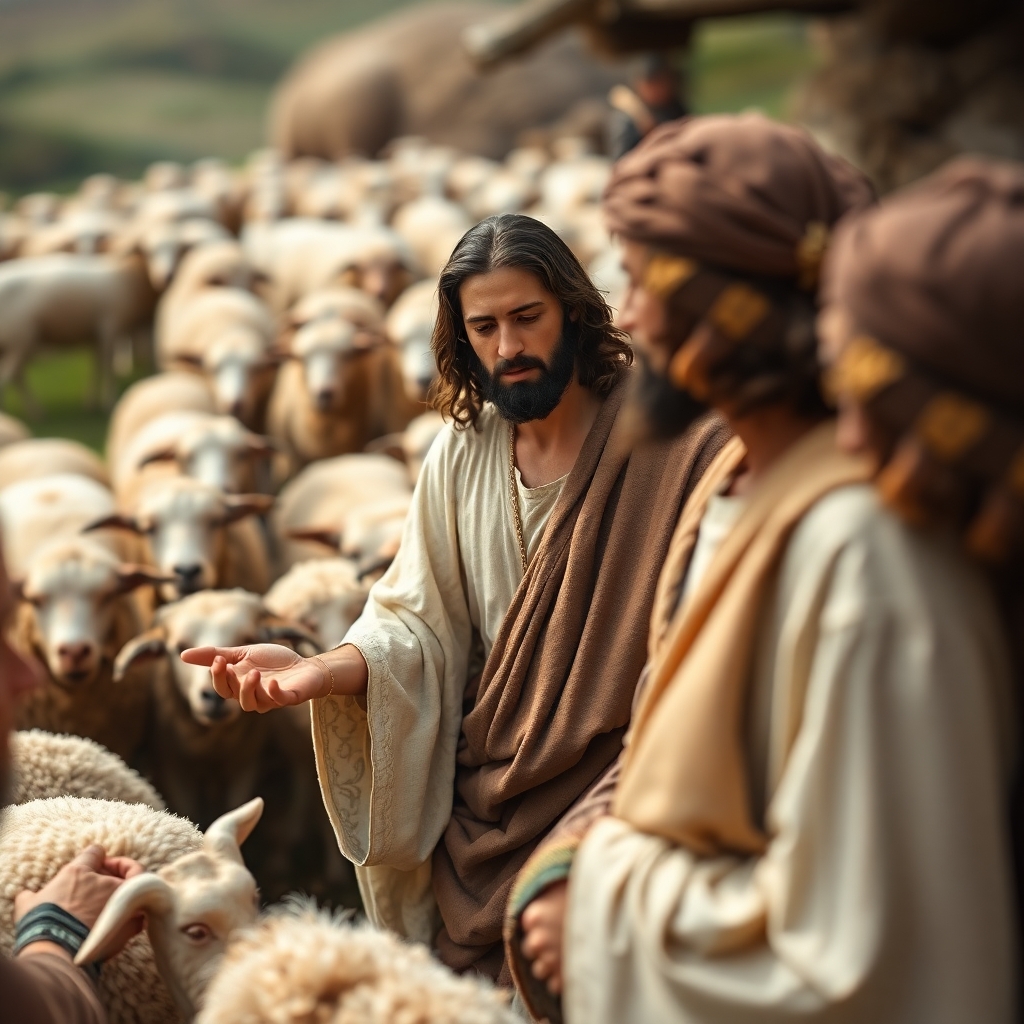
Kingdom Kernel #4 – The Good Shepherd’s Example

Jeremiah 23:1-8 – Shepherds of the Flock: Divine Leadership from Jeremiah’s Prophecy to Christ’s Perfect Model

The concept of “shepherds” in Jeremiah 23:1-8 serves as both a warning and an encouragement to disciple-makers, with Jesus Christ standing as the ultimate exemplar of shepherding leadership. This passage, set against the backdrop of Judah’s impending exile, presents a stark contrast between unfaithful leaders and the promise of a righteous shepherd-king.

 Etymology and Biblical Context

The Hebrew word for shepherd, derives from the root raw-aw’ (Strongs H7462), meaning to pasture, tend, or graze. This term encompasses not only the literal occupation of caring for sheep but also metaphorically represents leadership, particularly in a spiritual or governmental context.

In Jeremiah 23:1-8, God pronounces judgment on the “shepherds” who have failed in their duty to care for His people. These leaders, primarily referring to the kings and religious authorities of Judah, have “scattered the flock” through their negligence and self-serving actions.

 The Failure of Human Shepherds

The indictment against these shepherds is severe. They have:

1. Destroyed and scattered the sheep

2. Driven them away

3. Failed to attend to their needs

This failure of leadership resulted in the people’s spiritual and moral decay, ultimately leading to national calamity.

 Jesus: The Perfect Shepherd

In contrast to these failed leaders, Jesus Christ emerges as the perfect shepherd. He embodies the ideal qualities that God demands of His shepherds:

1. Goodness: Jesus is inherently good, reflecting the very character of God. (John 10:11)

2. Protection: He safeguards His flock, ensuring their eternal security.  (John 17:12)

3. Guidance: Jesus leads His followers in paths of righteousness. (John 10:3-4)

4. Nurture: He tenderly cares for the weak and vulnerable. (Matthew 11:28-30)

5. Sacrifice: Ultimately, Jesus lays down His life for His sheep. (John 10:11,15)

 The Promise of Restoration

Jeremiah’s prophecy doesn’t end with condemnation. God promises to:

1. Gather the remnant of His flock

2. Bring them back to their pasture

3. Raise up shepherds who will care for them properly

4. Establish a righteous Branch from David’s line

This messianic promise finds its fulfillment in Jesus Christ, the Good Shepherd who perfectly embodies God’s leadership.

 Implications for Disciple-Makers

For contemporary disciple-makers, this passage offers crucial lessons:

1. Warning: Leadership in God’s kingdom carries weighty responsibility. Neglect or self-interest can have devastating consequences on those under our care.

2. Encouragement: God Himself intervenes to restore and care for His people. Our efforts in discipleship are ultimately undergirded by His sovereign work.

3. Model: Jesus provides the perfect example of shepherding leadership. Disciple-makers should emulate His selfless care, protection, and guidance.

4. Hope: The promise of God’s restoration reminds us that our labor is not in vain. He is working to gather and nurture His flock, even in the face of human failure.

Jeremiah 23:1-8 presents a powerful contrast between human failure and divine faithfulness in spiritual leadership. It points us to Jesus Christ as the ultimate fulfillment of God’s promise to shepherd His people. For disciple-makers, this passage serves as both a sobering reminder of our responsibility and an encouraging assurance of God’s overarching care and provision for His flock.

Disciple-Maker’s Short Story

“The Gentle Shepherd’s Way”

The aroma of freshly brewed coffee wafted through Kathy’s cozy kitchen, mingling with the warm sunlight streaming through the windows. Sarah sat at the breakfast table, her hands wrapped around a steaming mug, her eyes fixed on Kathy with a mixture of affection and concern.

“Kathy,” Sarah began, her voice gentle but firm, “I’ve noticed you’ve been a bit… intense with Julie lately. I think it’s time we talked about the concept of shepherding like Jesus.”

Kathy’s brow furrowed. “What do you mean, Sarah? I’m just trying to help her grow in her faith.”

Sarah nodded, understanding in her eyes. “I know, and your heart is in the right place. But let’s explore this idea of ‘Shepherds of the Flock’ from Jeremiah’s prophecy to Christ’s perfect model. It might give us a new perspective.”

As Sarah began to explain, Kathy’s defensive posture slowly relaxed. She listened intently as Sarah painted a vivid picture of the failed shepherds in Jeremiah’s time, contrasting them with the promise of a righteous shepherd-king.

“You see,” Sarah continued, “Jesus exemplified what it truly means to be a good shepherd. He led with gentleness, protected His flock, and ultimately sacrificed Himself for them. That’s the model we’re called to follow in our discipleship.”

Kathy’s eyes widened with realization. “Oh,” she whispered, “I think I see what you mean. I’ve been pushing Julie so hard to pray more, but maybe I’ve been more of a taskmaster than a shepherd.”

Sarah reached across the table, squeezing Kathy’s hand. “It’s an easy trap to fall into. We all want to see growth, but we need to remember that true shepherding is about nurturing, not forcing.”

Just then, the doorbell chimed. Julie had arrived for their coffee date. As she entered the kitchen, Kathy felt a newfound sense of purpose and humility wash over her.

“Julie!” Kathy greeted her warmly. “We were just talking about prayer. How have you been doing with that lately?”

Julie’s shoulders slumped slightly. “To be honest, I’ve been struggling. I know I should pray more, but it feels like such a chore sometimes.”

Kathy caught Sarah’s eye, receiving an encouraging nod. Taking a deep breath, she reflected on the gentle shepherd she aspired to be.

“Julie, I want you to know that God loves you, regardless of how much you pray,” Kathy said softly. “Let’s think about prayer differently. Instead of a task to complete, what if we viewed it as a conversation with someone who cares deeply for us?”

Julie’s eyes glistened with unshed tears. “That… that sounds nice. But how do I start?”

“Why don’t we pray together right now?” Kathy suggested. “Nothing formal, just a chat with our Heavenly Father.”

As the three women bowed their heads, Kathy led a simple, heartfelt prayer. She thanked God for His love, asked for His guidance, and expressed gratitude for their friendship. When they finished, Julie’s face shone with a newfound peace.

“That felt different,” Julie admitted. “Like I was actually connecting with God, not just reciting words.”

Sarah beamed at Kathy, pride evident in her eyes. Kathy felt a warmth in her chest, realizing that in learning to shepherd like Jesus, she was not only helping Julie but also growing closer to Christ herself.

As they continued their conversation over coffee, Kathy marveled at the transformation. By embracing the role of a gentle shepherd, she had opened the door to deeper, more meaningful discipleship. And in doing so, she felt her own heart aligning more closely with the ultimate Shepherd, Jesus Christ.

Kingdom Kernel #3 – “There Is None Like You”

Jeremiah 10:6-7 – “There Is None Like You”: Divine Uniqueness and the Eternal Kingdom of Christ

The biblical concept “There is none like You” as expressed in Jeremiah 10:6-7 encapsulates a profound theological truth about God’s unparalleled nature and sovereign rule. This phrase, rooted in the Hebrew “‘în kᵊmô” (Strongs H369 and H3644) literally translates to “there is not like you,” emphasizing God’s absolute uniqueness.

 Linguistic and Theological Significance

The Hebrew construction uses the negative particle “‘în” combined with the preposition “ka” (like) and the second-person masculine singular pronoun “mocha” (you). This grammatical structure intensifies the concept of God’s incomparability. The repetition of this idea throughout Scripture underscores its centrality to biblical theology.

In the context of Jeremiah 10:6-7, this phrase is juxtaposed with God’s greatness and might, as well as His rightful position as “King of the nations.” This juxtaposition reveals that God’s uniqueness extends beyond mere attributes to His very essence and authority.

 Christological Fulfillment

Jesus Christ, as the incarnate Word, perfectly embodies this concept of divine uniqueness. In Him, we see the fullness of God’s incomparable nature made visible (Colossians 1:15). Jesus’ teachings about the Kingdom of God directly connect to this idea of God’s unique sovereignty.

Christ’s miracles, teachings, and ultimately His resurrection demonstrate that there is indeed none like Him. He is the perfect representation of the Father’s unparalleled nature (Hebrews 1:3). Jesus’ claim to have “all authority in heaven and on earth” (Matthew 28:18) echoes the Jeremiah passage’s assertion of God’s kingship over all nations.

 Implications for the Kingdom of God

The concept of God’s uniqueness is foundational to understanding the Kingdom of God. Jesus, as the Messiah-King, inaugurates a kingdom that reflects the incomparable nature of God Himself. This kingdom operates on principles that are radically different from earthly empires, characterized by truth, compassion, and forgiveness.

The phrase “There is none like You” implies that God’s kingdom is likewise unique. It is not limited by geographical boundaries or temporal constraints. Instead, it is an eternal reign that encompasses “every square inch” of creation, Abraham Kuyper as famously stated.

 Transformative Power for Believers

Recognizing that there is none like our God transforms how believers view themselves and their place in the world. It instills a sense of awe and worship, as we contemplate a Being so far beyond our comprehension yet intimately involved in our lives.

This concept also challenges believers to reflect God’s unique character in their own lives. As subjects of this incomparable King, Christians are called to live in ways that demonstrate the distinctive nature of God’s rule. This involves embodying the compassion, justice, and love that characterize God’s kingdom.

The biblical assertion that “There is none like You” serves as a cornerstone for understanding God’s nature, Christ’s role, and the believer’s place in the Kingdom. It reminds us that we serve a God who is utterly unique, whose ways are higher than our ways, and whose kingdom transcends all earthly powers. As we grasp this truth, we are inspired to live lives that reflect the incomparable nature of our King, Jesus Christ.

Disciple-Maker’s Short Story

“A Taste of Truth”

The soft glow of candlelight danced across the faces of Will and Janet as they sat at their favorite corner table in Bangkok Spice. The aroma of lemongrass and ginger wafted through the air, mingling with the quiet murmur of conversation around them. At 65, their love had only deepened, like a fine wine aging to perfection.

Janet’s eyes twinkled as she leaned in, her voice barely above a whisper. “You won’t believe what happened during my Bible study this week, Will.”

Will raised an eyebrow, intrigued. “Oh? Do tell, my dear.”

“Well, we were discussing the uniqueness of Christ, and Sarah – you know, the new girl – she piped up and said, ‘But don’t we all serve the same god, just with different names?'” Janet’s brow furrowed. “I wasn’t quite sure how to respond. How would you have handled that, Will?”

Will’s eyes softened, a gentle smile playing on his lips. He reached across the table, taking Janet’s hand in his. “Ah, the age-old question of universalism. It’s a tricky one, isn’t it?”

Just then, their server approached – a young man with kind eyes and a name tag that read ‘Hasan.’ As he set down their steaming plates of Pad Thai, Will felt a nudge from the Holy Spirit.

“Hasan,” Will began, his voice warm and inviting, “if you don’t mind me asking, what faith do you follow?”

Hasan’s eyes lit up. “I am Muslim, sir. But please, do not worry – we all have one god, we just call him different names, yes?”

Will nodded thoughtfully, seeing Janet lean in with interest. “That’s a common belief, Hasan. But you know, I’ve found something truly unique in Jesus Christ.”

Hasan tilted his head, curiosity piqued. “How so?”

Will’s eyes sparkled with passion as he spoke. “You see, Hasan, the Bible tells us in Jeremiah 10:6-7 that there is none like our God. He’s not just another name for a universal deity – He’s utterly unique in His nature and His actions.”

Janet watched in awe as Will continued, his words flowing with gentle conviction.

“Jesus claimed to be God in the flesh, Hasan. He performed miracles, taught with unparalleled authority, and ultimately rose from the dead. These aren’t just stories – they’re historical events that set Him apart from any other religious figure.”

Hasan’s brow furrowed, but he listened intently.

Will leaned in, his voice softening. “But what truly makes Jesus unique is His love, Hasan. And He didn’t just teach about God’s love – He demonstrated it by sacrificing Himself for us. He offers forgiveness and a personal relationship with God that no other faith can match. Which gives Him the right to say; “I am the Way, the Truth, and the Life. No one comes to the Father but through Me.”

Janet’s eyes welled with tears as she witnessed her husband’s gentle yet powerful testimony.

Hasan stood silent for a moment, clearly processing Will’s words. “I… I have never thought of it that way before,” he admitted. “You have given me much to consider, sir.”

As Hasan excused himself, Janet squeezed Will’s hand. “That was beautiful, darling. You’ve shown me exactly how to address this issue – with love, respect, and unwavering truth.”

Will smiled, a hint of moisture in his own eyes. “It’s all Him, Janet. Jesus is the Way, the Truth, and the Life. There truly is none like Him.”

As they savored their meal, both Will and Janet felt a renewed sense of purpose. Their date night had become more than just a romantic evening – it was a reminder of their calling to share the incomparable love of Christ with a world hungry for truth.

In that moment, surrounded by the warmth of candlelight and the lingering aroma of Thai spices, they silently recommitted themselves to being living testimonies of the unique and transformative power of Jesus Christ.

Kingdom Kernel #2 – The Unstoppable Force

1 But there will be no more gloom for her who was in anguish; in earlier times He treated the land of Zebulun and the land of Naphtali with contempt, but later on He shall make it glorious, by the way of the sea, on the other side of Jordan, Galilee of the Gentiles. 2 The people who walk in darkness will see a great light; those who live in a dark land, the light will shine on them. 3 You shall multiply the nation, you shall increase their gladness; they will be glad in Your presence as with the gladness of harvest, as men rejoice when they divide the spoil.

4 For You shall break the yoke of their burden and the staff on their shoulders, the rod of their oppressor, as at the battle of Midian. 5 For every boot of the booted warrior in the battle tumult, and cloak rolled in blood, will be for burning, fuel for the fire. 6 For a child will be born to us, a son will be given to us; and the government will rest on His shoulders; and His name will be called Wonderful Counselor, Mighty God, Eternal Father, Prince of Peace.

7 There will be no end to the increase of His government or of peace, on the throne of David and over his kingdom, to establish it and to uphold it with justice and righteousness from then on and forevermore. The zeal of the LORD of hosts will accomplish this. (Isaiah 9:1-7)

Isaiah 9:1-7  – The Unstoppable Force of Divine Passion: God’s Zeal and the Kingdom

In the tapestry of biblical prophecy, Isaiah 9:1-7 stands out as a beacon of hope, illuminating the path from darkness to light. At the heart of this passage lies a powerful declaration: “The zeal of the LORD of hosts will accomplish this.” This statement encapsulates the driving force behind God’s plan for His kingdom and His people.

 Understanding Divine Zeal

The Hebrew word for zeal used here is “קִנְאָה – qinʾā,” which carries connotations of ardor, jealousy, and passionate intensity . This zeal is not a mere emotion but an active, consuming force that propels God’s redemptive plan forward. It’s the fire that fuels His commitment to establish His kingdom on earth.

 The Context of Isaiah’s Prophecy

Isaiah speaks to a people walking in darkness, burdened by oppression and gloom. Yet, in this bleak landscape, he proclaims a startling reversal:

– A great light will dawn

– Joy will multiply

– Burdens will be broken

At the center of this transformation is a child whose very names echo with divine authority: Wonderful Counselor, Mighty God, Eternal Father, Prince of Peace .

 The Significance of God’s Zeal for His Kingdom

God’s zeal is the guarantee that His kingdom will be established. It’s not just a feeling or wish, but a divine promise backed by the full weight of God’s character and power. This zeal assures us of several key aspects of God’s kingdom:

1. Unstoppable Growth: There will be no end to the increase of His government or peace.

2. Eternal Reign: The Messiah will rule on David’s throne forever.

3. Justice and Righteousness: His kingdom will be upheld with justice and righteousness.

 The Zeal of the Lord in Action

God’s zeal is not a passive attribute but an active force in history and in our lives:

– It drove the incarnation, bringing the promised Messiah into the world.

– It fuels the expansion of God’s kingdom, even in the face of opposition.

– It ensures the fulfillment of every divine promise.

 The Personal Impact of God’s Zeal

For believers, God’s zeal offers profound assurance:

– It guarantees God’s intense love and unstoppable devotion to His people.

– It promises His relentless commitment to accomplish His purpose in our lives.

– It secures our future and salvation in Him.

 Conclusion: The Zeal That Changes Everything

The zeal of the LORD of hosts is not just a historical footnote. It’s an ongoing reality, continuing to work in our world and in our lives. It’s the assurance that God’s promises are not empty words, but certainties backed by divine passion.

As we contemplate the kingdom of God, we can take heart. The same zeal that promised a Savior and brought Him into the world is still at work today. It’s transforming lives, renewing hearts, and moving inexorably toward the day when every knee will bow and every tongue confess that Jesus Christ is Lord.

The zeal of the LORD of hosts will accomplish this. It’s not just a possibility—it’s a divine certainty.

Disciple-Maker’s Short Story

The Warehouse Disciples

The rhythmic hum of conveyor belts and the occasional beep of barcode scanners filled the cavernous warehouse. Amidst the organized chaos of cardboard boxes and forklifts, two figures stood apart, their conversation a stark contrast to the mechanical symphony around them.

Ed, a middle-aged warehouse supervisor with a lean, athletic build and eyes that reflected years of thoughtful experience, leaned against a stack of pallets. Beside him stood Carter, a younger man with eager eyes and a restless energy that seemed barely contained by his work uniform.

“You see, Carter,” Ed began, his voice low but intense, “when Isaiah said ‘The zeal of the LORD of hosts will accomplish this,’ he wasn’t just throwing words around. He was revealing the very engine of God’s kingdom.”

Carter’s brow furrowed. “Zeal? Sounds like a fancy word for motivation.”

Ed chuckled, a warm sound that seemed to soften the harsh fluorescent lighting. “It’s so much more than that, my friend. It’s a divine passion, an unstoppable force. Imagine the most determined person you’ve ever met, then multiply that by infinity. That’s God’s zeal.”

As Ed spoke, his eyes lit up with an inner fire that made Carter lean in closer. “God’s zeal isn’t just about feeling strongly. It’s His guarantee that what He promises, He’ll do. No matter what.”

Carter nodded slowly, his mind grappling with the concept. “So when God says He’ll establish His kingdom…”

“It’s as good as done,” Ed finished. “You can take that to the bank.”

Just then, a coworker named Don walked by, his curiosity piqued by the intensity of their conversation. “What’s this about banks?” he asked, pausing mid-stride.

Ed turned to Don, his face alight with the opportunity. “We’re talking about the most secure investment in the universe, Don. God’s promises.”

Don’s skepticism was evident in his raised eyebrow. “Right. Because those always pan out.”

Instead of being deterred, Ed’s enthusiasm seemed to grow. “Let me ask you this, Don. Have you ever had someone promise you something and then follow through, no matter what?”

Don’s face softened slightly. “Yeah, my grandma. She said she’d be at my graduation, even though she was sick. Made it happen, wheelchair and all.”

Ed nodded encouragingly. “That’s beautiful, Don. Now imagine that kind of determination, but perfect and infinite. That’s God’s zeal. It’s the force behind every promise He makes.”

As Ed spoke, Carter found himself nodding along, the concept crystallizing in his mind. He saw an opening and jumped in. “It’s like… it’s not just that God wants good things for us. He’s actively, passionately working to make them happen.”

Don looked thoughtful, his initial skepticism giving way to curiosity. “Sounds nice, but how do you know it’s real?”

Ed’s response was immediate and heartfelt. “Because I’ve seen it in my own life, Don. When I was at my lowest, feeling like everything was falling apart, I clung to God’s promises. And let me tell you, He came through in ways I couldn’t have imagined.”

As Ed shared his testimony, his words seemed to resonate not just with Don, but with several other coworkers who had drifted over, drawn by the passionate discussion.

Carter, watching this unfold, felt something stir within him. He saw in Ed not just a mentor, but a living example of the very zeal they were discussing. Ed’s passion for God’s kingdom was contagious, and Carter found himself wanting to embody that same unstoppable force.

As their break came to an end and the group dispersed, Carter turned to Ed. “I want to be like that,” he said quietly. “To have that kind of passion, that certainty in God’s promises.”

Ed placed a hand on Carter’s shoulder, his eyes twinkling. “That’s the beauty of it, Carter. God’s zeal isn’t just about Him accomplishing His will. It’s about transforming us in the process. As we align ourselves with His kingdom, that same unstoppable force begins to work through us.”

As they returned to their stations, Carter felt a new sense of purpose. He realized that becoming like Jesus wasn’t about striving harder, but about tapping into the divine zeal that Ed had described. It was about allowing God’s unstoppable passion to flow through him, changing him from the inside out.

The warehouse resumed its rhythmic pace, but for Carter, everything had changed. In the midst of cardboard boxes and inventory lists, he had glimpsed the unstoppable force of divine passion, and he knew he would never be the same.

Index for Kingdom Kernels

Is It Worth It? – #78

ENGLISH / ESPAÑOL

Welcome Back! Today, we’ll be looking at the Gospel of Matthew to see what Jesus says about the value of pursuing the kingdom of God. 

So let’s dive in.

(Click here to get a copy of the Gospel Sync document) 

Matthew 13:44-46

The kingdom of heaven is like treasure hidden in a field. When a man found it, he hid it again, and in his joy he went and sold all he had and bought that field. Again, the kingdom of heaven is like a merchant in search of fine pearls. When he found one very precious pearl, he went away and sold all he had and bought it. 

My Thoughts 

Do we really believe that the kingdom of God is so valuable that we would trade everything we own to possess it? I have to be honest, I don’t think I’m quite there yet. I want to be, but I’m not. And it’s not just about selling everything you have. It’s about trading every thought, every relationship, every motive, and dare I say, every breath for the rule and reign of God in our lives. Yeah, I’m not there yet.

But I don’t think any of us are. We want to be but we are a work in progress on this side of heaven and we’ll keep pressing toward that reality. But isn’t that the point Jesus is making. The kingdom is so valuable it’s worth striving toward the goal of surrendering everything for it. And so I see it as a continuous process rather than an arrived at destination (at least in this life). 

Pursuing the kingdom is very much like the kingdom itself. There are parts of the kingdom we already realize. There are parts in which we are growing. And there are elements of the kingdom we won’t completely see and understand until it comes into its fullness at the end of the age.

For now, as disciples and disciple-makers, we are in the hunt, so to speak. We are looking for and striving to realize the true value and the implications of being completely surrendered and enthralled with the kingdom of God. In the meantime we take Jesus at His word and believe the kingdom of God is so valuable that we will spend the rest of our lives pursuing it. 

My Story

I was reading Acts 1 and grappling with the fact that Jesus taught the disciples about the kingdom of God for forty days after His resurrection. That means that the kingdom was Jesus’s primary curriculum for three years and forty days. It was His main topic of discussion through His ministry. Now you would expect with that amount of time under the greatest Teacher to ever live that His students would have caught on. But their question in verse six reveals their absolute cluelessness. 

 “Lord, is it at this time You are restoring the kingdom to Israel?” (Acts 1:6)

They were still thinking ethnocentric. They hadn’t picked up on the scope of the kingdom being much broader than a people group or a territory. They had missed the grandeur and majesty of the King’s plan to bring everyone and everything under His benevolent rule.

But you know what? I’ve been studying the Bible for over forty years and I can’t say I’m any more illuminated than the small group of disciples seeing Jesus off to the right hand of the Father. Actually, I’m more than a little embarrassed to admit it too.

So I decided to spend the next 18 months studying the kingdom of God in earnest. I will be recording my findings here on my blog and hopefully I will get to take you on this journey with me.

I’d like to invite my readers to a Q&A session on July 27th at 9:30 am CST on Zoom. If you’d like to join in, click this link: Q&A

Our Action Plan

Now it’s time for application. Here’s some ideas.

  • Take one example of the kingdom of God and do a Bible study with those you are discipling (eg. Who’s In & Out, What does the kingdom look like? What does it mean to “inherit” the kingdom?)
  • Develop a gospel presentation that mirrors Jesus’s “Gospel of the Kingdom”
  • Join me and others once a month to study the kingdom

The kingdom of God was one of Jesus’s most preached topics. He told us to pray daily for the kingdom to come. It would do us well to understand and pursue with all our might one of His most highly prized realities.

¿Vale la pena? – #78

¡Bienvenido! Hoy, veremos el Evangelio de Mateo para ver lo que Jesús dice sobre el valor de buscar el Reino de Dios.

Así que vamos a comenzar

Mateo 13:44-46

Además, el reino de los cielos es semejante a un tesoro escondido en un campo, el cual un hombre halla, y lo esconde de nuevo; y gozoso por ello va y vende todo lo que tiene, y compra aquel campo. También el reino de los cielos es semejante a un mercader que busca buenas perlas,  que habiendo hallado una perla preciosa, fue y vendió todo lo que tenía, y la compró.

Mis Pensamientos

¿Realmente creemos que el Reino de Dios es tan valioso que cambiaríamos todo lo que poseemos para poseerlo? Tengo que ser honesto, creo que no he llegado allí todavía. Quiero ser parte, pero aún no lo soy. Y no se trata solo de vender todo lo que tienes. Se trata de cambiar cada pensamiento, cada relación, cada motivo, y me atrevo a decir, cada aliento por ser regido por el Reino de Dios en nuestras vidas. Sí, todavía no he llegado a ese punto.

Pero no creo que alguno de nosotros lo esté. Queremos serlo, pero somos un trabajo en progreso en este lado del cielo y seguiremos presionando hacia esa realidad. Pero, ¿no es ese el punto que Jesús está haciendo? El reino es tan valioso que vale la pena esforzarse por alcanzar el objetivo de entregarlo todo por él. Y así lo veo como un proceso continuo en lugar de un destino alcanzado (al menos en esta vida).

Perseguir el reino es muy parecido al reino mismo. Hay partes del reino que ya conocemos. Hay partes en las que estamos creciendo. Y hay elementos del reino que no veremos ni entenderemos completamente hasta que llegue a su plenitud al final de la era.

Por ahora, como discípulos y hacedores de discípulos, estamos en la caza, por así decirlo. Estamos buscando y esforzándonos por darnos cuenta del verdadero valor y las implicaciones de estar completamente entregados y cautivados con el Reino de Dios. Mientras tanto, tomamos la palabra de Jesús y creemos que el Reino de Dios es tan valioso que pasaremos el resto de nuestras vidas persiguiéndolo.

Mi Historia

Estaba leyendo Hechos 1 y lidiando con el hecho de que Jesús enseñó a los discípulos sobre el Reino de Dios durante cuarenta días después de Su resurrección. Eso significa que el reino fue el plan de estudios principal de Jesús durante tres años y cuarenta días. Fue su principal tema de discusión a través de su ministerio. Ahora, esperarías que con esa cantidad de tiempo bajo el Maestro más grande que jamás haya vivido, Sus estudiantes se hubieran dado cuenta. Pero su pregunta en el versículo seis revela su absoluta falta de idea.

 “Entonces los que se habían reunido le preguntaron, diciendo: Señor, ¿restaurarás el reino a Israel en este tiempo?” (Hechos 1:6)

Todavía tenían un pensar etnocéntrico. No se habían dado cuenta de que el alcance del Reino era mucho más amplio que para un grupo étnico o un territorio. Habían pasado por alto la grandeza y majestad del plan del Rey para poner a todos y a todo bajo Su gobierno benévolo.

¿Pero sabes qué? He estado estudiando la Biblia durante más de cuarenta años y no puedo decir que esté más iluminado que el pequeño grupo de discípulos que vieron a Jesús subir hacia la diestra del Padre. En realidad, me da un poco de vergüenza admitirlo.

Así que decidí pasar los siguientes 18 meses estudiando el Reino de Dios en serio. Registraré mis hallazgos aquí en mi blog y espero poder llevarlos en este viaje conmigo.

Nuestro Plan de Acción

Ahora es el momento de la aplicación. Aquí hay algunas ideas.

–       Toma un ejemplo sobre el Reino de Dios y haz un estudio bíblico con aquellos a quienes está

     discipulando (Por ejemplo ¿Quién está dentro y fuera, cómo se ve el reino? ¿Qué significa 

     “heredar” el reino?).   

–       Desarrolla una presentación del evangelio que refleje el “Evangelio del Reino” de Jesús

–       Únete a mí y a otros una vez al mes para estudiar el reino.

El reino de Dios fue uno de los temas más predicados por Jesús. Nos dijo que oráramos diariamente para que viniera el reino. Nos haría bien comprender y perseguir con todas nuestras fuerzas una de sus realidades más preciadas.

Traducción de Norma Klingler

Because it Grows – #76

ENGLISH / ESPAÑOL

Welcome Back! Today, we’ll be combining the Gospels of Matthew and Mark and considering what Jesus said about kingdom growth.  

So let’s dive in.

(Click here to get a copy of the Gospel Sync document) 

Matthew 13:31-33; Mark 4:30-32

He put before them another parable: He asked, “To what can we compare the kingdom of God? Then With what parable shall we present it?

“The kingdom of heaven is like a mustard seed that a man planted in his field. Although it is the smallest of all seeds, sown upon the earth yet it grows into the largest of all garden plants and becomes a tree, and puts forth great branches, so that the birds of the air come and nest in the shade of its branches.”

He told them still another parable: “The kingdom of heaven is like leaven that a woman took and mixed into three measures of flour, until all of it was leavened.”

My Thoughts 

I always loved the way the late Steve Smith used to approach these parables. He would ask, “If you were an eight year old boy or girl, what would you say this parable is about?” I like that question because it gets after what Jesus was trying to communicate rather than some theological detour that completely misses the point.

So what would an eight year old boy or girl say this parable is about? I think they would say, “the kingdom grows like a tree. Duh!”

So here’s my 65 year old response, “Why don’t we believe what Jesus said?” Maybe I’m the only one who’s become impatient and wants to speed things up. If Jesus said the kingdom grows like a plant, a slow steady process, why do I want to put it in a microwave when it’s really like a crockpot. Plants take time to grow. The farmer doesn’t hunch over the little sprouts and tug on them to hurry them along. What does he do? As in the previous parable in Mark 4:26-29, he simply goes to sleep. What? Where’s your sense of commitment!? Where’s the urgency!? 

Have you ever noticed that God loves the process as much as He loves the product? I mean, wouldn’t it be easier if He just culled out those “chosen sense the foundation of the world” and be done with it? Nope, God likes watching things grow and we should enjoy watching His kingdom grow alongside Him.

I’d like to invite my readers to a Q&A session on July 27th at 9:30 am CST on Zoom. If you’d like to join in, click this link or see the link in the video description below.

My Story

Yesterday Deb and I had the privilege of sending Mike and Rachel Castlen off to their next assignment in St. Louis. They’ve been leading the Dicopoulos Church for over two years now and they passed leadership on to Mike and Perla Stegall. It’s exciting to see the next generation step up to shepherd the oldest church in San Antonio. Well, the oldest church Deb and I have had the pleasure of being a part of 🙂.

The church was started a little over ten years ago when Daniel Aspenwall, Deb and I were out sharing the gospel. We approached two ladies attending a garden in the back of an apartment complex. (We must have looked like the brute squad coming up on these women, the three of us and Daniel being over six feet tall.) As we shared the good news, one of the ladies, Debbie, was interested in hearing more about Jesus. We were going out of town so we gave the assignment of starting the church to Daniel and had him invite Brett and Abigail Wilson to help. Debbie was baptized soon afterwards by Abigail.

Brett and Abigail shepherded that church for more than eight years and were discipling the Castlen’s along the way. Before heading off to Germany the Wilson’s handed the reins to Mike and Rachel. And now they have handed the church off to Mike and Perla. That’s four generations of laborer’s hands that little church has passed through; The Wood’s to the Wilson’s to the Castlen’s to the Stegall’s.

I recently heard a pastor lament that he was getting old but had no one to entrust the flock to as he aged. That makes me sad. No one wants to step up and be a part of the kingdom’s growing process? That’s why when we plant a church we start discipleship and leadership development at the same time, DAY ONE!

Our Action Plan

Now we’ll look at some ideas on how to help us as disciple-makers train others for leadership in the kingdom.

  • Start treating every disciple as a disciple-maker
  • Mentor in such a way that you use the 3Ds; Discover, Develop, Deploy
  • Challenge people to own their privilege and right to be a priest (1 Peter 2:9)

As we look forward to the kingdom’s growth, let’s steward discipleship in a manner that empowers individuals to become the “growth agents” they are designed to be.

Porque Crece – #76

¡Bienvenido! Hoy, combinaremos los Evangelios de Mateo y Marcos y consideraremos lo que Jesús dijo sobre el crecimiento del reino.

Así que comencemos.

Mateo 13:31-33; Marcos 4:30-32

Otra parábola les refirió, diciendo: El reino de los cielos es semejante al grano de mostaza, que un hombre tomó y sembró en su campo;  el cual a la verdad es la más pequeña de todas las semillas; pero cuando ha crecido, es la mayor de las hortalizas, y se hace árbol, de tal manera que vienen las aves del cielo y hacen nidos en sus ramas.

Otra parábola les dijo: El reino de los cielos es semejante a la levadura que tomó una mujer, y escondió en tres medidas de harina, hasta que todo fue leudado.

Mis Pensamientos

Siempre me encantó la forma en que el difunto Steve Smith solía abordar estas parábolas. Él preguntaba: “Si fueras un niño o una niña de ocho años, ¿de qué dirías que se trata esta parábola?” Me gusta esa pregunta porque se basa en lo que Jesús estaba tratando de comunicar en lugar de un desvío teológico que pierde completamente el punto.

Entonces, ¿de qué diría un niño o una niña de ocho años que se trata esta parábola? Creo que dirían: “el reino crece como un árbol. ¡Obvio!”

Así que aquí está mi respuesta a mis 65 años: “¿Por qué no creemos lo que dijo Jesús?” Tal vez soy el único que se ha impacientado y quiere acelerar las cosas. Si Jesús dijo que el reino crece como una planta, un proceso lento y constante, ¿por qué quiero ponerlo en un microondas cuando en realidad es como una olla de cocción lenta? Las plantas tardan en crecer. El granjero no se encorva sobre los pequeños brotes y tira de ellos para apresurarlos. ¿Qué hace? Como en la parábola anterior en Marcos 4:26-29, simplemente se va a dormir. ¿Qué? ¿Dónde está tu sentido de compromiso? ¿Dónde está la urgencia?

¿Alguna vez has notado que Dios ama el proceso tanto como ama el producto? Quiero decir, ¿no sería más fácil si Él simplemente eliminó a aquellos “elegidos que sienten el fundamento del mundo” y terminara con eso? No, a Dios le gusta ver crecer las cosas y deberíamos disfrutar viendo crecer Su reino junto a Él.

Mi Historia

Ayer, Deb y yo tuvimos el privilegio de enviar a Mike y Rachel Castlen a su próxima iglesia en St. Louis. Ellos han estado dirigiendo la Iglesia Dicopoulos durante más de dos años y ahora pasaron el liderazgo a Mike y Perla Stegall. Es emocionante ver a la próxima generación dar un paso adelante para pastorear la iglesia más antigua de San Antonio. Bueno, la iglesia más antigua de la que Deb y yo hemos tenido el placer de ser parte 🙂.

La iglesia se inició hace poco más de diez años cuando Daniel Aspenwall, Deb y yo estábamos compartiendo el evangelio. Nos acercamos a dos señoras que asistían a un jardín en la parte trasera de un complejo de apartamentos. (Debimos haber parecido el escuadrón bruto que se acercaba a estas mujeres, nosotros tres y Daniel quien medía más de seis pies de altura). Mientras compartíamos las buenas noticias, una de las señoras, Debbie, estaba interesada en escuchar más sobre Jesús. Íbamos a salir de la ciudad, así que le dimos la tarea de comenzar la iglesia a Daniel y le pedimos que invitara a Brett y Abigail Wilson para ayudar. Debbie fue bautizada poco después por Abigail.

Brett y Abigail pastorearon esa iglesia durante más de ocho años y fueron discipulando a los Castlen en el camino. Antes de partir a Alemania, los Wilson entregaron las riendas a Mike y Rachel. Y ahora han entregado la iglesia a Mike y Perla. Son cuatro generaciones de manos de obreros por las que ha pasado esa pequeña iglesia; de los Wood (nosotros) a los Wilson, a los Castlen y a los Stegall.

Recientemente escuché a un pastor lamentarse de que estaba envejeciendo pero no tenía a nadie a quien confiar el rebaño a medida que envejecía. Eso me entristece. ¿Nadie quiere dar un paso al frente y ser parte del proceso de crecimiento del reino? Es por eso que cuando plantamos una iglesia comenzamos el discipulado y el desarrollo del liderazgo al mismo tiempo, ¡DÍA UNO!

Nuestro plan de acción

Ahora veremos algunas ideas sobre cómo ayudarnos a nosotros, como hacedores de discípulos, a capacitar a otros para el liderazgo en el reino.

–       Comienza a tratar a cada discípulo como un hacedor de discípulos

–       Mentor de tal manera que uses las 3 Ds; Descubre, Desarrolla, Despliega

–       Desafiar a las personas a reconocer su privilegio y derecho a ser sacerdotes (1 Pedro 2:9)

Mientras esperamos el crecimiento del reino, administremos el discipulado de una manera que capacite a las personas para que se conviertan en los “agentes de crecimiento” para lo que están diseñados.