
Entrance into the Kingdom is the Prerogative of the King
And someone said to Him, “Lord, are there just a few who are being saved?” And He said to them, “Strive to enter through the narrow door; for many, I tell you, will seek to enter and will not be able. “Once the head of the house gets up and shuts the door, and you begin to stand outside and knock on the door, saying, ‘Lord, open up to us!’ then He will answer and say to you, ‘I do not know where you are from.’ “Then you will begin to say, ‘We ate and drank in Your presence, and You taught in our streets’; and He will say, ‘I tell you, I do not know where you are from; DEPART FROM ME, ALL YOU EVILDOERS.’ “In that place there will be weeping and gnashing of teeth when you see Abraham and Isaac and Jacob and all the prophets in the kingdom of God, but yourselves being thrown out. “And they will come from east and west and from north and south, and will recline at the table in the kingdom of God. “And behold, some are last who will be first and some are first who will be last.” (Luke 13:23-30)
Disciple-Maker’s Short Story: The Narrow Beat
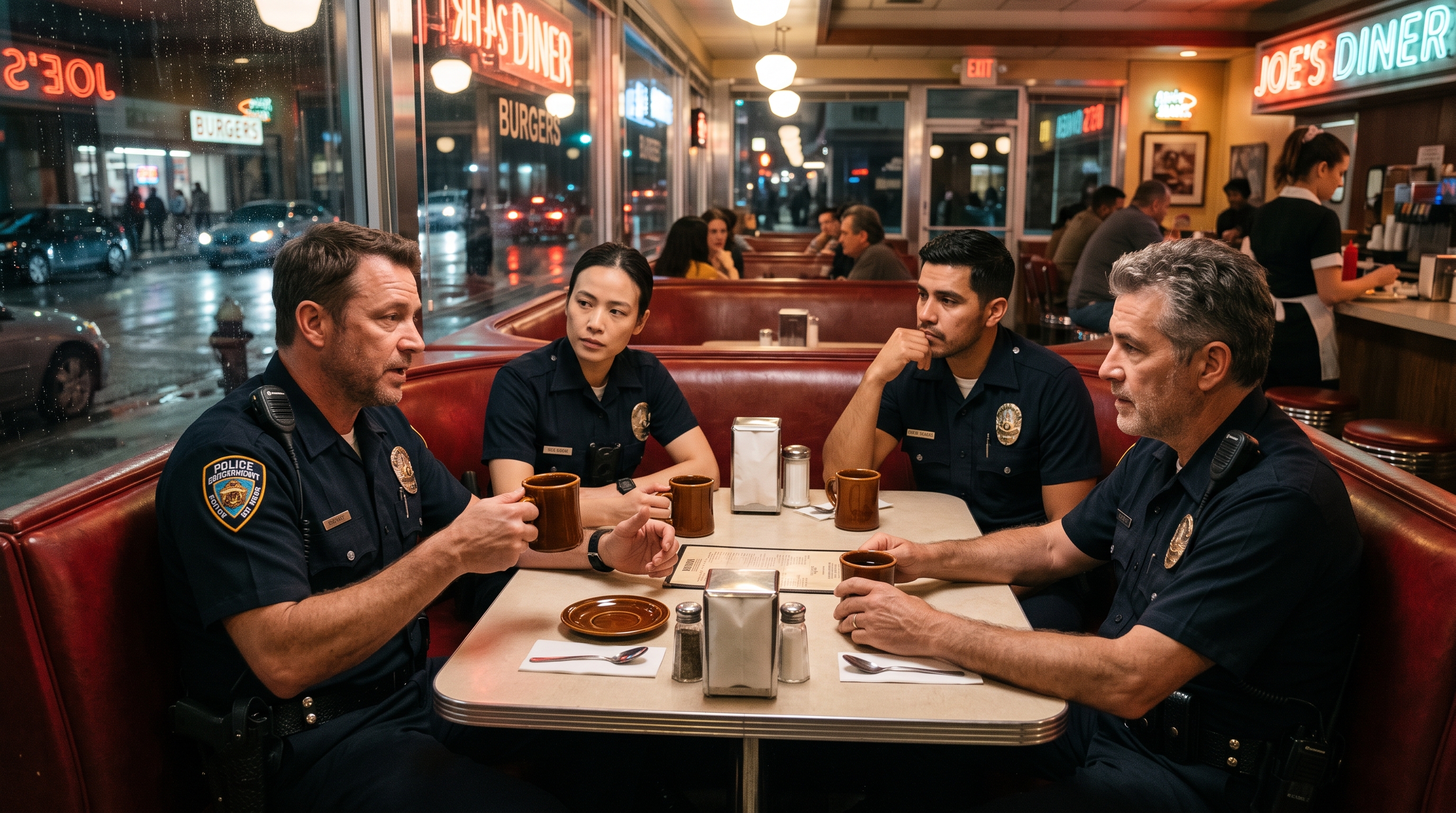
The neon sign of “Stan’s 24-Hour Diner” buzzed with an erratic, electric hum, a sound that seemed to harmonize with the ringing in Sergeant Miller’s ears. It was 9:30 PM, and the Friday night air in San Antonio had finally cooled, stripping the humidity from the asphalt.
Miller pushed open the glass door, the bell jingling a tired announcement. Behind him trailed three other officers: David Ruiz, who was still checking his radio volume; Sarah Jenkins, who looked ready to sleep for a week; and Mack “Mackie” Mackenzie, who was already loosening his utility belt as he scanned the room for a booth.
The diner was mostly empty, save for a few truckers and a couple of stragglers from the game. The four of them slid into a red vinyl booth near the back, the leather creaking under the weight of their gear. They smelled of stadium popcorn, diesel fumes, and the specific, metallic scent of a long shift.
“Easy night,” Mack said, rubbing his face with both hands. “Home team up by twenty-one points. Crowd was too happy to fight. I’ll take it.”
“Better than last week,” Jenkins agreed, pulling a menu from the chrome holder. “I thought that ref was going to need an escort off the field.”
The waitress, a woman named Barb who had been pouring coffee since the Reagan administration, dropped four heavy ceramic mugs on the table without asking. “The usual?” she asked.
“Please, Barb,” Miller said. “And keep the coffee coming.”
As they settled in, the adrenaline of the patrol began to fade, replaced by the philosophical fatigue that often hits law enforcement in the quiet hours. They watched the steam rise from their cups.
“You see that kid in the fourth quarter?” Ruiz asked, stirring sugar into his black coffee. “The receiver? Took a hit that would’ve leveled a moose, popped right back up. That’s focus.”
“That’s youth,” Mack chuckled, blowing on his drink. “Wait ‘til he’s forty. He won’t be popping up. He’ll be filing for disability.”
The conversation drifted from the physicality of the game to the sheer mass of humanity they had just overseen. Five thousand people screaming, cheering, living their separate lives, all packed into one concrete bowl.
“It makes you think though,” Jenkins mused, looking out the window at the passing headlights. “All those people. All those different backgrounds. We spend all night making sure they don’t kill each other, then they all just filter out the exits and go home.”
“Like ants,” Mack said. “Just marching along.” He took a long sip. “It’s nice to think they all end up in a good place eventually. You know? The big stadium in the sky.”
Ruiz paused, his spoon clinking against the side of his mug. “You think everyone goes there?”
Mack shrugged, his demeanor casual, the epitome of a man who didn’t like to complicate his worldview. “Sure. Why not? Unless you’re a serial killer or something. I figure God is like a good referee—he lets the little stuff slide as long as the game flows. All roads lead to heaven, right? As long as you’re heading generally north, you’ll get there.”
Jenkins nodded in agreement. “It’s a comforting thought. We see enough bad down here. I’d like to think the afterlife is a bit more… democratic.”
Miller, who had been silent until now, set his mug down with a deliberate thud. He was the senior officer, a man whose face carried lines etched by twenty years of seeing the things people tried to hide. He looked at Mack, then at Jenkins.
“That sounds nice, Mackie,” Miller said, his voice low but carrying a gravelly weight. “It sounds fair. But it’s not what the manual says.”
Mack grinned. “We talking about the penal code or the Bible, Sarge?”
“We’re talking about reality,” Miller said. He leaned forward, the leather of his holster creaking. “You know that intersection at 4th and Main we worked last month? The one with the construction?”
“Yeah,” Jenkins said.
“If a driver ignores the ‘Road Closed’ signs and drives into the pit because he feels like that road should lead home, does his intention save him?”
“That’s different,” Mack argued. “That’s traffic. We’re talking about eternity.”
“The stakes are higher,” Ruiz interjected. He was younger than Miller, but his faith was a visible current in his life, something that drove him to be the first on scene and the last to leave. “Jesus didn’t say, ‘come as you are and stay that way.’ He talked about a narrow door. A specific one.”
Mack rolled his eyes good-naturedly. “Here comes the fire and brimstone. Can’t we just enjoy the coffee?”
“It’s not brimstone, Mack,” Miller said gently. “It’s urgency. You remember the passage, Ruiz? Luke 13?”
Ruiz nodded. “Someone asked Jesus, ‘Lord, are there just a few who are being saved?’ It’s exactly what we’re talking about. Everyone wanted to know the numbers. They wanted the statistics.”
“And what did He say?” Miller asked, his eyes locked on Mack. “He didn’t give them a number. He gave them a command. He said, ‘Strive to enter through the narrow door; for many, I tell you, will seek to enter and will not be able.'”
“Strive,” Mack repeated, unimpressed. “Sounds like work.”
“It is,” Ruiz said, his voice animating. “That word can also be translated ‘agonize.’ It’s an athletic term. Like that receiver tonight. He didn’t just wander into the end zone. He fought for it. He trained for it. He took the hit and kept moving.”
Jenkins frowned, tilting her head. “So, you have to earn your way in? I thought you guys preached grace.”
“It’s not about earning it,” Miller corrected. “It’s about the exclusivity of the entrance. The door is narrow because the door is a Person. It’s Jesus. And the terrifying part of that story isn’t the struggle—it’s the timeline.”
Miller traced the rim of his cup with a calloused finger. “Jesus tells them that once the head of the house gets up and shuts the door, that’s it. People will stand outside knocking. They’ll say, ‘Lord, open up to us!’ But He’ll answer, ‘I do not know where you are from.'”
The diner seemed to quiet down, the ambient noise fading into the background of the conversation.
“That seems harsh,” Jenkins whispered.
“Listen to the defense the people offer,” Ruiz added, picking up the thread. “They say, ‘We ate and drank in Your presence, and You taught in our streets.’ They don’t say, ‘We loved you.’ They don’t say, ‘We served you.’ They say, ‘We were around. We were close by. We liked the vibe.'”
Miller pointed a finger at the window, toward the dark parking lot where the stadium lights were now doused. “It’s like someone sitting in the stands tonight, watching the game, buying a hot dog, and thinking that makes them part of the team. They were in the presence of the team. They watched the plays. But they never put on the jersey. They never entered the field.”
Mack shifted uncomfortably. “So, the ‘all roads’ thing…”
“Is a lie we tell ourselves so we don’t have to commit,” Miller stated flatly. “If all roads lead to the same place, Mack, then it doesn’t matter how you drive. It doesn’t matter who you follow. But Jesus is saying, ‘I am the door.’ If you don’t know the Homeowner, why would He let you in just because you stood on His porch?”
“It’s about relationship,” Ruiz said, his voice softening. “The motivation isn’t fear of hell, Mack. It’s knowing who the King is. Jesus lived his life in total dependence on the Father. He didn’t just drift. He was focused. He modeled that ‘narrow way’ for us—not just being a good guy, but being connected to the Source.”
“Depart from me,” Miller quoted, his voice solemn. “I do not know where you are from. That’s the sentence. It’s not ‘I hate you.’ It’s ‘I don’t know you.'”
Barb arrived with four plates of eggs and hash browns, breaking the tension. The clatter of silverware on ceramic seemed louder than usual.
Mack looked down at his food, his appetite suddenly dampened. He looked at Miller. “So, that whole ‘laissez-faire’ attitude… you think that’s dangerous?”
“I think it’s fatal,” Miller said. “If you saw a kid walking toward a cliff edge in the dark, and he said, ‘Don’t worry, gravity works differently for me,’ would you let him keep walking just to be polite?”
“No,” Mack said quietly. “I’d tackle him.”
“Exactly,” Ruiz smiled slightly. “Because you care about him.”
Miller picked up his fork. “We strive, Mack. We agonize to get through that door not because we’re trying to impress God, but because we know that outside of that door, there is nothing but weeping and gnashing of teeth. We want to be where the King is. We want to be known by Him.”
Jenkins stirred her coffee, looking thoughtful. “So, the urgency… the door shuts.”
“It shuts,” Miller confirmed. “Maybe not tonight. Maybe not tomorrow. But it shuts. And I’d rather be inside, sitting at the table with Jesus, than standing outside explaining how I was ‘pretty sure’ any road would get me there.”
The four of them ate in a contemplative silence for a few minutes. The concept hung in the air—the image of a narrow door, a ticking clock, and the vast, terrifying difference between being a spectator in the stands and a player on the field.
Finally, Mack took a bite of toast. He chewed slowly, looking at Ruiz, then at Miller.
“I never thought about it like that,” Mack admitted, his voice lacking its usual cynical edge. “The difference between knowing about someone and actually knowing them.”
“It makes all the difference,” Miller said, taking a sip of his coffee. “It’s the only thing that matters.”
Outside, the traffic light on the corner turned from green to yellow, then to a stark, unyielding red. Inside, the conversation had shifted. The casual drift of the night had been anchored by a heavy truth, leaving the two “outsiders” to ponder the direction of their own roads, and the narrowness of the door that stood waiting.
Introduction
A challenging and deeply personal question confronts Jesus in Luke 13:23: “Lord, are there just a few who are being saved?” The popular religious sentiment of the day likely hoped for a broad, inclusive answer. However, the King’s response cuts directly to the core of discipleship and authority, issuing a profound command: “Strive to enter through the narrow door; for many, I tell you, will seek to enter and will not be able.” This powerful teaching, set against a backdrop of coming judgment and exclusion, establishes a foundational truth about the Kingdom of God. This study will examine Luke 13:23-30 to understand the implications of the King’s sovereign authority over entrance, the demanding nature of the “narrow door,” and the vital, yet often controversial, truth that entry into the Kingdom is a matter of urgent, focused, and exclusive commitment to Jesus Christ.
Key Words and Phrases
Strive – Uses the Greek word ἀγωνίζομαι – agōnizomai – (Strong’s G75), meaning to enter a contest, to contend in the gymnastic games, to contend with adversaries, fight, struggle with difficulties and dangers, to endeavor with strenuous zeal, or strive to obtain something. Like the boxer must strive with strenuous zeal, contending against his opponents and struggling through personal difficulties to obtain the gold medal.
Narrow – Uses the Greek word στενός – stenos – (Strong’s G4728), meaning narrow (from obstacles standing close about) or strait. Like a passage one must tightly squeeze through (cf. Matthew 7:13-14).
Door – Uses the Greek word θύρα – thyra – (Strong’s G2374), meaning a door, a vestibule, or any opening that serves as an entrance, way, or passage. This word is often used to signify a particular entrance, like a single gateway that strictly limits access.
Saved – Uses the Greek word σῴζω – sōzō – (Strong’s G4982), meaning to save, preserve, rescue, deliver, or make whole. Like a person being rescued from a sinking ship who is in the process of being pulled to safety.
Strive to enter through the narrow door – The command to “Strive to enter through the narrow door” (Luke 13:24) requires an urgent and focused commitment to the Kingdom of God. Matthew 7:13-14 clarifies this as choosing the difficult, life-giving path over the easy, destructive one. Furthermore, John 10:9 identifies the door: Jesus Christ himself is the singular way to salvation and entry into the Kingdom. Therefore, striving is an active choice to commit to Jesus Christ as the exclusive path to eternal life, which is synonymous with entering the Kingdom of God.
Messianic Model – Focus on Jesus’ Example
Jesus did indeed live a perfect life (2 Corinthians 5:21; 1 Peter 2:22), but we must remember that we, as His disciples, do not. Therefore, our entry into the Kingdom is entirely dependent on Him and Him alone for the forgiveness of sins (Ephesians 1:7; 1 John 1:9).
The essence of the “narrow way” He demonstrated was not merely sinlessness, but His complete and continual dependence on the Father. He modeled for us what a true relationship with God should look like: a singular focus and devotion to the One who provides all direction, protection, and life (John 5:19; John 4:34). It is this very faith, focus, and reliance that Jesus lived out perfectly (John 8:29) for us, His disciples, to practice in turn (1 Corinthians 11:1; 1 Peter 2:21).
Key Theological Implications
Jesus’ teaching on the requirements for entering the Kingdom stands in stark contrast to our age, which often views truth as relative and sees any exclusivity as “hate speech.” The popular, yet destructive, religious belief that “all roads lead to heaven” may offer momentary comfort, but Jesus clearly warns of its disastrous outcome. The pervasive cultural push to accommodate all faiths (and non-faith) is ultimately a lie. It is the responsibility of a true follower of Jesus not only to love others but also to faithfully communicate the truth: that the King, who alone holds the authority to set the standards for entrance, will welcome some into His kingdom and exclude others. This challenging truth is central to Jesus’ message. In fact, Jesus used many parables to communicate this exact same exclusionary reality:
- Parable of the Sower (Matthew 13:1-23)
- Parable of the Weeds/Tares (Matthew 13:24-30; Matthew 13:36-43)
- Parable of the Leaven (Matthew 13:33)
- Parable of the Hidden Treasure (Matthew 13:44)
- Parable of the Dragnet (Matthew 13:47-50)
- Parable of the Ten Virgins (Matthew 25:1-13)
- Parable of the Talents/Minas (Matthew 25:14-30; Luke 19:11-27)
- Parable of the Wedding Feast/Great Banquet (Matthew 22:1-14; Luke 14:12-24)
Contemporary Spiritual Significance
As Christians, we must be bold enough to communicate the gospel in a loving yet accurate way, swimming heavily against the currents of universalism. While this may risk offense, it is infinitely better than allowing friends, family, and acquaintances to spend eternity completely separated from God. This pursuit aligns with one of the Apostle Paul’s primary prayer requests: that he would preach the gospel accurately and with boldness (Ephesians 6:19-20; Colossians 4:3-4).
The Transformative Power of Preaching an Exclusionary Gospel
The true gospel is, by its very nature, exclusionary. A message that fails to proclaim the narrow way to the kingdom of God—through Jesus Christ alone—is no gospel at all; it is a lie from the enemy that delivers a person directly into the eternity they seek to escape. Conversely, this true gospel, though narrow, possesses the power not only to secure eternal life but also to radically transform the believer’s present state, granting them peace, hope, love, and security. Entering into this reality guides one’s actions toward healthy living and deep spiritual well-being. It is the comprehensive answer to humanity’s woes, both now and for the life to come.
Conclusion
The passage in Luke 13:23-30 serves as a stark and unyielding declaration: entrance into the Kingdom of God is the exclusive prerogative of the King, Jesus Christ. His command to “strive” is a call to a strenuous, urgent, and singularly focused commitment to the narrow door, which is Himself. Those who trust in mere religious association (“We ate and drank in Your presence”) rather than a genuine, life-altering relationship with Him will hear the crushing judgment of exclusion. The true gospel is exclusionary, offering only one way to the Father. But wonderfully, this true gospel also possesses the boundless, transformative power to completely secure our eternal life and radically change our present state.


