Association Does Not Equal Salvation – #169

| Gospel Sync | Kingdom Kernels | On the Road Podcast | Website

Rather Listen? Click here…

Welcome Back! Today, we’ll be looking at the Gospel of Luke to see how Jesus answers this question: “Will only a few people be saved?”

So let’s dive in.

(Click here to get a copy of the Gospel Sync document) 

Luke 13:22–30

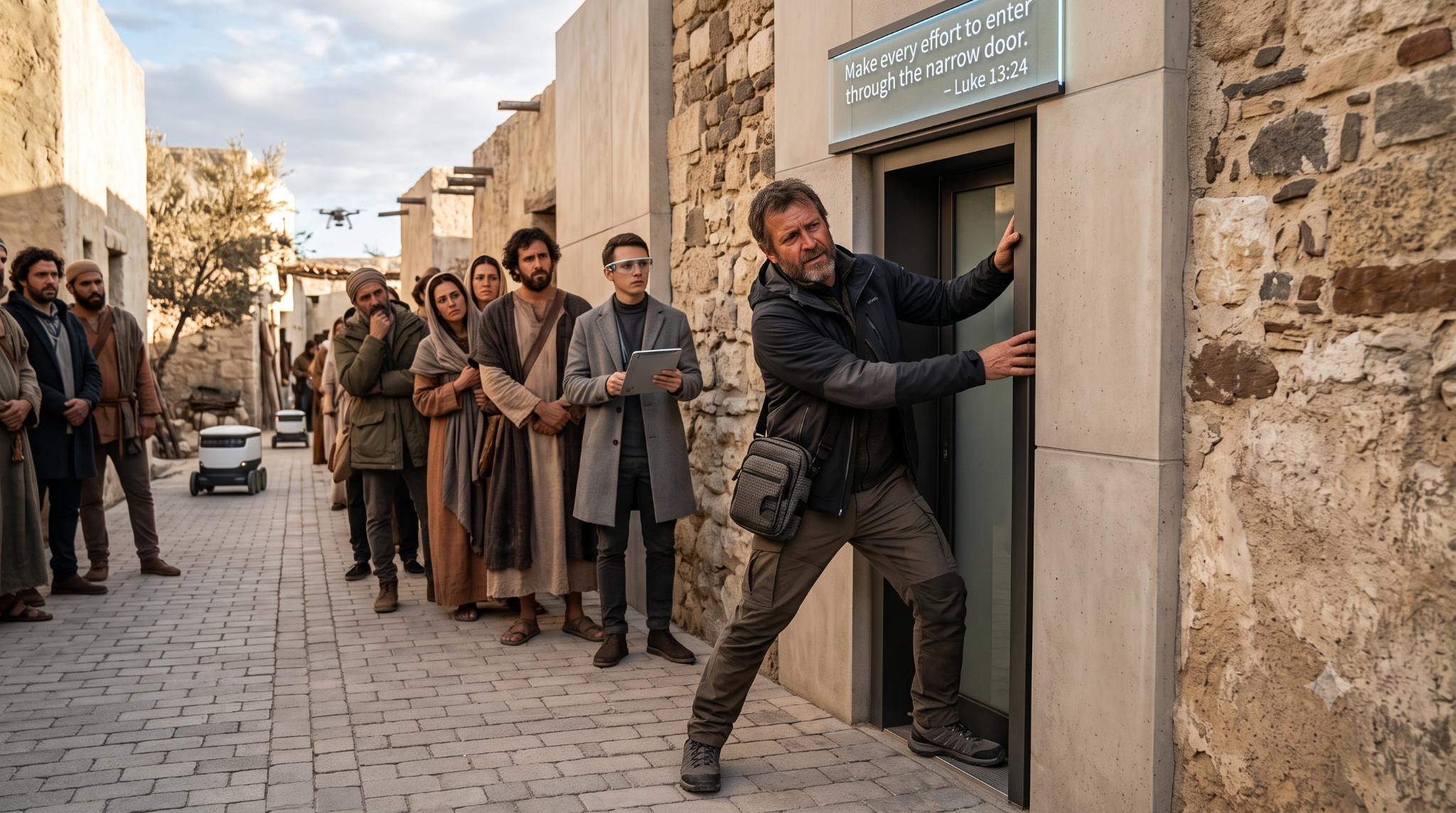
Then Jesus traveled throughout the towns and villages, teaching as He made His way toward Jerusalem. “Lord,” someone asked Him, “will only a few people be saved?” Jesus answered, “Make every effort to enter through the narrow door. For many, I tell you, will try to enter and will not be able. After the master of the house gets up and shuts the door, you will stand outside knocking and saying, ‘Lord, open the door for us.’ But he will reply, ‘I do not know where you are from.’ Then you will say, ‘We ate and drank with you, and you taught in our streets.’ And he will answer, ‘I tell you, I do not know where you are from. Depart from me, all you evildoers.’ There will be weeping and gnashing of teeth when you see Abraham, Isaac, Jacob, and all the prophets in the kingdom of God, but you yourselves are thrown out. People will come from east and west and north and south, and will recline at the table in the kingdom of God. And indeed, some who are last will be first, and some who are first will be last.”

My Thoughts

“Will only a few people be saved?” Jesus answers this person’s question, and His answer should make us pay attention—like a man walking on a frozen lake who suddenly hears a loud CRACK beneath his boots. Something is dreadfully wrong here, and it might just cost me my life! Jesus draws the person’s attention (and everyone else within earshot) to the sobering reality that “association does not equal salvation.”

Jesus was around a lot of people. I mean, a lot of people. His presence may have made them feel safe. And when you’re with the Good Shepherd, you should feel safe… unless, of course, you’re a wolf. Jesus poignantly points out that many people are “wolves in sheep’s clothing.” They obviously don’t see themselves that way. That becomes clear in His story when these people are shocked to find they aren’t gaining entrance into the kingdom of God.

And notice that Jesus connects “being saved” with entering the “kingdom of God” (in fact, He emphasizes this twice in the passage). Those who enter His kingdom aren’t simply people who lived in the same neighborhood or saw Him on TV a few times or even ate a meal or two with Him. He wants loyal subjects who desire to be with Him so much that they submit their lives to Him. They humble themselves by owning their shortcomings and wanting to do something about them. They repent—turning away from living life on their own terms and turning toward the way God wants them to live. The King actually influences their thinking and, by His grace, their actions.

People coming from every direction sounds like a lot of people to me. It’s just not the people who assumed they were “in” simply because they were a “churchgoer,” celebrated Christmas, or prayed a prayer with all the right words. It sounds like Jesus is looking for more than just association. He’s looking for people who love their King so much that He has become their very life.

My Story

I’ve mentioned in a couple of posts that I’m sharing the gospel with an emphasis on the kingdom of God. This week, I was sharing with four soldiers. After we discussed and discovered that Jesus is the King, that we are His subjects, and that He rules over everything, I got to the punchline: “The subjects of the King can respond in three ways: allegiance, indifference, or rebellion. Which one are you?”

For the first time since I started presenting the gospel this way, someone said they were in outright rebellion. This one person’s stark admission was contagious. All four soldiers agreed they were in rebellion against the King.

I asked my next question: “Do you want to rebel against King Jesus?”

All four said, “No.”

Then I asked, “What would it take for you to quit rebelling?”

They were brutally honest and had some good ideas, but they all revolved around being a “better person.” That’s when I explained the reason He had to die for our sins. I shared that we need to respond by believing and receiving the gift of His mercy, and by repenting—doing an “about-face” in our hearts and desiring to have Him rule over our lives. By His grace, He will respond to our heart’s desire; He is the One who makes us better people.

They all thanked my dad-in-law and me for sharing with them, and they resolved to get to know the King better and allow Him to call the shots in their lives.

Our Action Plan

Now it’s time for application. Here’s some questions and ideas:

  • Do you and those you are discipling know what true repentance looks like?
  • Do a Bible study with those you are discipling on those who believed and repented in the Gospels.
  • Share the gospel in a way that emphasizes repentance. 

Jesus offers us a sobering warning: simply growing up hearing His name or attending religious services is not enough to enter the kingdom of God. While these are good things, the King requires more than mere association. He calls for our complete allegiance and a genuine willingness to align our lives with His will. Though we will inevitably stumble along the way, true faith is marked by a heart whose deepest desire is to know and serve Him.

| Gospel Sync | Kingdom Kernels | On the Road Podcast | Website |

Ingredient #10: Reminding (Constantly)

The WIGTake for Spiritual Generations 

All 12 Ingredients for Spiritual Generations and Podcasts

By Pheaney (Peter) Lindell and Chuck & Deb Wood

Rather Listen? Click here…

Last week, we looked at the posture of a servant. But even the best serving can be forgotten. Jesus knew that we drift and we forget. Because of this, His ministry was a relentless cycle of repetition and reminding.

The Jesus Model

Consider the scene in the boat in Mark 8. The disciples had just witnessed Jesus feeding thousands of people—twice. Yet, when they realized they had forgotten to bring bread, they immediately panicked. Jesus had to walk them back through the math of the miracles, asking, “When I broke the five loaves for the five thousand, how many baskets full of broken pieces did you pick up?” (Mark 8:14-21). He was frustrated, yes, but He was persistent. He refused to let them live in the “leaven” (the false teaching) of the Pharisees; He kept bringing them back to the reality of who He was.

This need for reminding is so central that Jesus revealed it as a specific role of the Holy Spirit. He told the disciples, “The Helper, the Holy Spirit… will teach you all things, and bring to your remembrance all that I said to you” (John 14:26). If the Third Person of the Trinity is dedicated to the ministry of reminding, we should not consider it beneath us.

The Scriptural Model

The apostles picked up this mantle of repetition. Paul, writing to his seasoned protégé Timothy, didn’t assume Timothy was on auto-pilot. He wrote, “For this reason I remind you to kindle afresh the gift of God which is in you” (2 Timothy 1:6). Even the most faithful leaders can let their fire dim; they need the external spark of a reminder to blaze again.

Peter was even more explicit about this strategy. He didn’t apologize for repeating himself. He declared, “Therefore, I will always be ready to remind you of these things, even though you already know them… I consider it right, as long as I am in this earthly dwelling, to stir you up by way of reminder” (2 Peter 1:12-13). Peter understood that knowledge isn’t enough; we need “stirring up.” The goal of reminding isn’t to inform the intellect but to awaken the will.

Stories

When I first grasped that discipleship was about becoming like Jesus, I realized I wasn’t the only one who had been missing the mark. For years, I treated discipleship like a Wednesday night line-up: a class to attend, a curriculum to finish, or a method to master. It was a program, not a pursuit.

I soon discovered that the core discipline of discipleship is the relentless effort to keep Jesus at the center. He isn’t just a distant Lord or a historical Savior; He is the target and the ultimate model. I started a constant internal rhythm, reminding myself to think, speak, and act like Him. Most importantly, I had to learn what it meant to simply abide in Him.

The power of this “constant reminding” became clear during a recent coaching session. I was working with a group of church leaders on the topic of healthy families. They were asking great questions. I paused and asked, “Before I give you an answer, where am I going to look first?”

“The Scriptures,” they answered confidently.

“Close,” I said with a smile.

They caught my drift immediately. “Jesus!” they shouted in unison.

Exactly. While the Scriptures are our map, Jesus is the destination. This is the art of discipleship: keeping the Master in sight when the “business” of religion tries to fog the view. Of course, this requires a fair amount of persistence. I often joke that there are only three ways to truly learn anything: repetition, blunt force trauma, and repetitive blunt force trauma.

While that’s a bit tongue-in-cheek, the truth remains. We are forgetful people. We need to be reminded—over and over—that every principle and every truth we teach must eventually lead us back to the same place: Jesus, Jesus, Jesus.

Suggestions

  1. Jesus-Centered: In every lesson, no matter the topic (relationships, finances, work), find the thread that leads back to the Gospels. Remind them that Jesus is the hero of every story.
  2. Review Identity and Purpose: Regularly bring them back to their identity in Christ and His purpose for their lives. Try to always bring these two together like Jesus did.
  3. Review the Basics: Don’t be afraid to reteach the fundamentals annually (Time with Jesus, Sharing the Gospel, The Great Commission, etc.). Assume they leak and need a refill on the basics.

Application for Disciple Makers

For us, the WIGTake is accepting the role of “Chief Reminding Officer.” You will often feel like a broken record, repeating the same truths about grace, identity, and the Kingdom over and over. Do not be discouraged by this. Those you are discipling are being bombarded daily by the world’s counter-narratives. Your voice needs to be the steady rhythm of truth that cuts through the noise. Spiritual parenting isn’t just about teaching new things; it’s about helping people remember what is true when life tries to make them forget. It is not just about checking a box of information transfer; it is about “kindling afresh” the fire of God in them, knowing that sometimes the most profound ministry is simply reminding someone of who they already are in Christ.

Next Week: We remind people of the truth because the mission feels impossible. When the task feels too big, we have to lean on something sturdier than our memory. Next week: Ingredient #11: Trusting the Promises of God.

All 12 Ingredients for Spiritual Generations and Podcasts
Ingredient #9: Serving

The WIGTake for Spiritual Generations 

All 12 Ingredients for Spiritual Generations and Podcasts

By Pheaney (Peter) Lindell and Chuck & Deb Wood

Rather Listen? Click here…

We just explored the heart of a spiritual parent. But in the Kingdom, parenting and leadership don’t lead to a throne; they lead to a servant’s towel. In a world obsessed with ladder-climbing, Jesus taught us how to descend.

The Jesus Model

When James and John asked for positions of glory, Jesus did not just deny their request; He deconstructed their worldview. He told them, “You know that those who are recognized as rulers of the Gentiles lord it over them… But it is not this way among you” (Mark 10:43-45).

This phrase—“it is not this way among you”—draws a line in the sand. In the Kingdom, leadership is not about how many people serve you, but how many people you serve. Jesus did not just teach this; He lived it as the ultimate reality of His mission: “For even the Son of Man did not come to be served, but to serve, and to give His life a ransom for many.” If the King of the Universe entered history to serve, then no task is too small for us.

The Scriptural Model

Paul echoes this radical posture in his letter to the Corinthians. He clarifies the content of his message and the nature of his position: “For we do not preach ourselves but Christ Jesus as Lord, and ourselves as your bond-servants for Jesus’ sake” (2 Corinthians 4:5).

Note the duality: Jesus is Lord, and Paul is a servant. The word for servant here is doulos—a bond-servant or slave. Paul didn’t view his spiritual authority as a platform for prestige but as a mandate for service. He belonged to Jesus, and because of that, he made himself a servant to the people he was leading. He wasn’t serving them to please them; he was serving them “for Jesus’ sake.” This is the safeguard against burnout: we serve people, but we do it for the Lord in the context of our calling.

Stories

It was time to leave the nest. The Army had put me on orders for Korea, signaling the end of my season living in Cecil and Jeannie’s basement. They had treated me like a son, and I wanted to honor that relationship. Cecil was on full-time staff with The Navigators, relying on financial support for his ministry. I decided that as soon as I settled in overseas, I would write him a check every month. I wanted to serve him the way he had served me.

There was just one problem: the Army wasn’t paying me.

When I had re-enlisted, the Army was happy to retain my services, but a glitch in the finance system meant they forgot to pay me for them. For three months, I served my country for free. It sounds noble in retrospect, but at the time, it was a disaster. I was writing checks to Cecil, assuming the direct deposit would hit. It didn’t. The checks bounced.

After three months of bad paper, Cecil knew something was wrong. He didn’t get angry, and he didn’t write me off. Instead, he took action. Even as a civilian, he drove onto Fort Campbell, walked into the finance office, and advocated for me until they sorted out the error.

Then I received his letter—this was in the days before email. He didn’t lecture me about balancing my checkbook. He simply told me to stop sending checks until I was stable. Then came the part that blew me away: he had deposited $500 into my account to make sure I was okay.

Cecil was my spiritual leader, my mentor, and yet he served me. He lived out Mark 10:43-45 vividly:

“But it is not this way among you, but whoever wishes to become great among you shall be your servant; and whoever wishes to be first among you shall be slave of all. For even the Son of Man did not come to be served, but to serve, and to give His life a ransom for many.”

Another Story from a Friend

A good friend who is making disciples at his workplace was in a fix. He switched home insurance companies to save some money, but the new company required him to repair a fence. 

So, I jumped in the car early one morning with one of my kids, drove 3 hours, and spent 4+ hours repairing his fence.

Fast forward three weeks, and the insurance company wasn’t happy with another part of the property, so they still dropped his coverage.

Seems like a lame story, except that this friend reaches out to me all the time with updates, prayer requests, and questions. Serving deepened the relationship, even if it didn’t do anything else at that moment.

Suggestions

  1. The “Towel” Task: When you are together at a ministry event, be the first one to take out the trash or stack the chairs. Model that spiritual authority does not exempt you from menial labor.
  2. Generosity: If you know they are struggling financially, look for ways to bless them without creating dependency. A surprise gift card or paying for a meal can demonstrate the Father’s provision.
  3. Serve Together: Plan a service project where you serve the poor or help a neighbor. Train them to look outward and see the needs of others as a priority.

Application for Disciple Makers

For us, the WIGTake involves embracing the inconvenience of serving. We often desire the influence of leadership without the grit of service. But spiritual authority is accrued in the trenches. It is found in helping someone move apartments, staying late to clean up after an event, or listening to a broken story when you are exhausted.

Those you are discipling are watching. They need to see you use your influence to lift others up, not to prop yourself up. Serving destroys the entitlement that often creeps into ministry. It reminds us—and demonstrates to those watching—that we do not preach ourselves. We preach Jesus as Lord, and we offer our lives as servants to those we are raising up.

Next Week: We often assume that if we serve and lead well once, the lesson is learned. But human beings have spiritual amnesia. Next week, we look at the necessity of the “broken record”: Ingredient #10: Reminding (Constantly).

All 12 Ingredients for Spiritual Generations and Podcasts

Retreat or Tactical Repositioning? – #168

| Gospel Sync | Kingdom Kernels | On the Road Podcast | Website |

Rather Listen? Click here…

Welcome Back! Today, we’ll be looking at the gospel of John to see how Jesus discreetly chose to avoid persecution. 

So let’s dive in.

John 10:39–42

At this, they tried again to seize Him, but He escaped their grasp. Then Jesus went back across the Jordan to the place where John had first been baptizing, and He stayed there. Many came to Him and said, “Although John never performed a sign, everything he said about this man was true.” And many in that place believed in Jesus.

My Thoughts

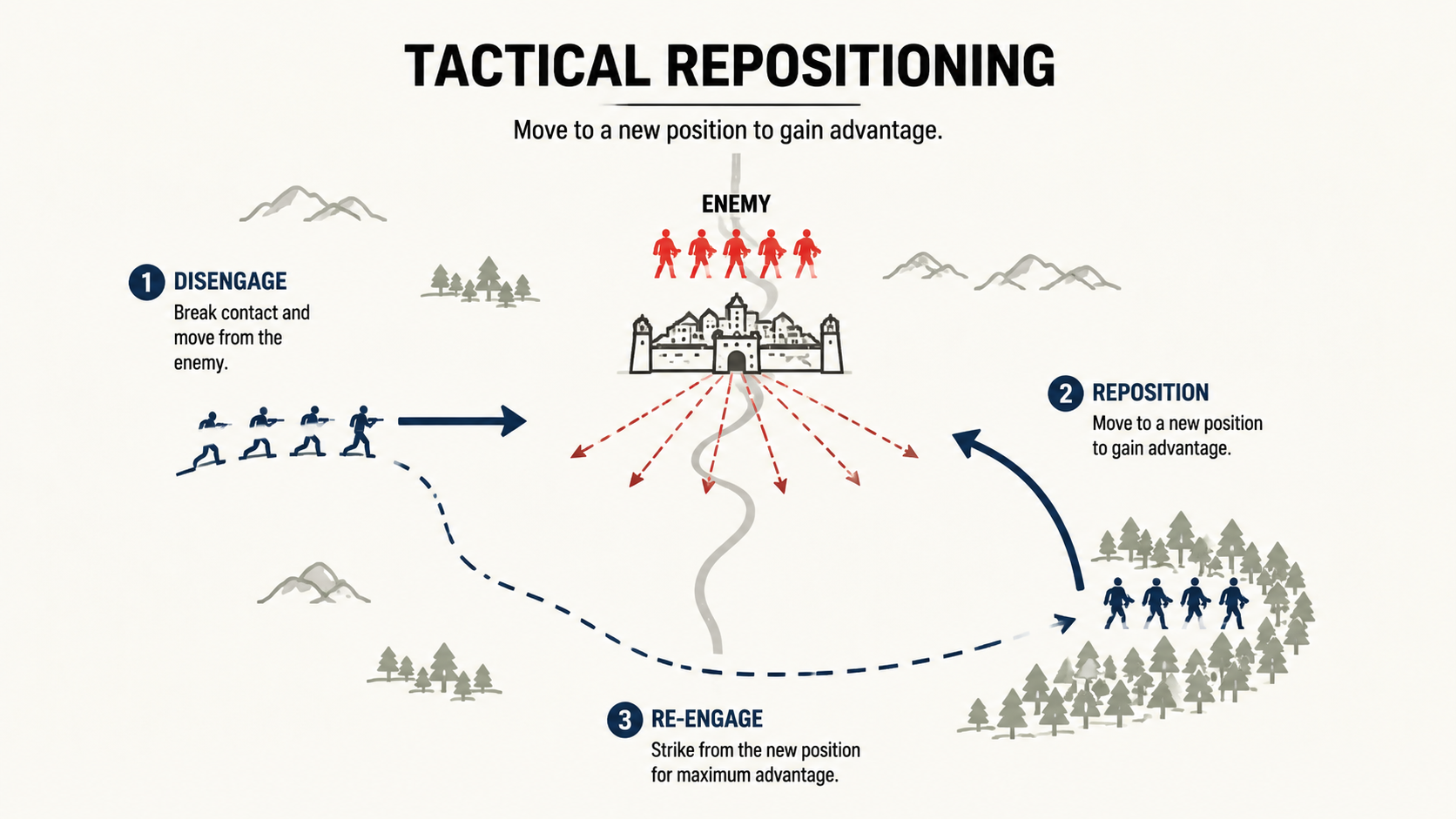
 It’s interesting how Jesus responds to the heat He’s getting from the religious leaders in this season of His ministry. This is what we used to call in the Army a “tactical repositioning” not a “retreat.” In other words, “Run, run away. Live to fight another day.” It’s not an act of cowardice. No one could ever rightfully call Jesus a coward. It’s an act of stewardship. Jesus knows when to duck and weave and when to take a punch. There would come a day when He literally let’s them kill Him. But not this day. There was still work to do.

Notice how Jesus was in fact modeling for the disciples what He commanded them to do when things got a little too dicey on their mission.

“But whenever they persecute you in one city, flee to the next…” (Matthew 10:23)

Discretion is the better part of valor. There is a time to stand your ground and a time to move on.

So how did Jesus know when was the right time for a “tactical repositioning” and a time to go to the cross. Answer: Abiding deeply in the Father (John 5:39). And Jesus instructs us to abide in Him the way He abided in the Father. This is when we will know which to choose as we are living life and making disciples.

My Story

As an Army Chaplain, I had to learn early on which hills were truly worth dying on.

Sure, we encountered situations that felt sketchy, and a few that were just flat-out wrong. But I didn’t bat an eye when instructed to provide a Quran to a Muslim soldier or to ensure a Wiccan soldier wasn’t persecuted for their faith.

The Army was crystal clear on the difference between providing and performing. My job was to provide access to religious support for all soldiers. However, I was not required to perform a service that violated my personal convictions or my endorsing body’s theological standards.

Under our Constitution, every person has the right to practice their faith, provided it doesn’t infringe on the rights of others. As chaplains, we were the guardians of those rights.

If you think through the day-to-day scenarios, you can see where this gets a little tricky. There is a massive amount of gray area—or maybe not so massive, depending on your convictions—that a chaplain has to navigate.

One area I wrestled with was the expectation of “non-sectarian prayers.”

By definition, a non-sectarian prayer is kept general, intended to be inclusive of people from various faiths or no faith at all. My problem was simple: I don’t have a generic God.

The Triune God of the Christian faith specifically instructs us to invoke the name of the Son, the Lord Jesus Christ. I couldn’t bring myself to pray to a “vanilla god” or a “government god.” I could only pray to the God of all creation—the One who truly answers.

For years, I went about my duties without this being an issue, consistently praying in Jesus’ name. But eventually, it caught up with me. I was officially asked to resign my commission as an Army officer and chaplain.

This was the hill I was willing to die on.

Ironically, the situation was ultimately resolved when a higher-ranking chaplain stepped in and plainly pronounced, “Chaplain Wood has Constitutional rights, too.”

Ultimately, the instructions of Jesus helped me pick my battles wisely.

As we are discipling others for Him, it is only a matter of time before they face this kind of hostility. When that day comes, we will need to be ready to point them right back to His example.

Our Action Plan

Now it’s time for application. Here’s some questions and ideas.

  • Do you know how to discern when and when not to “fall on your sword?”
  • Are you training the folks you’re mentoring how to handle push back and persecution?
  • Read and study Daniel chapter 1 and learn how Daniel navigated some tricky situations. 

It’s always good to prepare for the storm before it comes. And they will come. Let’s take a page out of Jesus’ playbook and be wise stewards of the life and circumstances God has given us.

| Gospel Sync | Kingdom Kernels | On the Road Podcast | Website |