Kingdom Kernel #31 – Two Types of Fish

The Parable of the Dragnet: Unveiling Christ’s Kingship and His Judgment

Kingdom Kernel Collection

“Again, the kingdom of heaven is like a dragnet cast into the sea, and gathering fish of every kind; and when it was filled, they drew it up on the beach; and they sat down and gathered the good fish into containers, but the bad they threw away. So it will be at the end of the age; the angels will come forth and take out the wicked from among the righteous, and will throw them into the furnace of fire; in that place there will be weeping and gnashing of teeth.” (Matthew 13:47-50)

Introduction: Contextualizing the Parable

In Matthew 13:47-50, Jesus presents the Parable of the Dragnet, a vivid metaphor for the Kingdom of Heaven. Set within a series of kingdom parables, this passage likens the kingdom to a dragnet cast into the sea, gathering fish of every kind. At the end of the age, the angels sort the catch, keeping the good and throwing away the bad, with the wicked cast into a furnace of fire. This parable reveals the nature of Christ’s kingship, the reality of divine judgment, and the eternal scope of God’s redemptive plan, emphasizing Jesus’ present and future lordship.

Key Words and Phrases

Dragnet – σαγήνη (Strong’s G4522 – sagēnē) – refers to a large fishing net dragged across the sea to capture all in its path, derived from a root suggesting enclosure or sweeping inclusivity. This imagery underscores the kingdom’s universal reach, gathering both righteous and wicked.

Threw away – ἐκβάλλω (Strong’s G1544 – ekballō) – meaning to cast out or expel, carries a forceful connotation of rejection, often used for divine judgment (John 12:31).

End of the age – συντέλεια (Strong’s G4930 – synteleia) and αἰών (Strong’s G165 – aiōn) denotes the consummation of the current era, a time of divine reckoning (Matthew 24:3). These terms collectively paint a picture of Christ’s sovereign authority as the Messiah and King, orchestrating a final, discerning judgment.

Theological Significance: The Kingdom and Its King

The dragnet symbolizes the Kingdom of Heaven’s present inclusivity, where righteous and wicked coexist under Christ’s lordship (Matthew 13:24-30). Jesus, as the Messiah, is the King who reigns now through grace and will return in glory to judge (Revelation 19:11-16). His dual nature—loving yet just—is evident: He offers salvation to all but executes righteous judgment, separating the righteous for eternal life and the wicked for punishment (2 Corinthians 5:10). The angels’ role highlights Christ’s delegated authority, affirming His divine sovereignty (Matthew 25:31-32). The “end of the age” points to the eschatological fulfillment of God’s redemptive plan, where Christ’s eternal reign is fully realized in Daniel 7:14.

Christological Fulfillment: Jesus as Present and Future King

The parable reveals Jesus as the Messiah who reigns presently, calling all to repentance (Mark 1:15), yet His lordship awaits ultimate fulfillment. The dragnet’s gathering reflects the gospel’s universal call, while the sorting signifies Christ’s discerning judgment as King (John 5:22). His current reign transforms believers through the Holy Spirit, preparing them for the kingdom’s consummation. The act of “throwing away” the bad fish prefigures the final separation, where Christ’s justice ensures the wicked face divine consequence (Revelation 20:15), while His love preserves the righteous (John 10:28).

Implications for Believers: Transformative Power

For contemporary Christians, this parable underscores the urgency of living under Christ’s lordship now. Disciple-makers must teach the reality of judgment, the necessity of genuine faith (Matthew 7:21), and the consequences of unrepentance (Luke 13:3). The dragnet’s imagery encourages believers to embody righteousness amidst a mixed world, trusting in Christ’s redemptive grace (Galatians 6:9). By recognizing Jesus’ present kingship, believers are empowered to live as kingdom citizens, anticipating the eternal glory of His reign.

Conclusion: The Eternal Kingdom and Its King

The Parable of the Dragnet reveals Jesus as the sovereign King, whose lordship is real now and will be fully manifested at the end of the age. The terms sagēnē, ekbállō, and suntéleia aiōnos illuminate His inclusive yet discerning reign, balancing love and justice. This concept calls believers to urgent evangelism, genuine faith, and patient endurance, transforming their lives as they await Christ’s eternal kingdom (Revelation 22:5). Through this parable, Jesus’ kingship shines as both a present reality and a future hope, inviting all to submit to His redemptive rule.

Disciple-Maker’s Short Story

The Dragnet at Dusk

The sun dipped low over the bay, painting the water in hues of amber and violet as Lisa and Elly pedaled along the coastal road, their mountain bikes humming against the asphalt. The salty breeze carried the tang of the sea, mingling with the creak of fishing boats bobbing at the docks. Elly’s tires wobbled slightly as her gaze lingered on the boats, their nets draped like veils over weathered decks. Her mind drifted to the passage she’d read that morning—Matthew 13:47-50, the Parable of the Dragnet, where Jesus spoke of a net gathering fish of every kind, only to be sorted at the end of the age.

“Let’s take a break,” Elly called, slowing her bike near a rocky outcrop with a sweeping view of the ocean. The two women dismounted, leaning their bikes against a weathered bench. The horizon shimmered, a canvas of divine artistry, and Elly’s heart stirred with questions. She turned to Lisa, her friend and mentor, whose steady faith had always grounded her. “Lisa, I read about the good and bad fish this morning. The dragnet. What does it mean? It’s been stuck in my head all day.”

Lisa sat on the bench, her eyes tracing the waves. She was older, her face etched with lines of quiet wisdom, yet her presence radiated warmth. “The dragnet,” she began, her voice soft but deliberate, “is about the Kingdom of Heaven. Jesus said it’s like a net cast wide, pulling in everyone—righteous and wicked alike. But at the end, there’s a sorting. The good are kept; the bad are cast away.”

Elly frowned, kicking a pebble with her sneaker. “It sounds so final. Like there’s no room for mistakes.” Her life felt like a tangled net—moments of faith knotted with doubts, her temper flaring too often, her patience fraying with her coworkers. She wanted to be good, but the weight of her flaws made her wonder if she’d be “thrown away.”

Lisa’s gaze softened, reading Elly’s unspoken fears. “It’s not about being perfect, Elly. The parable shows Jesus as King—loving, just, and sovereign. He’s reigning now, not just at the end. The net’s still in the water, gathering us all. It’s why we’re called to become like Him, to let His Spirit shape us into the ‘good fish’—not by our strength, but by His grace.”

Elly hugged her knees, the ocean’s rhythm steadying her. “But how? I mess up all the time. I yelled at my boss last week. I’m not… righteous.”

Lisa leaned forward, her voice carrying the weight of conviction. “The righteous aren’t sinless. They’re the ones who trust Jesus, who let Him transform them. Look at John 10:28—He holds us, and no one can snatch us away. The sorting isn’t about earning your place; it’s about surrendering to His kingship now. Every choice to love, to forgive, to repent—it’s you becoming more like Him.”

The words sank deep, stirring a quiet resolve in Elly. She thought of Galatians 6:9—not growing weary in doing good. Maybe her small acts of kindness, her prayers for patience, were threads in a net being woven by a greater hand. The boats in the bay rocked gently, their nets a reminder of Christ’s inclusive call, yet also His promise of justice. She wanted to live for that King, to reflect His heart in a world of tangled nets.

As the last light faded, Elly stood, her bike ready. “I want to be like Him,” she said, almost to herself. “Not just for the end, but now.”

Lisa smiled, mounting her bike and turning on her headlamp. “That’s the Kingdom, Elly. It’s here, in you, growing. Let’s ride.”


Kingdom Kernel Collection

Do Words Really Matter? – #137

Index for all posts in the Gospel Sync Series

ENGLISH / ESPAÑOL

Welcome Back! Today, we’ll be looking at the Gospel of John to evaluate the language of the Master and strive to emulate His high standards. 

So let’s get started.

(Click here to get a copy of the Gospel Sync document) 

John 8:27-30

They did not understand that He was telling them about the Father. So Jesus said, “When you have lifted up the Son of Man, then you will know that I am He, and that I do nothing on My own, but speak exactly what the Father has taught Me. He who sent Me is with Me. He has not left Me alone, because I always do what pleases Him.” As Jesus spoke these things, many believed in Him.

My Thoughts 

Can you imagine being able to say what Jesus just said? Let me paraphrase, “I have only done and said exactly what God wants me to and I have always pleased Him.” WOW! That’s incredible! And the response? Many believed in Him! 

I don’t know about you but if someone I knew made that statement, my response wouldn’t be to believe. I would be rolling my eyeballs and shaking my head. Why? Because I know people. But I think that was the very thing that these people who believed in Him rested their faith in, they knew Him. 

They were utterly astonished, saying, “He has done all things well…” (Mark 7:37)

Or when He challenges the religious leaders with this question;

Which one of you convicts Me of sin? (John 8:46)

WOW AGAIN! Jesus had a reputation and it matched what He said and how He said it.

Now, let me go from preaching to meddling. Jesus makes an astounding statement about His words, His speech, His language. He didn’t say anything that wouldn’t have passed through the Father’s lips first. I don’t know about you but I find that extremely convicting. And the reason I bring this up as a disciple maker is because I’m alarmed at the language I hear Christians using today. I expect the world to be profane and coarse but not those who profess to be disciples of Jesus. Everyone from dignitaries, to government officials, to pastors preaching from the pulpit are droppin’ the F-Bomb like there’s no tomorrow. Well, there is a tomorrow! 

But I tell you that every careless word that people speak, they shall give an accounting for it in the day of judgment. (Matthew 12:36)

Jesus is not just talking about profanity, its words that don’t edify, encourage, challenge, and exhort others in a godly manner. Shouldn’t our language be starkly different from the world? Maybe we need to do a little house cleaning (or should I say, mouth cleaning). 

My Story

There’s an old saying, “He swears like a sailor.” Whoever made that up hadn’t met an Airborne Ranger. Surely they would have found a better example for one who uses foul language. In fact that was one of the hardest battles I had to fight as a new Christian. It took me a while but through a little discipline and a lot of grace I managed to control my tongue (as far as profanity goes). As I made disciples, I would challenge them to watch their language as it has an impact on their witness not to mention displeases their Lord. I heard every excuse in the book from “It’s just words” to “That seems legalistic” to “It’s the only language soldiers understand.” I even had some chaplains use these common excuses. Well, I was a Ranger Instructor, and let me assure you my students clearly understood what I was saying without all the expletives sprinkled into good old-fashioned English.

So how did I get a handle on the words coming out of my mouth? First, I had to be convinced it was wrong to use this kind of language.

Let no unwholesome word proceed from your mouth, but only such a word as is good for edification according to the need of the moment, so that it will give grace to those who hear. (Ephesians 4:29)

Next, it took a lot of prayer. I’d pray every day during my devotional time that God would clean my mouth up. 

Next I had to have a standard. My standard was if I couldn’t say it in front of my grandmother, it probably would be offensive. So I used vocabulary that was appropriate for women, children, and old people. (By the way, this standard would not apply to some grandmothers today)

Lastly, I applied persevering discipline. I carried a 3×5 card in my back pocket and every time I cussed, I put a mark on it. At first, by the end of the day, it was dripping with ink. Finally it was once a day, then once a week, and then once a month. Then one year when my Korean troops dropped an outhouse on my head, I let one slip. It took a deliberate plan to get my language under control.

Don’t get me wrong, I still can’t make the statement Jesus made but I am working on it. As disciple makers let’s set an example of godly speech and encourage those we disciple to do the same.

Our Action Plan

Now it’s time for application. Here’s some ideas;

  • Monitor your words. Are they words the Father or Jesus would use?
  • Make an intentional plan to change your speech patterns.
  • Talk to those you are discipling about the importance of godly language.

Jesus only spoke what the Father wanted Him to speak. If we are going to be like Him we need to be mindful of what comes out of our mouths too. We won’t be perfect but we can strive to move that direction.

Organic Writing – No Artificial Intelligence or Sweeteners Added

Index for all posts in the Gospel Sync Series

¿Realmente importan las palabras? – #137

¡Bienvenidos de nuevo! Hoy analizaremos el Evangelio de Juan para evaluar el lenguaje del Maestro y esforzarnos por emular sus altos estándares.

Comencemos.

Juan 8:27-30

No entendían que les hablaba del Padre. Entonces Jesús dijo: «Cuando hayan levantado al Hijo del Hombre, entonces sabrán que yo soy, y que no hago nada por mi cuenta, sino que hablo exactamente lo que el Padre me ha enseñado. El que me envió está conmigo; no me ha dejado solo, porque siempre hago lo que le agrada». Mientras Jesús decía estas cosas, muchos creyeron en él.

Mis Pensamientos

¿Te imaginas poder decir lo que Jesús acaba de decir? Permítanme parafrasear: “Solo he hecho y dicho exactamente lo que Dios quiere que haga y siempre le he agradado”. ¡GUAU! ¡Increíble! ¿Y la respuesta? ¡Muchos creyeron en Él!

No sé ustedes, pero si alguien que yo conociera hiciera esa declaración, mi reacción sería no creer. Pondría los ojos en blanco y negaría con la cabeza. ¿Por qué? Porque conozco gente. Pero creo que precisamente en eso depositaban su fe estas personas que creían en Él: lo conocían.

Quedaron completamente asombrados, diciendo: “Todo lo ha hecho bien…” (Marcos 7:37).

O cuando desafía a los líderes religiosos con esta pregunta:

¿Quién de ustedes me convence de pecado? (Juan 8:46).

¡GUAU! Jesús tenía una reputación que coincidía con lo que decía y cómo lo decía.

Ahora, pasemos de la predicación a la intromisión. Jesús hace una declaración asombrosa sobre sus palabras, su discurso, su lenguaje. No dijo nada que no hubiera salido primero de los labios del Padre. No sé ustedes, pero a mí me parece sumamente condenatorio. Y la razón por la que menciono esto como hacedor de discípulos es porque me alarma el lenguaje que oigo usar a los cristianos hoy en día. Espero que el mundo sea profano y grosero, pero no así quienes profesan ser discípulos de Jesús. Todos, desde dignatarios hasta funcionarios gubernamentales y pastores, predicando desde el púlpito, sueltan palabrotas como si no hubiera un mañana. ¡Pues sí hay un mañana!

Pero yo les digo que de toda palabra insustancial que hablen las personas, darán cuenta de ella en el día del juicio. (Mateo 12:36)

Jesús no solo se refiere a la grosería, sino a palabras que no edifican, animan, desafían ni exhortan a otros de una manera piadosa. ¿No debería nuestro lenguaje ser completamente diferente al del mundo? Quizás necesitemos hacer un poco de limpieza en la casa (o debería decir, limpieza bucal).

Mi Historia

Hay un viejo dicho: “Maldice como un marinero”. Quien lo inventó no conocía a un Ranger del Aire. Seguramente habría encontrado un mejor ejemplo para alguien que usa malas palabras. De hecho, esa fue una de las batallas más difíciles que tuve que librar como nuevo cristiano. Me llevó un tiempo, pero con un poco de disciplina y mucha gracia logré controlar mi lengua (en lo que a blasfemias se refiere). Al hacer discípulos, los retaba a cuidar su lenguaje, ya que impacta en su testimonio, además de desagradar a su Señor. Escuché todas las excusas posibles, desde “Son solo palabras” hasta “Eso parece legalista” y “Es el único idioma que entienden los soldados”. Incluso algunos capellanes usaron estas excusas tan comunes. Bueno, yo era instructor de Rangers, y les aseguro que mis alumnos entendían claramente lo que decía sin todos los improperios que salpicaban el inglés tradicional.

Entonces, ¿cómo lograba controlar las palabras que salían de mi boca? Primero, tuve que convencerme de que estaba mal usar ese tipo de lenguaje.

Que ninguna palabra mala salga de vuestra boca, sino la que sea buena para la necesaria edificación, para que imparta gracia a los que oyen. (Efesios 4:29)

Después, me llevó mucha oración. Oraba todos los días durante mi tiempo devocional para que Dios limpiara mi boca.

Después, tenía que tener un estándar. Mi estándar era que si no podía decirlo delante de mi abuela, probablemente sería ofensivo. Así que usé un vocabulario apropiado para mujeres, niños y ancianos. (Por cierto, este estándar no se aplicaría a algunas abuelas de hoy).

Por último, apliqué una disciplina perseverante. Llevaba una tarjeta de 3×5 en el bolsillo trasero y cada vez que maldecía, le ponía una marca. Al principio, al final del día, estaba empapada de tinta. Finalmente era una vez al día, luego una vez a la semana y luego una vez al mes. Un año, cuando mis tropas coreanas me lanzaron una letrina en la cabeza, se me escapó una. Tuve que hacer un plan deliberado para dominar mi lenguaje.

No me malinterpreten, todavía no puedo decir lo que dijo Jesús, pero estoy trabajando en ello. Como hacedores de discípulos, demos ejemplo de un lenguaje piadoso y animemos a quienes discipulamos a hacer lo mismo.

Nuestro Plan de Acción

Ahora es momento de aplicar. Aquí tienes algunas ideas:

Presta atención a tus palabras. ¿Son palabras que usaría el Padre o Jesús?

Haz un plan intencional para cambiar tus patrones de habla.

Habla con quienes estás discipulando sobre la importancia del lenguaje piadoso.

Jesús solo habló lo que el Padre quería que dijera. Si queremos ser como Él, también debemos ser conscientes de lo que sale de nuestra boca. No seremos perfectos, pero podemos esforzarnos por avanzar en esa dirección.

Escritura Orgánica: Sin Inteligencia Artificial ni Edulcorantes Añadidos

Si ve un problema importante en la traducción, envíeme una corrección por correo electrónico a charleswood1@gmail.com

Kingdom Kernel #30 – The Keys to the Kingdom

Unlocking Christ’s Eternal Reign Through Authority, Discipline, and Power

Kingdom Kernel Collection

“And Jesus said to him, “Blessed are you, Simon Barjona, because flesh and blood did not reveal this to you, but My Father who is in heaven. “I also say to you that you are Peter, and upon this rock I will build My church; and the gates of Hades will not overpower it. “I will give you the keys of the kingdom of heaven; and whatever you bind on earth shall have been bound in heaven, and whatever you loose on earth shall have been loosed in heaven.”

Then He warned the disciples that they should tell no one that He was the Christ. From that time Jesus began to show His disciples that He must go to Jerusalem, and suffer many things from the elders and chief priests and scribes, and be killed, and be raised up on the third day. Peter took Him aside and began to rebuke Him, saying, “God forbid it, Lord! This shall never happen to You.” But He turned and said to Peter, “Get behind Me, Satan! You are a stumbling block to Me; for you are not setting your mind on God’s interests, but man’s.”

Then Jesus said to His disciples, “If anyone wishes to come after Me, he must deny himself, and take up his cross and follow Me. “For whoever wishes to save his life will lose it; but whoever loses his life for My sake will find it. “For what will it profit a man if he gains the whole world and forfeits his soul? Or what will a man give in exchange for his soul? “For the Son of Man is going to come in the glory of His Father with His angels, and WILL THEN REPAY EVERY MAN ACCORDING TO HIS DEEDS. “Truly I say to you, there are some of those who are standing here who will not taste death until they see the Son of Man coming in His kingdom.”” (Matthew 16:17-28 NASB95)

Introduction

In Matthew 16:17-28, Jesus delivers a profound revelation following Peter’s confession of Him as “the Christ, the Son of the living God” (v. 16). Set in Caesarea Philippi, a region saturated with pagan worship, Jesus declares, “Blessed are you, Simon Barjona, because flesh and blood did not reveal this to you, but My Father who is in heaven… I will give you the keys of the kingdom of heaven; and whatever you bind on earth shall have been bound in heaven, and whatever you loose on earth shall have been loosed in heaven” (v. 17-19, NASB95).

He concludes by promising that some disciples “will not taste death until they see the Son of Man coming in His kingdom” (v. 28), echoed in Mark 9:1 and Luke 9:27 as seeing the “kingdom of God come with power.” These passages collectively establish Jesus’ messianic identity, His delegation of authority to His church, and the present and future reality of His kingdom. This essay synthesizes the themes of the “keys of the kingdom,” “binding and loosing,” and “seeing the kingdom in power.”

Key Words and Phrases

The phrase “keys of the kingdom of heaven” hinges on kleis (Strong’s G2807), meaning “key,” derived from kleiō (to shut or lock). Kleis connotes authority to grant or deny access, rooted in the Jewish concept of stewardship (Isaiah 22:22). The “kingdom of heaven” (basileia tōn ouranōn, Strong’s G932) reflects God’s sovereign rule, both spiritual and eschatological, akin to the Hebrew malkuth (dominion). Basileia underscores Christ’s divine kingship, present now and culminating in eternity.

The terms “bind” (deō, Strong’s G1210) and “loose” (lyō, Strong’s G3089) denote tying/restricting and releasing/permitting, respectively. In rabbinic Judaism, these were idiomatic for authoritative decisions—prohibiting or permitting actions under God’s law. The periphrastic future perfect passive (estai dedemenon/lelumenon) in Matthew 16:19 suggests divine ratification of earthly decisions aligned with heaven’s will, linking deō and lyō to the stewardship symbolized by kleis.

The “rock” (petra, Strong’s G4073) upon which Christ builds His church signifies the revelation of Jesus’ divine sonship, not Peter himself, but the truth of His messiahship. In Matthew 16:28, Mark 9:1, and Luke 9:27, “see” (horaō, Strong’s G3708) implies not just physical sight but spiritual perception or experiential knowledge, as in recognizing divine authority (John 1:18). “Power” (dynamis, Strong’s G1411) in Mark 9:1 denotes miraculous strength or divine ability, associated with miracles (Luke 4:36), resurrection (Philippians 3:10), and the Spirit’s empowerment (Acts 1:8). Together, these terms frame Jesus’ authority, the church’s role, and the kingdom’s transformative reality.

Theological Significance and Christological Fulfillment

Theologically, the “keys of the kingdom” represent Christ’s delegation of authority to His church, rooted in His identity as Messiah, confessed by Peter (Matthew 16:16). The petra—the revelation of Jesus as “the Christ, the Son of the living God”—is the foundation of the church, which prevails against “the gates of Hades” (v. 18). The kleis empowers believers to proclaim salvation, opening the kingdom to those who accept Christ (Acts 2:38-39) and closing it to unrepentant hearts (2 Corinthians 7:9-10), reflecting God’s redemptive plan through Christ’s death and resurrection (Matthew 16:21).

“Binding and loosing” (deō and lyō) extend this authority to church discipline and instruction. In Matthew 18:15-18, Jesus applies these terms to confronting sin or restoring repentant members, balancing justice and mercy (1 Corinthians 5:4-5; John 20:23). This authority, exercised under Christ’s lordship, ensures the church’s holiness and advances the kingdom. Prophetically, the keys and binding/loosing point to Christ’s eternal reign, where He holds “the keys of death and Hades” (Revelation 1:18), fulfilling His role as the Davidic King (Isaiah 9:7).

The promise that some disciples would “see (horaō) the kingdom of God come with power (dynamis)” (Matthew 16:28; Mark 9:1; Luke 9:27) underscores the kingdom’s present and future reality. This was partially fulfilled in the transfiguration (Matthew 17:1-8), where Peter, James, and John witnessed Jesus’ divine glory, and at Pentecost (Acts 2), where the Spirit empowered the church. Theologically, this affirms the kingdom’s “already” presence through Christ’s death, resurrection, and ascension (Luke 11:20; Ephesians 1:20-23), and its “not yet” consummation at His return (Revelation 11:15). The dynamis of the kingdom—its transformative power—heals, saves, and judges, manifesting Christ’s active lordship today.

Transformative Power for Believers

For contemporary Christians, the kleis symbolizes stewardship of the gospel, empowering believers as priests (1 Peter 2:9) to share Christ’s message and foster kingdom growth. Binding and loosing call for responsible church discipline—confronting sin with grace (Galatians 6:1) and teaching sound doctrine (Titus 2:1)—reflecting Christ’s attributes of justice and mercy. The call to “see” (horaō) the kingdom with dynamis invites disciples to discern God’s redemptive work through the Spirit (Romans 14:17), living under Christ’s lordship now while anticipating His return (Matthew 16:27). This transformative power demands sacrificial living (Matthew 16:24), allegiance to Christ, and participation in His mission to proclaim salvation and advance His unshakable kingdom (Hebrews 12:28).

Conclusion

The “keys of the kingdom,” “binding and loosing,” and “seeing the kingdom in power” collectively illuminate Jesus as the Messiah who delegates authority to His church, governs it with divine justice, and manifests His reign with transformative power. Linguistically rooted in kleis, basileia, deō, lyō, petra, horaō, and dynamis, these concepts reveal Christ’s present and eternal lordship, empowering believers to open the kingdom through the gospel, maintain its holiness, and discern its reality. This truth inspires disciples to steward Christ’s message faithfully, embody His kingship, and live in the power of His unshakable kingdom—now and forever.

Disciple-makers Short Story

The Weight of the Keys

The diner smelled of grease and coffee, a comforting haze after the morning’s drills. Calvin and Owen slid into a cracked vinyl booth, their firemen’s jackets slung over the seats, still damp with sweat. The clatter of plates and the hum of conversation filled the air, but Calvin’s mind was elsewhere—on a passage that had been gnawing at him for weeks. Owen, his rookie partner, was nursing a Coke, his eyes heavy from the training but curious as Calvin leaned forward, Bible open on the table.

“Alright, Owen,” Calvin began, his voice low but steady, “you asked about that tough bit in Matthew 16. Peter’s confession, the keys, all that. It’s heavy stuff, but it’s worth unpacking.” He tapped the page. “This is where Jesus changes everything.”

Owen raised an eyebrow, swirling the ice in his glass. “Yeah, you said it’s about authority or something. But what’s with the ‘keys of the kingdom’? Sounds like a fairy tale.”

Calvin chuckled, but his eyes were serious. “It’s no fairy tale. It’s power—real power. Let’s start with Peter. He’s just a fisherman, right? Rough around the edges, impulsive. But in Caesarea Philippi, surrounded by pagan shrines, he says, ‘You are the Christ, the Son of the living God.’ That’s not just a guess, Owen. Jesus says it’s a revelation straight from God. That’s the rock—the truth of who Jesus is. Not Peter himself, but what he confessed.”

Owen nodded slowly, leaning in. “Okay, so Jesus is the Messiah. Got it. But what’s with the keys?”

Calvin’s fingers traced the verse. “Jesus tells Peter, ‘I will give you the keys of the kingdom of heaven.’ The Greek word for key is kleis—it’s about authority, like a steward who can open or lock a door. In Jewish tradition, keys meant you were trusted with something big, like running a household. Here, it’s the gospel itself. Jesus is saying, ‘You’re my steward, Peter. You get to open the kingdom to people—or close it.’”

Owen frowned, setting his glass down. “Close it? That sounds harsh.”

“It’s not about being a gatekeeper,” Calvin said, his voice softening. “It’s about responsibility. Jesus goes on: ‘Whatever you bind on earth shall have been bound in heaven, and whatever you loose on earth shall have been loosed in heaven.’ The words bind—deō—and loose—lyō—were rabbinic terms. They meant making decisions, like saying what’s allowed or forbidden under God’s law. For the church, it’s about guiding people—calling out sin, forgiving it, teaching truth. It’s justice and mercy, holding both together.”

Owen’s eyes flickered with recognition. “Like what we do at the station. You train us to make split-second calls—save a life, protect the team. It’s heavy, knowing your choice matters.”

“Exactly,” Calvin said, leaning back. “That’s what the keys are. A weight. You’re entrusted to act in line with God’s will. And it’s not just Peter. We’re all priests, Owen—1 Peter 2:9 says so. We carry the gospel, open doors for others to know Jesus. But it’s gotta be His way, not ours.”

The waitress dropped off their burgers, but Owen barely noticed, his mind turning. “Okay, but then Jesus says some of them won’t die till they ‘see the kingdom come with power.’ That’s in Matthew 16:28, right? And Mark and Luke. What’s that about?”

Calvin took a bite, chewing thoughtfully. “That’s the part that blew my mind. The Greek word for ‘see’ is horaō—it’s not just looking, it’s perceiving, understanding. And ‘power’ is dynamis—miraculous strength, like the Spirit’s work. Jesus is saying some disciples will witness His kingdom breaking in, right then. And they did—six days later, Peter, James, and John see Him transfigured, shining like the sun, talking with Moses and Elijah. It’s a glimpse of His glory, His reign. Then Pentecost comes, and the Spirit falls like fire. The kingdom’s not just future—it’s now, Owen.”

Owen’s burger sat untouched. “So… Jesus is king now? Not just waiting to come back?”

Calvin nodded, his voice earnest. “He’s reigning now. His death, resurrection, ascension—it’s all dynamis, power that changes everything. The church is His body, carrying that power to heal, save, transform. But it’s not easy. Jesus said, ‘Take up your cross’ right after this. Following Him means sacrifice, living like He did.”

The diner noise faded for Owen. He thought of the drills that morning—Calvin pulling him from a simulated blaze, steady under pressure. He thought of his own doubts, the way he froze sometimes, afraid to fail. “Calvin… how do you do it? You’re always so sure, so calm. Like you’ve got that dynamis yourself.”

Calvin’s face softened, but there was a flicker of pain. “I’m not always sure. Last year, we lost a kid in a house fire. I carried that weight for months, wondering if I could’ve done more. But Jesus… He’s the one who holds the keys of death and Hades. Revelation 1:18. He showed me I’m not the savior—He is. That’s why I want to be like Him, Owen. Not just to carry the keys, but to live with His heart—His justice, His mercy, His courage. It’s the only way to make sense of this life.”

Owen’s throat tightened. He saw it now—not just words on a page, but a call. The keys weren’t a fairy tale; they were a mission, a trust. He thought of the people he’d saved, the ones he couldn’t. Jesus was offering something bigger—a kingdom that didn’t falter, a power that didn’t fail. “I want that,” he said quietly. “To live like Him. To carry that weight and not break.”

Calvin smiled, clapping Owen’s shoulder. “Then start here. See Him—horaō. Know He’s king. Let His Spirit shape you. The keys are yours too, if you’re willing to follow.”

The diner buzzed on, but for Owen, the world shifted. The weight of the keys felt real, not crushing but grounding. He wanted to be like Jesus—not for glory, but to open doors, to bind and loose with grace, to see the kingdom’s power in every choice. As they paid the check, he felt a spark of dynamis within, a quiet resolve to live for the King who trusted him with His reign.

Kingdom Kernel Collection

A Lack of Situational Awareness – #136

Index for all posts in the Gospel Sync Series

ENGLISH / ESPAÑOL

Welcome Back! Today, we’ll be looking at the Gospel of John and see how the religious leaders lacked situational awareness and why it’s important for us as disciple makers to train others in this essential skill. 

So let’s get started.

(Click here to get a copy of the Gospel Sync document) 

John 8:21-26

Again He said to them, “I am going away, and you will look for Me, but you will die in your sin. Where I am going, you cannot come.” So the Jews began to ask, “Will He kill Himself, since He says, ‘Where I am going, you cannot come’?” Then He told them, “You are from below; I am from above. You are of this world; I am not of this world. That is why I told you that you would die in your sins. For unless you believe that I am He, you will die in your sins.” “Who are You?” they asked. “Just what I have been telling you from the beginning,” Jesus replied. “I have much to say about you and much to judge. But the One who sent Me is truthful, and what I have heard from Him, I tell the world.”

My Thoughts 

If someone just told me “You will die in your sins,” I think I’d pay attention to that statement. I would either repent or at the very least, get angry that someone is telling me I’m going to hell. Ultimately that’s what Jesus is saying here. You will spend all eternity in complete and utter torment separated from God. But it seems like it went right over the religious leader’s heads. I mean, did they just hear what Jesus said? “YOU WILL DIE IN YOUR SINS!” 

Their response was to try to figure out what Jesus was saying. “Will He kill Himself?” Or trying to figure out “who” He was. That’s getting a little closer. It was probably more like, “Who do you think you are?” But they are still poking around in the dark and missing the real issue because Jesus has to tell them twice, “You will die in your sins.”

There could be several reasons why these leaders lack situational awareness. They could be so blinded by their pride that they wouldn’t even consider their own shortcomings. They could be so focused on peripheral insignificant doctrines that they missed the forest for the trees. Or the enemy could have their ears so jammed up they only hear what he wants them to hear. The point is they apparently didn’t hear what Jesus was saying.

But it is the same today. In fact people avoid talking about sin altogether because it’s “offensive.” But if we don’t talk about sin we never establish the need for forgiveness and therefore there is no need for a Savior. We have ripped out the very motivation for turning to God. This is why I say we must share the bad news when sharing the good news. Otherwise, it doesn’t make sense, Christianity degenerates into a good luck charm. No, we need to hear Jesus’ words about our sin and then repent. When we share the gospel we need to tell people about their sin so they can turn to the only One who can rescue them from the same fate as the religious leaders of His day.

My Story

The tart aroma of strawberry bubblegum wafted all the way to the back of the patrol. I quietly hustled along the single file of Ranger students snaking their way up the mountain. My goal: Find the chewing offender and school him. The smell could not only give away our position but it was filling the nostrils of everyone in the patrol. They couldn’t have smelled a skunk let alone an enemy campfire or diesel exhaust coming from the nearby objective. This one Ranger’s odiferous candy was a total lack of situational awareness.

In the Army it was important to teach soldiers the art of situational awareness. It is the skill of knowing what is happening around you and in you so you can respond appropriately. You can see how this skill would be helpful and even essential in a combat situation. But I’ve found it to be just as important in everyday life. Everything from recognizing the backup lights on a car in a parking lot, to seeing my wife needs help with bringing the groceries into the house, to someone noticing I’m struggling to get through a door with my walker and offering to help.

But it’s also extremely helpful spiritually as well. I’m having a bad day and notice someone is having a worse one and offer an encouraging word. I get frustrated with some physical challenges and remind myself some people are struggling with disastrous things. And yes, I sin and realize I need to quickly repent and thank God for the forgiveness that comes through His Son’s work on the cross. 

As disciple makers it’s important to teach and train people in situational awareness just as much as it is to train soldiers in the same. Jesus helped His disciples size up the world around them. He commanded them to be alert for both the good and bad. He admonished them to keep their eyes open for ways to serve and avoid sin. Situational awareness is a soft skill but an essential skill and we need to practice and train it into disciples of Jesus. 

Our Action Plan

Now it’s time for application. Here’s some ideas;

  • What circumstances or situations have caught you off guard lately?
  • What “blind spots” do the people you are discipling have and how can you address them?
  • Do a Bible study on what Jesus says about “being alert.”

Situational awareness is not a natural skill for those who live in a highly protective and safe society. For a disciple of Jesus to think it’s the same spiritually is extremely naive. Our enemy prowles about like a roaring lion seeking some to devour. (1 Peter 5:8) We are charged with loving and serving those around us. We must train ourselves and others to be alert in all circumstances.

Organic Writing – No Artificial Intelligence or Sweeteners Added

Index for all posts in the Gospel Sync Series

Falta de Conciencia Situacional – #136

¡Bienvenidos de nuevo! Hoy analizaremos el Evangelio de Juan y veremos cómo los líderes religiosos carecían de conciencia situacional y por qué es importante que, como hacedores de discípulos, capacitemos a otros en esta habilidad esencial.

Comencemos.

Juan 8:21-26

Les dijo de nuevo: «Me voy, y me buscarán, pero morirán en sus pecados. Adonde yo voy, ustedes no pueden venir». Entonces los judíos comenzaron a preguntar: «¿Acaso se suicidará, ya que dice: “Adonde yo voy, ustedes no pueden venir”?». Entonces les respondió: «Ustedes son de abajo; yo soy de arriba. Ustedes son de este mundo; yo no soy de este mundo. Por eso les dije que morirían en sus pecados. Porque si no creen que yo soy, morirán en sus pecados». «¿Quiénes son ustedes?», le preguntaron. «Justo lo que les he estado diciendo desde el principio», respondió Jesús. «Tengo mucho que decir de ustedes y mucho que juzgar. Pero el que me envió es veraz, y lo que le he oído, se lo digo al mundo».

Mis Pensamientos

Si alguien me dijera: “Morirás en tus pecados”, creo que le prestaría atención. Me arrepentiría o, como mínimo, me enojaría porque alguien me dice que voy al infierno. En definitiva, eso es lo que Jesús dice aquí. Pasarás la eternidad en un tormento absoluto, separado de Dios. Pero parece que al líder religioso no le importó. Es decir, ¿acababan de oír lo que Jesús dijo? “¡Morirás en tus pecados!”.

Su respuesta fue intentar descifrar lo que Jesús decía. “¿Se suicidará?”. O intentar averiguar “quién” era. Eso se acerca un poco más. Probablemente era más bien: “¿Quién te crees que eres?”. Pero siguen hurgando en la oscuridad y pasan por alto el verdadero problema porque Jesús tiene que repetirles: “Morirás en tus pecados”.

Podría haber varias razones por las que estos líderes carecen de conciencia de la situación. Podrían estar tan cegados por su orgullo que ni siquiera considerarían sus propios defectos. Podrían estar tan concentrados en doctrinas insignificantes y periféricas que los árboles les impidieron ver el bosque. O el enemigo podría tener los oídos tan tapados que solo oye lo que él quiere que oigan. El punto es que aparentemente no oyeron lo que Jesús decía.

Pero hoy en día ocurre lo mismo. De hecho, la gente evita hablar del pecado por completo porque es “ofensivo”. Pero si no hablamos del pecado, nunca establecemos la necesidad del perdón y, por lo tanto, no hay necesidad de un Salvador. Hemos arrancado la motivación misma para recurrir a Dios. Por eso digo que debemos compartir las malas noticias al compartir las buenas. De lo contrario, no tiene sentido; el cristianismo se convierte en un amuleto de buena suerte. No, necesitamos escuchar las palabras de Jesús sobre nuestro pecado y luego arrepentirnos. Cuando compartimos el evangelio, necesitamos hablarles a las personas sobre su pecado para que puedan recurrir al Único que puede rescatarlas del mismo destino que los líderes religiosos de su época.

Mi Historia

El aroma ácido del chicle de fresa flotaba hasta la retaguardia de la patrulla. Me apresuré en silencio junto a la fila india de estudiantes Rangers que serpenteaban montaña arriba. Mi objetivo: encontrar al infractor masticador y darle una lección. El olor no solo podía delatar nuestra posición, sino que llenaba las narices de todos en la patrulla. No podían haber olido ni una mofeta, y mucho menos una fogata enemiga ni el escape de un diésel proveniente del objetivo cercano. El oloroso caramelo de este Ranger era una completa falta de conciencia situacional.

En el Ejército era importante enseñar a los soldados el arte de la conciencia situacional. Es la habilidad de saber qué sucede a tu alrededor y dentro de ti para poder responder adecuadamente. Es comprensible que esta habilidad sea útil e incluso esencial en una situación de combate. Pero he descubierto que es igual de importante en la vida cotidiana. Todo, desde reconocer las luces de reversa de un auto en un estacionamiento, hasta ver que mi esposa necesita ayuda para llevar la compra a casa, hasta que alguien se da cuenta de que me cuesta pasar por una puerta con mi andador y se ofrece a ayudar.

Pero también es extremadamente útil espiritualmente. Estoy teniendo un mal día y veo que alguien lo está pasando peor y le doy una palabra de aliento. Me frustro con algunos desafíos físicos y recuerdo que algunas personas están lidiando con situaciones desastrosas. Y sí, peco y me doy cuenta de que necesito arrepentirme rápidamente y agradecer a Dios por el perdón que viene a través de la obra de su Hijo en la cruz.

Como hacedores de discípulos, es importante enseñar y capacitar a las personas en la conciencia situacional tanto como lo es entrenar a los soldados en la misma. Jesús ayudó a sus discípulos a evaluar el mundo que los rodeaba. Les ordenó estar atentos tanto a lo bueno como a lo malo. Les amonestó a mantener los ojos abiertos para encontrar maneras de servir y evitar el pecado. La conciencia de la situación es una habilidad blanda, pero una habilidad esencial y debemos practicarla y entrenarla para ser discípulos de Jesús.

Nuestro Plan de Acción

Ahora es momento de aplicar. Aquí tienes algunas ideas:

¿Qué circunstancias o situaciones te han tomado por sorpresa últimamente?

¿Qué puntos ciegos tienen las personas a las que discipulas y cómo puedes abordarlos?

Haz un estudio bíblico sobre lo que Jesús dice sobre estar alerta.

La conciencia situacional no es una habilidad natural para quienes viven en una sociedad altamente protectora y segura. Para un discípulo de Jesús, pensar que es lo mismo espiritualmente es extremadamente ingenuo. Nuestro enemigo ronda como león rugiente buscando a quién devorar. (1 Pedro 5:8) Estamos obsesionados con amar y servir a quienes nos rodean. Debemos entrenarnos a nosotros mismos y a los demás para estar alerta en toda circunstancia.

Escritura Orgánica – Sin Inteligencia Artificial ni Edulcorantes Añadidos

Si ve un problema importante en la traducción, envíeme una corrección por correo electrónico a charleswood1@gmail.com

Qualis Pater, Talis Filius – #135 

Index for all posts in the Gospel Sync Series

ENGLISH / ESPAÑOL

Welcome Back! Today, we’ll be looking at the Gospel of John and look at what Jesus says about His identity and purpose in the Father.   

So let’s get started.

(Click here to get a copy of the Gospel Sync document) 

John 8:12-20

Once again, Jesus spoke to the people and said, “I am the light of the world. Whoever follows Me will never walk in the darkness, but will have the light of life.” So the Pharisees said to Him, “You are testifying about Yourself; Your testimony is not valid.” Jesus replied, “Even if I testify about Myself, My testimony is valid, because I know where I came from and where I am going. But you do not know where I came from or where I am going. You judge according to the flesh; I judge no one. But even if I do judge, My judgment is true, because I am not alone; I am with the Father who sent Me. Even in your own Law it is written that the testimony of two men is valid. I am One who testifies about Myself, and the Father, who sent Me, also testifies about Me.” “Where is Your Father?” they asked Him. “You do not know Me or My Father,” Jesus answered. “If you knew Me, you would know My Father as well.” He spoke these words while teaching in the temple courts, near the treasury. Yet no one seized Him, because His hour had not yet come.

My Thoughts

“Qualis pater, talis filius” is from an old Latin proverb, “as the father, so the son.” In contemporary words, “Like Father, Like Son.” Jesus was exactly like His Father. The problem is that the religious leaders of the day neither recognized Jesus nor His Father. They had a huge case of “Mistaken Identity.”

It’s one thing to make a mistake about someone else’s identity but it’s an entirely another thing to be mistaken about your own. Jesus was sure of both His and His Father’s identity. He knew who He was and He knew who the Father was. I believe this is one of the foundational aspects of mental health. It is also foundational for having the confidence to weather the storms of life.

In this particular instance Jesus is being accosted by leaders who were considered to be experts on “knowing God.” And yet they didn’t have a clue. Their faulty concept of the identity of God directly impacted the understanding of their own identity. They saw themselves as privileged pious men. God saw them as hypocrites. They saw themselves as righteous judges. God saw them as uncompassionate murderers. They saw themselves as educated men. God saw them as fools. And the list of incongruencies goes on.

How do people land so far from the mark on their own personal identities? When one knows not from the well they came from, they are doomed to every kind of concept they can dream up. They did not know the Source and therefore they did not know themselves. That is one of the core reasons for knowing God. He is the beginning and the end of everything we were meant to be. One of Jesus’ primary missions was to live an example that clarified this simple truth for us. We are made in the image of God and truly knowing Him and being known by Him defines our identity and purpose. Stray from the Source and the only option is confusion and self-deception. If we pursue knowing Him and His Father day by day, we will have clarity, direction, peace, and hope. In a world that has lost its mind, doesn’t this sound like the antidote to the madness?

For this reason also, since the day we heard of it, we have not ceased to pray for you and to ask that you may be filled with the knowledge of His will in all spiritual wisdom and understanding, so that you will walk in a manner worthy of the Lord, to please Him in all respects, bearing fruit in every good work and increasing in the knowledge of God; strengthened with all power, according to His glorious might, for the attaining of all steadfastness and patience; joyously giving thanks to the Father, who has qualified us to share in the inheritance of the saints in Light. (Colossians 1:9-12)

My Story

I grew up thinking “if I do such and such, I’ll be somebody.” What I had to embrace is that I was already “somebody” in the eyes of God and that my “doing” would spring out of that truth. Don’t get me wrong, that didn’t happen overnight and truth be told, I’m still working on it. It’s taken years of reading the Bible, hearing others talk about Him and seeing them walk with Him, and God Himself stripping away the layers of faulty thinking like peeling back the layers of an onion. It’s been a journey.

But the first step in the right direction brought so much relief and clarity to life. It started when I released control of my life and let Jesus have the final say. When I humbled myself before Him and confessed my sin and believed He had a better plan for my life. Then, the better I got to know Him, the better I knew myself.

If you’re just beginning to try to find your way to God, stop reading and start doing what I’ve written about above with every fiber of your being. But my blog is primarily aimed at disciple-makers so let me exhort those of you helping others. Our primary effort isn’t trying to recruit people to a church or ministry. We don’t focus on getting people on board with a certain program or strategy. It’s not even to make people into good boys and girls. Our job as disciple-makers is to help people get to know God through Jesus and become His disciples.

“A disciple is not above his teacher; but everyone, after he has been fully trained, will be like his teacher.” (Jesus in Luke 6:40)

Our Action Plan

Now it’s time for application. Answer these questions;

  • When Jesus commanded us to make disciples, was it to make disciples of us or Him?
  • How are you doing at helping people become more like Jesus?
  • Make a plan to teach those you are discipling to make disciples of Jesus, not themselves.

It seems like the whole world is having an identity crisis. But this isn’t really anything new. We have lost our way since the Garden of Eden. The good news is that Jesus not only came to save us from our sins but also to show us what our identity and purpose are.

Organic Writing – No Artificial Intelligence or Sweeteners Added

Index for all posts in the Gospel Sync Series

Qualis Pater, Talis Filius – #135

¡Bienvenidos de nuevo! Hoy analizaremos el Evangelio de Juan y veremos lo que Jesús dice sobre su identidad y propósito en el Padre.

Comencemos.

Juan 8:12-20

Jesús volvió a hablar a la gente y dijo: «Yo soy la luz del mundo. El que me sigue no andará en tinieblas, sino que tendrá la luz de la vida». Los fariseos le dijeron: «Tú das testimonio de ti mismo; tu testimonio no es válido». Jesús respondió: «Aunque yo dé testimonio de mí mismo, mi testimonio es válido, porque sé de dónde vengo y adónde voy. Pero ustedes no saben de dónde vengo ni adónde voy. Ustedes juzgan según la carne; yo no juzgo a nadie. Pero incluso si juzgo, mi juicio es verdadero, porque no estoy solo; estoy con el Padre que me envió. Incluso en su propia Ley está escrito que el testimonio de dos hombres es válido. Yo soy el que da testimonio de mí mismo, y el Padre que me envió también da testimonio de mí». «¿Dónde está tu Padre?», le preguntaron. «No me conocen a mí ni a mi Padre», respondió Jesús. «Si me conocieran a mí, también conocerían a mi Padre». Habló estas palabras mientras enseñaba en el templo, junto al lugar de las ofrendas. Sin embargo, nadie lo apresó, porque aún no había llegado su hora.

Mis Pensamientos

“Qualis pater, talis filius” proviene de un antiguo proverbio latino: “Como el padre, así el hijo”. En palabras contemporáneas, “De tal palo, tal astilla”. Jesús era exactamente igual a su Padre. El problema es que los líderes religiosos de la época no reconocían ni a Jesús ni a su Padre. Sufrían un grave caso de “identidad equivocada”.

Una cosa es equivocarse sobre la identidad de otra persona, pero otra muy distinta es equivocarse sobre la propia. Jesús estaba seguro de su identidad y de la de su Padre. Sabía quién era Él y quién era el Padre. Creo que este es uno de los aspectos fundamentales de la salud mental. También es fundamental para tener la confianza necesaria para afrontar las tormentas de la vida.

En este caso particular, Jesús es abordado por líderes que se consideraban expertos en “conocer a Dios”. Y, sin embargo, no tenían ni idea. Su concepto erróneo de la identidad de Dios afectó directamente la comprensión de su propia identidad. Se consideraban hombres piadosos y privilegiados. Dios los vio como hipócritas. Se veían a sí mismos como jueces justos. Dios los vio como asesinos despiadados. Se veían a sí mismos como hombres cultos. Dios los vio como necios. Y la lista de incongruencias continúa.

¿Cómo es posible que la gente se desvíe tanto de su identidad personal? Cuando uno desconoce su origen, está condenado a cualquier concepto que se le ocurra. Desconocía la Fuente y, por lo tanto, no se conocía a sí mismo. Esa es una de las razones fundamentales para conocer a Dios. Él es el principio y el fin de todo lo que debemos ser. Una de las misiones principales de Jesús fue dar un ejemplo que nos aclarara esta simple verdad. Estamos hechos a imagen de Dios, y conocerlo verdaderamente y ser conocidos por Él define nuestra identidad y propósito. Al alejarse de la Fuente, la única opción es la confusión y el autoengaño. Si buscamos conocerlo a Él y a su Padre día a día, tendremos claridad, dirección, paz y esperanza. En un mundo que ha perdido la razón, ¿no suena esto como el antídoto contra la locura?

Por esta razón, también desde el día que lo supimos, no hemos cesado de orar por ustedes y de pedirles que sean llenos del conocimiento de su voluntad en toda sabiduría y entendimiento espiritual, para que vivan como es digno del Señor, agradándole en todo, dando fruto en toda buena obra y creciendo en el conocimiento de Dios; fortalecidos con todo poder, conforme a su gloriosa potencia, para alcanzar toda constancia y paciencia; dando gracias con gozo al Padre, que nos ha hecho aptos para participar de la herencia de los santos en la luz. (Colosenses 1:9-12)

Mi Historia

Crecí pensando: “Si hago esto y aquello, seré alguien”. Lo que tuve que aceptar es que ya era “alguien” a los ojos de Dios y que mi “hacer” surgiría de esa verdad. No me malinterpreten, eso no sucedió de la noche a la mañana y, a decir verdad, todavía estoy trabajando en ello. Me ha llevado años leer la Biblia, escuchar a otros hablar de Él y verlos caminar con Él, y a Dios mismo despojándome de las capas de pensamiento erróneo como si se pelaran las capas de una cebolla. Ha sido un viaje.

Pero el primer paso en la dirección correcta trajo mucho alivio y claridad a mi vida. Comenzó cuando solté el control de mi vida y dejé que Jesús tuviera la última palabra. Cuando me humillé ante Él, confesé mi pecado y creí que Él tenía un plan mejor para mi vida. Entonces, cuanto mejor lo conocía, mejor me conocía a mí mismo.

Si apenas estás empezando a intentar encontrar tu camino hacia Dios, deja de leer y empieza a hacer lo que he escrito arriba con cada fibra de tu ser. Pero mi blog está dirigido principalmente a quienes hacen discípulos, así que permítanme exhortar a quienes ayudan a otros. Nuestro principal esfuerzo no es reclutar personas para una iglesia o ministerio. No nos centramos en que se unan a un programa o estrategia en particular. Ni siquiera se trata de convertir a las personas en buenos chicos y chicas. Nuestra labor como hacedores de discípulos es ayudar a las personas a conocer a Dios a través de Jesús y convertirse en sus discípulos.

«El discípulo no es superior a su maestro; pero todo el que haya sido plenamente capacitado, será como su maestro» (Jesús en Lucas 6:40).

Nuestro Plan de Acción

Ahora es momento de aplicar. Responde estas preguntas:

  • Cuando Jesús nos mandó hacer discípulos, ¿fue para hacer discípulos de nosotros o de Él?
  • ¿Cómo te va ayudando a las personas a ser más como Jesús?
  • Planifica enseñar a quienes estás discipulando a hacer discípulos de Jesús, no de sí mismos.

Parece que el mundo entero está atravesando una crisis de identidad. Pero esto no es nada nuevo. Hemos perdido el rumbo desde el Jardín del Edén. La buena noticia es que Jesús no solo vino a salvarnos de nuestros pecados, sino también a mostrarnos cuál es nuestra identidad y propósito.

Escritura orgánica: sin inteligencia artificial ni edulcorantes añadidos.

Si ve un problema importante en la traducción, envíeme una corrección por correo electrónico a charleswood1@gmail.com

Kingdom Kernel #29 – Unveiling the Kingdom: The Parable of the Sower and the Mystery of God’s Reign

Kingdom Kernel Collection

He began to teach again by the sea. And such a very large crowd gathered to Him that He got into a boat in the sea and sat down; and the whole crowd was by the sea on the land. And He was teaching them many things in parables, and was saying to them in His teaching, “Listen to this! Behold, the sower went out to sow; as he was sowing, some seed fell beside the road, and the birds came and ate it up. Other seed fell on the rocky ground where it did not have much soil; and immediately it sprang up because it had no depth of soil. And after the sun had risen, it was scorched; and because it had no root, it withered away. Other seed fell among the thorns, and the thorns came up and choked it, and it yielded no crop. Other seeds fell into the good soil, and as they grew up and increased, they yielded a crop and produced thirty, sixty, and a hundredfold.” And He was saying, “He who has ears to hear, let him hear.” (Mark 4:1-9)

Introduction

The Parable of the Sower (Matthew 13:1–23, Mark 4:1–20, Luke 8:4–15) stands as a hermeneutical key to understanding the “mystery” (Greek: μυστήριον, mustérion, Strong’s G3466) of God’s kingdom. This term, rooted in the Greek mueó (“to initiate into secrets”), transcends its Hellenistic cultural context of esoteric rituals to describe divine truths revealed only through God’s grace. In the Gospels, Jesus employs this parable to unveil how the kingdom operates in a hidden yet transformative manner, centering on receptive hearts and the power of God’s Word.

Linguistic Roots: Defining the Terms

The Greek mustérion signifies a divine secret once concealed but now disclosed to those initiated by God. Unlike pagan mysteries guarded by exclusivity, Jesus democratizes access to this truth: the kingdom’s arrival is not through political force but through the sowing of the “word of God” (Luke 8:11). The term’s etymology underscores initiation—not into human rituals, but into God’s redemptive plan. Isaiah’s prophecy (Isaiah 6:9–10, cited in Matthew 13:14–15) frames this mystery as a divine paradox: the same message that hardens some hearts softens others, fulfilling God’s sovereign design.

The Parable as Revelation of Kingdom Dynamics

Jesus’ parable illustrates four responses to the “word of the kingdom” (Matthew 13:19):

The hardened heart (pathway soil): Satan snatches the Word, preventing understanding.

The shallow heart (rocky soil): Initial joy withers under trials.

The distracted heart (thorny soil): Worldly cares choke spiritual growth.

The receptive heart (good soil): The Word flourishes, yielding exponential fruit.

Here, the “mystery” lies in the kingdom’s unexpected manifestation—its growth depends not on human merit but on soil conditions (hearts) prepared by God. As Jesus explains to His disciples, “To you has been given the mystery of the kingdom of God, but to those outside, everything comes in parables” (Mark 4:11). The parable both reveals and conceals, separating earnest seekers from the spiritually indifferent.

Christological Fulfillment and Present Lordship

Jesus, as the divine Sower and incarnate Word, embodies the mystery. His teaching fulfills Isaiah’s prophecy, confirming His role as Messiah-King who inaugurates the kingdom in humility. The parable’s focus on hearing and perseverance (Luke 8:15) underscores that the kingdom is both a present reality and a future hope. While its ultimate consummation awaits Christ’s return, its power is active now: the Word transforms lives, and the Spirit enables believers to “bear fruit with perseverance.” (Luke 8:15)

Transformative Implications for Believers

The mystery of the kingdom reshapes discipleship. Believers are called to:

Sow indiscriminately, trusting God to prepare hearts. (Matthew 13:3–9)

Cultivate receptive soil by rooting out distractions and deepening faith. (Mark 4:18–19)

Anticipate spiritual multiplication, as good soil yields “thirty, sixty, or a hundredfold.” (Mark 4:20)

This parable also reaffirms Christ’s present lordship. Though His reign is contested, the Word’s efficacy proves His authority. As Paul later articulates, the mystery hidden for ages is “Christ in you, the hope of glory” (Colossians 1:26–27)—a present indwelling that prefigures eternal fulfillment.

Conclusion: The Eternal Word and Kingdom Expansion

The Parable of the Sower reveals that the kingdom advances not through coercion but through the Spirit-empowered Word. By defining mustérion as God’s gracious disclosure, Jesus invites His followers into a participatory role: as sowers, hearers, and bearers of fruit. This mystery, centered on Christ’s redemptive work, transforms hearts today while pointing toward a harvest of cosmic renewal. In a world of shallow faith and divided allegiances, the parable calls believers to persevere as “good soil,” assured that the Sower’s promise will yield an eternal crop.

Disciple-Maker’s Short Story

The Sower’s Circle

In the soft glow of early spring, Pastor Tom and Anna’s living room hummed with quiet anticipation. The clock ticked toward 7 p.m., and the small group—Q-A-A, Questions, Answers, and Application—settled into mismatched chairs and a sagging couch. A faint breeze carried the scent of blooming lilacs through an open window, mingling with the warmth of coffee and Anna’s homemade lemon bars.

The Parable of the Sower, preached that morning, lingered in their minds like a seed waiting to take root.

Tom, lean and graying, sat in a wooden chair brought from the dining room, his Bible open to Matthew 13. Anna, her smile as steady as the lamplight, passed a plate of snacks. The group—eight in all, from college students to retirees—began with a recap of the sermon: the sower, the seeds, the soils, and the mysterious yields of thirty, sixty, a hundredfold. Tom’s voice, gentle but deliberate, invited them to dig deeper. “What stood out to you today? What questions do you have?”

The first to speak was Rachel, a barista with a nose ring and a notebook full of scribbled thoughts. “Why doesn’t Jesus just tell it straight?” she asked, her brow furrowing. “Parables feel like riddles. Why make it so hard to get?”

Tom leaned forward, but instead of answering, he turned to the group. “What do you think? Why parables?” Silence hung for a moment, then Marcus, a retired mechanic with hands like worn leather, cleared his throat. “Maybe it’s like a oil filter. You know, like filtering oil for dirt and debris. The ones who really want to understand stick around and ask, like the disciples did.” Heads nodded. Sarah, a shy college freshman, added, “It’s like he’s inviting us to chase the truth. If it was all laid out, we might not care as much.”

Tom smiled, his eyes crinkling. “That’s good. Jesus himself says in Matthew 13:11, ‘To you it has been granted to know the mysteries of the kingdom, but to them it has not been granted.’ Parables separate the curious from the casual. They’re not just stories—they’re a call to lean in, to seek. And when we do, like Marcus said, we get initiated into something deeper.” Rachel jotted a note, her face softening as if a knot had loosened.

Next came Jamal, a high school teacher whose tie was still knotted from the morning service. “Okay, but the fourth soil—the good soil—feels so rare,” he said, his voice tinged with frustration. “The path, the rocks, the thorns… that’s most people, right? How much seed—how much of the Word—has to be sown to find that good soil?”

Again, Tom deflected to the group. “What do you make of that? How much sowing is enough?” Anna spoke up, her voice steady. “I think it’s not about counting the seeds. The sower in the story just keeps scattering, no matter the ground. It’s like he trusts the seed to do its work, even if most of it doesn’t take.” Peter, a wiry landscaper, chimed in. “Yeah, in my job, I plant a lot of seeds that don’t make it. You don’t stop planting—you just keep going, hoping for the ones that do.”

Tom nodded, flipping to Mark 4:20. “Exactly. Jesus says the good soil ‘hears the word and accepts it and bears fruit.’ It’s rare, sure, but the sower doesn’t discriminate. He sows everywhere, trusting God to prepare the hearts. Our job isn’t to judge the soil—it’s to keep sowing, keep sharing, keep praying. The yield’s up to Him.”

The room grew quieter as Ellen, a grandmother with a soft Southern drawl, raised her hand. “Tom, is this parable why you started Q-A-A?” Her question landed like a stone in still water, rippling through the group. Tom’s eyes met Anna’s, and a flicker of something—memory, maybe—passed between them.

“Let’s hear from you first,” Tom said, his voice softer now. “What do you think?” Ellen smiled faintly. “Well, this group feels like good soil to me. A place where we can ask hard questions, dig into the Word, and figure out how to live it. Maybe you started it to help us be that fourth soil.”

Others murmured agreement. Rachel added, “Yeah, it’s like we’re learning to sow, too—not just hear the Word, but spread it.” Tom leaned back, his smile broadening. “Exactly! When Anna and I started this, we’d been through some rocky years—ministry struggles, doubts, distractions. We saw how easy it was for the Word to get snatched away or choked out. We wanted a space to cultivate good soil, for ourselves and others. This parable? It’s a reminder that the Word works, but it takes time, questions, and persistence. Like Jesus, we’re called to sow generously and trust the harvest to God.”

The group fell silent, the weight of the parable settling in. Tom shifted gears. “Let’s close with applications. How’s this parable challenging you to live differently? To be more like Jesus?”

Peter spoke first, his voice rough but earnest. “I’m gonna start talking about my faith at work. I’ve been too quiet, worried about the ‘rocks’ or ‘thorns’ in people’s lives. But Jesus didn’t hold back. I want to sow like He did.”

Rachel, flipping through her notebook, said, “I need to stop overthinking and just listen to the Word with an open heart. Be that good soil, you know? Jesus was always seeking the Father’s will—I want that kind of focus.” Jamal, his earlier frustration softened, added, “I’m gonna keep teaching my students about truth, even when it feels like it’s not sticking. Jesus kept sowing, no matter the odds. I want His patience.”

As the group shared, Anna’s eyes glistened. She spoke last, her voice barely above a whisper. “I want to be like Jesus in how He saw people—not as bad soil, but as potential for a harvest. He never gave up on anyone. That’s the heart I want.”

The clock struck 8:30, and the group prayed, their voices weaving together like roots reaching deep. Outside, the spring night was alive with possibility, as if the seeds of their words were already taking hold, waiting for the Sower’s hand to bring the yield.

Kingdom Kernel Collection

The Depth Challenge 

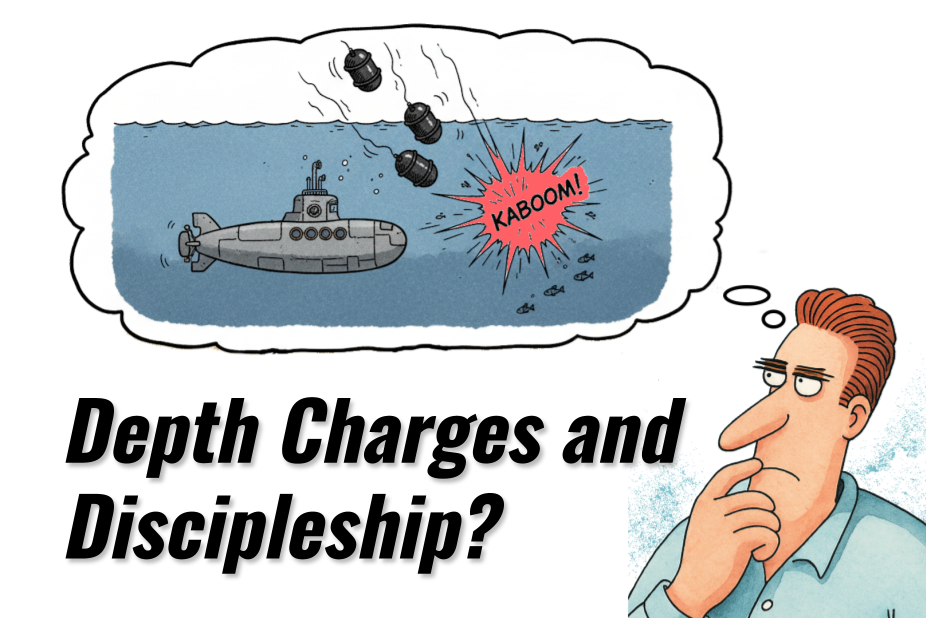
Depth Charges in WWII Anti-Submarine Warfare

Depth charges were the primary anti-submarine weapon of World War II, undergoing significant tactical evolution throughout the conflict while presenting unique challenges in confirming their effectiveness.

At the war’s outset, Allied navies relied on basic barrel-shaped depth charges rolled off the stern of escort vessels. These contained 200-300 pounds of explosive set to detonate at predetermined depths. Early tactics were crude—ships would drop charges where a U-boat had last been detected, hoping for a lucky hit within the weapon’s roughly 20-foot lethal radius. The Battle of the Atlantic, however, drove rapid tactical and technological improvements that transformed these weapons from relatively ineffective to submarine killers.

Ships began dropping patterns of multiple charges to saturate an area, dramatically increasing hit probability. The innovative “creeping attack” emerged, where one ship held sonar contact while another crept in slowly to attack, preventing U-boats from hearing the approach. Forward-throwing weapons like the Hedgehog (1942) and Squid (1943) represented major advances, firing projectiles ahead of the ship to maintain continuous sonar contact during attack. These contact-fuzed weapons only exploded upon hitting a submarine, reducing false alarms. Depth settings also improved as U-boats learned to dive deeper; by war’s end, charges could reach 500+ feet. Long-range patrol aircraft became increasingly important after 1943, dropping depth charges on surfaced or shallow-running U-boats with devastating effect once the Atlantic “air gap” closed.

Confirming a U-boat kill, however, remained notoriously difficult throughout the war. The most convincing proof was physical evidence surfacing after an attack—oil slicks, hull fragments, wooden fittings, clothing, or personal effects. Large oil patches spreading over time were particularly persuasive, though clever U-boat commanders sometimes released oil and debris deliberately to fake their destruction while escaping.

Sonar operators listened for the distinctive sounds of a submarine breaking up—hull collapse, bulkheads failing, or internal explosions. If a previously active submarine suddenly went silent with no further contact despite extensive searching, crews claimed a “probable” kill. This uncertainty was deeply frustrating for crews who might spend hours in brutal attacks without knowing if they’d succeeded.

The difficulty in confirmation led to widespread overclaiming. Allied navies classified results as “confirmed,” “probable,” or “possible” kills, but actual success rates were often far lower than reported. Early in the war, it sometimes took over 100 depth charges per U-boat actually sunk. Intelligence from decoded German communications occasionally provided confirmation when U-boats failed to report in, but this couldn’t be shared with crews for security reasons.

Many wartime claims were only verified years later by comparing Allied attack records with German U-boat loss records. Despite these challenges, improved tactics, technology, and training transformed depth charges into effective weapons by 1943-44, contributing decisively to the defeat of the U-boat threat and Allied victory in the Battle of the Atlantic.

Depth Charges and Discipleship: Generational Assessment 

The challenge facing World War II naval commanders dropping depth charges into uncertain waters mirrors a contemporary challenge in disciple-making: how does a first generation disciple-maker accurately assess what is happening at multiple levels below them? In both cases, information must travel through layers—whether ocean depths or spiritual generations—and what surfaces determines understanding and action.

When Allied warships dropped depth charges against U-boats, they sent destructive force through multiple depth layers, waiting for evidence to surface that confirmed success. Sonar operators at various positions reported what they heard, lookouts scanned for debris, and commanders pieced together fragmentary information to assess whether they had achieved their objective. The uncertainty was maddening. Oil slicks might indicate a kill or a clever deception. Breaking-up noises heard at one depth might not be detected at another. Each level of observation contributed partial knowledge, but only the commander integrating all reports could attempt to see the complete picture.

Discipleship faces a parallel dynamic, but with an essential difference: the purpose is constructive rather than destructive. When a primary disciple-maker seeks to assess the health and progress of discipleship spanning multiple generations, they face the same challenge of penetrating multiple “depths” of leadership. Just as depth charges had to reach through layers of water to their target, assessment questions must travel through generations of disciple-makers—from the first generation disciple-maker, through second-generation disciples, to third-generation and beyond. Each generation represents a spiritual depth in the multiplication chain.

The critical parallel lies in responsibility at each level. Just as naval crews had to accurately report what they observed at their position—sonar contacts, visual confirmation, acoustic evidence—each disciple-maker must faithfully transmit information both up and down through the assessment system. An intentional process can serve as the modern equivalent of sonar, providing the mechanism for information flow, but it only functions effectively if each generation faithfully pushes data upstream to leadership and downstream to those they disciple. The primary disciple-maker at the beginning of the stream, like a naval commander, sees the complete picture aggregated from all depths, but depends entirely on the timeliness, integrity, and accuracy of feedback at each intermediate level.

Where depth charges brought destruction, discipleship assessment must bring construction. The goal is not to destroy but to build up the body of Christ—identifying where discipleship is thriving, where it needs support, where spiritual “pressure” exists in the form of challenges or needs at various depths. The information that surfaces through an intentional process should reveal spiritual vitality, multiplication patterns, obstacles to growth, and opportunities for encouragement. When a third-generation disciple-maker reports struggles, and that information travels faithfully through the second generation to the first generation disciple-maker, the response should be resources, prayer, and support flowing back down through the same channels.

The dangers, however, echo those faced by WWII crews. Communication can break down. Information can be filtered by fear or pride at intermediate levels. Just as some U-boat commanders released fake debris to deceive pursuers, disciple-makers might report inflated success to please leadership above them especially if they perceive their salaries or resources are contingent on their performance. Conversely, they might suppress troubling information to avoid appearing unsuccessful. The intentional process of gathering information provides the mechanism, but cannot guarantee transparency.

This is where the comparison reveals its most important lesson: multiple verification points proved essential in naval warfare, and they remain essential in discipleship assessment. The first generation disciple-maker cannot rely solely on what bubbles up through official channels. They need direct relationships, periodic face-to-face contact, and cultural norms that reward honest reporting over optimistic fiction. Just as naval intelligence eventually compared attack reports with intercepted enemy communications to verify kills, wise primary leaders create feedback loops—visiting downstream generations, encouraging peer-to-peer communication, and modeling vulnerability about their own challenges.

The ultimate goal transforms the comparison entirely. Depth charges succeeded when they destroyed their target. Discipleship assessment succeeds when it strengthens every generation of disciple-makers—when the first generation disciple-maker gains accurate understanding, when intermediate generations feel supported rather than merely monitored, and when the newest disciples at the deepest levels know their reality matters to leadership even though they may never meet face-to-face. The intentional process of assessment downstream becomes not a weapon sent into the depths, but a lifeline connecting generations, ensuring that assessment remains constructive, that information flows freely in both directions, and that the entire generational chain grows stronger through transparent, faithful communication across every spiritual generation.

Biblical Examples

Jesus established the pattern of commissioning disciples, sending them into ministry, and receiving their reports. In Matthew 10 and Luke 9, He focused on the Twelve, giving them authority and specific instructions before sending them out, then gathering them afterward to hear what had happened. Later, in Luke 10, He expanded this approach by sending seventy-two disciples in pairs, who returned with joy to report that even demons submitted to them in His name (Luke 10:17). Jesus didn’t send His disciples into the harvest and abandon them to figure things out alone—He created a rhythm of sending, assessing, and responding. His prayer in John 17 reveals the generational scope of His vision: He prayed not only for the disciples He had personally trained, but also “for those who will believe in me through their message” (John 17:20)—acknowledging multiple spiritual generations flowing from His original investment. His final commission made this generational multiplication explicit: “Go and make disciples of all nations…teaching them to obey everything I have commanded you” (Matthew 28:19-20), which necessarily includes the command itself to make disciples, creating an unbroken chain until He returns.

Paul replicated this same pattern throughout his apostolic ministry, maintaining active assessment across the churches and leaders he had established. He regularly sent co-workers like Timothy, Titus, and Epaphroditus to assess situations and report back (Philippians 2:19-30; 2 Corinthians 8:16-24), while also receiving reports from church members about both encouraging developments and troubling conduct. The Corinthian correspondence reveals this dynamic clearly—Paul responds to oral reports from “Chloe’s household” (1 Corinthians 1:11) and written questions from the church, addressing specific issues at multiple depths of their community life. He didn’t wait for problems to surface accidentally; he intentionally created channels for information to flow.

Moreover, Paul trained those he mentored to practice the same assessment principles in their own spheres of leadership. He instructed Timothy to carefully evaluate potential elders (1 Timothy 3:1-7; 5:22), to assess the effectiveness of different workers (2 Timothy 2:2—”entrust to reliable people who will also be qualified to teach others”), and to pay attention to how teaching was being received and applied (2 Timothy 2:14-19). To Titus, he gave similar directives about appointing elders in every town and addressing false teaching that was disrupting “whole households” (Titus 1:5-11), requiring Titus to assess not just individual leaders but the ripple effects of their influence through family and community networks. Both Jesus and Paul understood that faithful multiplication required more than initial training—it demanded ongoing assessment, honest reporting, and responsive care across every generation of disciple-makers.

Potential Application

5 Step Process:

  1. Identify & List: Identify and list your top ten discipleship elements
  2. Select & Ask: Choose one discipleship element and ask one of the people you are discipling the associated question during your regular meeting
  3. Engage & Equip: Listen, encourage, and coach based on what you hear—then ask them to do the same with someone they’re discipling
  4. Surface & Synthesize: Each generation reports key insights upstream in their next meeting (2-3 sentences max)
  5. Pray & Respond: Disciple-makers up and down the chain review, pray, send encouragement/resources back downstream

Key Suggestions for Implementation:

Make it Conversational, Not Clinical:

  • Embed the question naturally in existing discipleship meetings—don’t create a separate “assessment meeting”
  • Frame it as “I’m curious about…” rather than “I need to assess…”
  • The question should spark genuine conversation, not data collection

Simplify Information Flow:

  • Each person only passes upstream: (1) their own answer, (2) one memorable insight from downstream
  • Avoid lengthy reports—think “headline + story” not “comprehensive analysis”
  • Use voice messages or quick texts between meetings if something significant surfaces

Rotate Elements Organically:

  • Establish regular rhythms (e.g., “Love God” one week, “Prayer” in another)
  • Let the first generation disciple-maker choose the next element based on what surfaced in the previous cycle
  • This makes it responsive rather than mechanical

Build in Multiple Verification:

  • First generation disciple-maker periodically asks the same question directly to 2nd or 3rd generation disciples perhaps in a 1-3-9 meeting (bypassing layers)
  • Compare: Does what they say match what was reported upstream?
  • These relational meetings filters information without creating surveillance culture

Create Psychological Safety:

  • Explicitly celebrate “I’m struggling with…” reports more than “Everything’s great!” reports
  • Share your own struggles first before asking downstream
  • If salaries or resources are involved, expect it to muddy the waters in your assessment

Additional Pitfalls to Avoid:

  • Going too deep too fast – Start with just 2-3 generations until the rhythm is established
  • Forgetting to close the loop – If someone shares a struggle and never hears back, trust evaporates
  • Making it one-directional – Downstream generations should also ask the first generation disciple-maker the same questions periodically
  • Losing the “why” – Regularly remind everyone: “We do this to strengthen each other, not monitor each other”
  • Collecting without connecting – Information without relationship breeds cynicism

The Simplest Version:

One question → One conversation → One insight upstream → One response downstream → Repeat when natural

The power isn’t in the system’s complexity—it’s in the consistency of care it reveals.

Example – First Generation Disciple-Maker’s Assessment Notes

Discipleship Element: The Word
Question: “What are your rhythms in getting in the Word of God?”
Date: September 30, 2025
Stream: John (me) → Marcus → Al  → David


Generation 1 (John – Me)

My own answer first:

  • Morning coffee + OT/Gospel/NT (one chapter each) – consistent 7 days a week
  • Struggling with depth – Sometimes I’m on autopilot and don’t get much from my reading
  • Need to spend some concerted time in Bible study (2-3 hours a week)

Generation 2 (Marcus)

What I heard from Marcus:

  • Reading through Matthew right now, 15-20 min during lunch break at work
  • Uses audio Bible during commute (30 min)
  • Said he’s feels like he’s getting plenty of time in the Word

What Marcus reported from downstream:

  • Al mentioned he’s all over the place with it

Generation 3 (Al)

What Marcus heard from Al:

  • Tries to read before bed but often too exhausted
  • Sometimes goes 3-4 days without opening his Bible
  • When he does read, it’s “just a verse or two from a devotional app”

What Al reported from downstream:

  • David is actually doing better than he is—reading with his roommate

Generation 4 (David)

What Al heard from David:

  • New believer (8 months), reading through John with his roommate Jake (also new believer)
  • They meet 3x/week at breakfast, read a chapter, talk about what confuses them
  • Misses days when his roommate travels for work but loves discovering new things

Observations & Patterns

Strengths:

  • David has built-in accountability and freshness of a new believer
  • Marcus has multiple touchpoints (visual + audio)
  • Everyone has some rhythm, even if inconsistent

Challenges:

  • Al is isolated in his struggle—very little accountability 
  • Marcus and I both sense we’re going through motions (mature believer drift)
  • Weekend gaps, bedtime struggles for Al, travel disruptions for David

Surprises:

  • The newest believer has the most joy and consistency
  • The “problem” isn’t lack of discipline—it’s lack of engagement/freshness (me & Marcus) or sustainable structure (Al)

Prayer & Response Plan

Prayer Focus:

  • Al: Needs encouragement and accountability. Pray and suggest integrating into a morning routine.
  • Marcus: Pray for renewed hunger, not just habit.
  • David: Protect his enthusiasm, help him build depth and daily consistency.
  • Me: Ask God to break through my mechanical approach and draw some folks into a deeper Bible study.

Downstream Encouragement:

To Marcus: “Thanks for your honesty about ‘checking the box.’ I’m feeling that too. What if we both tried asking God one question each week: ‘What do You want me to see that I’m missing?’ Let’s ask each other what we are getting out of the Word when we meet.”

Marcus to Al: “Tell Al I’m proud he was honest about his struggle. Ask if he’d be willing to try something: read one chapter a day beginning in the Gospel of Mark for the next 16 days in the morning with coffee instead of at bedtime. In 16 days you’ll have finish your first book in the Bible. A quick win!”

Al to David: “Tell David his question about him and his buddy reading together made my day. His hunger is a gift. Encourage him to write down his questions as he reads—they’re gold. Maybe Al could meet with him and Jake once to answer some of those questions? That might help both of them.”


A Look in the Mirror – #134

ENGLISH / ESPAÑOL

Welcome Back! Today, we’ll be looking at the Gospel of John to see how Jesus made judgmental people look at their own imperfections.

So let’s get started.

(Click here to get a copy of the Gospel Sync document)

John 8:1-11

But Jesus went to the Mount of Olives. Early in the morning He went back into the temple courts. All the people came to Him, and He sat down to teach them. The scribes and Pharisees, however, brought to Him a woman caught in adultery. They made her stand before them and said, “Teacher, this woman was caught in the act of adultery. In the Law Moses commanded us to stone such a woman. So what do You say?” They said this to test Him, in order to have a basis for accusing Him. But Jesus bent down and began to write on the ground with His finger. When they continued to question Him, He straightened up and said to them, “Let him who is without sin among you be the first to cast a stone at her.” And again He bent down and wrote on the ground. When they heard this, they began to go away one by one, beginning with the older ones, until only Jesus was left, with the woman standing there. Then Jesus straightened up and asked her, “Woman, where are your accusers? Has no one condemned you?” “No one, Lord,” she answered. “Then neither do I condemn you,” Jesus declared. “Now go and sin no more.”

My Thoughts

It should only take a little self reflection to help truth and grace find their way to the top.

The religious leaders had Jesus pinned to the mat on this one. Or at least they thought they did. It was a requirement of the Mosaic Law to put an adulteress or adulterer to death. (Deuteronomy 22:22-24; Leviticus 20:10) Surely this was a sin that required the strictest justice. But there are several things wrong with this situation.

First, where’s the man? I mean the woman was caught in the very act. The Law requires both the man and woman be put to death. That’s the initial clue that something fishy is going on here. Second, the Jews were under Roman occupation and law. They were forbidden to execute capital punishment. (Hence the reason they had to bring Jesus to Pilate to have Him crucified.) This was just another attempt to put Jesus in a political headlock between the Jews and the Romans. And lastly, their trickery was quite apparent to Jesus and He knew they were trying to trap Him. They weren’t interested in justice or righteousness. They were interested in one thing, getting rid of the person who exposed their hypocrisy. But it all backfired.

Jesus, with the wisdom of heaven, puts a counter move on them that they couldn’t squirm out of. He tells them to look in the mirror. He exposes their imperfections publicly and they slink away with their tails between their legs. The Master, as always, was ready with the wisdom, mercy, and forgiveness to counter anything they threw at Him.

But notice too that Jesus didn’t declare her innocent. He didn’t wink at her sexual immorality or justify it as though it was just an “alternate life-style” or some degenerative birth defect that she was unable to resist. No, He called it what it was, sin. And He added, don’t do it again!

We as disciple makers need to be careful when using the sharp edges of truth and grace. Truth does not always demand punishment and grace doesn’t always demand tolerance. They must both be applied and taught as a unit and great wisdom needs to be applied as a brain surgeon would use a scalpel. Just as Jesus did in this situation.

This will demand that we first take a long look in the mirror. It doesn’t mean not helping a brother get a speck out of his eye. But it does mean removing the log from our own.

My Story

I’m not often put into situations like this one. Jesus had to navigate the tricky shoals of each party being in the wrong and dealing with both in an appropriate manner. No, mine are either “black and white” or a matter of “preference.” Let me explain.

There are times when it is absolutely clear to me that a person is in the wrong and I don’t address it. Usually, it’s because I’m afraid. Afraid of losing a friendship or afraid of the backlash it might cause. I’m working on being more loving by being courageous. To let a person walk off a cliff when you know it’s there, is not very loving.

The other side of the coin is when it’s not a moral issue but preference. There are times when I’ll weigh in too strongly and I shouldn’t. If that person is being told by Jesus to do something different from the way He told me to do it, who am I to judge the servant of another. (Romans 14:4)

So should I stop making disciples because I don’t get it right every time? Ridiculous! As disciple makers we are learning the art of influencing people the way Jesus did. This takes practice and probably a whole lot of mistakes. We must take the risk of leading even when we know we won’t get it right every time. But as leaders, we also need to humble ourselves, be willing to admit our faults, repent, and look to Jesus for the next right thing to do. This is the heavy mantle of disciple making and we should bear its burden comfortably.

Our Action Plan

Now it’s time for application. Here’s some ideas;

  • Pray for wisdom
  • Listen to the people you are discipling, are they too harsh or too soft on sin?
  • Do a Bible study with them on the application of grace and truth

Jesus was put into some tricky situations but handled them like the expert disciple-maker He is. Like Jesus, we will enter into some awkward, messy, and even hostile circumstances where the wisdom of God is the only solution. Let’s acknowledge our own shortcomings and apply grace and truth appropriately.

Organic Writing – No Artificial Intelligence or Sweeteners Added

(Click here to get a copy of the Gospel Sync document)

Una Mirada al Espejo – #134

¡Bienvenidos de nuevo! Hoy analizaremos el Evangelio de Juan para ver cómo Jesús hizo que las personas críticas se fijaran en sus propias imperfecciones.

¡Comencemos!

Juan 8:1-11

Pero Jesús se dirigió al Monte de los Olivos. Temprano por la mañana, regresó al templo. Todo el pueblo acudió a él, y se sentó a enseñarles. Pero los escribas y fariseos le trajeron a una mujer sorprendida en adulterio. La pusieron de pie ante ellos y le dijeron: «Maestro, esta mujer fue sorprendida en el acto mismo de adulterio. En la Ley, Moisés nos mandó apedrear a tal mujer. ¿Qué dices, pues?». Decían esto para ponerlo a prueba, para tener base para acusarlo. Pero Jesús se inclinó y comenzó a escribir en el suelo con el dedo. Como insistían en preguntarle, se enderezó y les dijo: «El que esté sin pecado, que tire la primera piedra contra ella». Y de nuevo se inclinó y escribió en el suelo. Al oír esto, comenzaron a retirarse uno a uno, comenzando por los mayores, hasta que solo quedó Jesús, con la mujer allí de pie. Entonces Jesús se enderezó y le preguntó: «Mujer, ¿dónde están tus acusadores? ¿Nadie te ha condenado?». «Nadie, Señor», respondió ella. «Entonces yo tampoco te condeno», declaró Jesús. «Ahora vete y no peques más».

Mis Pensamientos

Basaría con un poco de introspección para que la verdad y la gracia se abrieran paso.

Los líderes religiosos tenían a Jesús condenado a muerte por este caso. O al menos eso creían. La Ley Mosaica exigía la muerte de cualquier adúltero o adúltera (Deuteronomio 22:22-24; Levítico 20:10). Sin duda, este era un pecado que requería la justicia más estricta. Pero hay varios aspectos erróneos en esta situación.

Primero, ¿dónde está el hombre? Es decir, la mujer fue sorprendida en el acto mismo. La Ley exige que tanto el hombre como la mujer sean condenados a muerte. Esa es la primera pista de que algo raro está sucediendo. Segundo, los judíos estaban bajo la ocupación y la ley romanas. Tenían prohibido ejecutar la pena capital (de ahí la razón por la que tuvieron que llevar a Jesús ante Pilato para que lo crucificaran). Este fue otro intento de poner a Jesús en una situación política difícil entre judíos y romanos. Y por último, su engaño era bastante evidente para Jesús, quien sabía que intentaban tenderle una trampa. No les interesaba la justicia ni la rectitud. Les interesaba una sola cosa: deshacerse de quien había expuesto su hipocresía. Pero todo les salió mal.

Jesús, con la sabiduría del cielo, les lanzó una contraofensiva de la que no pudieron escapar. Les dijo que se miraran al espejo. Expuso sus imperfecciones públicamente y ellos se escabulleron con el rabo entre las piernas. El Maestro, como siempre, estaba listo con la sabiduría, la misericordia y el perdón para contrarrestar cualquier cosa que le lanzaran.

Pero note también que Jesús no la declaró inocente. No hizo la vista gorda ante su inmoralidad sexual ni la justificó como si fuera solo un “estilo de vida alternativo” o un defecto de nacimiento degenerativo al que no podía resistirse. No, lo llamó por su nombre: pecado. Y añadió: ¡No lo vuelvan a hacer! Como hacedores de discípulos, debemos ser cuidadosos al usar las aristas de la verdad y la gracia. La verdad no siempre exige castigo, ni la gracia siempre exige tolerancia. Ambas deben aplicarse y enseñarse como un todo, y se requiere gran sabiduría, como un neurocirujano usaría un bisturí. Tal como lo hizo Jesús en esta situación.

Esto requerirá que primero nos miremos detenidamente en el espejo. No significa no ayudar a un hermano a sacarse una paja del ojo. Pero sí significa quitar la viga del nuestro.

Mi Historia

No suelo encontrarme en situaciones como esta. Jesús tuvo que sortear los escollos de la injusticia de cada parte y lidiar con ambas de forma adecuada. No, las mías son o bien “blanco o negro” o bien “cuestión de preferencias”. Déjenme explicar.

Hay veces en que tengo absolutamente claro que alguien está equivocado y no lo abordo. Normalmente, es por miedo. Miedo de perder una amistad o miedo a las consecuencias negativas que pueda causar. Estoy trabajando en ser más amoroso siendo valiente. Dejar que alguien se tire por un precipicio cuando sabes que está ahí no es muy amoroso.

La otra cara de la moneda es cuando no se trata de una cuestión moral, sino de preferencias. Hay veces en que intervengo con demasiada fuerza y ​​no debería. Si Jesús le dice a esa persona que haga algo diferente a lo que me dijo a mí, ¿quién soy yo para juzgar al siervo de otro? (Romanos 14:4)

¿Debería entonces dejar de hacer discípulos porque no siempre lo hago bien? ¡Ridículo! Como hacedores de discípulos, estamos aprendiendo el arte de influir en las personas como lo hizo Jesús. Esto requiere práctica y probablemente muchos errores. Debemos asumir el riesgo de liderar incluso cuando sabemos que no siempre lo haremos bien. Pero como líderes, también debemos ser humildes, estar dispuestos a admitir nuestras faltas, arrepentirnos y buscar en Jesús la siguiente decisión correcta. Esta es la pesada responsabilidad de hacer discípulos y debemos llevarla con comodidad.

Nuestro Plan de Acción

Ahora es momento de aplicar. Aquí tienes algunas ideas:

  • Ora pidiendo sabiduría.
  • Escucha a las personas a las que estás discipulando: ¿son demasiado duras o demasiado blandas con el pecado?
  • Realiza un estudio bíblico con ellas sobre la aplicación de la gracia y la verdad.

Jesús se vio envuelto en situaciones difíciles, pero las manejó como el experto hacedor de discípulos que es. Al igual que Jesús, nos encontraremos con circunstancias incómodas, complicadas e incluso hostiles donde la sabiduría de Dios es la única solución. Reconozcamos nuestras propias deficiencias y apliquemos la gracia y la verdad apropiadamente.

Escritura orgánica: sin inteligencia artificial ni edulcorantes añadidos.

Si ve un problema importante en la traducción, envíeme una corrección por correo electrónico a charleswood1@gmail.com

Kingdom Kernel #28 – The Divine Commission – Pray, Appoint, and Send (Luke 10:1-12)

Kingdom Kernel Collection

Now after this the Lord appointed seventy others, and sent them in pairs ahead of Him to every city and place where He Himself was going to come. And He was saying to them, “The harvest is plentiful, but the laborers are few; therefore beseech the Lord of the harvest to send out laborers into His harvest. Go; behold, I send you out as lambs in the midst of wolves. Carry no money belt, no bag, no shoes; and greet no one on the way. Whatever house you enter, first say, ‘Peace be to this house.’ If a man of peace is there, your peace will rest on him; but if not, it will return to you. Stay in that house, eating and drinking what they give you; for the laborer is worthy of his wages. Do not keep moving from house to house. Whatever city you enter and they receive you, eat what is set before you; and heal those in it who are sick, and say to them, ‘The kingdom of God has come near to you.’ But whatever city you enter and they do not receive you, go out into its streets and say, ‘Even the dust of your city which clings to our feet we wipe off in protest against you; yet be sure of this, that the kingdom of God has come near.’ I say to you, it will be more tolerable in that day for Sodom than for that city. (Luke 10:1-12)

Introduction: Contextualizing the Mission

In Luke 10:1-12, Jesus, the Messiah and King, expands His kingdom mission by appointing seventy “others” to go ahead of Him, preparing the way for His arrival in every city and place. This follows the earlier sending of the Twelve (Luke 9:1-6), revealing a pattern of divine delegation rooted in God’s redemptive plan. The passage highlights key actions—appointing, beseeching, and sending—intertwined with praying and going, which illuminate Jesus’ lordship and the Kingdom of God’s nearness. This essay analyzes these terms linguistically and theologically, connecting them to Christ’s eternal reign and their transformative power for believers today.

Linguistic Roots: Defining the Terms

The Greek terms in Luke 10 provide a foundation for understanding this commission. “Appointed” (ἀνέδειξεν, anedeixen, Strong’s G322) derives from ana (up) and deiknumi (to show), meaning to lift up or designate publicly. Jesus visibly sets apart the seventy, marking them for a purpose tied to His authority as King. “Beseech” (δεήθητε, deēthēte, Strong’s G1189) from deomai (to beg or petition) conveys urgent, dependent prayer, as the disciples implore the Lord of the harvest to act. “Sent/send” (ἀπέστειλεν, apesteilen, Strong’s G649) stems from apostellō, blending apo (from) and stellō (to set in order), signifying a deliberate dispatch with divine commission, echoing the apostolic mission of the Twelve.

Etymologically, these words emphasize intentionality and authority. Anedeixen suggests a royal appointment, deēthēte a reliance on divine power, and apesteilen a purposeful extension of Christ’s mission. Together, they frame the seventy’s role as an outflow of Jesus’ messianic kingship, preparing the world for His presence.

Theological Significance: The Kingdom in Action

The appointment of the seventy mirrors the sending of the Twelve, expanding the scope of God’s kingdom proclamation. This dual commission prophetically points to Christ’s reign over all mankind and how the kingdom would spread, fulfilling God’s redemptive plan (Isaiah 49:6). Jesus, as the Lord of the harvest, orchestrates this mission, revealing His divine attributes: omniscience in knowing the need, omnipotence in empowering laborers, and mercy in offering peace and healing (Luke 10:9).

Prayer (deēthēte) and going (apesteilen) are inseparable. The command to beseech the Lord for laborers underscores human dependence on divine initiative, while sending them as “lambs among wolves” (Luke 10:3) demonstrates faith in action. This duality reflects the Kingdom of God’s nearness—present in power yet requiring participation. The message, “The kingdom of God has come near” (Luke 10:9, Luke 10:11), ties directly to Jesus’ identity as Messiah, whose presence inaugurates God’s reign, a reality both now and not yet fully consummated (Matthew 4:17).

Christological Fulfillment: Jesus as King

Jesus’ lordship shines through this passage. He appoints with authority, directs prayer to Himself as the harvest’s Lord, and sends with a mission that prefigures His eternal reign (Revelation 11:15). Unlike earthly kings, His rule is marked by vulnerability and provision, as seen in the command to carry no resources (Luke 10:4), trusting the King who supplies all needs (Philippians 4:19). This lordship is not merely future; it is real today, transforming believers into laborers who extend His reign in this age, even as we await its ultimate fulfillment.

Transformative Power: Living the Commission

For contemporary Christians, this concept inspires a life of purpose and dependence. Being appointed calls us all as priests (1 Peter 2:9) to recognize our divine calling under Christ’s kingship. Beseeching fuels prayer for kingdom expansion, while being sent compels us to go boldly, trusting God amid rejection or reception (Luke 10:10-11). The interconnectedness of Scripture—seen in the Twelve’s mission (Luke 9), the Great Commission (Matthew 28:18-20), and the harvest imagery (John 4:35-38)—reveals a unified narrative of God’s unstoppable kingdom. Embracing this transforms disciples into active heralds, reflecting Jesus’ eternal reign and the expansive nature of His rule, both now and forever.

Conclusion

The appointment and sending of the seventy in Luke 10:1-12 unveil Jesus as the Messiah who reigns with purpose and power. Through anedeixen, deēthēte, and apesteilen, we see a King who delegates, invites prayer, and commissions laborers to proclaim His near kingdom. This passage bridges ancient text to modern faith, affirming Christ’s lordship as a present reality with eternal promise, urging believers to pray and go as reflections of His redemptive plan.

Disciple-Maker’s Short Story

The Weight of the Call

The late afternoon sun spilled golden light across the park, threading through the budding branches of ancient oaks. Ed’s sneakers crunched against the gravel path as he walked beside the outreach team, their voices rising in soft prayer. The air carried the scent of damp earth and the faint tang of blooming azaleas. Every Saturday, they came here—prayer walking through the local park, sharing the gospel with joggers, dog walkers, anyone who’d listen. Today, though, Ed’s attention wasn’t on the strangers they approached. It lingered on Felix, who, as always, hung back with the prayer team, his hands shoved deep into his jacket pockets, his eyes fixed on the ground.

Felix was a wiry man in his late twenties, all sharp angles and quiet intensity. He’d joined the church a year ago, drawn in by the community, but Ed had noticed this pattern early on. When the team fanned out to talk to people, Felix stayed rooted, murmuring prayers under his breath. At first, Ed figured it was just his way—some people were talkers, others intercessors. But lately, it gnawed at him. Felix wasn’t shy; he’d banter with the team over coffee or fix a kid’s bike tire without any problem. So why this hesitation?

The next day, Ed found Felix at the bike shop where he worked part-time. The bell above the door jingled as Ed stepped inside, the space humming with the metallic clink of tools and the faint hum of a radio playing classic rock. Felix was hunched over a derailleur, his fingers deftly threading a cable, his brow furrowed in concentration. Ed leaned against the counter, watching for a moment before clearing his throat.

“Hey, Felix,” he started, his tone light but steady. “Got a sec?”

Felix glanced up, wiping his hands on a rag. “Yeah, sure. What’s up?”

Ed shifted his stance, choosing his words with care. “I’ve seen you out there with us—prayer walking, lifting up the team. You’re solid, man. You’ve got the training, too—those evangelism workshops we did last fall. You aced the role-plays. So I’ve been wondering… why don’t you ever step out and share?”

Felix’s shoulders stiffened, his gaze dropping to the greasy rag in his hands. He twisted it once, twice, before answering. “I’m not really built for that, you know? Evangelism’s a gift, right? Some people have it—guys like you who can just walk up to anybody and start talking about Jesus. I don’t. I figure my part’s praying for you all. That’s what I’m good at.”

Ed nodded slowly, letting the words settle. He’d heard this before—people carving out their roles, dodging what scared them by calling it a “gift.” But something in Felix’s voice, a faint tremor beneath the excuse, told Ed there was more. He leaned forward, resting his elbows on the counter.

“Fair enough,” he said. “But let me ask you this: when you signed up for this team, didn’t you commit to sharing the gospel? Not just praying, but going out with us?”

Felix’s jaw tightened, and he tossed the rag onto the workbench. “Yeah, I guess. But like I said, I don’t have the gift. I’m not off the hook or anything—I just think God’s got other people for that job.”

Ed straightened, his voice softening but carrying a quiet weight. “Felix, you know the Great Commission, right? Matthew 28:18-20—Jesus tells the disciples to go, make disciples, teach them to obey everything He commanded. And that includes Mark 16:15—‘preach the gospel to all creation.’ He didn’t say, ‘Only if you’ve got the gift.’ He said it to all of us. You, me, the whole church. Prayer’s vital, don’t get me wrong—but it’s not a substitute for going.”

Felix didn’t respond right away. He turned back to the bike, fiddling with the chain, but his hands moved slower now, less sure. Ed waited, the silence stretching between them like a taut wire. Finally, Felix let out a breath, his voice barely above a whisper.

“It’s not about gifts, okay? I’m… I’m scared, Ed. What if I mess it up? What if I say the wrong thing and push someone away from God instead of toward Him? I’d rather pray and let you guys handle it.”

There it was—the real thing, raw and jagged. Ed felt a pang of recognition; he’d wrestled with that fear himself years ago. He stepped closer to Felix, his tone gentle but firm.

“I get it. I’ve been there. But here’s the thing: Jesus didn’t send us out because we’re fearless or perfect. He sent us because He’s with us. Look at Luke 10—the seventy He appointed weren’t superheroes. They were just people, like us, told to go as lambs among wolves. And you know what? He went with them. He goes with us, too. How about this: next week, you come with me. I’ll share first, show you how I do it. You just watch. No pressure.”

Felix met his eyes, uncertainty flickering there, but he gave a small nod. “Okay. I’ll try.”

The following Saturday, the park buzzed with life—kids shrieking on the playground, a guy strumming a guitar under a pavilion. Ed and Felix walked side by side, the outreach team scattering ahead. Felix’s hands were back in his pockets, his posture tense, but he stayed close. Ed scanned the path and spotted a man sitting alone on a bench, scrolling on his phone—a wiry guy in a hoodie, maybe mid-thirties.

“Watch this,” Ed murmured to Felix, then approached the man with an easy smile. “Hey, we’re sharing a story that changed our lives. Mind if I tell you mine?”

The guy glanced up, shrugged. “Free country.”

Ed settled beside him, leaving space, and started his story;

Well there was a time in my life when I was angry and alone. One day this guy approached me like I did you and told me how God loved me so much He sent His Son Jesus to the earth, He lived a perfect life and then Jesus died on a cross for everything I’ve ever done wrong. The man said if I surrendered my life to Jesus as my King, my Boss, He would give me true life. I did that by telling God I believed what this man said and I wanted to start living my life His way not mine. My life radically changed from that point on. I was much happier and had people that really cared about me. Have you ever had an experience with Jesus that changed your life?”

The man snorted, but it wasn’t hostile. “Not really. Church isn’t my thing.”

“Fair enough,” Ed said, unfazed. “I wasn’t big on it either till I figured out it’s not about the building. It’s about a relationship with Jesus”

The man paused, then shrugged again. “I’m not very religious.”

Ed pulled out a small tract and gave it to the man, “ Well if you ever change your mind, my contact info is on the back and this is just something to chew on.”

The guy took it, nodded, and Ed stood, clapping Felix on the shoulder as they walked away. Felix’s eyes were wide, his voice hushed. “That’s it? You just… talked to him? Like it was nothing?”

“It’s not nothing,” Ed said. “It’s everything. But yeah—it’s simple. Tell them who Jesus is, what He’s done for you, and let Him do the rest. You ready to try?”

Felix swallowed hard, but something shifted in his stance—a spark of resolve. He nodded. Ahead, a woman sat on a picnic blanket, reading a book. Felix took a shaky breath and stepped forward, Ed trailing just behind.

“Uh, hi,” Felix started, his voice cracking slightly. “Mind if I interrupt for a sec?”

She looked up, surprised but not annoyed. “Sure, what’s up?”

“I’m Felix. I’m here with my friend Ed, and… I’ve been telling people a story that changed our lives.Would you like to hear mine?” Felix started with his simple story that bled into a meaningful conversation that lasted twenty minutes.

The woman wanted to know more. Felix blinked, startled by her openness, then fumbled for one of the cards Ed had given him. “Here—this has some info if you’re curious.”

She smiled faintly, taking it. “Thanks, Felix.”

As they walked away, Felix turned to Ed, his face lit with a mix of shock and exhilaration. “Oh, I can do this! It’s not… it’s not as hard as I thought.”

Ed laughed, slinging an arm around his shoulders. “Told you. It’s not about being slick or fearless. It’s about being like Him—Jesus went to people, met them where they were. You just did that, too.”

Felix grinned, the weight lifting from his frame. For the first time, he saw it—not just the call, but the One who’d called him. And he wanted to be more like Him, one shaky step at a time.

Kingdom Kernel Collection