
The gap between kingdom acknowledgement and kingdom understanding
To these He also presented Himself alive after His suffering, by many convincing proofs, appearing to them over [a period of] forty days and speaking of the things concerning the kingdom of God. …So when they had come together, they were asking Him, saying, “Lord, is it at this time You are restoring the kingdom to Israel?” (Acts 1:3, 6)
Introduction
We often find ourselves living in the tension between simply acknowledging Jesus as King and deeply understanding—and applying—the realities of the Kingdom He modeled. In Acts 1:3, we find Jesus leading a remarkable forty-day intensive. He proved His resurrection and spoke directly about “the things concerning the kingdom of God.” This period served as a profound capstone to the previous three years, during which He relentlessly preached and demonstrated the Kingdom throughout His earthly ministry.
Yet, even after this post-resurrection masterclass, the first instinct of His closest followers was to pivot back to their own political comfort zones. They asked, “Lord, is it at this time You are restoring the kingdom to Israel?” (Acts 1:6). Their earthbound questions collided with a Risen King whose vision was infinitely broader than a national border.
Like those early followers, many of us struggle with that exact same gap: the space between acknowledging the Kingdom and actually understanding how it operates. We find it hard to trade our cultural scripts for Kingdom reality. To follow Jesus effectively—and to authentically guide those you are discipling into His way of life—we must move beyond seeking our own personal agendas and begin to grasp the radical, co-regent identity for which we were designed.
Key Words and Phrases
The kingdom of God –
- βασιλεία (Strong’s G932 – basileia) royal power, kingship, dominion, rule, of the royal power of Jesus as the triumphant Messiah, of the royal power and dignity conferred on Christians in the Messiah’s kingdom, a kingdom, the territory subject to the rule of a king, used in the N.T. to refer to the reign of the Messiah.
- Θεός (Strong’s G2316 – theos) a god or goddess, a general name of deities or divinities, the Godhead, trinity, spoken of the only and true God, refers to the things of God, His counsels, interests, things due to Him, whatever can in any respect be likened unto God, or resemble Him in any way, God’s representative or viceregent, of magistrates and judges.
- Jesus went about Galilee preaching the kingdom of God.
Restoring the kingdom to Israel –
- Ἀποκαθίστημι (Strong’s G600 – apokathistēmi) to restore to its former state, to be in its former state.
- The Jewish people held prophetic expectations that the Messiah would restore the kingdom of Israel through military conquest. While they were correct that this restoration would eventually occur, it was first necessary for the suffering Servant King described in Isaiah 53:1 to come. This misunderstanding prompted the disciples to ask their question.
Messianic Model – Focus on Jesus’ Example
When we look at this interaction in Acts 1, we see a profound model in how Jesus approached, understood, and taught the Kingdom of God:
- He learned about the Kingdom as a man. In His incarnation, Jesus emptied Himself (Philippians 2:7). During His earthly ministry, He did not rely on a “divine cheat code” to bypass human development. He had to learn about the Kingdom of God the exact same way we do—through deep submission to the Scriptures and the guidance of the Holy Spirit.
- The Kingdom was His absolute foundation. Because He had internalized the heart of the Father, Jesus lived and taught Kingdom values consistently and without error. This wasn’t a side-topic; it was the core of His three-year ministry, culminating in an intensive forty-day seminar strictly on this subject after His resurrection.
- He was relentlessly patient. In Acts 1:6, we see that His closest followers still didn’t get it. After all that time with the Master Teacher, their default was still earthbound. Yet, Jesus doesn’t express frustration or rage-quit on them. He patiently redirects their focus from political timelines to the empowerment of the Holy Spirit for global witness (Acts 1:7-8).
Key Theological Implications
The disciples’ question reveals a deep truth: understanding the kingdom of God isn’t an optional elective; it’s essential to understanding our true identity and purpose. Jesus taught that the Kingdom must be our absolute highest priority. He told us to “seek first His kingdom and His righteousness” and compared it to a hidden treasure worth selling everything to obtain. It was the very reason He was sent, and it is what defines us as a “royal priesthood.” (Matthew 6:33; Matthew 13:44; Luke 4:43; 1 Peter 2:9)
But knowing the Kingdom is not just an intellectual pursuit or a theological puzzle to solve. It requires spiritual re-orientation. Jesus said that “unless one is born again he cannot see the kingdom of God.” Comprehension begins with a new birth, and it takes revelation from heaven, combined with modeling, assessment, relearning, and actually living it out. We don’t have to guess how to do this, because Jesus gave us the ultimate example. He did nothing of His own initiative, setting the standard so we could “walk in the same manner as He walked.” (John 3:3; Matthew 13:11; Matthew 16:17; John 13:13-15; John 5:19; 1 John 2:6)
When we truly understand the Kingdom, we understand the King. We see the Father through Him and realize we’ve been radically transferred into the kingdom of His beloved Son. Because the earth and everything in it belongs to Him and He holds all authority in heaven and on earth, His ownership completely shapes how we steward our lives. The King’s authority defines the scope of the kingdom we represent. (John 14:9; Colossians 1:13; Psalm 24:1; Matthew 28:18)
This brings us to a massive, mind-blowing reality: co-regency. To make any coherent sense of the Kingdom, we must understand our calling as co-regents. This isn’t a new idea; it’s the original design established in the dominion mandate in Eden. Jesus has made us a “kingdom and priests to our God; and they will reign upon the earth.” This co-regency isn’t just present-tense—it is eschatological. It is the ultimate trajectory of our eternal lives. We are promised that if we endure, we will also reign with Him, sit with Him on His throne, and “reign forever and ever.” Our highest calling isn’t just surviving until we go to heaven; the final word of Scripture on human vocation is partnering with the King to reign over His creation. (Genesis 1:26-28; Revelation 5:10; 2 Timothy 2:12; Revelation 3:21; Revelation 22:5)
Contemporary Spiritual Significance
We live in an age—especially in a modern U.S. context—where the very idea of a “king” or a “kingdom” is frowned upon, if not completely odious. Authority in general is highly suspect because we have witnessed so many abuses of power, even by clergy. But it is not only unfair, it is profoundly unwise to project those human abuses onto God. Jesus is God, and God is love, which was perfectly displayed throughout His earthly life. (1 John 4:8-10; John 14:9; Acts 10:38)
While God is incredibly loving, He is also our Master and Creator, and He should be approached with profound reverence and awe. Furthermore, He is completely just and will eternally punish those who remain rebellious. It is foolish to trifle with, ignore, or challenge His absolute authority. (Genesis 1:1; Hebrews 12:28-29; Hebrews 10:31; 2 Thessalonians 1:7-9)
Because of who He is, it is absolutely essential for all believers to understand and actively live out their identity and purpose within His kingdom. This Kingdom is radically different from the world’s culture. To actually swim against the prevailing cultural currents, Kingdom living must be rigorously studied and intentionally practiced alongside those you are discipling. (1 Peter 2:9; Colossians 1:13; Matthew 6:33; Ephesians 2:10; Philippians 3:20; Matthew 7:13-14; 1 Peter 4:3-4; John 15:18-19; Philippians 2:15)
The Transformative Power of Kingdom Living
When we align ourselves with our Kingdom identity and purpose, we are ultimately aligning ourselves directly with the King. And when we align ourselves with Him, we begin to live out the exact design He created us for.
Think about it like a piece of high-performance machinery. When a machine is used for what it was specifically engineered to do, it runs powerfully and efficiently. But if you try to use it for something it wasn’t designed for—like trying to use a smartphone to hammer in a nail—the results are completely inadequate, incredibly frustrating, and ultimately destructive.
This is exactly why it is so crucial to read and submit to the “Owner’s Manual” (the Bible). Our Creator knows the proper functions of His creation and how we can best be used to experience true fulfillment and happiness. It is precisely because He knows our design that Jesus can extend the invitation: “Take My yoke upon you and learn from Me… for My yoke is easy and My burden is light.” (Matthew 11:29-30)
When we stop fighting against our design and align ourselves with the King, the exhausting hustle stops. We begin to genuinely experience His peace, joy, and love, along with an unshakeable hope for the future. And as we experience this transformation, we get to model that same peace and hope to those we are discipling.
Conclusion
Ultimately, bridging the gap between simply acknowledging Jesus as King and truly understanding His Kingdom is the journey of a lifetime. As we see in Acts 1, it requires intentionally moving past our earthbound expectations to embrace a much grander reality. We are not just subjects waiting for an afterlife; we are invited into an active, co-regent partnership with the Creator right now. By choosing to “seek first His kingdom” (Matthew 6:33) and submitting to our original design, we shed the exhaustion of cultural striving and step into true identity and purpose. This radical shift doesn’t happen by accident. It demands that we immerse ourselves in the King’s teachings, rely on the Holy Spirit, and patiently walk out these truths. As we do, we won’t just experience the transformative power of His reign firsthand—we will become a living model of the Kingdom, brilliantly reflecting His hope and authority to those we are discipling.
Disciple-Maker’s Short Story
A True Story and the Reason for this Book
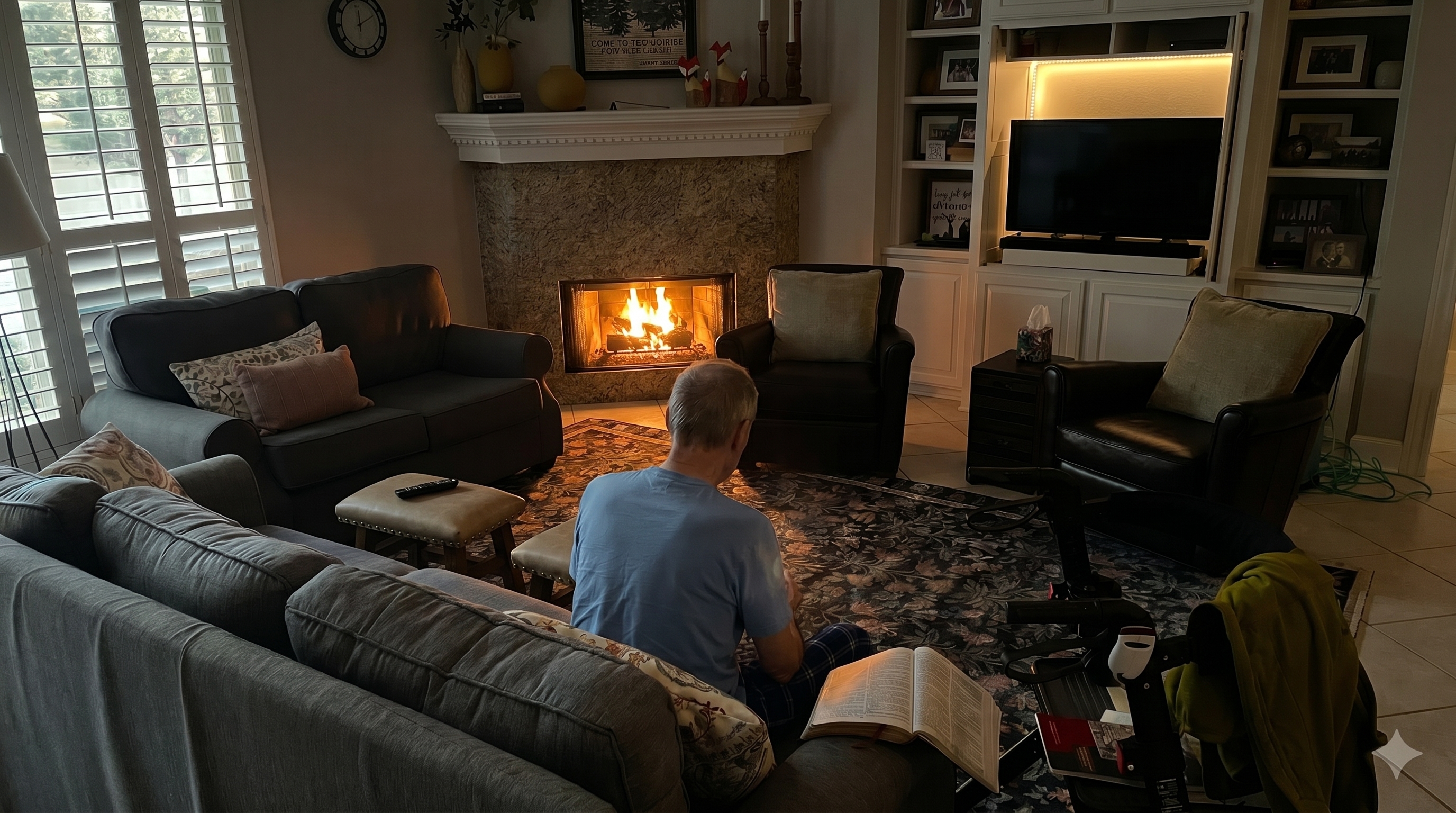
The house is silent, save for the rhythmic hiss of the gas fireplace to my left. At 7:30 am, the world is still holding its breath, and I am holding mine. I am tucked into the corner nook of my couch—my designated “station”—wearing nothing more formal than pajama bottoms and a well-loved t-shirt celebrating the Texas Rangers’ past World Series victory.
To my right, the built-in bookshelves glow under soft LED lighting, illuminating the faces of our sons, their wives, and our grandchildren. They are our heart’s legacy, framed in wood and glass, watching over me as I begin my morning ritual. My bare toes burrow into the intricate patterns of the Persian rug, the wool soft against my skin. There is a sense of groundedness here. Like Moses before the burning bush, I feel the weight of the moment. My feet are bare because this corner of the living room has become holy ground.
Resting on the seat of my rollator is a homemade platter, serving as a makeshift table for my mug of hot tea. In my lap lies one of my most prized possessions: a Bible so worn the leather feels like silk. It is a map of my life, crisscrossed with underlines, tear stains, and margins crowded with notes from decades of seeking.
The Hundredth Reading
I turned the page to the beginning of Acts. I’ve traveled these roads with Luke and Paul many times—at least a hundred, if I’m being honest. I expected the familiar comfort of a story well-known, but as I smoothed down the pages of Acts 1, something shifted.
I stared at the text, struck by a sudden, jarring realization. The men in these verses had spent three years in the shadow of the Master. They had heard the parables, seen the healings, and walked through the trauma of the crucifixion. They had even spent forty days with the resurrected Christ, receiving “intense teaching” on the Kingdom of God. Yet, in Acts 1:6, their first question was about a political restoration of Israel.
After all that time, they still understood so little about the Kingdom.
The Question in the Room
The steam from my tea rose in the morning light, but my focus was locked on the page. A quiet, persistent voice began to echo in the stillness of the room. It wasn’t an accusation; it was an invitation that felt like a piercing light.
“And how much DO YOU understand about My Kingdom?”
I realized then that I had often treated the Kingdom as a theological concept to be studied rather than a reality to be inhabited. I had gleaned the “information” of the book of Acts and the Gospels, but I had barely scratched the surface of the “reign” of the King. That morning, the tea grew cold as a new fire started. I decided that my usual devotional routine or even my study time in the afternoons wasn’t enough. I committed to spending the bulk of my time in the afternoon—an hour to an hour and a half—rediscovering what it actually means to live under the rule of God.
A Journey Shared
I knew I couldn’t do this alone. The Kingdom is not a solitary island; it’s a city, a body, a family. I reached out to a few close friends, inviting them to journey into the depths with me. I told them I wanted to move past the surface-level Sunday school answers and really grapple with the “marvelous Kingdom” Jesus spoke of.
I thought it might be a six-month deep dive. I was wrong.
Six months dissolved into a year of intense discovery. One year bled into two. The more we looked, the more we realized how vast the landscape truly is. We found that the Kingdom isn’t just about where we go when we die; it’s about the staggering reality of Christ’s authority here and now—in our families, our suffering, our joys, and even in the quiet corners of our living rooms.
Today, as I sit in my nook with my feet on the rug, I’m no longer looking for a finish line. I’ve surrendered to the fact that I will spend the rest of my life as a student. I am a lifelong traveler, seeking to understand our wonderful King and the breadth of His reach. The “deficit” I felt that morning was actually a gift—it was the hunger that led me to the feast.
“But seek first His kingdom and His righteousness, and all these things will be added to you.” — Matthew 6:33
How to Use This Book: The Format and Our Approach
If you are going to lead others in the ways of Jesus, you must have a roadmap for your own heart first. As you progress through this book, you will notice that every chapter follows the exact rhythm you just experienced. This isn’t by accident. It is designed to move you systematically from head knowledge to holistic living.
- Introduction: We always start by establishing the primary tension in the text—the gap between what we know and what we actually live.
- Key Words and Phrases: We live in a culture that loves to project its own definitions onto ancient texts. By briefly digging into the original Greek and Hebrew words, we bypass our cultural assumptions and anchor our understanding to what was actually being said.
- Messianic Model: We always look to Jesus. He is not just our Savior; He is the ultimate example of Kingdom living. We cannot guide those we are discipling if we are not first tracing His footsteps.
- Theological & Contemporary Significance: Here, we bridge the ancient text to our modern context, pulling out the massive implications for our daily lives.
- Transformative Power & Conclusion: We wrap up the teaching by exploring how yielding to this specific Kingdom truth changes us from the inside out.
- Disciple-Maker’s Short Story: After this first true chapter, every chapter will end with a fictionalized vignette. While the names and exact scenarios may be fictional, every single one of these stories is heavily drawn from over forty-five years of real-life experience walking with people. They are designed to show you what these truths look like in the beautiful messiness of real life and relationships with those you are discipling.
The Approach: Unhurried Meditation We live in an age of rapid-fire information, endless scrolling, and instant gratification. This book is an invitation to do the exact opposite.
The insights in these chapters weren’t born from simply skimming verses; they were forged during those hour-and-a-half afternoon blocks of dedicated quiet. To truly grasp the Kingdom, I encourage you to slow down. Don’t just read these chapters—marinate in them. Wrestle with the text. Pray over the implications. Let the Holy Spirit do the heavy lifting in your heart before you attempt to pass these truths on to anyone else. You will find that this framework of studying, meditating, and practically applying the text is a highly reproducible model you can use directly with those you are guiding.
The Power of Community Finally, you cannot learn Kingdom realities in isolation. Just as I invited my close friends to journey into the depths with me, I encourage you to read this alongside others. I cannot overstate how incredibly helpful it was to bounce these ideas off my friends. Their ongoing encouragement was the fuel that kept me going when the study felt overwhelming, and their thoughtful challenges sharpened my perspectives along the way. Just as “iron sharpens iron,” their input was an essential part of this process.
Do the same. Bring these chapters into your living room, your coffee shop meetings, and your intentional relationships. Ask the hard questions together. The Kingdom is a family, and we learn its ways best when we are walking side by side.


