
Some of the most important people in Scripture are not kings, prophets, or warriors. They are craftsmen.
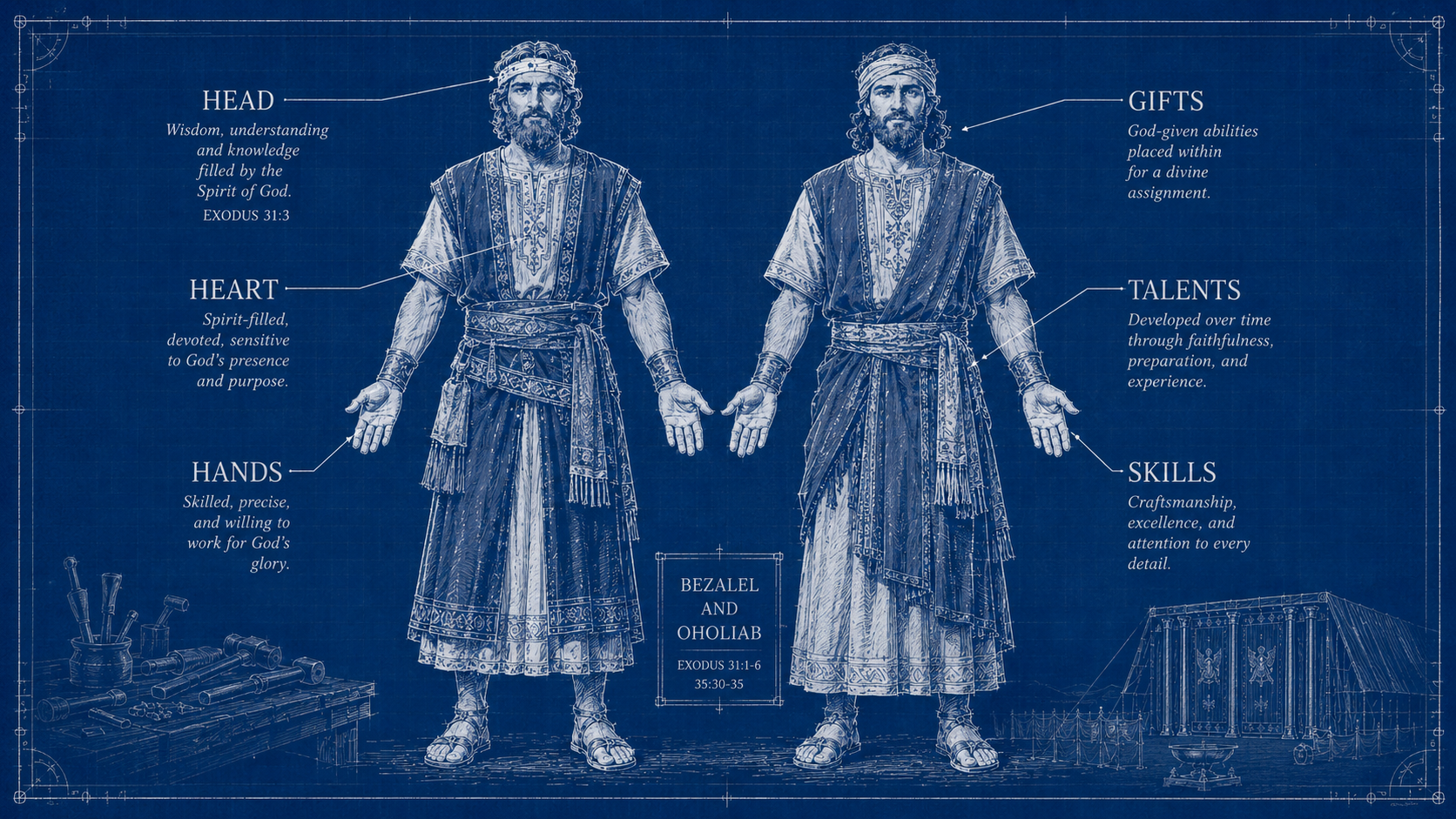
In Exodus 31, God names Bezalel and Oholiab and entrusts them with one of the most sacred assignments in Israel’s history: building the tabernacle, the dwelling place of God among His people. This was not a random appointment. The Lord said, “I have chosen Bezalel… and I have filled him with the Spirit of God, with wisdom, with understanding, with knowledge and with all kinds of skills” (Exodus 31:2–3).
That statement reveals something profound about the way God works through people. He does not merely recognize natural ability. He fills, directs, and empowers it.
Chosen and Filled
Bezalel and Oholiab were not just gifted men. They were Spirit-filled men. Their craftsmanship was not merely technical — it was spiritual. Their work was an act of worship.
This gives us a helpful framework: head, heart, and hands. They had wisdom and knowledge in the mind. They had spiritual sensitivity in the heart. They had skill and precision in the hands. Their calling was narrow in one sense — craftsmanship — but staggering in its reach. Through their work, the entire nation of Israel would encounter the presence of God.
And neither man worked alone. Moses did not do the building himself. God chose men to help him. Bezalel did not carry the assignment by himself — Oholiab was appointed alongside him. And their work was never meant to stop with just the two of them. God also gave them the ability to teach others, so that the work could multiply beyond what any one person could accomplish.
God’s work is never designed to be a solo venture.
Prepared Over Time
It is unlikely these men received all their skill in a single moment. God could have granted instant ability if He wished — but Scripture shows another pattern: preparation before presentation, development before distinction, training before the crowning contribution.
Moses was shaped over forty years in the wilderness. Joseph was formed through suffering and long delays before his defining moment. The patriarchs endured seasons of obscurity before their purposes became clear. In the same way, Bezalel and Oholiab were almost certainly being prepared long before Exodus 31 for the moment when their gifts would be needed most. What looked like ordinary work in the early years was God’s quiet preparation for an extraordinary assignment.
Jesus Himself models this perfectly. He grew in wisdom and stature. He lived as a carpenter. He spent years at a workbench before His public ministry began — and every hour of that hidden life prepared Him for His ultimate work on the cross. If the Son of God walked the path of quiet development and faithful obscurity, we should not despise the seasons in which God is shaping us. Faithfulness in the hidden years is never wasted.
Publicly Commissioned
In Exodus 35:30–35, Moses publicly announces their calling before the whole congregation. This was not a private arrangement between God and two craftsmen. It was an open commissioning before the entire community — because the work they were doing mattered to the whole nation.
They were building the place where God would dwell among His covenant people. This was not merely creative labor. It was sacred work.
Verse 34 becomes especially significant: God gave them the ability to teach others. That is the multiplication principle at work. They were not only to build — they were to train. Not only to work — but to reproduce their skill in others, ensuring the work could outlast any single season of effort.
The Work Begins
Exodus 36:1–2 marks the turn from calling to action. Moses summons Bezalel, Oholiab, and every skilled person whose heart had been stirred and whose ability had been given by God. The work begins.
Now the weight of the assignment becomes real. They were constructing the meeting place between a holy God and His people. That required exactness, reverence, and obedience. Every curtain, every piece of furniture, every detail had to be made according to God’s command.
The hardest part of a crowning contribution is often simply starting. Fear can freeze us. Doubt can delay us. We may think the assignment is too large — or we may dismiss it as too small. But Ephesians 2:10 makes this clear: “For we are His workmanship, created in Christ Jesus for good works, which God prepared beforehand so that we would walk in them.” Every assignment is intentional. Every calling matters. We cannot afford to hesitate.
Contribution, Not Achievement
This is where we have to make a distinction that cuts close.
Achievement is measured by applause, visibility, and personal success. It asks, What did I accomplish? Contribution is measured by faithfulness, service, and lasting impact. It asks, What did I give? Who did I build up? What did I help others become?
Bezalel and Oholiab were not chasing achievement. They were making a contribution to the worship life of Israel — one that would shape the spiritual formation of an entire nation.
This is exactly why Matthew 28:18–20 and 2 Timothy 2:2 fit so naturally into their story. In the Great Commission, the risen Christ does not merely call people to admire Him — He sends His disciples to make disciples of all nations, to baptize and teach and reproduce His followers across generations. In 2 Timothy, Paul gives Timothy the same pattern in compact form: what you have received, entrust to faithful people who will be able to teach others also. That is a four-generation chain of ministry. Discipleship is meant to be passed on, not held.
Bezalel and Oholiab lived that principle centuries before it was written down. Multiplication is not a modern strategy. It is a biblical standard.
Finishing Well
It is one thing to cast a grand vision, but it is another entirely to drive the final nail. The gap between starting a project and completing it is where most of us give up, yet Scripture captures Bezalel’s follow-through with striking simplicity: “Now Bezalel the son of Uri, the son of Hur, of the tribe of Judah, made all that the LORD had commanded Moses. With him was Oholiab the son of Ahisamach, of the tribe of Dan…” (Exodus 38:22-23).
They finished.
That is no small thing. Many start well and do not finish well. Many receive a calling but never see it through. Passion fades. Endurance gives out. The assignment gets set aside. Bezalel and Oholiab stand out precisely because they carried their work all the way to completion. They did not stop when the work was mostly done. They did not settle for close enough. They finished — faithfully, obediently, thoroughly.
Their legacy is not the tabernacle itself, which no longer stands. Their legacy is the example they leave: that faithfulness, precision, perseverance, and obedience are not minor virtues. They are the marks of a life well spent.
A Final Challenge
Every believer should sit with some honest questions.
What has God been preparing you for — even since childhood? What gifts, talents, and skills has He placed in your hands? Do you know the difference between doing something in your own strength and doing it empowered by the Holy Spirit? Is any assignment from God too great for you — or have you been dismissing something as too small?
Who are you meant to train, strengthen, or build up so that the work continues beyond you? Are you chasing achievement, or are you pursuing contribution?
And here is perhaps the hardest question of all: What if your crowning contribution is still ahead of you — and you have been waiting instead of working?
Not every calling will be public. Not every assignment will be dramatic or celebrated. But every assignment given by God is holy.
Bezalel and Oholiab were hidden heroes. Their names appear in a handful of chapters, in a book most people skim. But they built the place where heaven met earth, trained those who came after them, and finished everything God asked of them.
The question is not whether your life will impress the world. The question is whether you will step into the work God prepared for you, develop what He has placed in your hands, multiply it in others — and finish well.

