
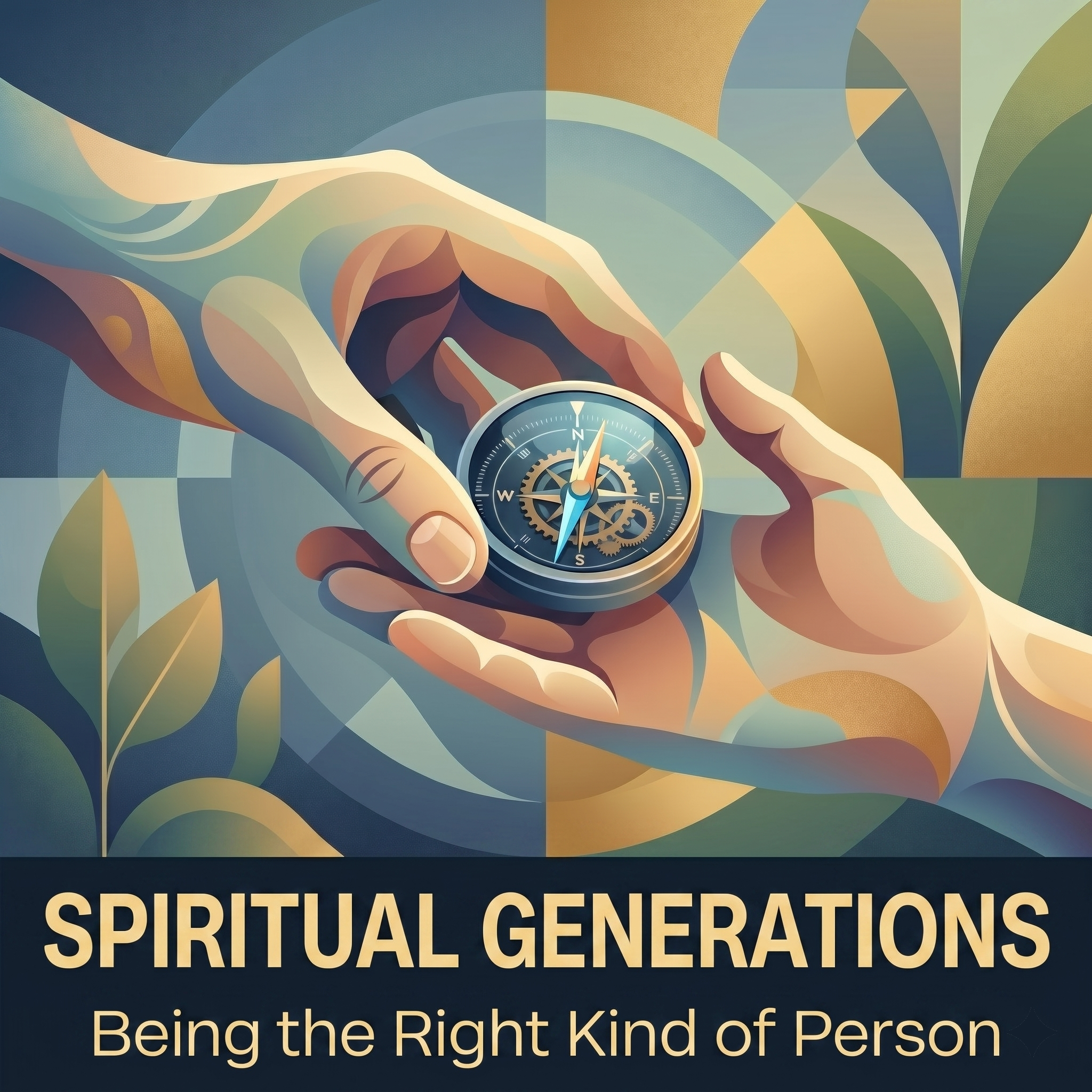
The WIGTake for Spiritual Generations
By Chuck & Deb Wood and Pheaney (Peter) Lindell
Last week, we teased the WIGTake (What’s It Gonna take?) to seeing spiritual generations of disciples for Jesus. Making good on our promise, we start today by focusing on you—the number one ingredient. In the economy of the Kingdom, you cannot impart what you do not possess. The first and most critical ingredient for spiritual generations is not a strategy, a curriculum, or a charismatic personality—it is you. Specifically, it is the quality of your walk with God and your character.
The Jesus Model
If we want to become a generational leader, we need to look no further than Jesus. He is the right person, We see this vividly in His life. Before He preached a sermon or healed a leper, the Father established His identity. At His baptism, a voice came out of the heavens: “You are My beloved Son, in You I am well-pleased” (Mark 1:11). Jesus operated from a place of beloved security, not a desperate need for approval.
Furthermore, Jesus did not emerge from the womb fully formed in His humanity; He submitted to the process of growth. Scripture tells us He “continued to grow and become strong, increasing in wisdom; and the grace of God was upon Him” (Luke 2:40, 52). If the Son of God prioritized spiritual and personal development, how much more must we? This growth created a person who was magnetic yet holy. The Father later reiterated on the Mount of Transfiguration, “This is My Son, My Chosen One; listen to Him!” (Luke 9:35). His authority to lead flowed directly from His identity as the Chosen Son.
We also see the heart of His leadership in His priestly role. Jesus was never a mechanical taskmaster driving His followers to production; He was a sympathetic partner committed to their restoration. Scripture tells us He “always lives to make intercession for them” (Hebrews 7:25), meaning His primary work was going to the Father on their behalf. He remained approachable and safe, a High Priest who “sympathizes with our weaknesses” (Hebrews 4:14-16), understanding the struggle rather than condemning the stumbler.
At its core, being a disciple of Jesus means becoming like Him (Matthew 10:24-25; Luke 6:40; 1 John 2:6). We must “master the Master,” as the late Howard Hendricks famously put it. If we want to see generations impacted, we must look closely at His ways, His words, and His intent, aligning our lives to the pattern He set.
The Scriptural Model
When we move from the Gospels to the Epistles, we see this principle codified in the life of Paul. Writing to his spiritual son, Timothy, Paul reflects on his own calling: “I thank Christ Jesus our Lord, who has strengthened me, because He considered me faithful, putting me into service” (1 Timothy 1:12).
Notice the order of operations. Paul does not say Christ considered him “talented,” “educated,” or “strategic.” He considered him faithful. The Greek word here implies trustworthiness. Before Paul was entrusted with the care of the churches, he had to be entrusted with the character of Christ. The appointment to service was the result, not the cause, of his faithfulness.
This challenges our modern tendency to promote people based on potential or charisma. In the Scriptures, the “right kind of person” is one who has proven they can be trusted. This aligns with the explicit requirement for stewardship: “In this case, moreover, it is required of stewards that one be found trustworthy” (1 Corinthians 4:2). Paul acknowledges that the capacity for ministry comes from Christ (“who has strengthened me“), but the requirement for the assignment was his own faithfulness. This creates a powerful dynamic: we rely on His strength, but He requires our faithfulness. God is looking for a vessel that is reliable, one that won’t crack under the weight of the ministry He intends to pour into it.
Stories
The words hit me like a rifle report. My mentor leaned across the table. “You know the kind of men Jesus chose, Chuck? Fishermen. Working men. Men who’d drop their nets and follow.”
I was a young Army sergeant then, hungry to prove myself. But something in those words planted deep.
I wanted to be that kind of man.
The decision came at Fort Campbell. I’d just finished my tour as an Air Assault Instructor—a prestigious assignment, a golden ticket upward. The smart move was to become a squad leader in the Ranger Battalion, pad my résumé, and play the army promotion game. Instead, I volunteered to be a Ranger Instructor.
“Back-to-back instructor jobs?! Career suicide,” my peers said, shaking their heads. “You’ll never recover.”
But I saw something they didn’t. Ranger School meant predictable hours, no deployments. Time I could pour into ministry and into becoming the man I’d promised to be.
The Army’s promotion timeline is brutal. E7, Sergeant First Class, in seven and a half years? Ask any leader—they’ll tell you it’s theoretically possible but practically impossible.
Yet there I stood, receiving my stripes ahead of everyone who’d played it safe. Even ahead of those who called me foolish.
Matthew 6:33 became my compass: “Seek first His kingdom and His righteousness, and all these things will be given to you.”
God honored that sacrifice in ways I couldn’t have engineered. Not just the promotion, but something better—He surrounded me with men and women cut from the same cloth. People who’d drop their nets. People who understood that some things matter more than career trajectories.
I’d become the kind of person Jesus was looking for.
And He gave me a whole platoon of the same kind of men.
Suggestions
- The “Secret” Meeting: Schedule a daily, non-negotiable appointment with Jesus before you meet with anyone else. If your public ministry exceeds your private intimacy, you are heading for a crash. Saturate yourself in the Scriptures, especially the Gospels.
- Integrity Audit: Ask a trusted friend or spouse, “Where is my character inconsistent with my message?” Give them permission to be brutally honest, and then take action on what they say.
- Holistic Health: Do not neglect your physical or emotional health in the name of “spiritual” service. Establish a regular rhythm of exercise and rest to ensure you are a vessel built to last.
Application for Disciple Makers
For us, being the “right kind of person” requires embodying the full spectrum of this biblical witness. We must lead from a place of secure identity, knowing we are beloved by the Father (like Jesus), while simultaneously proving ourselves trustworthy in the small things (like Paul). We must commit to our own growth, constantly increasing in wisdom so our lives carry the weight of experience. And we must lead with sympathy, offering a safe harbor for others’ struggles. The WIGTake here is simple but weighty: the ceiling of your influence on those you are discipling is your own personal transformation in Christ.
Next Week: Character is the vessel, but what good is a vessel if it’s empty? Next week, we look at the fire that fills the vessel and the engine that drives spiritual reproduction: Ingredient #2: Love.
The Top 12 Ingredients –
- Being the Right Kind of Person
- Love
- Finding the Right Kind of Person
- Authoritative Vision Casting
- Prayer and the Hand of God
- 2nd Generation Conviction
- Time With
- Spiritual Parenting
- Serving
- Reminding (Constantly)
- Trusting the Promises of God
- Perseverance

 ToBeLikeJesus