
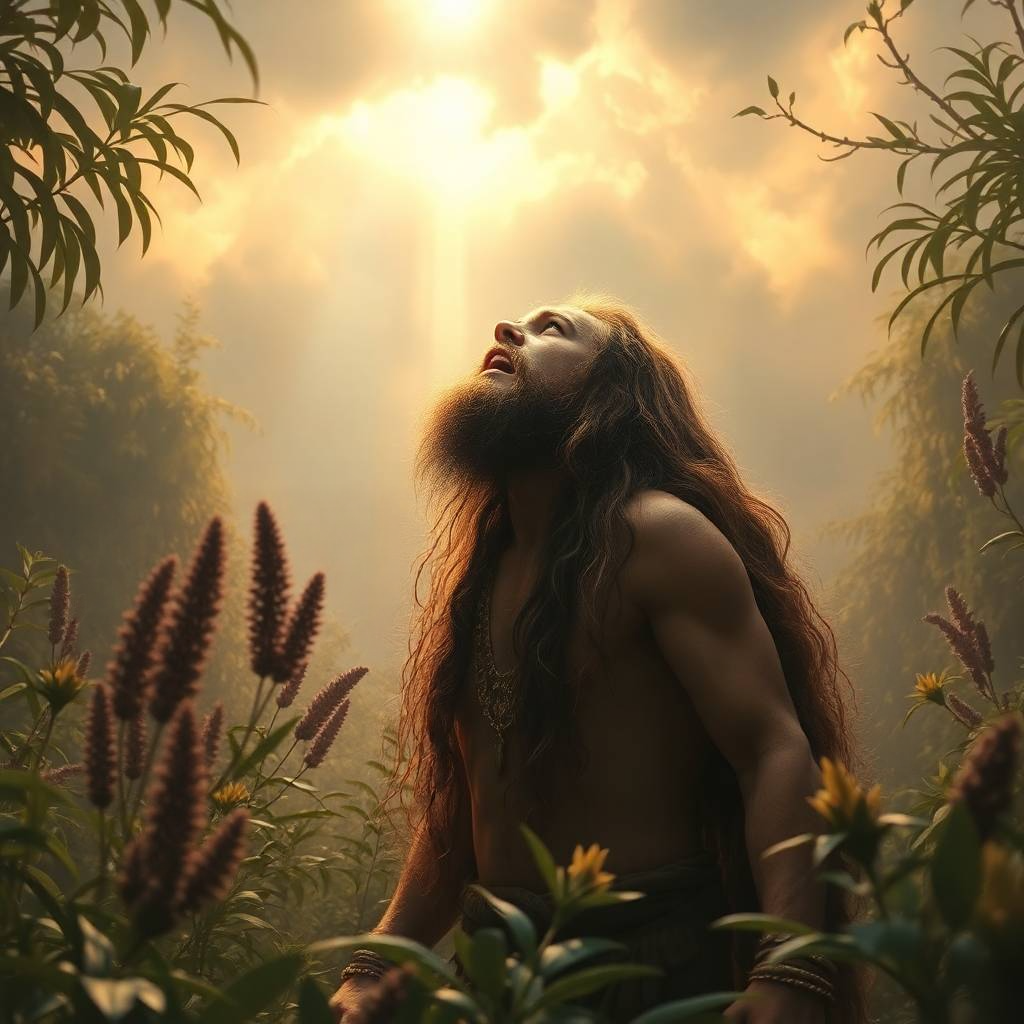
Daniel 4:34-37 – The Humility and Repentance of a King Who Realizes His Subordination to the King of Kings
34 “But at the end of that period, I, Nebuchadnezzar, raised my eyes toward heaven and my reason returned to me, and I blessed the Most High and praised and honored Him who lives forever;
For His dominion is an everlasting dominion,
And His kingdom endures from generation to generation.
35 “All the inhabitants of the earth are accounted as nothing,
But He does according to His will in the host of heaven
And among the inhabitants of earth;
And no one can ward off His hand
Or say to Him, ‘What have You done?’
36 At that time my reason returned to me. And my majesty and splendor were restored to me for the glory of my kingdom, and my counselors and my nobles began seeking me out; so I was reestablished in my sovereignty, and surpassing greatness was added to me. 37 Now I, Nebuchadnezzar, praise, exalt and honor the King of heaven, for all His works are true and His ways just, and He is able to humble those who walk in pride.”
(Daniel 4:34-37)
Introduction
In Daniel 4:34-37, we witness a profound transformation in King Nebuchadnezzar as he acknowledges the supreme authority of the Most High God. This passage provides a powerful illustration of the biblical concepts of humility and repentance, particularly in the context of recognizing one’s subordination to the King of kings.
Background and Context
The passage from Daniel 4:34-37 is part of the Book of Daniel in the Old Testament, which recounts events during the Babylonian captivity of the Jewish people (circa 6th century BCE). This specific chapter is a first-person narrative attributed to King Nebuchadnezzar II, the powerful ruler of the Neo-Babylonian Empire, known for his military conquests, including the siege of Jerusalem, and his grand building projects, such as the Hanging Gardens.
In Daniel 4, Nebuchadnezzar describes a divine judgment that led to his humbling. Earlier in the chapter, he recounts a troubling dream of a great tree being cut down, which the prophet Daniel interprets as a warning from God (verses 4-27). The dream foretells that Nebuchadnezzar, due to his pride and failure to acknowledge God’s sovereignty, would lose his sanity and kingdom for a period, living like a beast until he recognizes the Most High as the true ruler over all.
How Nebuchadnezzar Arrived at His Humble State
Nebuchadnezzar’s descent into humility began with his pride and self-exaltation as a ruler who attributed his success solely to his own power (Daniel 4:30). Despite Daniel’s warning to repent and show mercy to the oppressed to avoid judgment (4:27), Nebuchadnezzar did not heed the advice. As a result, God’s judgment came upon him: he was driven from his throne, lost his sanity, and lived like an animal for a set period, often interpreted as seven years (4:31-33).
The passage in verses 34-37 marks the moment of Nebuchadnezzar’s restoration. After the decreed period, he lifts his eyes to heaven, signifying repentance and acknowledgment of God’s supreme authority. His reason returns, and he praises God, recognizing His eternal dominion and justice. Consequently, God restores Nebuchadnezzar’s sanity, kingdom, and even greater glory, leading him to proclaim God’s ability to humble the proud.
This narrative underscores themes of divine sovereignty, the consequences of pride, and the power of repentance, with Nebuchadnezzar’s transformation serving as a testimony to God’s ultimate authority over earthly rulers.
Linguistic Analysis
The Hebrew word for “humble” used in Daniel 4:37 is שְׁפַל (shᵉphal, Strong’s H8214), which means to bring low or abase. This term emphasizes the action of lowering oneself or being brought low by an external force. In contrast, “pride” is derived from גֵּוָה (geʼvah, Strong’s H1466), signifying majesty or arrogance.
The phrase “my reason returned to me” in verses 34 and 36 uses the Aramaic word מַנְדַּע (mandaʻ, Strong’s H4486), which denotes knowledge or understanding. This return of reason signifies a spiritual awakening and recognition of divine sovereignty.
Theological Significance
The Nature of True Humility
True humility, as exemplified by Jesus Christ, involves a correct understanding of one’s position in relation to God. Jesus, though equal with God, “humbled himself by becoming obedient to death—even death on a cross” (Philippians 2:8). This perfect example of humility demonstrates that it is not about self-deprecation, but about recognizing God’s supreme authority and aligning oneself with His will.
Repentance as a Response to Divine Revelation
Nebuchadnezzar’s experience illustrates how divine revelation can lead to repentance. When his “reason returned,” he recognized the Most High God’s sovereignty, leading to a dramatic change in his attitude and actions. This mirrors the Christian experience of conversion, where the Holy Spirit brings conviction and leads to repentance.
Implications for Understanding the Kingdom of God
God’s Sovereignty Over Earthly Kingdoms
The passage emphasizes God’s eternal dominion and His authority over all earthly rulers. This concept is central to understanding the Kingdom of God, which transcends and supersedes all human kingdoms.
The Transformative Power of Humility
Nebuchadnezzar’s transformation from pride to humility demonstrates the power of God to change even the most arrogant heart. This change is a key aspect of entering and participating in God’s Kingdom, as Jesus taught, “Blessed are the poor in spirit, for theirs is the kingdom of heaven” (Matthew 5:3).
Christological Fulfillment
Jesus Christ, as the perfect embodiment of humility, fulfills and exemplifies the principles seen in Nebuchadnezzar’s experience. His life, death, and resurrection demonstrate the ultimate submission to God’s will and the exaltation that follows true humility.
Conclusion
The concepts of humility and repentance, as illustrated in Daniel 4:34-37, are foundational to understanding our relationship with the King of kings. By following Christ’s example of perfect humility, believers can experience the transformative power of God’s kingdom and participate in His eternal reign.
Disciple-Maker’s Short Story
The Weight of Grace
The morning dew clung to the grass like tiny crystals, catching the first rays of sunlight as Jeremy and Manny made their way along the park’s winding trail. Their breathing had settled after their run, but Jeremy could sense an unusual tension in his mentor’s silence. They stopped at a wooden bench overlooking a small pond, where a family of ducks glided across the still water.
“Your teaching last night,” Manny began, his voice gentle but firm. “You’ve got good insights, Jeremy. But I noticed something that reminded me of my younger self.”
Jeremy felt his shoulders tighten. He’d been proud of last night’s discussion on spiritual disciplines. The group had been engaged, taking notes, nodding along. “What do you mean?”
Manny watched the ducks for a moment. “Do you remember the story of Nebuchadnezzar?”
“The king who lost his mind and ate grass?” Jeremy shifted on the bench. “Sure, but what’s that got to do with—”
“He was brilliant, capable, successful,” Manny continued. “Built mighty Babylon. But he forgot something crucial: where his authority came from.” He turned to face Jeremy. “Last night, when Sarah tried to share her perspective on contemplative prayer, you shut her down pretty quickly.”
The memory made Jeremy wince. He’d dismissed her contribution as “too mystical,” asserting that his more structured approach was clearly biblical.
“I was just trying to keep things doctrinally sound,” he defended, but the words felt hollow as they left his mouth.
“Like Nebuchadnezzar, we can become so convinced of our own wisdom that we forget who the real King is.” Manny’s voice carried no judgment, only compassion. “Jesus, who had all authority, chose to wash feet. To listen to the overlooked. To guide with questions and self discovery.”
The morning breeze carried the scent of wildflowers, and Jeremy found himself thinking of Jesus’ parables about seeds and growth—how the Kingdom often came through gentle nurture rather than force.
“I thought being a strong leader meant having all the answers,” Jeremy admitted, his voice barely above a whisper. “But that’s not really like Jesus at all, is it?”
Manny smiled. “The strongest trees bend with the wind, brother. Real authority, like Jesus showed us, comes from serving, from creating space for others to grow.” He patted Jeremy’s shoulder. “It’s not about having an iron fist, but about having an open hand.”
Jeremy watched a young duck break away from its family, experimenting with its own path before rejoining the group. He thought about Sarah’s uncommon insight, about other voices he might have silenced without realizing it.
“I want to be more like Him,” Jeremy said finally. “More like Jesus. But I guess that means I need to do some unlearning first.”
“That’s the beauty of grace,” Manny replied, standing up. “It gives us room to grow, to fail, to learn. Just like you give your church members that same grace.” He gestured toward the trail ahead. “Ready for another lap?”
Jeremy nodded, feeling somehow both humbled and lifted up. As they resumed their walk, the morning sun warming their shoulders, he began to see his role differently—not as a ruler of his small kingdom, but as a servant in a far greater one.

